Hematology I Non-malignant Leukocyte Disorders
 Call Kai
 Learn
 Practice Test
 Spaced Repetition
 Match
 Flashcards
 Knowt Play
1/120

Earn XP
Description and Tags
CLS 536 Unit 3 10/#/2026
121 Terms
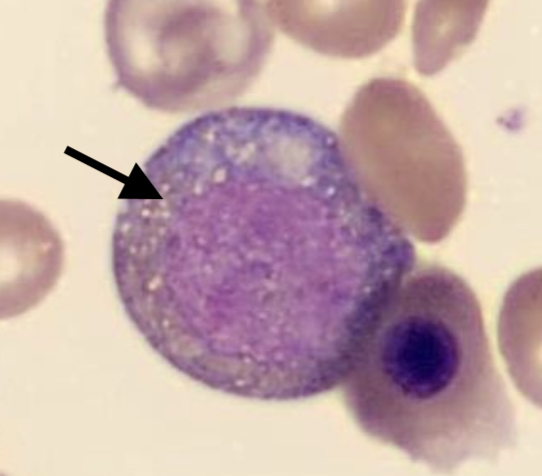
What cell is this?
What are the 4 classifications of leukocytes?
Defense function, shape of nucleus, site of origin, and type of granulation
What are the non-malignant changes seen in WBCs?
What is the hematological word for increased WBCs and what value would this be in an adult?
What is the hematological word for decreased WBCs and what value would this be in an adult?
What are some examples of quantitative changes?
How does the lab measure quantitative changes in WBCs?
How does the lab measure qualitative changes in WBCs?
What are some examples of qualitative changes?
Toxic cell death/injury, reactive to stimulus/AGN, hereditary, nuclear, and/or cytoplasmic
What is another name for increased neutrophils, and what is the range in adults?
What are some conditions that cause neutrophilia?
What do we often see with neutrophilia?
What are all the cells seen with a left shift (list from most to least mature)?
What are factors that affect neutrophil concentration?
Bone marrow production and its release of neutrophils, rate of neutrophil egress to tissue/survival time in blood, and ratio of marginating to circulating in peripheral blood
What can cause a falsely elevated neutrophil count (pseudoneutrophilia)?
What causes neutropenia?
What is phase 1 of leukocytosis development?
Early infection where WBCs move into tissue as marrow releases neutrophils and left shift appears
What is phase 2 of leukocytosis development?
Established infection where the marginated pool re-equilibriates with the circulating pool and marrow release is equal to the output to the tissues
What is phase 3 of leukocytosis development?
Recovery where marrow decreases the release of WBCs and the left shift disappears
What is alternate phase 3 of leukocytosis development?
Exhaustion where the demand for WBCs is greater than production by the bone marrow and neutrophil storage becomes depleted and developed leukopenia as a result
What is typically seen with a leukamoid reaction?
Extreme neutrophilic reaction, WBC count > 25×10³/μL, a left shift with many immature precursors, LAP score is elevated
What is an LAP test measuring and why?
Measures the amount of leukocyte alkaline phosphatase present and activated neutrophils have more LAP
What are the 3 characteristics of a leukamoid reaction?
What does LAP stand for?
What is the importance of LAP?
What are the cytoplasmic granulocyte qualitative abnormalities?
Dohle bodies, vacuoles, toxic granulation, and intracellular organism
What are the nuclear granulocyte qualitative abnormalities?
Hyposegmentation, hypersegmentation, and barr bodies
What are Dohle bodies?
Aggregates of rough ER and rRNA that appear as blue inclusion in cytoplasm of neutrophils and eosinophils
What is toxic granulation?
Large deep purple staining primary granules in neurophils
What are cytoplasmic vacuoles?
Clear, unstained areas in cytoplasm

What inclusion is this?
Dohle body
What are the 3 toic changes that can be seen together in neutrophils?
What is CML?
What is the Philadelphia chromosome?
How does a leukamoid reaction differ from CML?
Leukemoid reaction contains transient neutrophilia, a normal karyotype, and an elevated LAP score
CML contains neutrophilia, philadelphia chromosome, and a decreased LAP score
What is a leukoerythroblastic reaction?
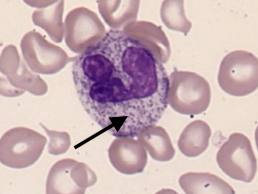
What inclusion is this cell?
Toxic granulation
What are intracellular organisms in cytolasmic abnormalities?
Bacteria, histoplasmosis, candida, morulae, and Anaplasma

What is this inclusion?
Morulae
What are the cytoplasmic abnormalities of neutrophils?
What is the composition of Dohle bodies?
Rough ER rRNA
What is the composition of toxic granules?
Primary granules
What is the composition of cytoplasmic vacuole?
Open spaces from phagocytosis
What is the composition of morulae?
Clusters of Ehrlichia rickettsial organisms
What conditions are associated with Dohle bodies, toxic granulation, and cytoplasmic vacuoles?
infections, burns, cancer, or inflammatory states
What conditions are associated with morulae?
Ehrlichiosis
What are some examples of nuclear changes?
What is Pelger-Huet?
Decreased segmentation of the granulocyte nucleus with coarse chromatin clumping in the nucleus
Do cells function normally in Pelger-Huet?
Yes with normal granules
What is acquired/psuedo Pelger-Huet?
Myeloproliferative states with hypogranular nucleus

What is the nuclear change?
Pelger-Huet

What is the nuclear change?
Pince Nez
What causes hypersegmentation and how many lobes must be present?

What is a Barr body?
What is the nuclear change?
When should one suspect inherited neutrophil functional abnormalites?
When patients have recurrent, severe infections, abscesses, or antibiotic-resistant sepsis
How do neutrophils kill invaders?
What is Alder-Reilly?
Large, purple granules in the cytoplasm of all leukocytes surrounded by vacuole
What causes Alder-Reilly?
Incomplete degradation of mucopolysaccharides that accumulate in lysosomes
Can Alder-Reilly cells function normally?
Yes

What is this anomaly?
Alder-Reilly
How are the neutrophils impacted functionally in Alder-Reilly?
What are the cytolasmic granules made of Alder-Reilly?
What is Chediak-Higashi syndrome?
Giant gray peroxidase positive lysosome bodies in cytoplasm of leukocytes
What causes Chediak-Higashi syndrome?
Fusion of primary and secondary granules of neutrophis
What is defective in Chediak-Higashi syndrome?
Protein transport and chemotaxis

What is this anomaly?
Chediak-Higashi syndrome
What is the primary dysfunction of neutrophil in Chediak-Higashi?
What causes patients with Chediak-Higashi to have a high mortality rate early in childhood
What is May-Hegglin?
Inclusions that contain crystalline RNA from rough ER that look similar to Dohle bodies but are larger and more round
What accompanies May-Hegglin?
Giant PLTs

What anomaly is present?
May-Hegglin
What are the 2 main characteristics of May-Hegglin?
What is chronic granulomatous disease characterized b?
defects in respiratory burst oxidase system
What does chronic granulomatous disease affect in the cell
Cells are unable to generate antimicrobial oxygen metabolites so neutrophils can phagocytize organisms but cannot kill them
What is the presentation of CGD?
Neutrophil count normal, Ig levels increased, and recurrent infections
Why might IgG levels be increased in CGD?
What is nitroblue tetrazolium testing (NBT)?
Reduced to a blue insoluble formazan pigment by O2 generated by active normal phagocytes
What is the difference between a qualitative and a quantitative test?
What is Flow cytometry assay for CGD?
Dihydrohoamine 123 (DHR123) assay
Is NBT testing quantitative or qualitative?
Qualitative
Is DHR testing quantitative or qualitative?
Quantitative
What do cells appear in NBT testing?
Normal cells reduce colorless NBT to blue-black but CGD cells fail to reduce NBT
What do cells appear in DHR testing?
Normal cells reduce DHR to a strongly fluorescent compound but CGD cells contain low activity with minimal conversion
What type of bacteria are CGD most susceptible to?
What is the CAtALASE acronym?
If neutrophil can’t kill CGD, where does it go?
What is myeloperoxidase deficiency?
Defective bacericidal activity and the absence of MPO
Which WBCs normally have MPO?
What is leukocyte adhesion deficiencies (LAD)?
Decrease or absent leukocyte cell-surface adhesion proteins (CD11/CD18 complex → β2 integrins)
What causes LAD?
β2 integrins unable to recognize C3bi complex
Can LAD cells function normally?
No, they have, multiple defects, including adhesion to endothelial cells, chemotaxis, phagocytosis, respiratory burst, and degranulation
How does lab diagnose LAD?
Flow cytometry for CD11b/CD18
What is the treatment for LAD?
Prophylatic antibiotics
What clinical features are associated with Alder-Reilly?
Mucopolysaccharidosis such as Hurler’s syndrome
What clinical features are associated with Chediak-Higashi?
Repeated pyrogenic infections
What clinical features are associated with May-Hegglin?
Bleeding tendency associated with thrombocytopenia
What clinical features are associated with CGD?
Recurrent infections especially in childhood
What clinical features are associated with LAD?
Serious condition with recurrent infections
What are LE cells?
PMN phagocytoses nuclear material of another cell present within the OG cell