2A.1 MEMBRANES
 Call Kai
 Learn
 Practice Test
 Spaced Repetition
 Match
 Flashcards
 Knowt Play
1/15

There's no tags or description
Looks like no tags are added yet.
16 Terms
Draw structure of phospholipid molecules

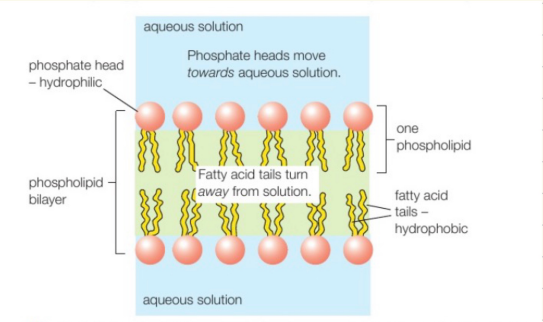
Draw phospholipid bilayer
What is the membrane made of
Proteins
Phospholipids
Describe the fluid mosaic model
States the phospholipids are able to move through the bilayer and proteins and other molecules scattered in the membrane
Describe the bilayer structure of the membrane due to phospholipids
hydrophillic ( polar ) heads face outwards towards extracellular fluid/cytoplasm
hydrophobic non polar fatty tail facing inwards away from the aqueos solution/cytoplasm
function of cholesterol
Cholesterol rigid molecule —> makes it more stable and stronger
Refulates fluidity of membrane ( binds to fatty acid tails) forms barrier to movement of small molecules and ions
structure of cholesterol
fits between hydrophobic fatty acid tails ( only its insoluble non polar part) the part of cholesterol that is polar is with the polar phosphate head
function of membrane proteins
1) Channel proteins for facilitated diffusion. ○ Form hydrophilic tunnels through the hydrophobic center of the bilayer allowing the passage of larger polar molecules.
2) Carrier proteins for Active Transport.
3) Enzymatic proteins to catalyze important metabolic reactions (could be extrinsic and intrinsic proteins)
structure
Globular proteins w their hydrophillic r groups facing outwards and their hydrophobic r groups face inwards towards the fatty acid tails
can be embedded in one layer/
can be on the surface (extrinsic)
or occupy the full thickness(within the hydrophobic center)
carbohydrates structure
Can be glycoproteins/ glycolipids
Funciton of carbohydrates
1)Receptors for hormones eg recognition receptors for antigens
2) cell recognition
describe affect of temperature on the membrane
increased kinetic energy phospholipis move more, proteins denature thus increase permeability
effect of alcohol on membrane
alcohol dissolves the lipids thus increases permeability
compare and contrast fluid mosaic model and davson daniellie model
Similarities:
i. both have proteins
ii. both have {phospholipid / phospholipid bilayer}
Differences:
FMM has proteins that are embedded while DDM has proteins that are in a seperate external layer
FMM has cholesterol but DDM does not
FMM has glycoproteins by DDM does not
properties of the fmm
fluid
semi permeable