AOS 1 - Carbon Based Fuels & Measuring changes in chemical reactions
 Call Kai
 Learn
Learn Practice Test
 Spaced Repetition
 Match
Match Flashcards
 Knowt Play
1/28

There's no tags or description
Looks like no tags are added yet.
Name | Mastery | Learn | Test | Matching | Spaced | Call with Kai | Chat |
|---|
No analytics yet
Send a link to your students to track their progress
29 Terms
Define fuel?
-substances that are used (usually combusted) to produce energy.
Define fossil fuels?
natural fuels developed from the decomposition of biomass under extreme heat & pressure under the Earth's crust over millions of years.
Cannot be replenished- non-renewable.
What is crude oil?
viscous black mixture of hydrocarbons separated through fractional distillations into various fuels/products.
Differentiate renewable & non-renewable resources?
Renewable are resources that can be replenished w/i a relatively short period of time.
Non-renewable are not & are used at a rate faster than they can be replaced.
Define sustainability?
meeting the long-term ongoing needs of society, as well as immediate and short-term demands w/o compromising the ability of future generations to meet their own needs
What is the enhanced greenhouse effect?
process of the warming of the Earth's lower atmosphere due to the increased concentration of ghg like CO2, CH4 & water vapour in the atmosphere.
What is fractional distillation of crude oil?
the process of separating crude oil into its hydrocarbons through the conversion of crude oil into vapour that is then condensed back to liquid form.
What is biodiesel?
-biodiesel is a biofuel produced by the transesterification of fats & oils in organic matter
What is bioethanol?
-bioethanol is a biofuel produced by anaerobic fermentation of glucose from organic matter
Describe the steps in the production of bioethanol?
1. Biomass is milled/crushed
2. Heated with added enzymes to hydrolyse the strach content into glucose.
3. Cooled w/ heat exchangers.
4. Fermentation- enzymes complete breakdown of starch & glucose to ethanol & CO2.
5. Steam distillation occurs
6. Dehydration occurs to improve ethanol content.
Write the reaction for reaction of biomass to bioethanol?
1. Hydrolysis of starch to glucose
2. Anaerobic fermentation of glucose to ethanol & CO2. Yeast must be present as catalyst.

What is a transesterification reaction?
A type of chemical reaction used to produce biodiesel & glycerol from triglyceride.
1. Hydrolysis of triglyceride to fatty acid & glycerol
2. Esterification of fatty acid with methanol to methyl ester.
Write the first step of transesterification?
-Hydrolysis.
-KOH (or other base) as catalyst

Write the second step of transesterification?
-Esterification
-H2SO4 (or other acid) as catalyst

Write the overall transesterification reaction
-Δ60°C - Must be written above catalyst
-States must all be liquid (l)

Write the thermochemical equation for photosynthesis?
-Sunlight must be written as a catalyst.
-ΔH= 2805 kJ/mol - Must be written on the end.

What is cellular respiration? Write the thermochemical equation?
process of converting glucose into energy in the cells of living organisms.
-ΔH= -2805 kJ/mol - Must be written on the end.

What is metabolism?
chemical reactions in the body's cells that change food into energy.
What are carbohydrates?
-any polymer made up of sugar monomers like glucose.
-contain a ratio of 1 C: 2H: and 1O atoms.
-used as an energy source and storage as well as structural components. e
-enzymes break these down into their monosaccharide units. 16kJ/g
What are fats and oils?
Known as lipids, a class of organic compounds that are fatty acids or their derivates.
Those are made of C,H,O and are used for energy storage, insulation and protection. 37 kJ/g
What are proteins?
large molecules which are polymers of amino acids. have many other important roles so are rarely used by the body. 17kJ/g
What is heat content? How is it calculated?
The chemical energy of a substance aka enthalpy.
ΔH = H(products) - H(reactants)
What is an endothermic reaction?
-a net absorption of energy
-chemical energy of the products is greater than that of the reactants
-ΔH is positive

What is an exothermic reaction?
-a net release of energy
-chemical energy of the reactants is greater than that of the products.
-ΔH is negative
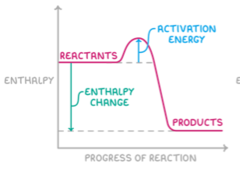
What is calibration factor & how is it calculated?
Amount of energy required in a given calorimeter to change the water temperature by 1°C.

How does a catalyzed reaction differ to an uncatalyzed reaction?
A catalyzed reaction provides an alternative reaction pathway with a lower activation energy but still the same enthalpy (ΔH).
How to solve limiting reactant problems?
1. Write a balanced chemical equation.
2. Calculate the amount of each reactant in mole.
3. Divide by the amount of mole that will react (equation coefficient).
How to determine temperature change in calorimeter on a temperature-time graph?
Extrapolate the graph with a line of best fit back to when the current was turned on.
How to determine energy efficiency?
