Sign Test
 Call Kai
 Learn
Learn Practice Test
 Spaced Repetition
 Match
Match Flashcards
 Knowt Play
1/4

There's no tags or description
Looks like no tags are added yet.
Name | Mastery | Learn | Test | Matching | Spaced | Call with Kai | Chat |
|---|
No analytics yet
Send a link to your students to track their progress
5 Terms
When are the three times when you use a sign test
When the investigation is a test of difference
When the data is nominal
When the experimental design is repeated measures (Same person tested twice) or matched pairs.
Explain the first stage of conducting a sign test
Figure out what type of hypothesis it is:
- Directional hypothesis- one tailed test
Non directional- two tailed test
Explain the second stage of conducting a sign test
Record the data and work out a sign- - for one side and a + for the other- for example, a minus for unhappier and a plus for happier

Explain the third stage of conducting a sign test
Find the calculated value (S)- this is the symbol for the test statistic we are calculating. To calculate- add up pluses and minuses and selecting the one that appears the least.
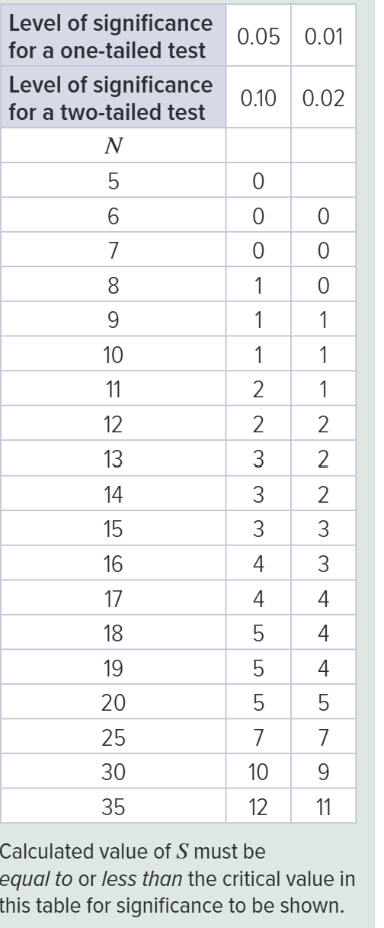
In the table above there are 10 pluses and 3 minuses so the calculated value is 3.
Explain the fourth stage of conducting a sign test
Find critical value of S:
Step 1:
N= total number of scores (ignoring any zeroes)= 13 for this study. (look back at picture on slide 3 or page 202 of book 1
Step 2:
Now we look at table of critical values- it is a directional hypothesis so it is a one tailed test. Locate the 0.05 value amnd match it up to 13, so it is three.
As a rule of thumb, use the number on the left, so 0.05 or 0.10.