Lesson Three: Bones
 Call Kai
 Learn
 Practice Test
 Spaced Repetition
 Match
 Flashcards
 Knowt Play
1/78

There's no tags or description
Looks like no tags are added yet.
79 Terms
What are the two subdivisions of the skeleton?
Axial skeleton and appendicular skeleton.
What structures make up the axial skeleton?
Skull, vertebrae, ribs, and sternum.
What structures make up the appendicular skeleton?
Upper and lower limbs, pectoral girdle, and pelvic girdle.
What do bone markings indicate?
Where bones form joints with other bones, muscles, and tendons
where ligaments attach
where blood vessels and nerves pass
Tuberosity
Large rounded projection; may be roughened.
Crest
Narrow ridge of bone; usually prominent.
Trochanter
Very large, blunt, irregularly shaped process; found only on the femur.
Line
Narrow ridge of bone; less prominent than a crest.
Tubercle
Small rounded projection or process.
Epicondyle
Raised area on or above a condyle.
Spine
Sharp, slender, often pointed projection.
Process
Any bony prominence.
Head
Bony expansion carried on a narrow neck.
Facet
Smooth, nearly flat articular surface.
Condyle
Rounded articular projection.
Ramus
Armlike bar of bone.
Groove
Furrow.
Fissure
Narrow, slitlike opening.
Foramen
Round or oval opening through a bone.
Notch
Indentation at the edge of a structure.
Meatus
Canal-like passageway.
Sinus
Bone cavity filled with air and lined with mucous membrane.
Fossa
Shallow basinlike depression in a bone, often serving as an articular surface.
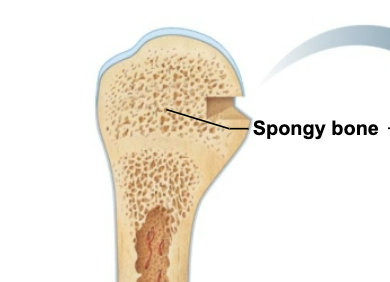
What are the two basic classes of bone tissue?
Compact bone and spongy/cancellous bone.
Describe compact bone.
Smooth and homogeneous bone tissue.

Describe spongy/cancellous bone.
Has small trabeculae (bars) and lots of space.
What are the four major groups of bones?
Long bones, short bones, flat bones, and irregular bones.
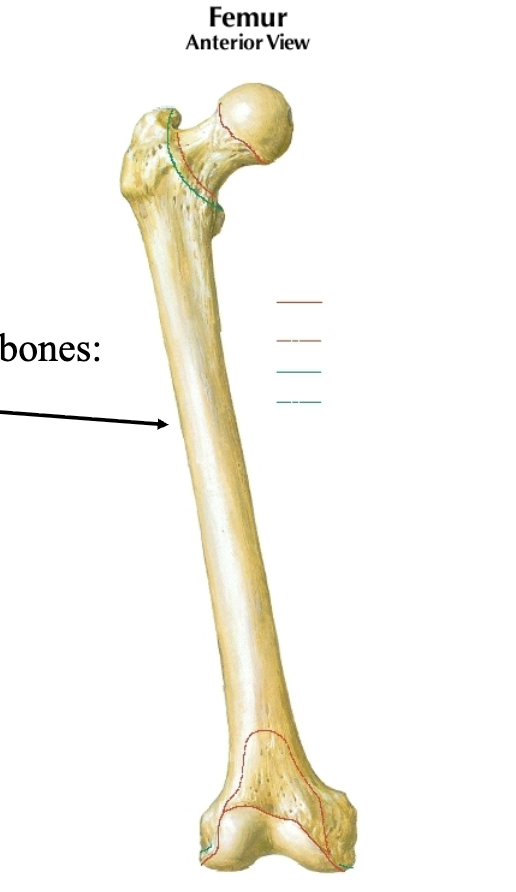
Describe long bones.
Longer than they are wide; made mostly of compact bone.

What is an example of a long bone?
Femur.
Describe short bones.
Cube-shaped; composed mostly of spongy bone.
What are examples of short bones?
Tarsals and carpals.

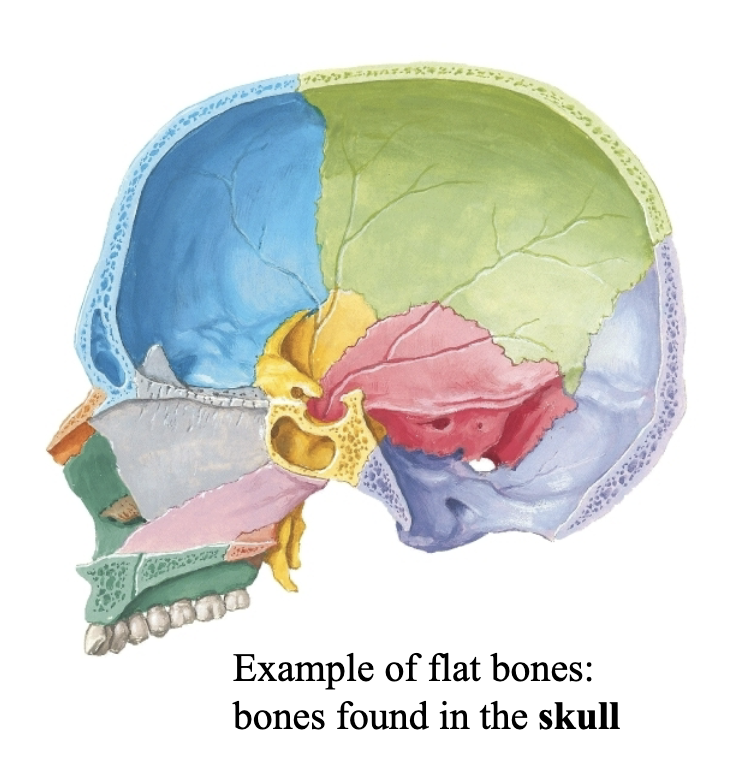
Describe flat bones.
Thin bones with two wafer-like layers of compact bone and spongy bone between them.
What is an example of a flat bone?
Bones of the skull.
Describe irregular bones.
Bones with irregular shapes.
What is an example of an irregular bone?
Vertebrae.

Epiphysis
End of a long bone; includes proximal and distal epiphyses.
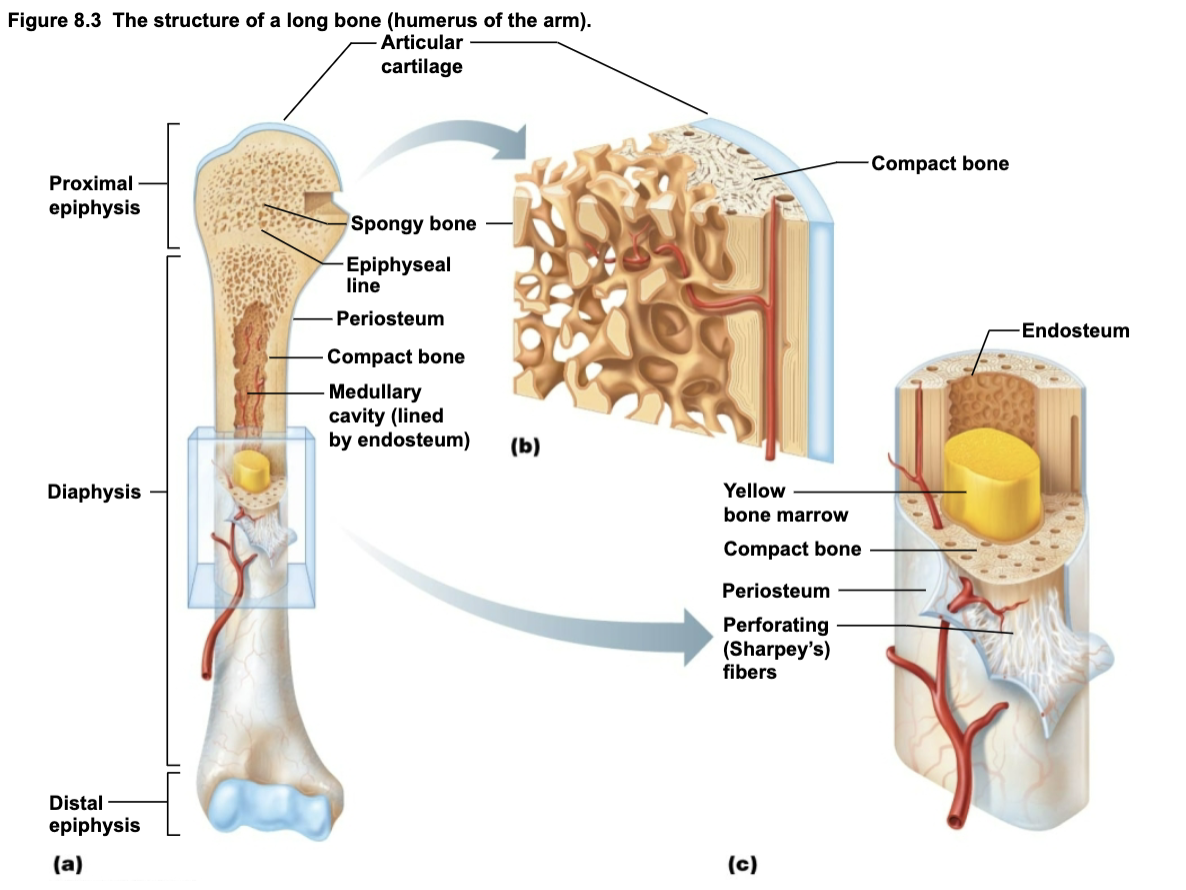
Periosteum
Covers the bone; Sharpey's fibers from the periosteum penetrate the bone.
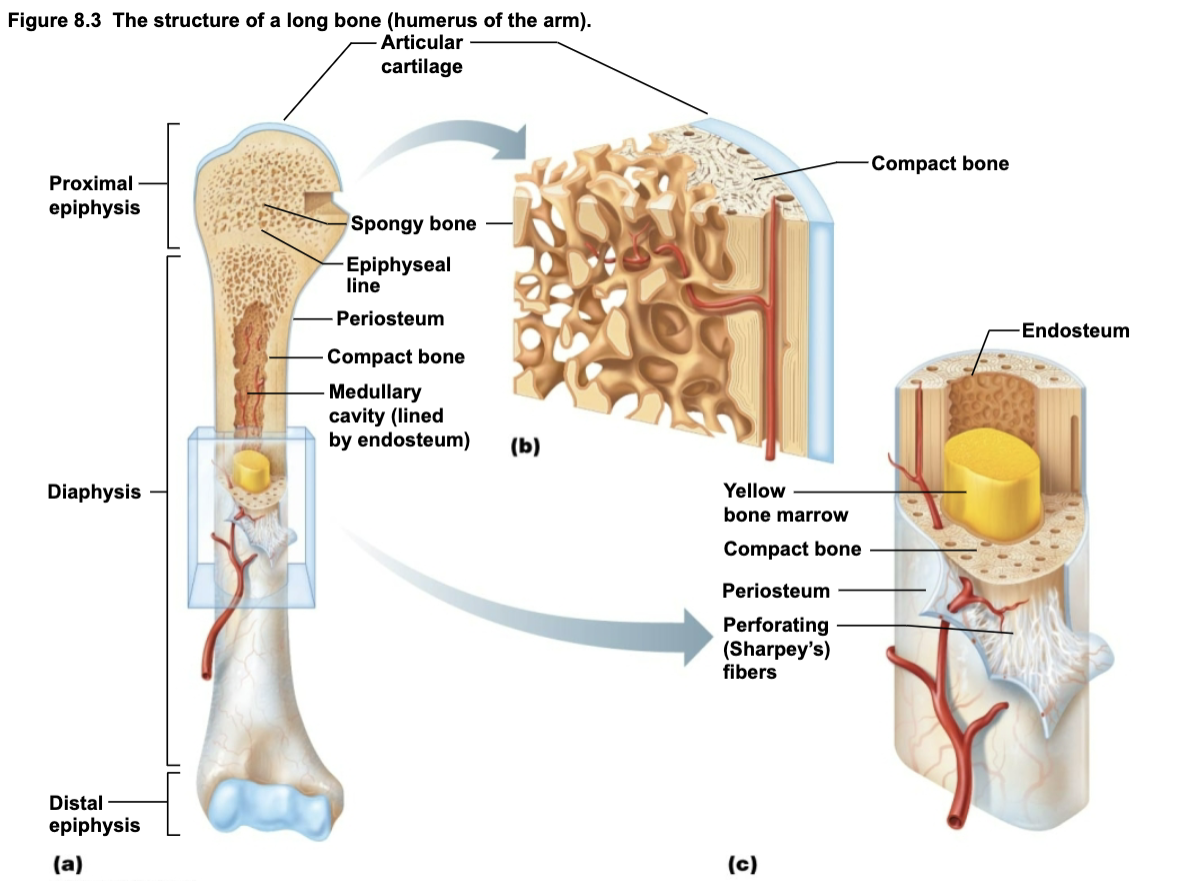
Articular cartilage
Covers the epiphyseal surface instead of periosteum.

Epiphyseal plate
Area of hyaline cartilage where longitudinal growth of bones occurs.
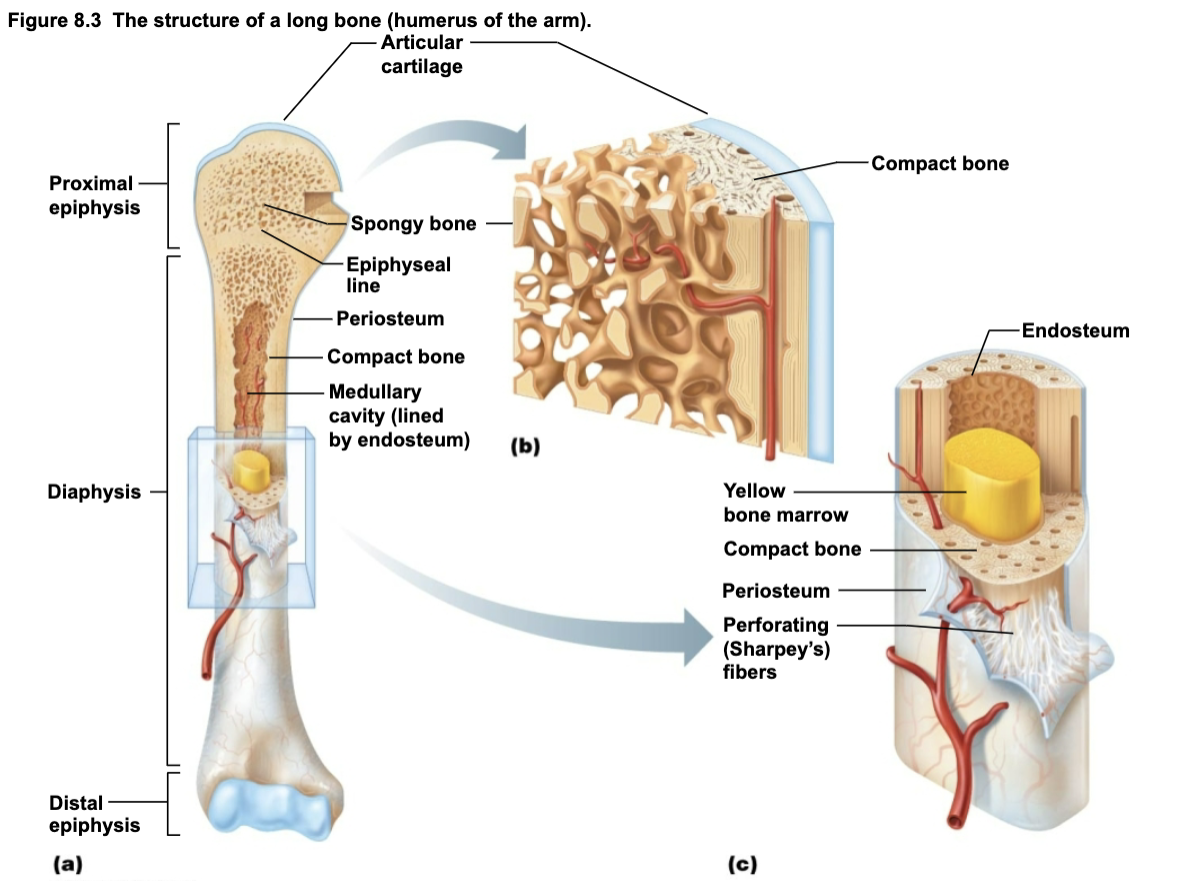
What does the epiphyseal plate become in adults?
Epiphyseal line.
Endosteum
Lines the shaft/interior of the bone.

Medullary cavity
Hollow central interior of a long bone.

What does the medullary cavity contain in adults?
Yellow bone marrow.
What does the medullary cavity contain in infants?
Red bone marrow.
Yellow bone marrow
Composed of adipose tissue (fat cells).
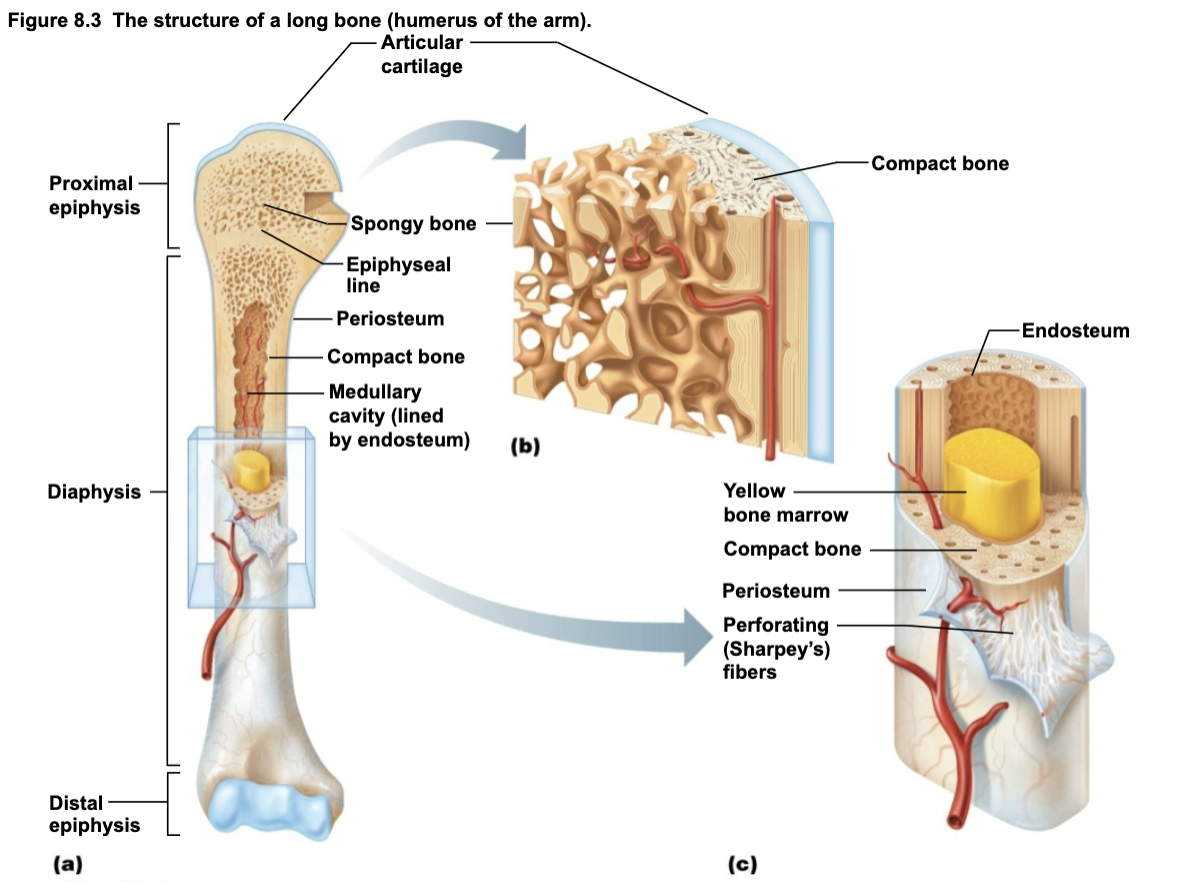
Red bone marrow
Consists of immature red and white blood cells and stem cells; used to produce blood cells.
What is the function of red bone marrow?
Production of blood cells.
Diaphysis
Shaft of a long bone.

Where is spongy bone found in a long bone?
Primarily within the epiphyses.

Where is compact bone found in a long bone?
Forms the dense outer portion, especially around the diaphysis.

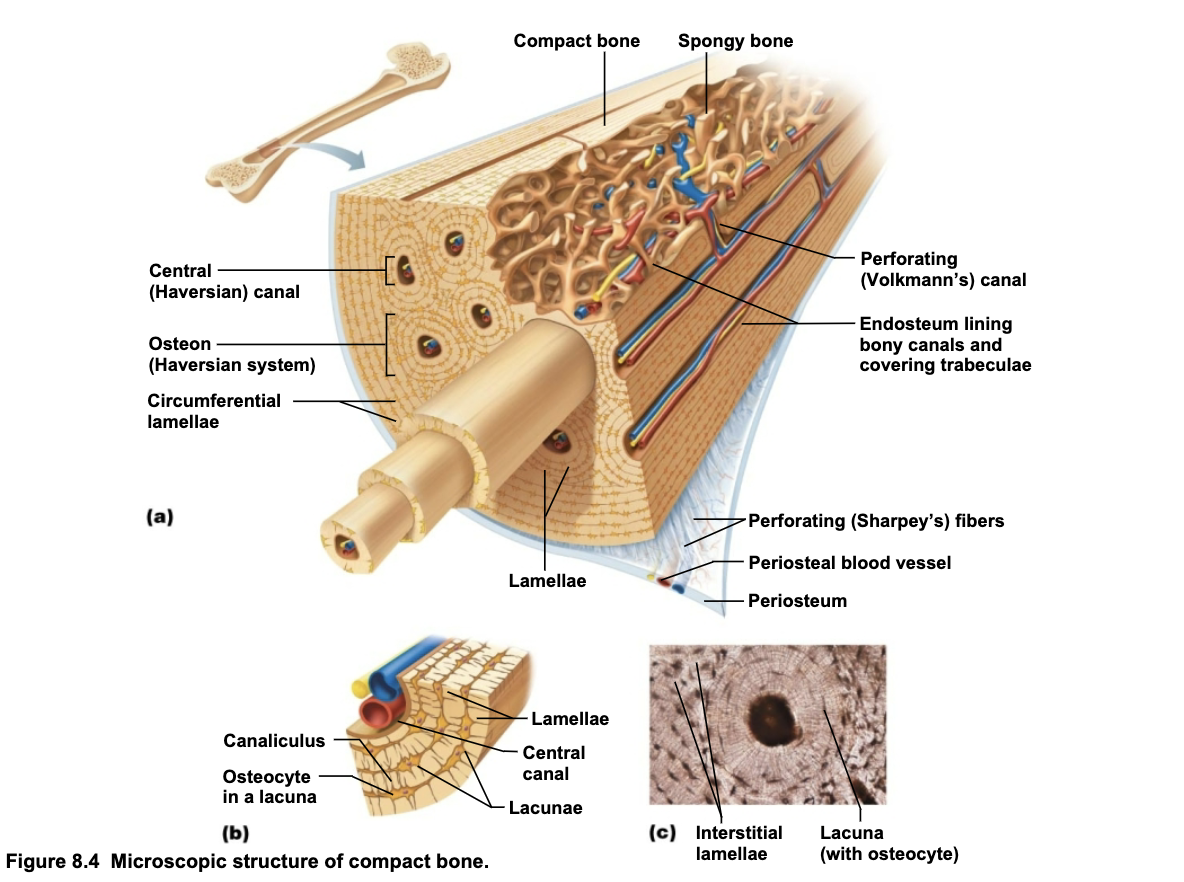
Osteon (Haversian system)
Central canal and all concentric lamellae surrounding the central/Haversian canal.
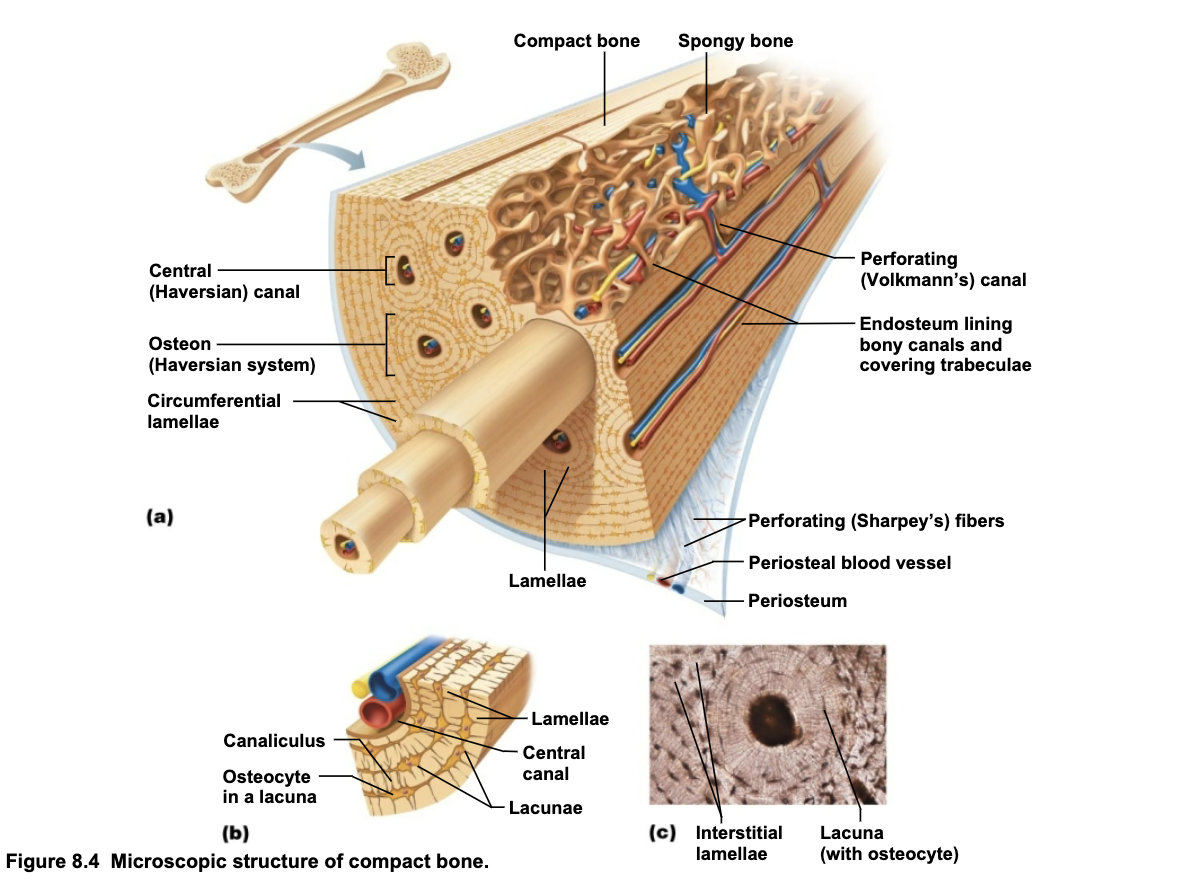
Haversian/central canal
Runs along the length of bone; carries blood vessels, lymph vessels, and nerves.

Canaliculus
One tiny canal radiating outward from the central canal.
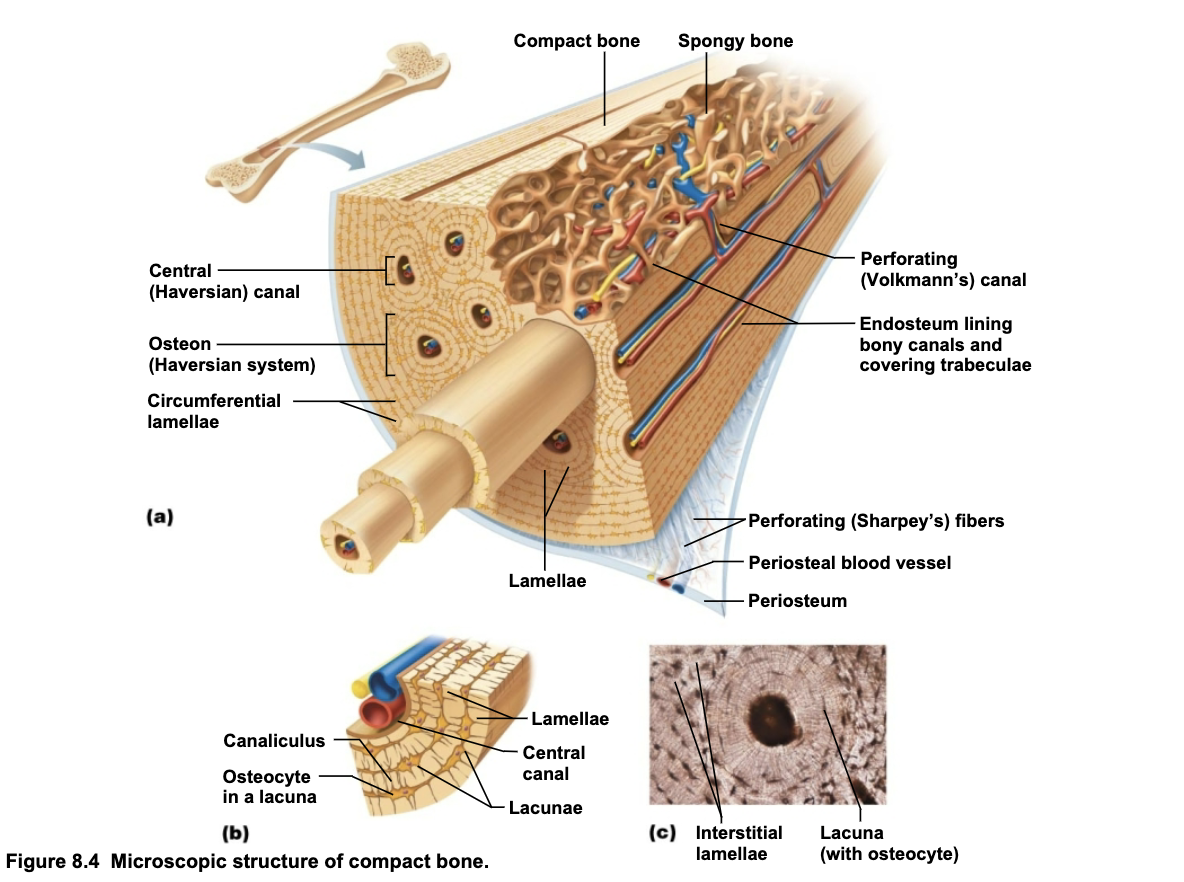
Canaliculi
Tiny canals radiating outward from the central canal that connect it to lacunae.
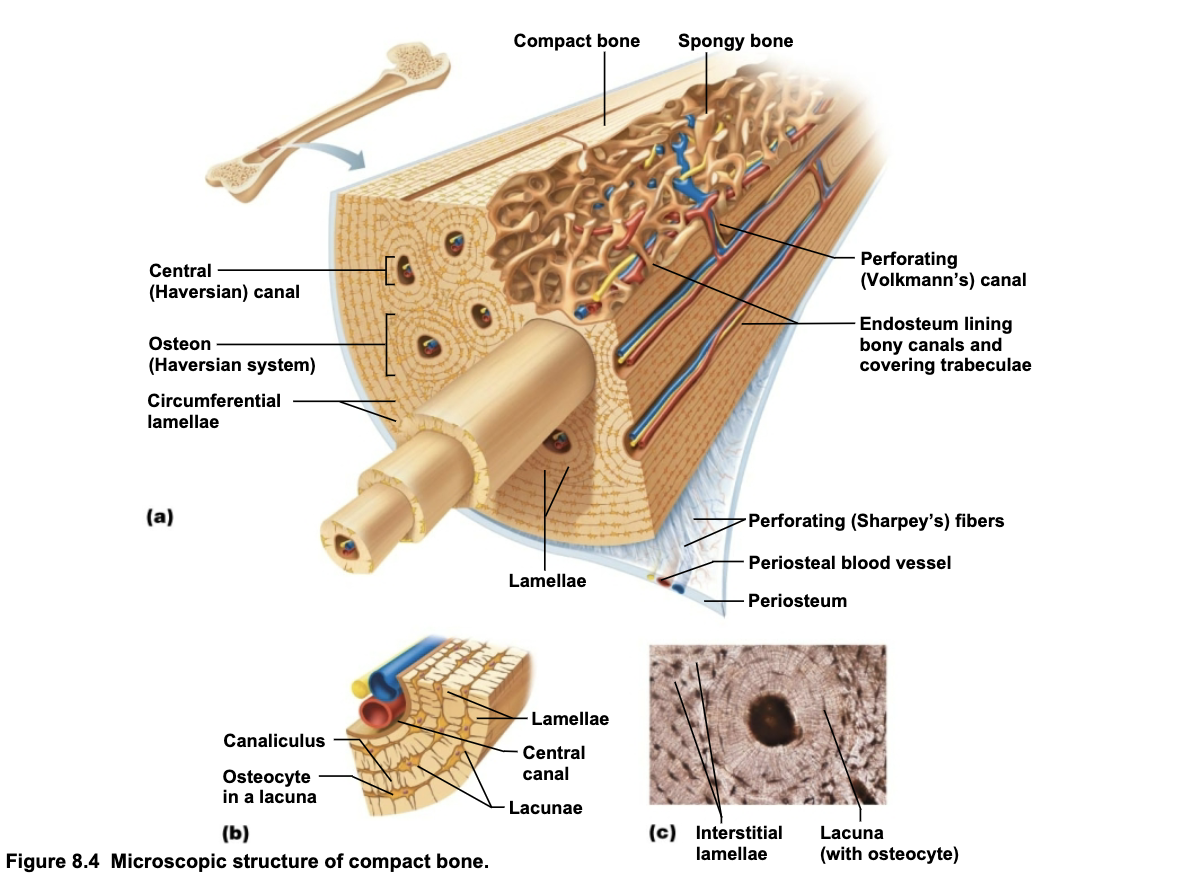
Osteocytes
Mature bone cells found inside lacunae.

Lacunae
Small chambers that house mature bone cells (osteocytes).

Perforating/Volkmann's canals
Canals that run into compact bone and the marrow cavity from the periosteum.

Lamellae
Layers of bone matrix associated with osteons.
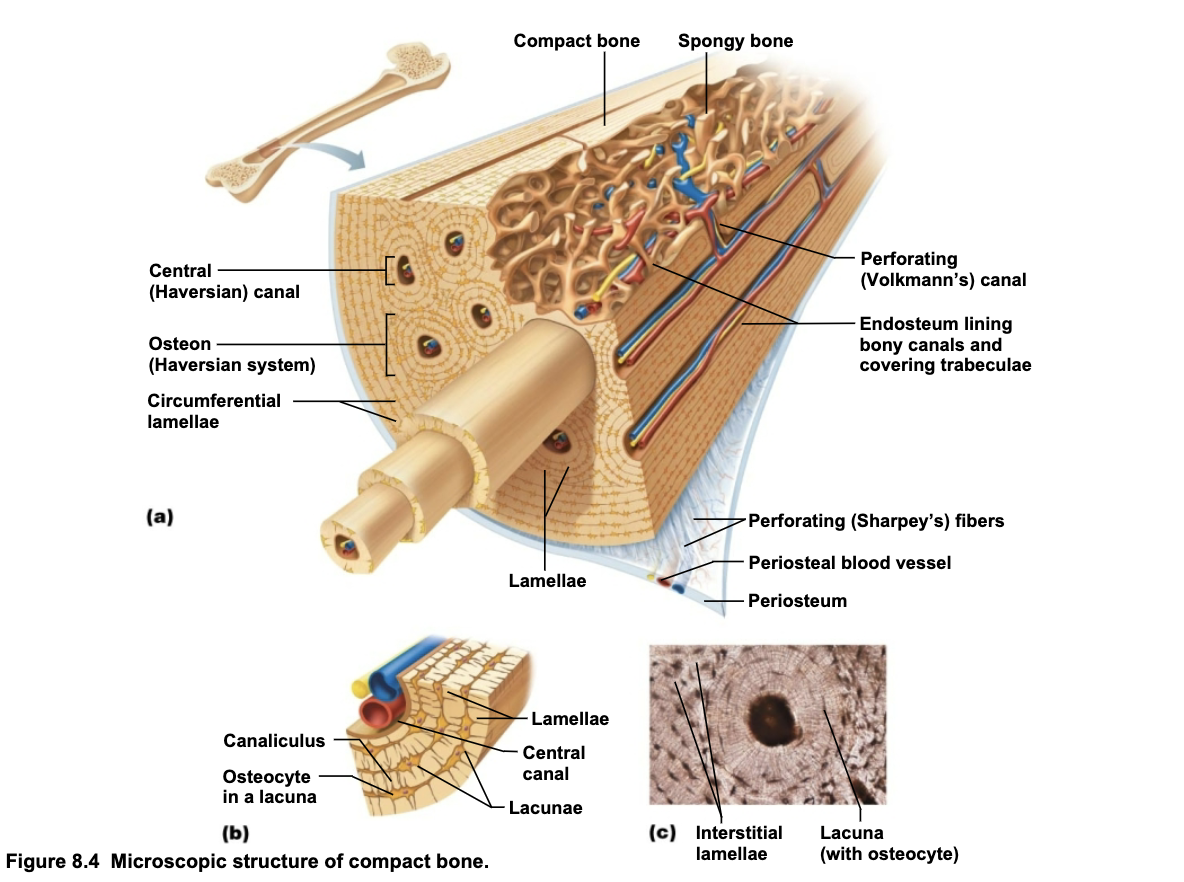
Circumferential lamellae
Layers of bone matrix extending around the circumference of compact bone.

Interstitial lamellae
Layers of bone matrix located between osteons.
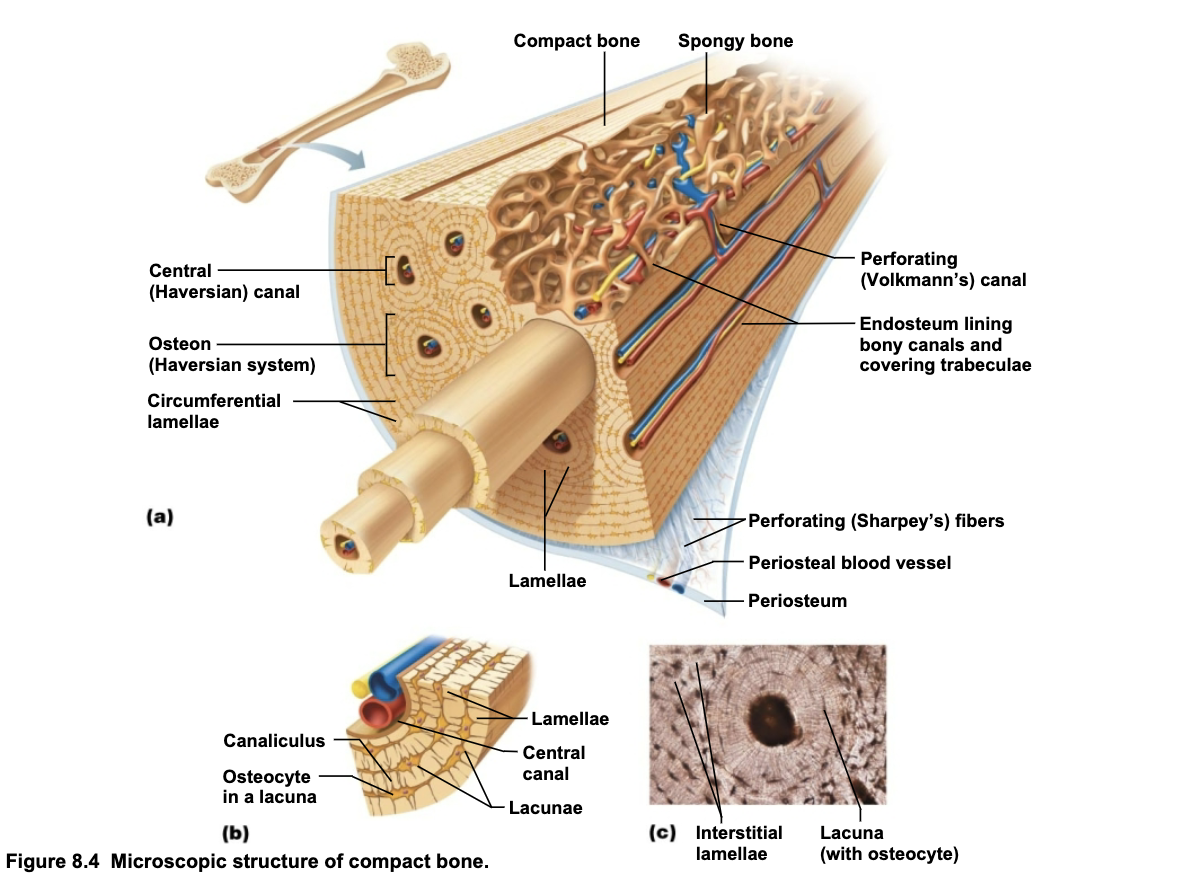
Perforating (Sharpey's) fibers
Fibers extending from the periosteum into the bone.
What are shin splints?
Dull ache in the shin.
Most causes of shin pain are classified as what?
Medial tibial stress syndrome (MTSS).
What can cause the pain associated with MTSS?
Inflammation of the periosteum (periostitis) and inflammation of the perforating fibers.
What mechanical factors can contribute to MTSS?
Flat feet and inversion of the feet during impact exercises.
Articular cartilage
Covers bone ends of movable joints.

Costal cartilage
Connects the ribs to the sternum.

Laryngeal cartilage
Constructs the larynx.
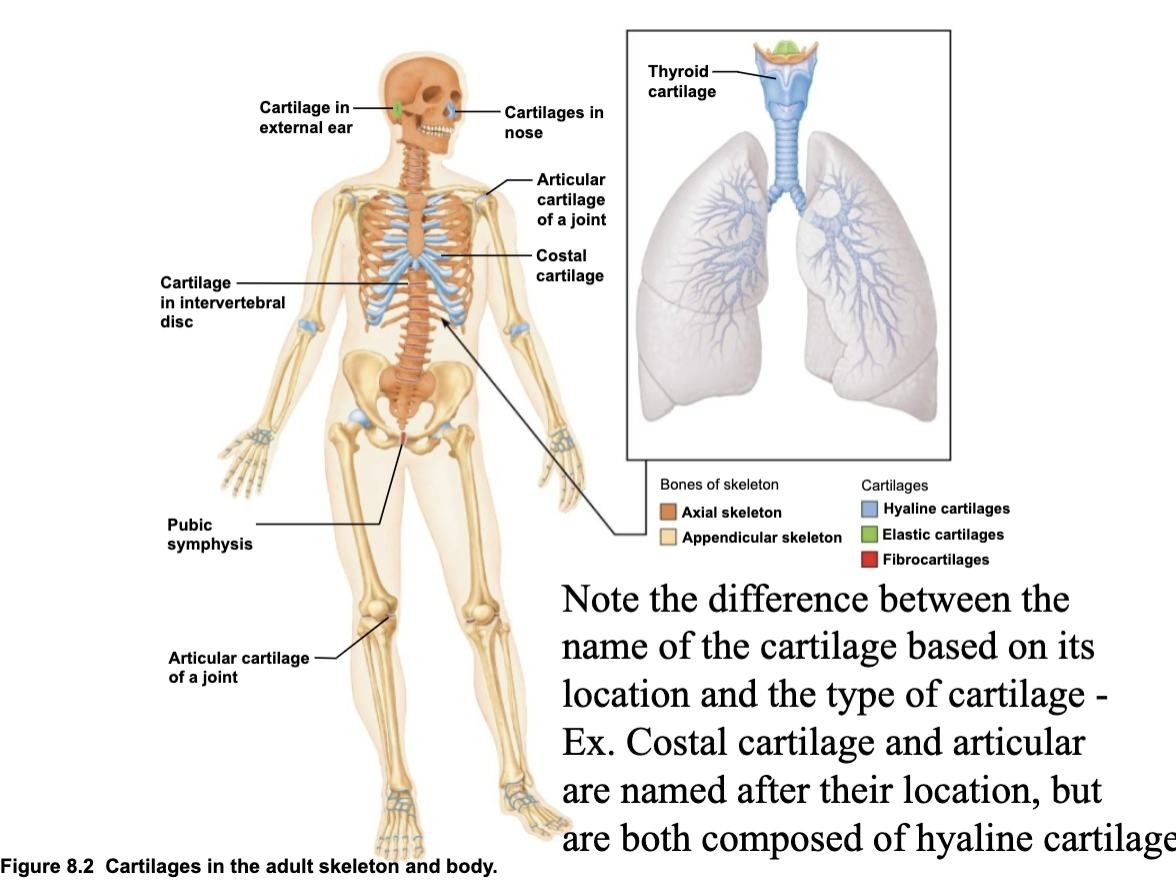
Tracheal and bronchial cartilage
Reinforces passageways of the respiratory system.
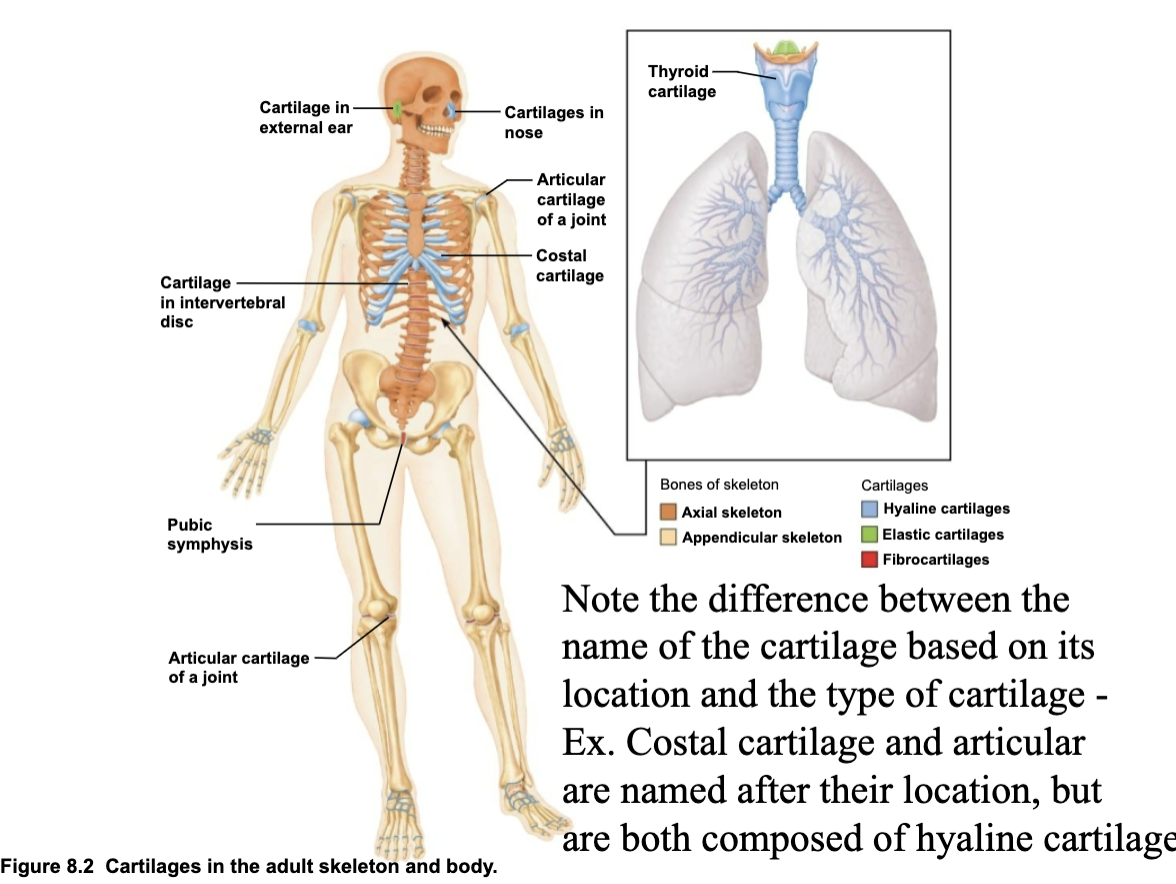
Nasal cartilage
Supports the nose.

Intervertebral discs
Cushion the bones of the spine.

What are the three main types of cartilage?
Hyaline cartilage, elastic cartilage, and fibrocartilage.
Where is hyaline cartilage found?
Nasal, articular, costal, and tracheal/bronchial cartilage.
What type of cartilage makes up most skeletal cartilages?
Hyaline cartilage.
Where is elastic cartilage found?
External ear and epiglottis.
Where is fibrocartilage found?
Knee joint, pubic symphysis, and intervertebral discs.
What type of cartilage is articular cartilage made of?
Hyaline cartilage.
What type of cartilage is costal cartilage made of?
Hyaline cartilage.
What is the difference between a cartilage's location-based name and its tissue type?
Names such as costal and articular describe location, while hyaline, elastic, and fibrocartilage describe the type of cartilage tissue.