Week 2 Motor System Anatomy and Disorders for Neuroscience
 Call Kai
 Learn
Learn Practice Test
 Spaced Repetition
 Match
Match Flashcards
 Knowt Play
1/48

There's no tags or description
Looks like no tags are added yet.
Name | Mastery | Learn | Test | Matching | Spaced | Call with Kai |
|---|
No analytics yet
Send a link to your students to track their progress
49 Terms
What is the starting place for any voluntary movement?
The desire to move.
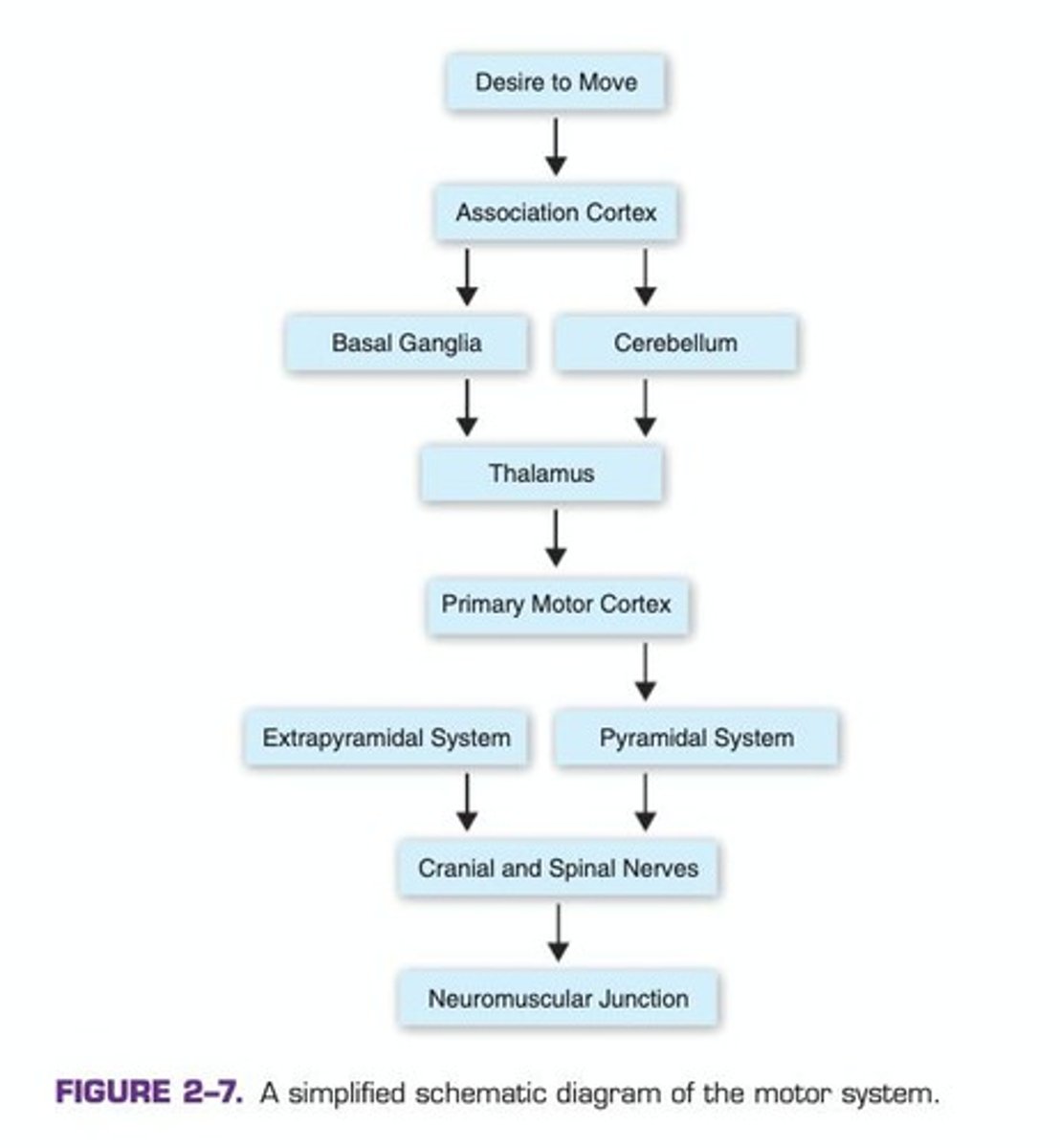
Which part of the brain is largely responsible for turning desire into movement?
The association cortex.
What does the primary cortex analyze?
A single type of neural input.
Name one of the primary cortices that analyzes sensory information.
Primary auditory cortex, primary visual cortex, or primary sensory cortex.
Where does planning for voluntary movement originate?
In the association cortex.
What is the role of the association cortex?
It formulates initial planning of a voluntary movement and sends motor impulses for further processing.
What area of the brain is responsible for recognizing complex visual stimuli?
The temporal association area.
What deficits can occur from damage to the temporal association area?
Visual agnosia, amnesia, and distractibility.
What is the function of the frontal association area?
It accesses all sensory areas of the brain and initiates and plans volitional movements.
What deficits are associated with the frontal association area?
Decreased attention, difficulty with abstract thinking, and decreased initiation.
What does the parietal association area integrate?
Bodily sensations with visual information.
What deficits can arise from damage to the parietal association area?
Difficulty manipulating objects, sensory neglect, and reading and writing deficits.
What is the role of the basal ganglia?
To link the association cortex with the primary motor cortex and smooth out motor impulses.
What are the components of the basal ganglia?
Caudate nucleus, putamen, and globus pallidus.
What is the effect of low levels of dopamine on the basal ganglia?
It can lead to rigidity, tremors, gait disturbances, and difficulty initiating movement.
What are the two major types of movement disorders associated with the basal ganglia?
Hypokinesia and hyperkinesia.
What is hypokinesia?
Too little movement, often accompanied by muscular rigidity.
What is hyperkinesia?
Excessive involuntary movement.
What is tardive dyskinesia?
Abnormal, involuntary movements due to prolonged use of antipsychotic drugs.
What is myoclonus?
Involuntary single or repetitive jerks of the body.
What are tics?
Rapid, coordinated, stereotyped movements under partial voluntary control.
What is dystonia?
Involuntary, abnormal postures due to co-contraction of agonist and antagonistic muscles.
What is the most common involuntary movement?
Tremor.
What is an essential tremor?
A tremor that occurs with sustained posture and is reduced by alcohol.
What is the primary function of the cerebellum?
The cerebellum controls coordinated movement, maintains muscle tone and balance, and provides coordination of rapid, alternating movements.
What types of sensory input does the cerebellum receive?
The cerebellum receives input from the association cortex, vestibular labyrinth, visual, tactile, and proprioceptive sensory receptors.
What is dysmetria?
Dysmetria is the inability to gauge distance, speed, and power of movement, leading to stopping before reaching a target or overshooting it.
What is ataxia?
Ataxia is a condition characterized by the combined effects of decomposition of movement, dysmetria, and dyssynergia.
What role does the thalamus play in motor control?
The thalamus acts as a doorway for subcortical systems to communicate with the cerebral cortex and refines motor impulses using sensory information.
What is the function of the primary motor cortex?
The primary motor cortex receives neural motor impulses processed by the basal ganglia, cerebellum, and thalamus.
What are the two main types of descending motor tracts?
The two main types are the pyramidal system (direct activation pathway) and the extrapyramidal system.
What does the pyramidal system control?
The pyramidal system controls voluntary, fine motor movements at a conscious level.
What is the role of the extrapyramidal system?
The extrapyramidal system controls postural support needed for fine motor movements and operates at an unconscious level.
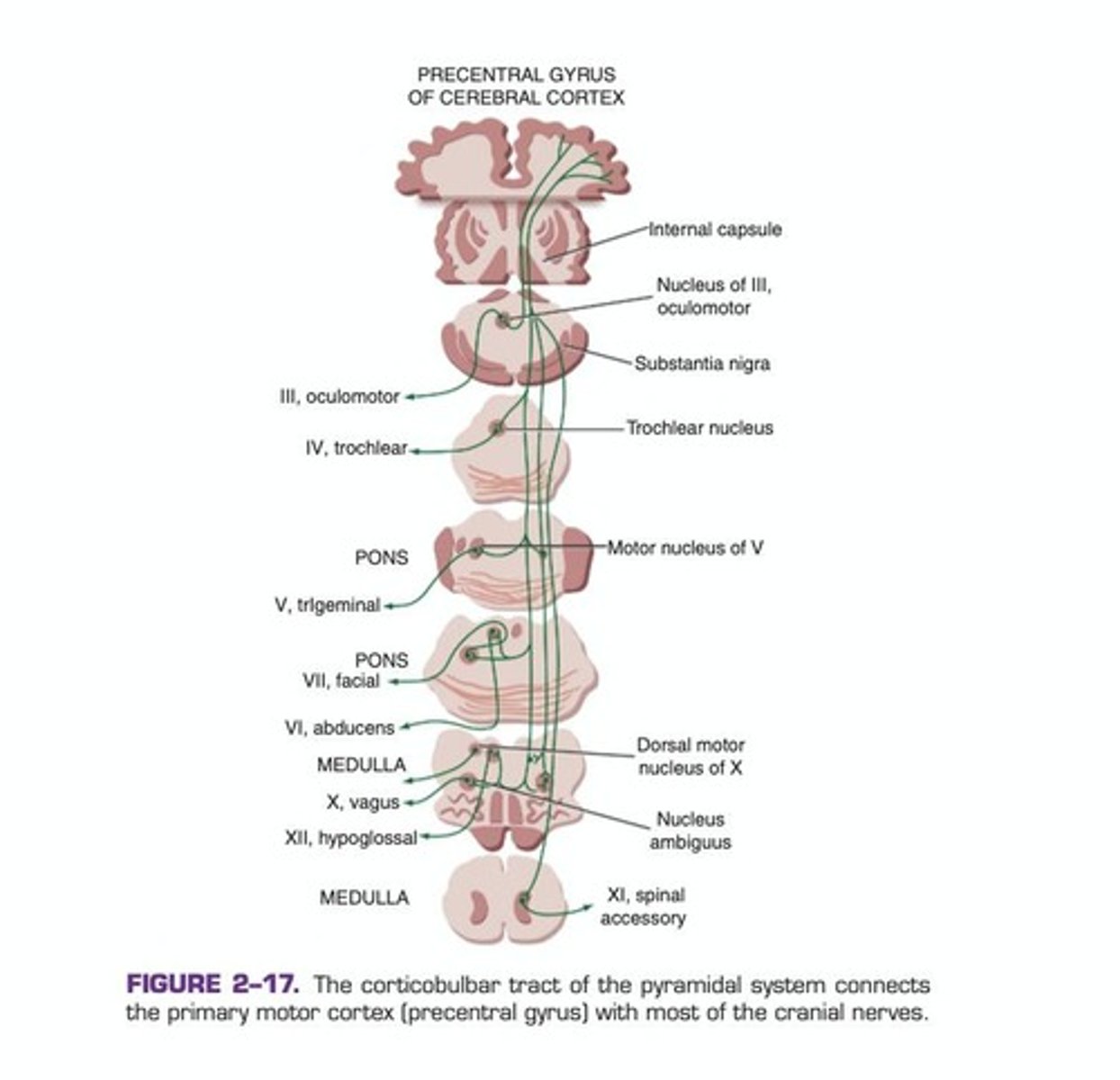
What are corticobulbar and corticospinal tracts responsible for?
Corticobulbar tracts provide motor innervation to cranial nerves, while corticospinal tracts connect to spinal nerves, controlling voluntary motor activity.
What happens when there is damage to the pyramidal tract?
Damage to the pyramidal tract results in weakness and reduced skilled movement, with normal reflexes typically preserved.
What is the final common pathway?
The final common pathway consists of lower motor neurons located in the ventral horns of the spinal cord, which generate activity in somatic and skeletal muscles.
What are the two types of lower motor neuron damage?
Bulbar lesions occur on the nuclei of cranial nerves, while peripheral lesions damage the axons of cranial nerves after they have left the CNS.
What is the role of lower motor neurons in speech?
Lower motor neurons innervate muscles involved in voice, resonance, articulation, and respiration for speech purposes.
Which cranial nerve is responsible for mastication?
The Trigeminal nerve (CN V) is responsible for the movement of muscles for mastication.
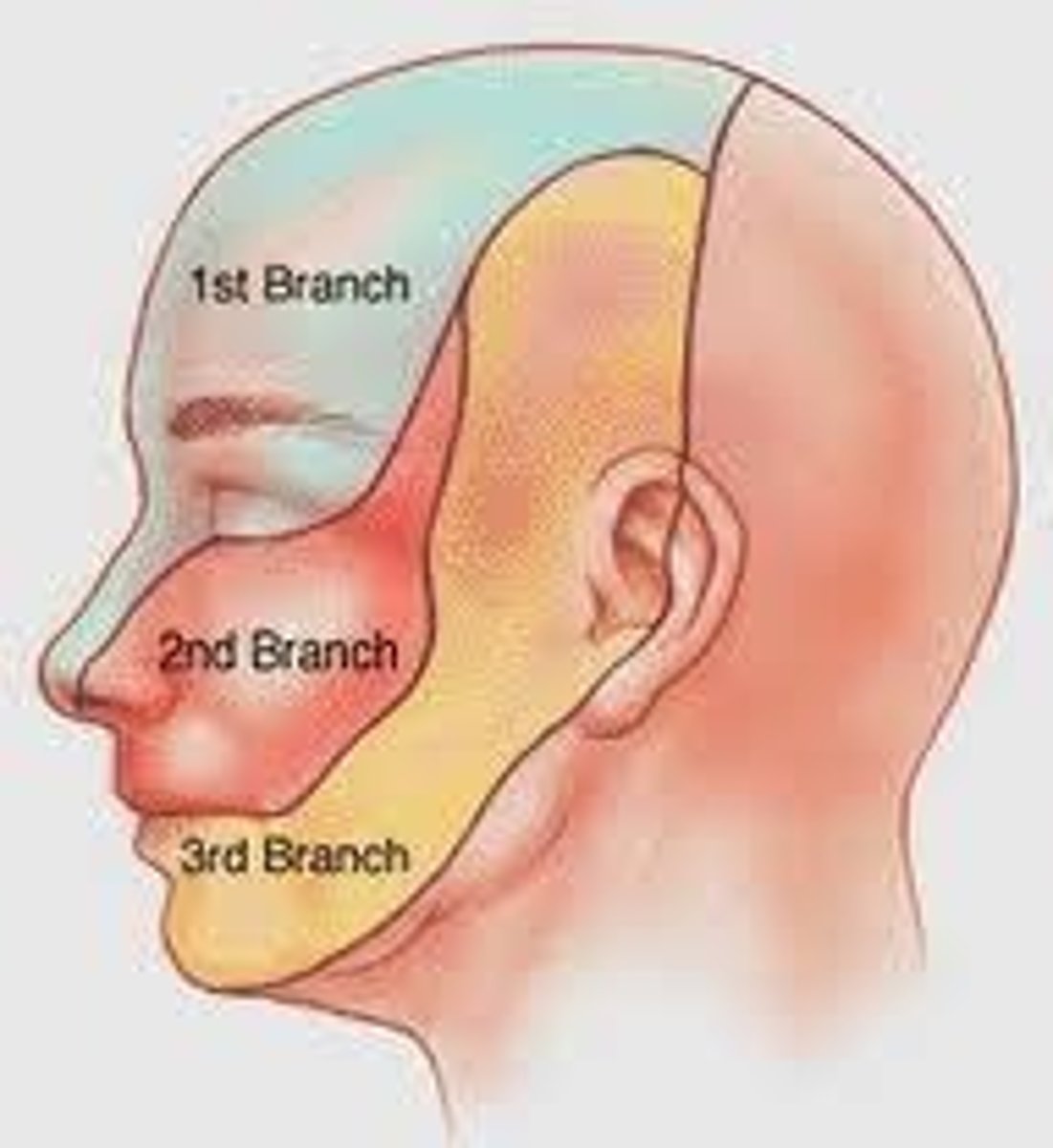
What is Bell's palsy?
Bell's palsy is an isolated unilateral weakness of the facial nerve (CN VII) leading to paralysis of muscles on the entire ipsilateral side of the face.
What functions does the Glossopharyngeal nerve (CN IX) serve?
The Glossopharyngeal nerve controls elevation of the palate and movement of the pharynx and larynx, contributing to swallowing.
What are the effects of damage to the Vagus nerve (CN X)?
Damage to the Vagus nerve results in weakness of the soft palate, pharynx, and larynx, affecting speech and swallowing.
What is the function of the Hypoglossal nerve (CN XII)?
The Hypoglossal nerve controls all intrinsic and most extrinsic muscles of the tongue, with damage leading to atrophy and weakness.
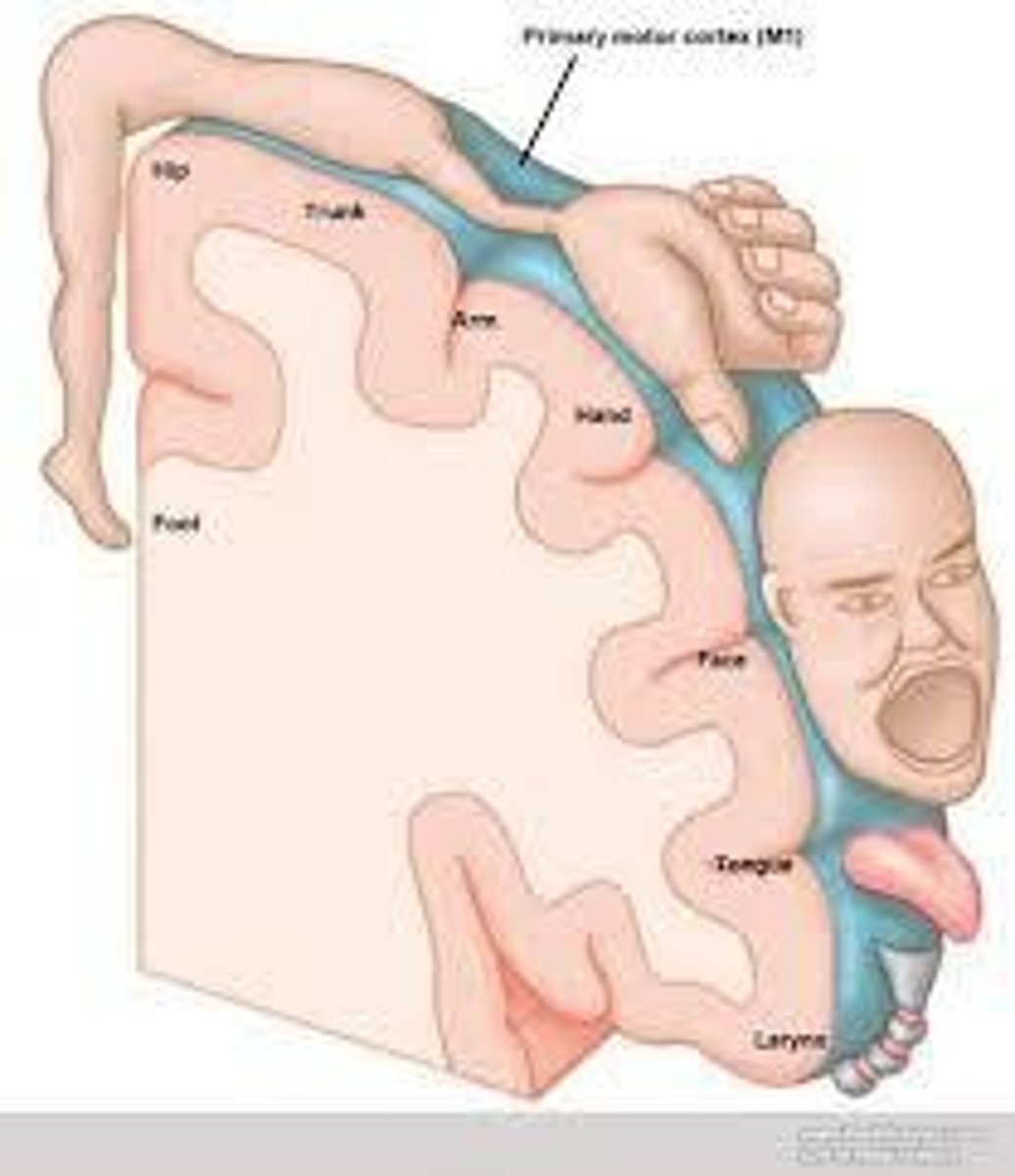
What is the significance of the motor strip representation?
The motor strip represents striated muscles in an upside-down fashion, with the number of motor neurons reflecting the degree of fine motor control required.
What is the impact of upper motor neuron lesions?
Upper motor neuron lesions produce weakness and reduced skilled movement, often resulting in spastic dysarthria.
What characterizes the indirect activation pathway?
The indirect activation pathway modifies motor impulses to skeletal muscles through multiple synapses and operates largely unconsciously.
What is the role of the neuromuscular junction?
The neuromuscular junction is where axons of lower motor neurons make synaptic connections with muscle cells.
What are the consequences of damage to lower motor neurons?
Damage to lower motor neurons can lead to paralysis, paresis, muscle atrophy, and flaccid dysarthria.
What is the relationship between cranial nerves and speech?
Cranial nerves innervate muscles involved in speech production, and damage to these nerves can significantly affect speech functions.