NCSF - CPT - Part 1
 Call Kai
 Learn
 Practice Test
 Spaced Repetition
 Match
 Flashcards
 Knowt Play
1/220

There's no tags or description
Looks like no tags are added yet.
221 Terms
What’s traditional understanding of health?
Individuals with no diagnostic criteria for disease or known health problems = healthy status
Individuals with disease or chronic health problems = unhealthy status
What’s the evolved concept of health?
Suggests people be viewed holistically rather than by independent physiological measures
The six factors in evolved concept of health include?
Physical health
Mental health
Emotional health
Intellectual health
social health
Environmental health
According to HHS:
_________ has been identified as the 4th leading risk factor for global mortality
Inactive adults have a higher risk for early death, heart disease, stroke, type 2 diabetes, depression and some cancers
About ___% of adults do not meet the guidelines for aerobic and strength activities
Physical inactivity
80
What’s the difference in the definition of Physical Activity vs Exercise. How to distinguish them?
Give three examples each
Exercise can qualify as physical activity, but physical activity may not be exercise – it is based on relative intensity
Physical activity: any purposeful and repeated bodily movement produced by voluntary skeletal muscle actions that increase metabolism
Examples: gardening, walking the dog, cleaning the house
Exercise – Planned, structured, and repetitive bodily movements performed to improve or maintain one or more components of physical fitness
Examples: weightlifting, taking an aerobics class, running 5 miles
For every person, the definitions of excises and physical activities are the same(T/F)
F
An activity may function as exercise for one person, but not another. Eg, walking around might serve as excises for an obese senior
What’s true exercise?
A true exercise must produce a stress that stimulates cellular responses and generates the potential for new or sustained adaptations
What’s principle of overload?
make the body work/stress harder
Eg: this week you squat 150 lbs next week you squat 160lbs
What’s principle of progression
Gradually increase challenges as you go
Eg: 120lbs - 130 - 140 - 150Once the body has adapted to a level of stress, additional stress is needed to promote further adaptations. Progressive-overload is practically combined in structured exercise programs for ongoing adaptation
Principle of specificity
Want to increase maximal strength? → Heavy resistance training with low reps.
Want muscular endurance? → Lighter resistance + higher reps.
A desired adaptation will occurs in response to specific stress placed upon the body therefore Exercise and activities must be intelligently chosen to match the fitness goal of your client.
Understanding elastic vs plastic responses:
Give one example each
Elastic: Have an acute response to an unaccustomed level of stress, but the system reverts back to the starting condition once the stimulus of stress is removed (Eg: a sedentary person walks 1 mile on a Saturday; experiencing an acute increase in their heart rate and metabolism, but no lasting adaptations)
Plastic: occurs with repeated stress which causes system improvements due to adequate recurring exposure (Eg: a sedentary person walks 1 mile at a frequency of 4x per week for eight (8) weeks; experiencing a mild reduction in their resting heart rate and improvements in their aerobic capacity)
For the baseline health benefits, people should aim for:
___ min of moderate-intensity activity per week
Or ___min of vigorous activity per week
Or an equivalent mix of the two intensities at doses of ≥10 minutes at a time each day, combined with muscle strengthening activities 2x per week
Should exert _____ kcals per week
150
75
1,000
For greater health/fitness benefits:
Just double the duration of physical activity for all three choices
Should exert 2,000 kcals per week
Moderate-intensity physical activity
Performed at _____ times the intensity of rest
On a scale relative to an individual’s personal capacity = ____ on a scale of 0-10
3.0-5.9
5-6
Vigorous-intensity physical activity
Performed at ___ or more times the intensity of rest
On a scale relative to an individual’s personal capacity = ____ on a scale of 0-10
6.0
7-8
CDC estimates 200,000 US deaths annually are due to physical inactivity alone
Risk for all-cause mortality is >____% higher with sedentary living and low cardiorespiratory fitness (CRF) compared to those who are highly active with high CRF
200
Blood lipid profile needs to know
For high risk individuals: LDL should be <___ mg/dl, ___mg/dl, apo-B <___ mg/dl
For moderate risk?
low risk?
LDL: <100 mg/dl, non - HDL should be < 130 mg/dl, Apo-B: 90 mg/dl
same as high risk
LDL: <130 mg/dl, non - HDL should be < 160 mg/dl, Apo-B: not relevent
Deep vein thrombosis? (DVT risk factors?)
Often occurs on leg, but elsewhere in the body is possible
Bed rest, surgery, pregnancy, varicose veins, blood-clotting disorder, obesity, smoking, family history, older age
Myocardial Ischemia
reflects a lack of O2 supply in the heart muscle often due to coronary artery blockage; severe blockage can trigger a heart attack
Pulmonary embolism
life-threatening blood clot that occurs in the pulmonary arteries of the lungs which can cause respiratory arrest and sudden death
What is the symbolic and diastolic blood pressure for Heathly, elevated, Hypertension stage 1 & 2 and hypertensive crisis?

Atherosclerosis
a progressive process of arterial wall damage that can lead to plaque accumulation in major arteries.
_____ is a blood clot capable of causing a heart attack, stroke or even pulmonary embolism.
Plaque
ID the 4 potential mechanisms by which aerobic exercise can reduce the risk for a heart attack.
Lowering blood pressure, platelet adhesion (stickiness of blood), and markers of low-grade inflammation
Managing LDL and blood triglyceride concentrations
Increasing HDL production in the liver and improving its characteristics
Helping to manage stress
Aerobic training ___ days/week for ____ min at ____% of VO2max can reduce blood pressure directly (4-10 mmHg systolic, 3-8 mmHg diastolic) and limit the risk for hypertension by: (4)
3-4
30-60
60-70%
Reducing resting heart rate
Reducing hormone activity that increases blood pressure
Improving arterial vasodilation
Creating baroreceptor adjustments that help the body better manage pressure
What are some factors shown to reduce heart diseases
Lower blood pressure and cholesterol
Healthier diet (high fiber, less saturated fat/refined sugar etc)
Exercise regularly
manage stress
Lose weight
Drink less alcohol
Health Related Components of Fitness (HRCF) Scores
What are some of the factors of HRCF?
Cardiorespiratory fitness, muscular strength, muscular endurance, flexibility and body composition
Performance Related Components of Fitness (PRCF) Scores
What are some of the factors of PRCF?
Power, Speed, Corrdination, balance and agility
Health vs Fitness
Understand the differences between these two ideas
Health is a disease-free state of well-being
Fitness relates to criterion-based measure of physical performance
The key concept is that a person doesn’t have a be fit to be healthy nor a person is not guaranteed health simply because they are fit
The following are HRCF - Cardiorespiratory Fitness (CRF)
Ability of our circulatory, respiratory and muscular systems to supply and utilize O2 during sustained physical activity.
What’s VO2 max?
T/F is CRF is the most important HRCF? Why
VO2max declines at a rate of ~__% per year upon reaching adulthood (greater after 45 years old)
The measure of CRF as indicated by maximal O2 use (ml/kg/min)
T, because of its link to risk for diseases and mortality (low measure is related to chronic diseases, high measures is linked with improved quality of life)
1%
Muscular Fitness
Strength
Endurance
Stability
Strength balance
Define each one aboved
Strength: the measure of maximal contractile force produced during a single effort
Endurance: The measure of contractile force decline over time; allows for prolonged force for an extended period
Stability: synergistic ability of muscles, nerves, proprioceptors, and connective tissues to maintain body segment positioning and offset disruptive forces
Strength balance: functional strength ratio of opposing muscle groups across a joint (AKA: agonist/antagonist muscle or muscle balance ratio. Eg: 3:2 strength ratio for the quadriceps and hamstrings at the knee) Which allows for proper levels of force output and stabilization within musculature that reciprocally facilitate joint actions. Inc movement proficiency and reduce risk for injury
Muscular fitness is essential because it impacts: (6)

Flexibility VS Mobility
Define each
What’s the key concept here?
Flexibility: The ability of a muscle to move through a range of motion (ROM) at a single joint in a single plane.
Mobility: The ability to move cooperative body segments through a full, unrestricted ROM without undesirable changes in biomechanics; multiple joints are used rather than one
flexibility is not synonymous with mobility

Body Composition
Indicated by the ratio of fat mass to fat free mass, often expressed as body fat percentage.
Adding muscle mass will positively change body composition without losing any fat.
What’s the key concept here?
Health risk is determined by the % of fat mass in the body, not the quantity of fat. Eg a 200 lbs ppl with 40 lbs of fat is healthier than a 150 lbs & 40lbs of fat ppl
What’s Normal - Weight Obesity?
Skinny fat; people w lower lean mass but higher overall fat percentage.
CDC suggests nearly ___% of U.S. adults qualify as obese based on BMI; >___% of the population is involved when the overweight category is included
35
70
Diet factors associated w obesity & Specific health risks
give 4
over sufficiency
High in refined sugars
High in saturated fat
Low in fruits/veggies
The following are PRCF components - Power
rate at which work is performed - (force x velocity) = (force x distance/time) = (work/time)
Development focuses on muscle recruitment patterns that elicit the fastest development of force (type II or fast-twitch fibers)
Define “powerful over the lifetime”
Sarcopenia: Loss of total skeletal muscle mass, paticular in reducation of ______ muscle fiber
Powerful over the lifetime: Functional aging, prolonged independence and a reduced risk for debilitating sarcopenia
Speed
Expressed as the time to perform a movement in a single direction.
Depends on neural recruitment patterns, adequate muscular fitness, stability, dynamic balance and flexibility
What is Often considered the most valued measure of performance in sports?
Speed
Balance
The ability to manage forces which act to disrupt stability; high balance translates to more efficient ___, ___, and ___
Needed for sport participation, activities of daily living, and to reduce the risk for injury/falls
What is Proprioceptors?
What’s the key concept here?
Movement, posture and bodily control
Organelles located in CTs and provide sensory input to CNS. Allows for physical awareness of the body’s position in space
When the body is challenged by disruptive environments, improved balance and neuromuscular coordination is achieved via increased proprioceptive function
Coordination
the ability to control and use multiple body parts and/or senses in a synergistic and efficient fashion to perform complex/high-speed motor tasks
Eg: Hand-eye coordination – combines visual processing speed with neuromuscular control of the hands - tennis
Agility
The ability to perform rapid, whole-body movements with change(s) of velocity/direction in response to analysis of the environment
Required both motor and data processing efficiency
In sports, allows one to physically pursue a person, ball etc under constantly changing conditions.
Understand Open skills vs closed skills
Open skills: motor skills that require reaction to changes in an unpredictable environment
Closed skills: motor skills performed in a stable or predictable environment, such as making a free-throw shot in basketball
What are the five self-selected behaviors that are the primary contributors to obesity:

Classifying Obesity
What is fit-healthy for male and female?
Stage 1-3 Obesity
What are two high risk factors (regarding waist circumference and BMI?)
M: <20%BF; F: <26%
Stage 1 = M: >=25% BF, F: >=32%; (>38% for old age)
Stage 2 = M: >=30% BF, F>=40% BF
Stage 3 = M:>=35% BF, F>=45%
M >= 40 inches waist circumference; F >=35 inches; it indicates significant visceral adiposity
BMI >30 is obesity > 35 is morbid obesity M or female but BF must be considered for BMI
Obesity is associated with: (list 4)
Mental health issues like depression and ADHD
Reduced quality of life and physical function
Increased risk for Sleep apnea, Metabolic syndrome, OA
Inc risk for all-cause death like diabetes, heart diseases stroke and cancers.
Hyperinsulinemia:
Excess levles of insulin, indicates IR, inc fat storage
Combination of aerobic/anaerobic exercise can positively impact obesity via: (3)
1) Improved insulin sensitivity
2) Heightened caloric expenditure for body fat losses
3) Potential mediation of systemic inflammation and hormone dysfunction
Physical activity alone is adequate for those chronic diseases(T/F)
F, dietary and behavior changes are needed for ideal results
T2DM accounts for ___-___% of all cases but is most preventable
90-95%
Diagnosing diabetes
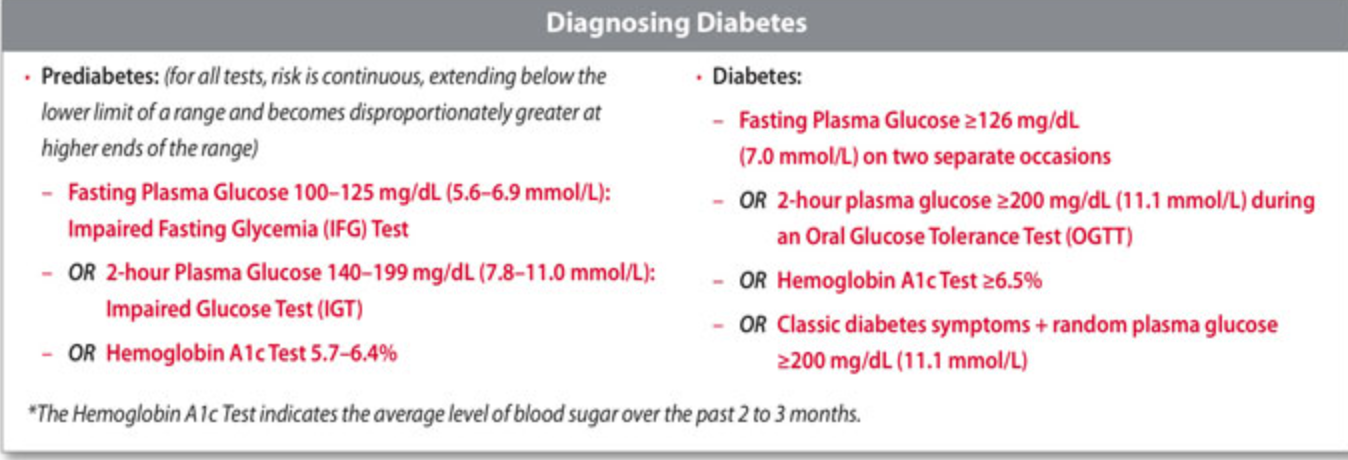
What are the 5 diabetes risk factors
1) Family history
2) Obesity
3) Poor diet
4) Gestational Diabetes
5) physical inactivity
For patients with different diabetic complication, what exercises should be avoided?
Retinopathy
Nephropathy
Neuropathy: impacts peripheral nerve tissue (often in the hands and feet) which results in weakness, numbness and/or pain
Cerebrovascular diseases: diseases that impact blood vessels of the brain such as, strokes and aneurysms; is the leading cause of death among diabetics
Retinopathy: Jumping, compressive exercises (eg, leg press) as well as those that jar the head or lower it below the waist should be avoided (they cause sharp spikes in blood pressure and intraocular pressure).
Nephropathy: heavy weightlifting or holding one’s breath during exercise should be avoided and proper hydration is crucial
Neuropathy: exercises that cause repetitive impact to the hands or feet should be avoided and proper footwear must be worn
So basically for patients with diabetic complication, don’t give heavy compressive exercises, give light/water aerobic exercises, stretching and light resistance training
Physical activity and cancer
Cancer is the second leading cause of the death in the US, but __-__% of cases are estimated to be related to lifestyle and environmental factors
Tabacco, diet, infections, physical inactivity, radiation, stress and environmental pollutants.
90-95
Where are some of the common fracture sites? (5)
Wrist, Humerus/Scapula joints, Rib cages, Pelvic/Femur joint, Lumber
What is Osteoporosis
A progressive disease resulting in reduction in bone mineral density and deterioration of skeletal tissue
Bone mass reduction occurs begin after age ___, further reduction occurs after age ___
30, 50
Why is Osteoporosis more common among women?
Women tend maintain lower peak bone mass
Experience additional losses following menopause due to lost of estrogen
Inadequate consumption of Ca2+ and VD
Method of reducing risk of osteoporosis: (3)
Compound resistance training activities that create bone stress like lunges, squats
Adequate Ca2+ and VD intake
Regular physical activity
Osteoarthritis
Degeneration of joint cartilage and the underlying bone; associated with previous injuries, joint overuse, obesity, and sedentary behaviors
Osteophytes
Osteophytes (bone spurs) form as the body's natural response to repair damage, reduce stress, or stabilize a joint experiencing wear and tear
Causing pin in surrounding nerves and muscle
Post-traumatic arthritis (PTA)
Results in edema, joint swelling and pain due to an acute physical injury or overuse; increases the risk for joint inflammatory disorder and premature degradation
PTA accounts for about 12% of osteoarthritis cases
Rheumatoid arthritis (RA)
Chronic, progressive autoimmune disease that causes severe joint inflammation, painful deformities and significant immobility over time
Often impacts the fingers, wrists, feet and ankles; creates greatest limitations to programming
What are some training modifications recommended for those with any form of arthritis? (3)
Use only moderate-intensity, non-impact resistance training (building muscle and strength using external loads, body weight, or elastic bands while minimizing physical stress and shock on your joints) and aerobic work
Employ longer warm-up and cool down periods
Include pool work if possible to reduce stress on joints
Physical Activity and Mental Health
Exercise has been shown to be just as effective as anti-depressant medications for people suffering from mild depression and anxiety’
Moderate-intensity exercise can improve mental health by:
Increasing concentrations of brain neurotransmitters such as dopamine and serotonin
Providing an analgesic effect via the action of endorphins
Improving psycho-social elements which enhance sense of well-being
Improving mood, self-esteem, self-efficacy, and cognitive function
Which neurotransmitter helps regulate blood pressure, pain perception, the sleep-wake cycle and mood?
Which hormone group is released after exercise that active opiate receptors and promote analgesic and pleasurable sensations?
Serotonin
Endorphins
Define Parkinson’s disease
characterized by tremor, muscular rigidity, and slow, imprecise movement abilities; is associated with________ degeneration and _____ deficiency
basal ganglia, dopamine
What are the four lifestyle factors that benefit neurodegenerative disorders?
Intellectual stimulation, Cognitive and social engagement, proper nutrition, Regular and engaging exercise
Which is a key performance-related component of fitness for active aging?
a.muscular strength
b.muscular endurance
c.muscular hypertrophy
d.muscular power
d.muscular power
because active aging focuses on maintaining the ability to perform everyday activities quickly and safely as people get older.
Bones contain organic components such as _____ and various mineral elements, including 98% of _____ storage in the body
collagen, calcium
T/F: Bone can real itself and is dynamic and changing
T
When daily Ca2+ intake is insufficient. Ca2+ storage are compromised and ________ declines over time.
Low BMD leads to _____, and if untreated, progress to _____
Bone mineral density (BMD)
Osteopenia (pre-disease state), Osteoporosis (bone structure become fragile and brittle
Bone growth
Bone length increases until the cartilage is ossified in the __________ of long bones; peak bone mass is usually attained by about age ____
epiphyseal plates
18
Give corresponding bone examples:
Long Bones
Short Bones
Irregular bones
Flat bones
Long Bones: Arms and legs
Short Bones: Hands and feet
Irregular bones: Vertebrae
Flat bones: Scapula
Bone development is critical in children; consumption of adequate ______ and participation in regular ______ activity is necessary
BMD can be improved until age ___; afterward, genetics, behaviors and lifestyle factors dictate the rate of decline – muscle strength is a key indicator
vitamin D/calcium
weight-bearing
30
T/F, play (jumping/landing activities) indicates greater stress when compared to controlled weightlifting performed with a 10RM resistance
T
(Bodyweight exercises aren't automatically easier or safer than weighted exercises).
Types of joints
The major types of joints are: ______ (3)
Fibrous(Sutures between skull bones), Cartilaginous (Intervertebral joints) and Synovial (shoulder)
Synovial Joint
Freely movable joints in the body that contain a fluid-filled cavity, cartilage, and a joint capsule; Uses synovial fluid to reduce frictional stresses and allow for considerable movement between the associated articulating bones.
Joints of the _____ skeleton are mostly synovial to support locomotion and activity needs
appendicular skeleton

What are the six types of synovial joints
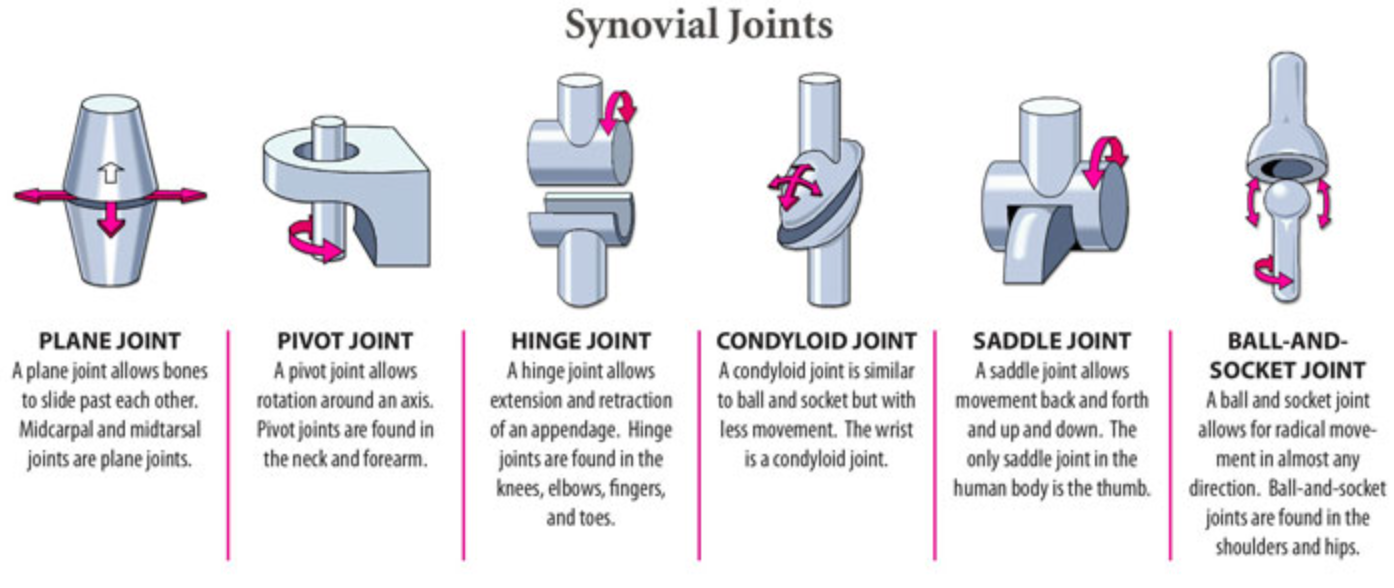
What are Ligaments and tendons?
Ligament: Fibrous bands of CT that support internal organs and hold bones together at joints
Tendons: Fibrous CT that connects bone and muscle
What are Muscle Fascia?
Fibrous CT that encapsulates full muscles as well as bundles of fibers
Sliding Filament Theory
An AP travels down _____ to stimulates the sarcoplasmic reticulum to release _____ ions which unlock the bond between ____ filaments and troponin. When troponin is removed due to Ca2+ sensing, ___ attach to actin forming bridge via _____. ATP is split at the attachment site and this releases energy, allowing the _____ to pull actin to shorten/contract the muscle fiber
T-tubules
Ca2+
Actin
Myosin & Myosin’s head
Myosin’s head
What’s the all or none principle?
A muscle fiber is either in a state of producing maximum tension (If AP is reached) or not producing any tension at all
Force production is dictated by what three things?
Motor unit firing rate, recruitment and synchronicity
Motor unit firing rate: Imagine your chest muscle has 100 motor units (hypothetically).
Bench pressing 45 lb: You might only need 20 motor units.
Bench pressing 135 lb: You might need 60 motor units.
Firing rate: Temporal summation. At sufficiently high firing rates, contractions can fuse into tetanus
Low firing rate: The fibers contract, relax, and contract again.
High firing rate: The contractions overlap, producing greater sustained tension.
Motor Unit Synchronization: When motor units fire together, their individual forces can combine to produce a larger instantaneous force.
What is a motor unit consist of?
A motor unit consists of one motor neuron + all the muscle fibers it controls.
Two types of motor unit firing patterns:
Synchronized firing - employed during _______ involving ______ fibers and warranting significant fiber recruitment
Asynchronous firing - employed during endurance activities involving slow-twitch fibers which conserve motor unit potential, allowing prolonged work
High-output demands, fast-twitch
Agonist-antagonist
relationships help facilitate smooth force production; one muscle contracts while the muscle on the opposite side of the joint relaxes (neural regulation)
Example: Bicep curl; Bicep is the _____ that contracts/shortens, Triceps is the _____ that relax/lengthens
agonist
antagonist
Types of muscle contractions - Concentric vs Eccentric Contraction
Concentric: The muscle produces forces while _____
Eccentric: The muscle produces forces while _____
Use Bicep curl and squat as an example to describe these two concepts
Shortening
Lengthening under load
Lifting the dumbbell (concentric), Slowly lowering the dumbbell (eccentric) Standing back up during a squat (concentric) lowering the body (eccentric)
Types of muscle contractions - Isotonic vs isometric vs isokinetic
IsoTONIC: The muscle produces forces while changing length and moving a load. Joint angle changed. What’s one example?
IsoMETRIC: Tension is created but no joint angle changes. Example?
IsoKINETIC: Joint moving at a constant, controlled speed; required specialized rehab equipment. Example?
Dumbbell curl, including lifting and lowering
Holding a dumbbell still halfway through a curl, or holding a plank.
Leg extension machines (dynamometer) used in a physical therapy setting. (A type of specialized machines that adjust resistance based on your effort)
Muscle fiber type
_____: Slow-twitch oxidative fibers possess the lowest power output, highest resistance to fatigue. Good for prolonged aerobic work, has highest mitochondrial densities
_____: fast-twitch, oxidative-glycolytic fibers that possess intermediate power output capabilities and diameter with moderate resistance to fatigue; Support both intense strength and prolonged exercise; versatile
_____: fast-twitch glycolytic fibers that possess the highest power output capabilities, lowest resistance to fatigue.
Type I
Type llA
Type llX
Size principle
Muscle fibers are recruited based on their size and force output
type I → type IIA → type IIX
Distribution is genetically predetermined; training will not change concentrations of fibers within specific muscles from fast to slow or slow to fast
Postural muscles maintain higher concentrations of ____ fibers (e.g., soleus)
Movers tend to have a greater _____ fiber concentration (e.g., biceps)
Muscles with greater quantities of type II fibers experience greater changes in response to hypertrophy training
type I
type II
Movement plane and exercises
_____: splits the body into left and right halves; includes exercises that require forward-backward movement (e.g., ____)
_____: splits the body into front and back halves; includes exercises that require side-to-side movement (e.g., _____)
_____: splits the body into top and bottom halves; includes exercises that require rotation (e.g., _____)
Sagittal, lunge
Frontal, lateral raises
Transverse, oblique twists
Anterior axillary line
runs down the forward crease of the armpit

midaxillary line
perpendicular line drawn downward from the apex of the axilla (armpit)

Trunk & Neck
Demonstrate Flexion, extension, lateral flexion (both trunk & neck)

Shoulder
Demonstrate Horizontal Abduction/Adduction, External Rotation, Internal Rotation, Abduction/Adduction, Flexion/Extension/Hyperextension

Elbow & Wrist
Demonstrate Flexion/Extension, Pronation/Supination, Radial/Ulnar Deviation

Hip
Demonstrate Abduction/Adduction, Hip Flexion/Extension/Hyperextension, Hip External/Internal Rotation

Knee & Ankle
Demonstrate Plantar/Dorsi Flexion, Ankle Inversion/Eversion, Knee Extended/Flexed

Prime Mover
The primary muscle responsible for generating the main force needed to complete a specific movement or joint action during an exercise
Personal trainers should know the contributing muscles for basic movements
Trunk and Neck
What are the Five Regions of the Vertebral Column and their corresponding bone number?
Hint: The number of vertebral column is when u eat your meals
Cervical vertebrae (7)
Thoracic vertebrae (12)
Lumbar vertebrae (5)
Sacrum and coccyx (9 fused)