Physics Chapters 12
 Call Kai
 Learn
 Practice Test
 Spaced Repetition
 Match
 Flashcards
 Knowt Play
1/126

There's no tags or description
Looks like no tags are added yet.
127 Terms
Two dimensional images display
SLICES of anatomy for physician interpretation

Two challenges of 2D imaging in ultrasound
Sound travels in a straight line
Sound beam must be narrow for optimal lateral resolution

How do you overcome the challenges of 2D imaging?
by using multiple pulses

Steps for Creating an Image
Ultrasound system sends out a pulse in a straight line (with a narrow beam width)
The pulse returns to the machine for processing and reflections are stored
Another pulse is then sent out in slightly different direction
Real Time Imaging
Steps for creating an image happen about 100 times in 1/100th of a second
How can we create a 2D image that maps out the anatomy we are looking at?
by creating multiple sound beams, very quickly, and keeping track of all the returning information from each beam
real time

Characteristics of the Different Types of 2D Transducers
shape and number of active elements
automatic redirection of sound beam for image creation
focusing of each sound beam
shape of 2D image
issue that occurs from damaged/nonfunctioning active element
Array
a transducer assembly containing several piezoelectric elements
Phased
time delays that allow electronic steering and focusing
Mechanical Steering
Refers to changing the ultrasound beam direction through mechanical means (such as attaching a crystal to motor) which physically points the crystal in different direction.
When a transducer is referred to as mechanical, it means the steering is mechanical.
Mechanical Transducer Active Element Characteristics
single, circular, disc shaped
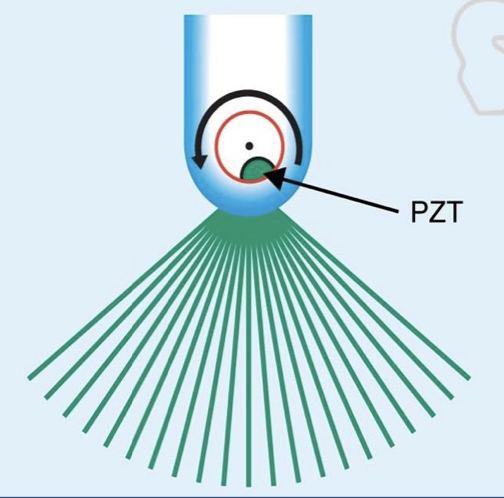
Mechanical Transducer….
physically moves, creating a sector shaped image

In Mechanical Transducers, the crystal is rotated
through an arc by a motor
mechanically steered, usually by a motor

Mechanical Transducer Crystals
Number: only one crystal
Shape: resembles a coin

Mechanical Transducer Image Shape
fan or sector shaped (spokes of a bicycle)
Greater depths = larger gaps
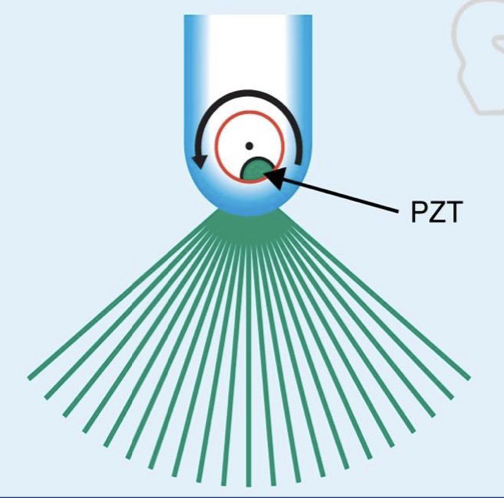
Mechanical Transducer Beam Steering
crystal rotates with a motor, emitting sound beams as it goes
called mechanical steering
Mechanical Transducer Beam Focusing
fixed focal depth (AKA conventional, mechanical, fixed focusing)
internal focusing (curved active element)
external focusing (acoustic lens)
Mechanical Transducer Damaged Crystal
entire image is lost (only one crystal, so if it breaks, entire transducer breaks)
least expensive type of transducer
some vaginal and rectal still use this
Transducer Arrays Active Element Characteristics
more sophisticated, multiple active elements
Transducer Arrays…
slab of PZT cut into multiplee seperate pieces called elements
In transducer arrays, each element has
its own wire connecting to it allowing it to work independently of the others
One element or multiple elements can be excited at one time, each producing
its own reflection and electronic signal.
Channel
the combination of the active element, wire, and system electronics
Linear
active elements are in a straight line
Annular
Elements are arranged as circular rings with a common center
Convex
Active elements are arranged in a bowed or arched line (AKA curved, curvilinear)
Multidimensional
Multiple elements arranged in a series of rows within the transducer
1.5D or 2D array
Linear Phased Arrays Characteristics
small footprint
no moving parts
focused by phasing

Linear Phased Array Crystals
Number: 100-300 elements
Shape: each element is rectangular and narrow; arranged in a single row

Linear Phased Array Image Shape
fan or sector shaped (similar to mechanical)

Linear Phased Array Beam Steering
electronically steered (phasing)
electronically transmits in different directions without any moving parts
Linear Phased Array Beam Focusing
electronically focused
controls that allow the sonographer to change depth and amount of focusing
todays equipment allows multi-focusing with multiple beams down the same scan line each with differing focal depths
Linear Phased Array Damaged Crystal
inconsistent or erratic beam steering - cannot always appreciated damage when looking at image
Are all elements excited in phased array?
yes
Individual wavelets are created from
each element
The individual wavelets interfere and form a
single sound beam
wavelets interfere _____ and ______ to determine the sound beam ___and ____
constructively and destructively, direction and focus
In linear phased arrays, Electrical Signals fire ______ of a second apart from ___ to ___ or ____ to ____
ten billionths
right to left or left to right
The tiny fraction of time allows the beam to
steer one way or another
Phase Delays
the name for these time differences
if the line has a slope
the beam is steered
if the spike is in a straight line
the beam is not steered
Beam Former
the electronics within the ultrasound system that create the patterns that allow steering
Beam steering to the right happens when the crystals are excited from ___ to ____
left to right

Beam steering to the left happens when the crystals are excited ____ to ___
right to left

What will create a focused sound beam?
creating a curved pattern with the excitation of the crystals where the outer crystals are excited first
if the line is straight
the beam is unfocused

if the line is curved
the beam is focused

SHORTER time delays between firing elements from outside in = _____curve
LESS
Less severe curve = _____ focus
deeper

describe this beam
this beam is being focused and steered to the left
Slope
pertains to steering
Curvature
pertains to transmit time
Multiple transmit focuses are accomplished by
sending multiple sound beams down the same scan line

Each of the sound beams in a given scan line will have a different
curvature pattern of excitation
produces different focal depths

Greatest curvature pattern = ______ focus
shallowest

Least curved pattern = _____ focus
deepest

can focusing occur during reception
yes
Dynamic Receive Focus is performed
automatically by the system, sonographer has no control
When sound returns to the transducer,
the returned sound excites neighboring elements in the probe
Variable time delays
change continuously throughout scanning
depend on depth of the reflector
Reflected Sound is focused at ____ depths
many
Transmit focus is limited to a
single focal point
Annular Phased Arrays
inner rings acquire data from shallow
outer rings acquire data from deep

Annular Phased Arrays Crystals
Number: varies
Shape: shaped like a disc, multiple rings with common center (bullseye)

Annular Phased Arrays Image Shape
fan or sector shaped

Annular Phased Arrays Beam Steering
mechanical steering
a motor physically moves the elements allowing the beam to be transmitted in different directions

Annular Phased Arrays Beam Focusing
multiple transmit focal zones create each scan line
smaller diameter = shallower focus
image created from focal zone of each crystal, the rest is ignored

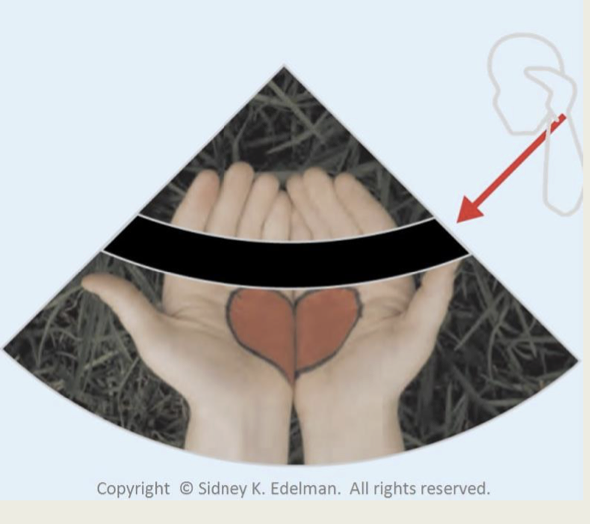
Annular Phased Arrays Damaged Crystals
When one ring malfunctions, a portion of the image is lost in that “zone” of the image
horizontal or side to side band is missing information
innermost ring —> band in most superficial aspect
outermost ring —> deeper band is missing information
Linear Sequential Arrays are AKA
linear switched arrays

Linear Sequential Arrays Crystals
Number: 120-250
Shape: rectangular shaped strips of PZT
active elements are larger than phased array
each crystal = 1 wavelength in width
transducer face can be up to 10 cm long

Linear Sequential Arrays Image Shape
rectangular
image is never wider than transducer face, but can be narrower

Linear Sequential Array Beam Steering
a group of crystals fires simultaneously for each sound beam
beams are parallel and directed straight ahead
a group of ten crystals will be excited and create a single sound beam, then another group of ten at slightly differing times at a different location
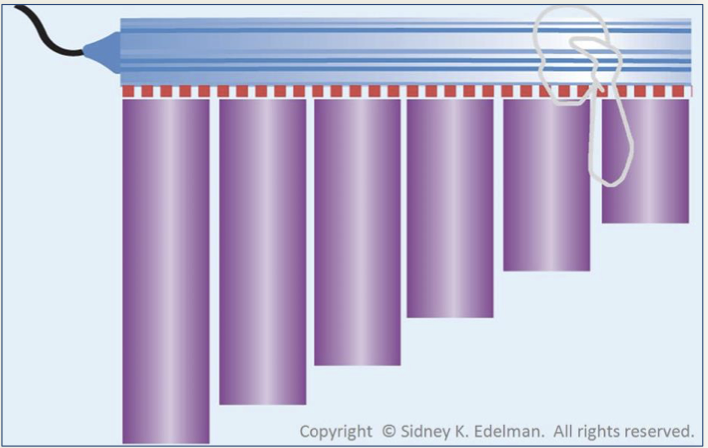
Linear Sequential Array Beam Focusing
Electronically focus on transmit and receive (modern transducers)

Linear Sequential Array Transmit Focus
curved excitation pattern (like linear phased array)
this changes the near zone length and therefore changes to the focus
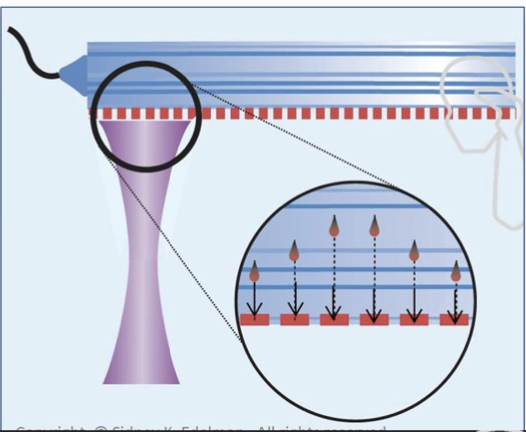
Linear Sequential Array Receive Focus
electrical delays in the signals returning
phase delays change continuously during reception, thereby focusing the beam at many depths

Linear Sequential Arrays Damaged Crystals
the portion of the image extending directly below the damaged crystal will be affected
only the scan lines that would have been created by the damaged element are missing

In linear sequential arrays, elements are excited in ___ to allow
groups
allows wavelet interference to create better resolution
In linear sequential arrays, a single element firing at a time would create
divergence too quickly, degrading image quality
electronic sound beam steering is possible with linear sequentials by
using sloped patterns of electrical excitation
this creates a parallelogram rather than a rectangle
used when we steer for doppler
Convex, Curved, Curvilinear Array Transducers
similar to linear arrays, but made bowed shaped to increase the clinical utility
Convex, Curved, Curvilinear Array Transducers Crystals
Number: 120-250
Shape: rectangular shaped strips of PZT
active elements are similar in size to linear array
each crystal = 1 wavelength in width
transducer face can be up to 10cm long
Convex, Curved, Curvilinear Array Transducers Image Shape
blunted sector shape — convex, but does not come to a point in the near field
curvature at the top of the image corresponds directly to the arc of transducer face
Convex, Curved, Curvilinear Array Transducers Beam Steering
Some, but not all, of the crystals fire simultaneously, creating each beam.
The beams are directed straight out from the crystal
Remember, the elements are arranged in an arc, therefore the beams travel in difference directions
The sound beams are not parallel to one another

Convex, Curved, Curvilinear Array Transducers Beam Focusing
Electronically transmitting and receiving (modern transducers)

Dynamic Receive Focusing
varying phase delays in returning echoes

Convex, Curved, Curvilinear Array Transducers Damaged Crystal
The portion of the image extending directly below the damaged crystal will be affected.
Only the scan lines that would have been created by the damaged element are missing

Vector, Vector Arrays or Virtual Sector
combination of linear sequential and linear phased array
sloped phase delay patterns can steer the beam in different directions
Vector, Vector Arrays or Virtual Sector Crystals
Number: 120-250
Shape: rectangular shaped strips of PZT
small transducer face/footprint
Vector, Vector Arrays or Virtual Sector Image Shape
trapezoid
at mid and deep depths, appears as sector but the top is flat
Vector, Vector Arrays or Virtual Sector Beam Steering
Some but not all of the crystals fire simultaneously, creating each beam (similar to linear sequential).
The beams radiate out in different directions from the transducer face after excitation in a slope pattern (similar to phased array)
Vector, Vector Arrays or Virtual Sector Beam Focusing
electronically transmitting and receiving (modern transducers)
dynamic receive focusing
Vector, Vector Arrays or Virtual Sector Damaged Crystal
drop out
Resolution
accuracy in imaging
Slice Thickness AKA Elevation Resolution contributes to
image quality and accuracy
Slice Thickness AKA Elevation Resolution answers the question…
are the reflections on the image created from structures directly in the imaging plane or from structures above or below the imaging plane?
Slice Thickness AKA Elevation Resolution is measured
perpendicular to the imaging place or above-to-below the imaging plane
is there slight thickness that varies with depth on an imaging plane ?
yes, not razor thin
THICK slice —> structures on either side of the razor thin image will
create reflections that appear on the image
What has the best elevational resolution?
mechanical and annular phased array
because they have disc shaped crystals and disc shaped crystals provide the thinnest slices