B10
 Call Kai
 Learn
 Practice Test
 Spaced Repetition
 Match
 Flashcards
 Knowt Play
1/67

There's no tags or description
Looks like no tags are added yet.
68 Terms
What is the functional group of carboxylic acids?
-COOH
Are carboxylic acids polar?
yes it is polar
Why do carboxylic acids have higher mp/bp than alkanes and alcohols of comparable Mr?
alkanes only have london forces
alcohols have london forces and hydrogen bonding
carboxylic acids have london forces and hydrogen bonding
H bonding stronger than london
carboxylic acids from dimers with hydrogen bonding
Are carboxylic acids soluble in water?
small ones are due to hydrogen bonding
solubility decreases as no. of C increases
london forces between large non-polar carbon chains start to dominate physical properties
Are carboxylic acids strong or weak?
weak
H+ ions partially dissociate in water
What ions form when the carboxylic acid partially dissociates?
carboxylate ions
hydrogen ions
Why are carboxylate ions energetically stable?
charge on ion is delocalised over the C and two O atoms
charge is spread out
increases the energetic stability
Which is a stronger acid - carboxylic acids or phenols?
carboxylic acids
Do carboxylic acids or phenols react with metal carbonates?
only carboxylic acids react
Do carboxylic acids or phenols react with strong bases (e.g. NaOH)?
both will react
Metal + acid —>
salt + hydrogen
metal carbonate + acid —>
salt + water + carbon dioxide
How can reacting an acid with metal carbonate be used as a test for carboxylic acids?
added to carboxylic acid = effervescence
test gas to identify as CO2
added to phenol = no effervescence
metal hydroxide + acid —>
salt + water
metal oxide + acid —>
salt + water
How are esters formed from carboxylic acids?
carboxylic acid + alcohol —> ester + water
heat
concentrated sulfuric acid catalyst
How can benzoic acid be purified using NaOH?
react impure sample with aqueous NaOH
forms aqueous solution of sodium benzoate
aqueous solution is then washed with organic solvent in a separating funnel
organic solvent wash separated from aqueous layer and discarded
benzoic acid reformed by adding dilute acid
purified benzoic acid will form an insoluble white solid
How can an impure sample of benzoic acid be purifired using recrystallisation?
dissolve impure solid in minimum volume of hot solvent
allow solution to cool - crystals form
filter crystals under pressure using a Buchner funnel, Buchner flask and filter paper
rinse crystals with ice cold solvent - remove filtrate impurities
dry crystals in a warm oven
What effect would the purification process have on the mp of benzoic acid?
range will be smaller
at the known value in the data book
How are acid anhydrides formed?
two carboxylic acids react and water is eliminated
What is the functional group of acid anhydrides?
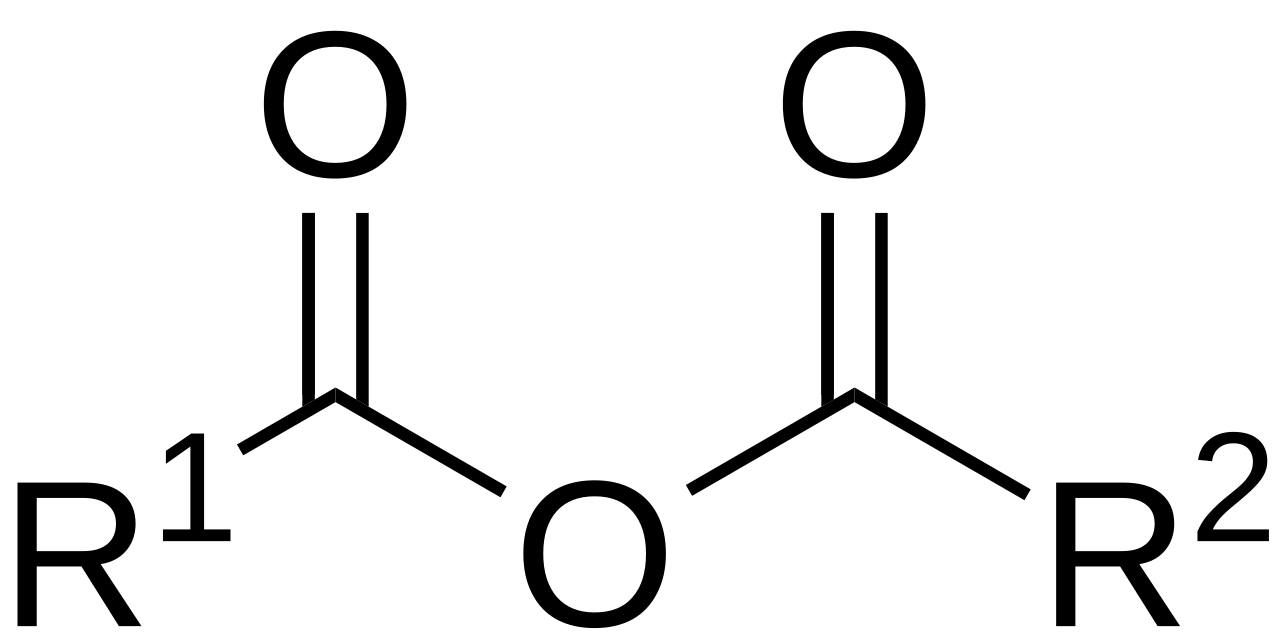
How are symmetrical acid anhydrides named?
the carboxylic acid it was formed from
anhydride
e.g. ethanoic anhydride
How are unsymmetrical acid anhydrides named?
named by naming each component carboxylic acid in alphabetical order followed by anhydride e.g. ethanoic propanoic anhydride
What do acid anhydrides form when reacted with water?
constituent carboxylic acids
What do acid anhydrides form when reacted with alcohols?
ester + carboxylic acid
What is the functional group of an ester?
-COO-
How are esters named?
alkyl group (from alcohol)
carboxylate (from carboxylic acid)
What are the three ways to form esters?
carboxylic acid + alcohol
acid anhydride + alcohol
acyl chloride + alcohol
How are esters formed from carboxylic acids and alcohols?
carboxylic acid + alcohol —> ester + water
warm
conc H2SO4
reversible
How are esters formed from acid anhydrides and alcohols?
acid anhydride + alcohol —> ester + carboxylic acid
not reversible
How are esters form from acyl chlorides and alcohols?
acyl chloride + alcohol —> ester + hydrogen chloride
not reversible
How are phenolic esters formed?
using acyl chlorides and acid anhydrides
What is hydrolysis?
the splitting of a bond or the chemical breakdown of a molecule using water
What are the two ways esters can be hydrolysed?
acid-catalysed hydrolysis
base-catalysed hydrolysis
What are the conditions needed for acid-catalysed hydrolysis?
heat under reflux with dilute sulfuric acid or dilute hydrochloric acid
What is formed from acid-catalysed hydrolysis?
ester + water + H+ —> carboxylic acid + alcohol
What are the conditions needed for base-catalysed hydrolysis?
heat under reflux with dilute sodium hydroxide solution
What is formed from base-catalysed hydrolysis?
ester + sodium hydroxide —> sodium carboxylate (salt of the carboxylic acid) + alcohol
What is the structure of acyl chloride?
Aldehyde with H substituted for Cl
How are acyl chlorides prepared?
carboxylic acid + sulfur dichloride oxide —> acyl chloride + sulphur dioxide + hydrogen chloride
What is the formula for sulfur dichloride oxide?
SOCl2
Why must acyl chlorides be formed in anhydrous conditions?
so they cannot react with water readily
Why must formation of acyl chlorides be carried out in a fume cupboard?
HCl gas = corrosive + toxic
SO2 gas = toxic
Why are acyl chlorides important in organic synthesis?
intermediates in organic synthesis
very reactive
can be used to make many compounds
What type of reactions do acyl chlorides undergo?
nucleophilic elimination
How do acyl chlorides form carboxylic acids?
when reacted with water
acyl chloride + water —> carboxylic acid + HCl
What would you observe in the formation of carboxylic acids from acyl chlorides?
steamy HCl fumes
How can acyl chlorides be used to form esters?
acyl chloride + alcohol —> ester + HCl
Why are acyl chlorides better for synthesis of esters than carboxylic acids?
no catalyst needed
reacts with phenol -forms phenyl esters
How are acyl chlorides used to form primary amides?
acyl chloride + NH3 —> primary amide + NH4Cl
(NH3 + HCl —> NH4Cl)
gets rid of HCl as base present
How are acyl chlorides used to form secondary amides?
acyl chloride + primary amide —> secondary amide + chloroamide
What is the mechanism for the reaction between ammonia and an acyl chloride?

What type of monomers undergoes addition polymerisation?
alkenes
What is addition polymerisation?
formation of a very long chain by repeated addition reactions of many unsaturated alkene molecules
Why are addition polymers unreactive?
strong, non-polar, single covalent bonds throughout
Why is it difficult to dispose of addition polymers?
unreactive
non-biodegradable
produce toxic gasses when burnt
What is a polymer?
a large molecule formed from many thousands of repeat units of smaller molecules known as monomers
What is a monomer?
a small molecule that combines with many other monomers to form a polymer
What is a condensation reaction?
a reaction in which two small molecules react together to form a larger molecule with elimination of a small molecule such as water or hydrogen
What are the two types of condensation polymers?
polyesters
polyamides
What are polyesters?
monomers are joined together by ester linkages
formed by reaction of a carboxylic functional group and an alcohol functional group
What are the key characteristics of addition polymerisation?
one monomer
one functional group (C=C)
addition reaction - only one product
long chain molecules involving a unit repeated many times
What are the key characteristics of condensation polymerisation?
one or two types of monomer
two different functional groups (OH and COOH)
condensation reaction - polymer + water
long chain molecules involving a unit repeated many times
What is hydrolysis?
breaking of a covalent bond with a water molecule
What are the conditions needed for hydrolysis of a polymer?
aqueous acid or aqueous alkali
heat
What are the two types of hydrolysis of polymers?
acid hydrolysis
base hydrolysis
What does the acid hydrolysis of polyesters form?
ester link breaks to form a hydroxyl group and carboxylic acid
What does the base hydrolysis of polyesters form?
ester link breaks to form a hydroxyl group and the salt of a carboxylic acid