Basics of Biomolecular Structure Prediction
 Call Kai
 Learn
 Practice Test
 Spaced Repetition
 Match
 Flashcards
 Knowt Play
1/21

There's no tags or description
Looks like no tags are added yet.
22 Terms
Enzyme: Matrix Metalloproteinase-2
Involved in connective tissue turnover
Expressed in mesenchymal cells during development and tissue regeneration degrade collagen – hence known as collagenase
G4 binding small molecules to stabilize G4 folding and prevention of diseases:
Folding of the overhang into a G-quadruplex structure inhibits telomere elongation by telomerase.
Given the fact that telomerase is overexpressed in a majority of human cancer cells, it has emerged as a potential target in the development of anti-cancer drugs.
Stabilization of G4 by ligand

c-MYC
a proto-oncogene and DHX36 inhibitors exhibit potent antiproliferative activity in breast, cervical, and lung cancer cells
DHX36
a helicase that unwinds G-quadruplex (G4) structures in promoter region of c-MYC, aiding transcription of c-MYC
KRAS (Kirsten Rat Sarcoma Virus Proto-oncogene)
a gene, encodes a small GTPase protein (K-Ras) that acts as a fundamental molecular "on/off" switch regulating cell growth, division, and survival
The KRAS promoter:
contains a G-rich sequence that folds into a G-quadruplex structure
Myc-associated Zinc Finger (MAZ) Protein
A transcriptional activator for KRAS.
It unwinds G4 structures at the KRAS promoter.
Critical in pancreatic ductal adenocarcinoma.
Researchers have developed synthetic G4-decoys:
mimick the KRAS G4 loop/motif, to trap MAZ and block it from binding the native KRAS promoter
Top-stacking
DHX36
Loop-binding:
Zinc finger proteins
Groove-binding:
telomeric end-binding protein
POT1 (Protection of Telomeres 1)
Contains highly conserved oligonucleotide/oligosaccharide-binding (OB) folds responsible for recognizing and nesting inside the grooves and loops of single-stranded telomeric G4 structures
Human POT1 binds directly to the single-stranded 3' overhang portions of telomeres (composed of repeated TTAGGG sequences) to protect chromosome ends from being recognized as damaged DNA

Enabling telomerase activity
By unfolding these intramolecular G-quadruplexes, POT1 frees up the 3' end of the telomere, allowing human telomerase to properly access and elongate the chromosome ends
OB Fold
Five-stranded β-sheet coiled to form a closed β-barrel, capped by an α-helix located at one end and a binding cleft at the other

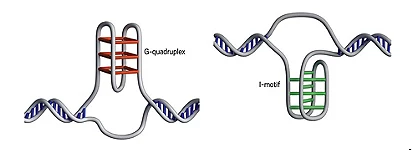
Human telomeric i-Motifs (Intercalated Motif)
Cytosine rich
These structures are highly dynamic and responsive to changes in the cell. They readily transition between folded and unfolded states based on local downregulations in pH, molecular crowding, and negative supercoiling stress generated during DNA transcription or replication.
I-motif alongside G-quadruplexes, can sterically hinder or inhibit the activity and processivity of telomerase
In cancer therapeutics, artificial stabilization of telomeric i-motifs can bypass tumor-associated telomerase activity, forcing immortalized cancer cells to hit their division limits, trigger senescence, and undergo programmed cell death (anti-cancer activity)
Telomere shortening is a classic hallmark of biological aging and cellular senescence. Because i-motif structures offer protective folding to telomeric ends
The protein folding problem: the most important unsolved problem in structural biochemistry:
The problem consists of 3 related puzzles
what is the physical folding code?
what is the folding mechanism?
Can we predict the 3D structure from the amino acid sequences of proteins?
Levinthal Paradox (Theoretical Calculation), 1969
If random search would take longer than the age of the universe, how do proteins fold so quickly?
Levinthal's paradox is a fundamental puzzle in molecular biology stating that a protein cannot find its functional three-dimensional shape by randomly searching through every possible conformation because it would take longer than the age of the universe, yet real proteins fold into their native states in milliseconds or seconds.
Thermodynamics Hypothesis
The information determining the tertiary structure of a protein resides in the chemistry of its amino acid sequence.
Renaturation of Ribonuclease.
Native structure of protein is solely determined by its sequence.
The native folded state is the lowest free-energy state under physiological conditions.

Machine learning methods can help identify complex relationships (or patterns) in large datasets, enabling prediction of protein structures:
AlphaFold uses deep neural network, which contains many layers of interconnected nodes.
This is why this approach is referred to as a “deep learning” algorithm
The system learns patterns from thousands of known protein structures and uses this knowledge to predict how a new protein will fold
AlphaFold
analyze protein sequences (PS)
compares them with evolutionary information
eg., if position 45 changes when position 120 changes, those residues may be close in the folded protein
predicts distances and angles between amino acids
builds a 3D protein structure

5 random seeds generate 5 different starting unfolded conformations:
5 different predicted structure ranked:
pTM: predicted template modeling
Confidence in overall fold
ipTM: interface predicted template modeling
Confidence in the interface between the molecules
Penalties (from atomic clashes)
Adjustment for disorders
These parameters are mathematically combined to determine the model rank!

AlphFold3 Model Scores
pTM: how close it is to original structure
Score > 0.5 - the overall predicted fold for the complex might be similar to the true structure
ipTM: accuracy of the predicted relative positions of the subunits within the complex
>0.8 represent high-quality; 0.6 and 0.8 could be correct or incorrect; <0.6 suggest failure
PAE (Predicted Aligned Error)
Level of confidence in relative position of 2 residues
Indicates if the packing or relative position of domain is accurate
Value in Angstrom, lower being better ie., smaller difference between predicted and true structure
