Lecture 4: Counselling for SINGLE gene disorders
 Call Kai
 Learn
Learn Practice Test
 Spaced Repetition
 Match
Match Flashcards
 Knowt Play
1/22

Earn XP
Description and Tags
Focus on PEDIGREE (Counselling with Saj)
Name | Mastery | Learn | Test | Matching | Spaced | Call with Kai | Chat |
|---|
No analytics yet
Send a link to your students to track their progress
23 Terms
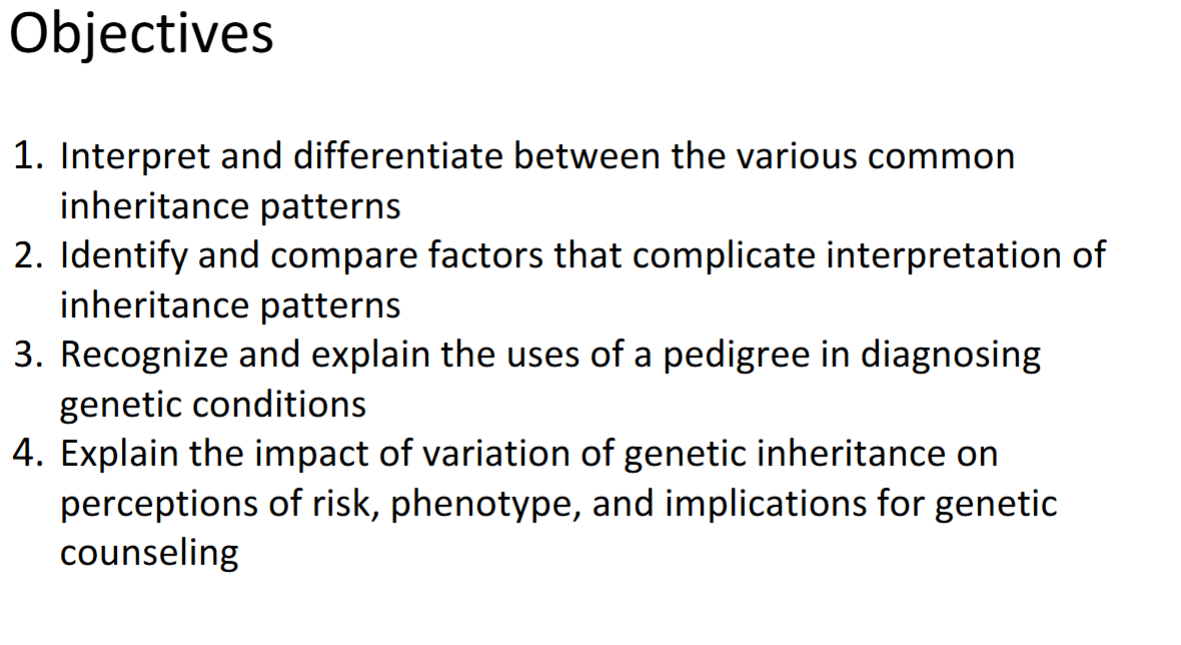
Objective 4 (Explain the impact of variation of genetic inheritance on perceptions of risk, phenotype, and implications for genetic counseling)
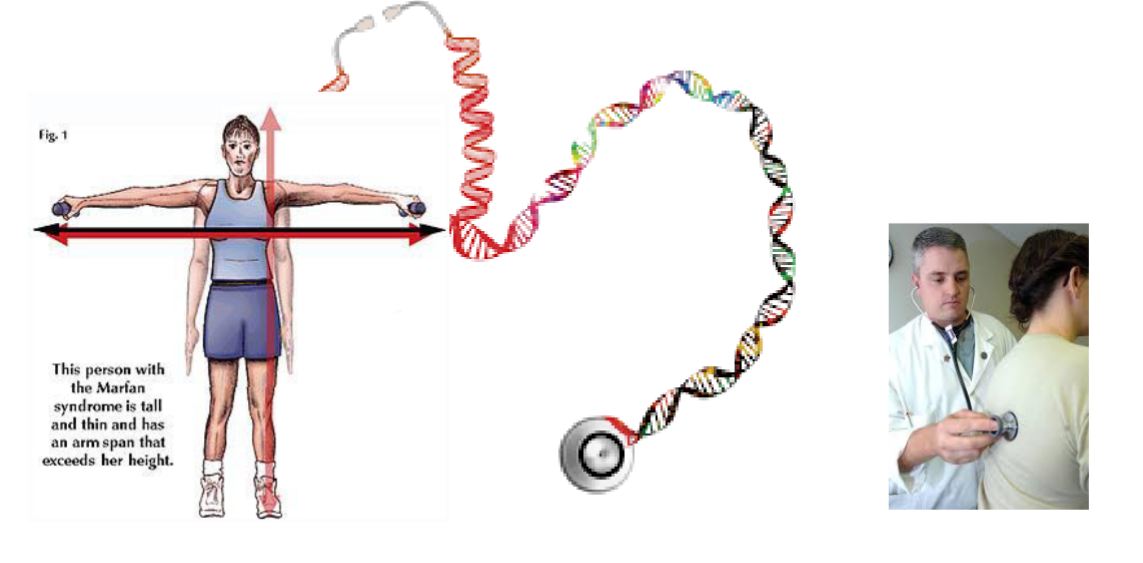
Diff genetic variants result in different dysmorphic features eg. marfan syndrome = long limbs
we all have a little bit of dysmorphic features
Variation in genetic inheritance—ranging from single-gene Mendelian mutations with high penetrance to polygenic risk scores with cumulative small effects—directly alters how physical traits or diseases manifest, how individuals interpret personal vulnerability, and how clinicians guide medical decisions
Objective 4 (Explain the impact of variation of genetic inheritance on perceptions of risk, phenotype, and implications for genetic counseling)
How does a medical geneticist/doctors role vs. a Genetic counsellors role differ when it comes to looking at genetic variations and inheritance
Medical geneticist/doctor
CORELATES signs and symptoms (eg. dysmorphic features - we all have a little bit) with the Genetic results given
Counsellors
Looks at FAMILY HISTORY, advise + coordinates tests and give psychological support
Objective 3 (Recognize and explain the uses of a pedigree in diagnosing genetic conditions)
What is a challenge with pedigrees in counselling/real life with humans that is not present in the lab
Inaccurate, falsified or incomplete family history provided by patients.
In the lab you can breed enough generations to give a lot of info on the exact inheritance pattern
eg. it is easy to see the different features of the different types of mendelian inheritance in the lab

Know the basics of reading a pedigree
****Objective 1 (Interpret and differentiate between the various common inheritance patterns)
WHAT ARE THE FIRST 2 most important QUESTIONS to ask when looking at a pedigree?
Are the parents affected?
If YES= likely DOM
If NO = likely RECESSIVE
Are there SEX EFFECTS? aka are the sexes equally affected?
Who passed it on and what gender is effected

****what type of inheritance pattern is this pedigree and why? aka What are all the different characteristics/hallmarks of this form of inheritance (hint 3)
remember these are all mendelian/ single gene diseases
AUTOSOMAL DOMINANT
Characteristics
Multiple generations affects (= likely Dom)
M + F equally likely affected
Male to male transmission occurs (rules out x linked = no male → male)
Each offspring of an affected parent (AUTO DOM disorder) has a _____% chance of being affected
50%

****what type of inheritance pattern is this pedigree and why? aka What are all the different characteristics of this form of inheritance
remember these are all mendelian/ single gene diseases
AUTO RECESSIVE
NO affected parent = likely recessive
Skips generations
Greatest recurrence risk is among siblings of affected individuals
Male and females equally likely to be infected (not X linked)
Objective 2 (Identify and compare factors that complicate interpretation of inheritance patterns)
What are some things that can complicate a recessive pedigree
AKA what do you have to think about/ take into account?
How do these things affect the pedigree/likelihood of a recessive disease?
Carrier status: they carry disease but it is not manifested; can’t tell they’re carrier unless tested = can cause underestimation of likelihood of disease
Consanguinity (inbreeding): Recessive alleles that cause rare diseases are generally uncommon in the public. However, because relatives share a recent common ancestor, they are much more likely to carry the exact same rare recessive mutation.
Increases the probability of disease and can make a recessive disease look dominant
Ethnicity: recessive alleles are found at a much higher frequency within specific ethnic groups or geographically isolated populations - This is usually due to historical factors like the founder effect or genetic isolation (marrying within the same culture or community).
Increases the carrier risk of a group = increases likely probability of disease = can make a recessive disease look dominant
In Auto Recessive disorders: If both parents are carriers of a mutation in the same gene each pregnancy has a ___% chance of inheriting both normal genes, ___% of being a carrier (inheriting 1) and ___% chance of inheriting both gene + becoming affected
25% chance of inheriting both normal genes, 50% of being a carrier (inheriting 1) and 25% chance of inheriting both gene + becoming affected
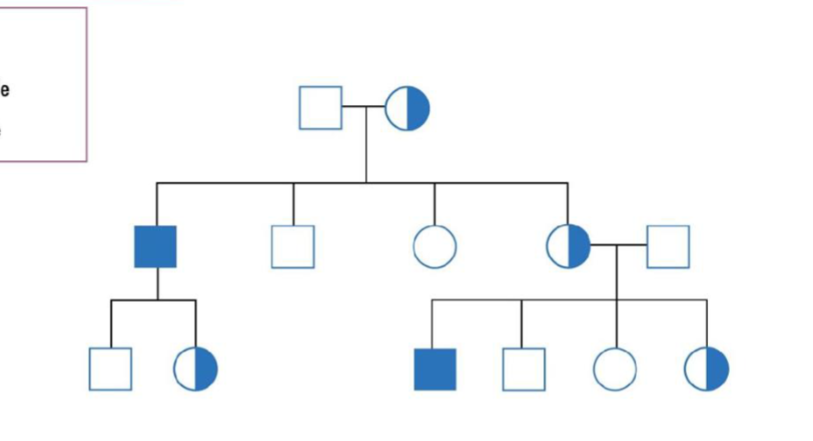
****what type of inheritance pattern is this pedigree and why? aka What are all the different characteristics of this form of inheritance
remember these are all mendelian/ single gene diseases
X- LINKED RECESSIVE
More common in men
All daughters of affected men are carriers
Conditions is never transmitted father to son
In X linked recessive disorders: Sons of carrier females have ___% chance of being unaffected. Daughters of carrier females have a 50% of being a _____ (carrier/affected)
Sons of carrier females have 50 % chance of being unaffected. Daughters of carrier females have a 50% of being a CARRIER

*******what type of inheritance pattern is this pedigree and why? aka What are all the different characteristics of this form of inheritance
remember these are all mendelian/ single gene diseases
MITOCHONDRIAL inheritance = Complicates pedigree
Inherited from MOTHER ONLY
All offspring of an affected or carrier female are at risk of being affected
All daughters of an affected or carrier or female are at risk of transmitting condition
Affected males cannot pass condition on


*******what type of inheritance pattern is this pedigree most likely and why?
If we go by OCCAMS RAZOR (Most simple explanation = most likely)
PARENTS NOT AFFECTED = Recessive
classically ¼ chance of being affected (this an INDEPENDENT VARIABLE all children are equally ¼ chance likely of being affected)

*****Lets say in this case it is not a recessive disorder. Lets say that this is a 22q.11 Deletion syndrome (auto Dominant disorder)
What is are the possible explanations?
22q.11 del from unaffected parents = most often (more likely) due to chance/de novo (BUT chance 2X is kinda unlikely)
Father is a GONADAL MOSAIC (not full gonadal mut. cause some children = unaffected)
Extreme Variable Expressivity: Parent is tested + shows autosomal dom. condition. In this case 22q11.2 deletion has incredibly diverse symptoms.
The parents could be affected and not know
Other “unaffected” children could also have genotype but not present either

How would you figure out if this case was due to GONADAL or AUTOSOMAL genetic mutation?
TEST in this case test the parents to see if they are autosomal or not
hard to test for gonadal
gonadal mosaicism is typically diagnosed by exclusion: if a couple has more than one child with the same dominant 22q11.2 deletion but both parents test completely negative on standard somatic blood work, gonadal mosaicism is deduced.

What is the explanation for this pedigree on BREAST CANCER?
Only females
Seems dominant b/c of infected parents + no generations skipped
can’t be X-linked because males are not affected so must be autosomal
BRCA is an AUTO DOM disorder so why does the pedigree not follow typical mendelian inheritance?
MALEs are less likely to be get specifically breast cancer because of lower amounts of breast tissue = less breast cancer chance
they are still affected by BRCA mutations but they manifest in DIFFERENT DISEASES more often eg. pancreatic cancer + melanoma
On the counter side, if a male does get breast cancer we suspect genetic inheritance (because it is so rare)


****What about this case looking at OVARIAN cancer. why is it female only despite BRCA being auto dom and can be in male populations?
Males DONT HAVE OVARIES = impossible for them to get ovarian cancer
If we look at the FULL MANIFESTATION OF BRCA (aka all the possible diseases it can cause) we notice the FATHER has PROSTATE cancer and passed on the mutation to their daughter which resulted in breast cancer


****Now on this breast cancer tree what is the possible explanation for Skipping a generation despite being an auto dom disorder?
It is possible that is hasn’t happened yet
TAKE INTO CONSIDERATION the AGE: cancer = more common as you age

****What about in this case where the AGE is clearly very old and they still do not have breast cancer. What is the possible explanation for Skipping a generation despite being an auto dom disorder?
NON-PENETRANCE INDIVIDUAL
BRCA only increases your risk of getting cancer. Having the mutation does not automatically mean that you will get cancer 100%
*****Identify and compare factors that complicate interpretation of
inheritance patterns
Mitochondrial diseases: Passing only from mother = messes with typical mendelian expectations
Heteroplasmy: A single cell contains thousands of mitochondria, and a mutation may affect only a portion of them. The ratio of normal to mutated mtDNA varies across different cells and tissues + ratio of mtDNA = Varying severity
GONADAL Mosaicism = may look like a recessive b/c parents are not affected but children are
NON-PENETRANCE and/or BROAD EXPRESSIVITY = just cause someone has the genetic variation does not mean that they will manifest the disease eg. 22q.11 del (so many different forms of the disease)
DOES NOT MANIFEST EQUALLY IN BOTH GENDERS eg. BRCA2 Breast cancer
AGE some diseases develop later in life thus they might not have manifested traits yet = mess with pedigree eg. breast cancer
You can pick the more likely outcome but that doesn’t mean you can rule out the other possibilities
as long as you don’t violate any rules it can all be possible