Ch 8,9 & 17 and 10.6-8 reactions

0.0(0)
Studied by 0 people
call kaiCall Kai
learnLearn
examPractice Test
spaced repetitionSpaced Repetition
heart puzzleMatch
flashcardsFlashcards
GameKnowt Play
Card Sorting

1/59

encourage image

There's no tags or description

Looks like no tags are added yet.

60 Terms

1
New cards

Addition of Halogens ( No Light)

knowt flashcard image
2
New cards
<p>Halohydrins from Akenes</p>

Halohydrins from Akenes

knowt flashcard image
3
New cards
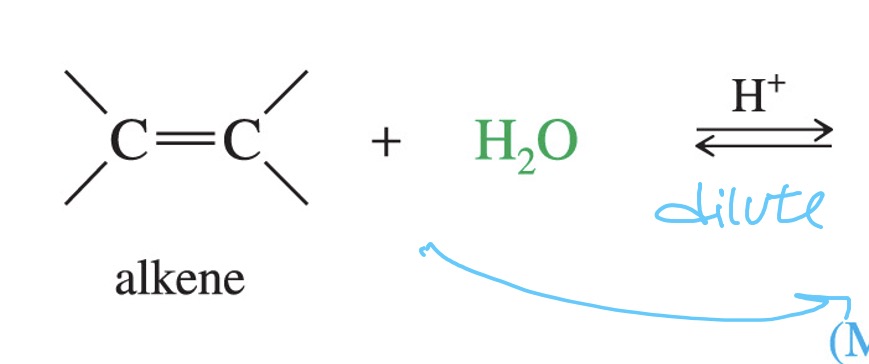
<p>Hydration of Alkenes</p>

Hydration of Alkenes

knowt flashcard image
4
New cards
<p>Allene Hydration- Oxymercuration-Demercuration</p>

Allene Hydration- Oxymercuration-Demercuration

Milder, so no rearrangement and markovnikov. 2 STEPS

<p>Milder, so no rearrangement and markovnikov. 2 STEPS</p>
5
New cards
<p>Hydroboration of Alkenes</p>

Hydroboration of Alkenes

Syn! Peroxide bonds leads to anti-markovnikov

<p>Syn! Peroxide bonds leads to anti-markovnikov</p>
6
New cards
<p>Catalytic Hydrogenation of Alkenes</p>

Catalytic Hydrogenation of Alkenes

Catalyst include: Pd, Pt, Ni (Pd/C in ethanol). Syn bc both H will add at the same time

<p>Catalyst include: Pd, Pt, Ni (Pd/C in ethanol). Syn bc both H will add at the same time</p>
7
New cards
<p>Epoxidation</p>

Epoxidation

Most common Peroxyacid used is MCPBA. Recognize the peroxyacid

O

||

(R-C-O-O-H)

Or instead of MCPBA, we use Cl2/H2O

<p>Most common Peroxyacid used is MCPBA. Recognize the peroxyacid </p><p>     O</p><p>     ||</p><p>(R-C-O-O-H)</p><p>Or instead of MCPBA, we use Cl2/H2O</p>
8
New cards
<p>Alkene Oxidation-Halohydrins</p>

Alkene Oxidation-Halohydrins

Using Cl2/H2O rather than MCPBA

<p>Using Cl2/H2O rather than MCPBA</p>
9
New cards
<p>Opening the epoxide ring</p>

Opening the epoxide ring

Anti-diol is formed
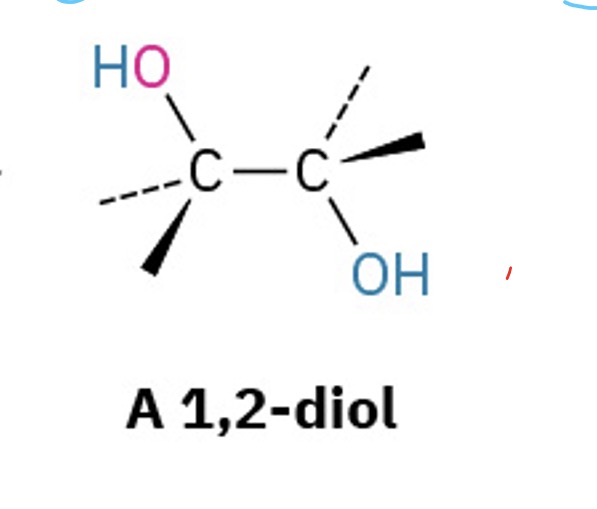
<p>Anti-diol is formed</p>
10
New cards
<p>Syn Hydroxylation of Alkenes</p>

Syn Hydroxylation of Alkenes

Either OsO4 or Cold, dilute KMnO4 in base

<p>Either OsO4 or Cold, dilute KMnO4 in base</p>
11
New cards
<p>Oxidative Cleavage of Alkenes: Ozonolysis</p>

Oxidative Cleavage of Alkenes: Ozonolysis

Break double bind to produce aldehydes and ketones. Instead of (CH3)2S, Zn, H3O+

<p>Break double bind to produce aldehydes and ketones. Instead of (CH3)2S, Zn, H3O+</p>
12
New cards
<p>Oxidative Cleavafe of Alkenes: Warm, Concentrated KMnO4</p>

Oxidative Cleavafe of Alkenes: Warm, Concentrated KMnO4

Ketone and Acid. No aldehyde as the H is replaced by OH.


<p>Ketone and Acid. No aldehyde as the H is replaced by OH. </p><p></p>
13
New cards
<p>Oxidative Cleavage with Warm, Conc KMnO4 but with a base!</p>

Oxidative Cleavage with Warm, Conc KMnO4 but with a base!

Same as with acid, but needs an extra step to protonate

<p>Same as with acid, but needs an extra step to protonate </p>
14
New cards
<p>Alkene Oxidation- Cyclic Periodate intermediate </p>

Alkene Oxidation- Cyclic Periodate intermediate

Needs to be Syndiol, but also works with free rotation

<p>Needs to be Syndiol, but also works with free rotation</p>
15
New cards
<p>Addition of Carbenes</p>

Addition of Carbenes

Several methods!

<p>Several methods!</p>
16
New cards
<p>Method 1: Diazomethane</p>

Method 1: Diazomethane

knowt flashcard image
17
New cards
<p>Simmons-Smith Reaction</p>

Simmons-Smith Reaction

knowt flashcard image
18
New cards
<p>Method 3: Dichlorocarbene or with any halogen</p>

Method 3: Dichlorocarbene or with any halogen

knowt flashcard image
19
New cards
<p>Reagents for Elimination </p>

Reagents for Elimination

KOH at 200 C favors an internal Alkyne. NaNH2 150C favors a terminal alkyne

<p>KOH at 200 C favors an internal Alkyne. NaNH2 150C favors a terminal alkyne</p>
20
New cards
<p>Dihalide Elimination Reactions</p>

Dihalide Elimination Reactions

With KOH

<p>With KOH</p>
21
New cards
<p>NaNH2 Elimination</p>

NaNH2 Elimination

1st equiv of HX adds to Alkyns to form vinyl halide

2nd equiv of HX added same orientation, the product is seminal

Markovnikov

<p>1st equiv of HX adds to Alkyns to form vinyl halide</p><p>2nd equiv of HX added same orientation, the product is seminal</p><p>Markovnikov</p>
22
New cards
<p>Addition of HX</p>

Addition of HX

1st equiv of HX adds to Alkyns to form vinyl halide

2nd equiv of HX added same orientation, the product is seminal

Marknokinov

If internal asymmetrical, get a mix of product

<p>1st equiv of HX adds to Alkyns to form vinyl halide</p><p>2nd equiv of HX added same orientation, the product is seminal</p><p>Marknokinov</p><p>If internal asymmetrical, get a mix of product</p>
23
New cards
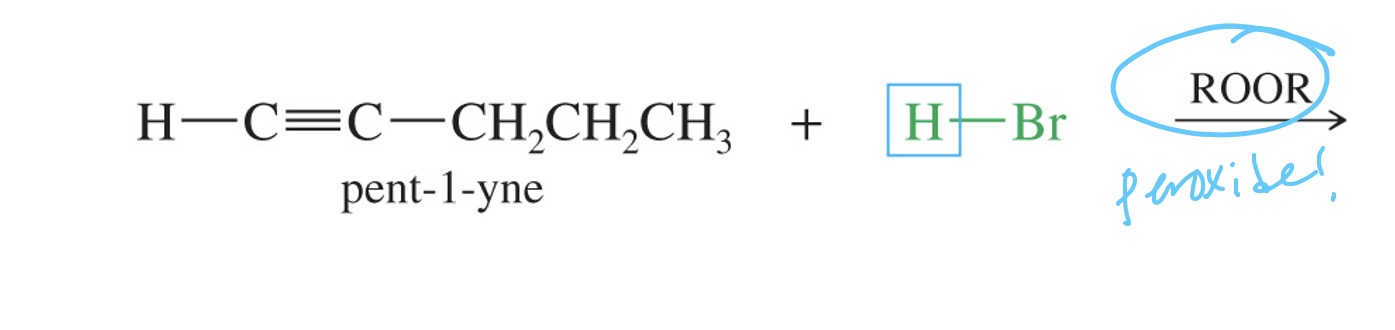
<p>Anti-mark addition to Alkynes</p>

Anti-mark addition to Alkynes

Uses peroxide, bromide added to terminal bc anti mark as less sub

<p>Uses peroxide, bromide added to terminal bc anti mark as less sub</p>
24
New cards
<p>Halogens upon of Alkynes</p>

Halogens upon of Alkynes

Cl2 and Br2 to Alkynes to form vinyl dihalides (mix of product syn and anti)

<p>Cl2 and Br2 to Alkynes to form vinyl dihalides (mix of product syn and anti)</p>
25
New cards
<p>Addition of 2nd Mole of Halogen</p>

Addition of 2nd Mole of Halogen

Forms a tetrahalide

<p>Forms a tetrahalide</p>
26
New cards
<p>Mercuric Ion-Catalyzed Hydration</p>

Mercuric Ion-Catalyzed Hydration

Found an intermediate vinyl alcohol (evil) that quicly tautomerizes to the more stable ketone or aldehyde

<p>Found an intermediate vinyl alcohol (evil) that quicly tautomerizes to the more stable ketone or aldehyde</p>
27
New cards
<p>Mercury(III)-Catalyzed Hydration of Alkynes- Internal vs Terminal</p>

Mercury(III)-Catalyzed Hydration of Alkynes- Internal vs Terminal

knowt flashcard image
28
New cards
<p>Hydroboration-Oxidation reaction</p>

Hydroboration-Oxidation reaction

Anti-Markovnikov, as hindered alkyl borane wont go to bulky areas


<p>Anti-Markovnikov, as hindered alkyl borane wont go to bulky areas</p><p></p>
29
New cards
<p></p>


Recognize the terminal alkyne

<p>Recognize the terminal alkyne</p>
30
New cards
<p>Catalytic Hydrogenation of Alkynes</p>

Catalytic Hydrogenation of Alkynes

Goes straight to Alkane. Catalyst: Pd,Pt, or Ni (Pd/C in ethanol)

<p>Goes straight to Alkane. Catalyst: Pd,Pt, or Ni (Pd/C in ethanol)</p>
31
New cards
<p>Lindlar’s Caralyst </p>

Lindlar’s Caralyst

Partially deactivated, where goes to Alkene rather than straight into alkane. Can just say H2/Lindlar’s for simplicity. product is Cis. Ni2,B,H2 accomplished thr same rxn

<p>Partially deactivated, where goes to Alkene rather than straight into alkane. Can just say H2/Lindlar’s for simplicity. product is Cis. Ni2,B,H2 accomplished thr same rxn</p>
32
New cards
<p>Reduction of Alkynes with Metal Ammonia</p>

Reduction of Alkynes with Metal Ammonia

Trans. Li and K are also acceptable reagents. Cannot react with NaNH2: NO REACTION. Have to use Na/NH3. Na+ not the same as Na.

<p>Trans. Li and K are also acceptable reagents. Cannot react with NaNH2: NO REACTION. Have to use Na/NH3. Na+ not the same as Na.</p>
33
New cards
<p>Oxidation of Alkynes</p>

Oxidation of Alkynes

The intermediate will two water molecules to produce the diketone. In COLD KMnO4 and Diluted.

<p>The intermediate will two water molecules to produce the diketone. In COLD KMnO4 and Diluted.</p>
34
New cards
<p>Permanganate Oxidation of Alkynes to Carboxylic Acids</p>

Permanganate Oxidation of Alkynes to Carboxylic Acids

Warm, KMnO4 and concentrated. In basic conditions. Orange is final product.

<p>Warm, KMnO4 and concentrated. In basic conditions. Orange is final product. </p>
35
New cards
<p>Ozonolysis</p>

Ozonolysis

knowt flashcard image
36
New cards
term image

Recognize which leads to identical and which leads to Co2

<p>Recognize which leads to identical and which leads to Co2</p>
37
New cards
<p>Alkoxide ion: addition to carbonyl compounds</p>

Alkoxide ion: addition to carbonyl compounds

knowt flashcard image
38
New cards

Alkoxides

Conjugate base of alcohol.

Alcohol reacts with metal (K, Na, MgBr)

<p>Conjugate base of alcohol.</p><p>Alcohol reacts with metal (K, Na, MgBr)</p>
39
New cards
<p>Synthesis of Alcohols</p>

Synthesis of Alcohols

My nucleophilic substitution (SN2 usually)

<p>My nucleophilic substitution (SN2 usually)</p>
40
New cards

Reduction of Carbonyl

Reduction of Aldehyde yields primary alcohol

reduction of Ketone yields secondary alchohol

[H]/Add hydrogen

Make sure octet rule is followed

<p>Reduction of Aldehyde yields primary alcohol</p><p>reduction of Ketone yields secondary alchohol</p><p>[H]/Add hydrogen</p><p>Make sure octet rule is followed </p>
41
New cards
<p>Reductions of Aldehyes and Ketones</p>

Reductions of Aldehyes and Ketones

knowt flashcard image
42
New cards
term image
knowt flashcard image
43
New cards
<p>NaBH4 </p>

NaBH4

A source is hydrides

Only reacts with aldehydes or ketones NOT esters or carboxylic acids

<p>A source is hydrides</p><p>Only reacts with aldehydes or ketones NOT esters or carboxylic acids</p>
44
New cards
<p>LiALH4</p>

LiALH4

Another source is hydride

Reduces Ketones and aldehyde to corresponding alcohol

Conveys esters and carboxylic acids to primary alcohol

<p>Another source is hydride </p><p>Reduces Ketones and aldehyde to corresponding alcohol</p><p>Conveys esters and carboxylic acids to primary alcohol </p>
45
New cards
<p>Alcohol Prep with Grignard Reagents</p>

Alcohol Prep with Grignard Reagents

knowt flashcard image
46
New cards
<p>Grignard Reactions with Acid Chloride and Esters</p>

Grignard Reactions with Acid Chloride and Esters

intermediate is a ketone

<p>intermediate is a ketone </p>
47
New cards
<p>Addition to Ethylene Oxide</p>

Addition to Ethylene Oxide

Grignard and Lithium reagents will attack epoxides to open them to form alcohols.

Relieves ring strain

<p>Grignard and Lithium reagents will attack epoxides to open them to form alcohols.</p><p>Relieves ring strain</p>
48
New cards
<p>Formation of Ethers </p>

Formation of Ethers

Ethers have an SP3 hybridized oxygen with 2 single bonds to carbon

<p>Ethers have an SP3 hybridized oxygen with 2 single bonds to carbon </p>
49
New cards
<p>Williamson Ether synthesis</p>

Williamson Ether synthesis

Only works for primary halide/Tos (secondary and tertiary will lead to elimination)

Only primary or secondary alkoxides (tertiary will eliminate)

Can make either symmetrical or asymmetrical ethers

<p>Only works for primary halide/Tos (secondary and tertiary will lead to elimination)</p><p>Only primary or secondary alkoxides (tertiary will eliminate)</p><p>Can make either symmetrical or asymmetrical ethers </p>
50
New cards
<p>Esterification</p>

Esterification

Esters: carboxylic acid and alcohol (or acid chloride instead of carboxylic acid)

<p>Esters: carboxylic acid and alcohol (or acid chloride instead of carboxylic acid)</p>
51
New cards
<p>Intramolecular Transesterification</p>

Intramolecular Transesterification

knowt flashcard image
52
New cards
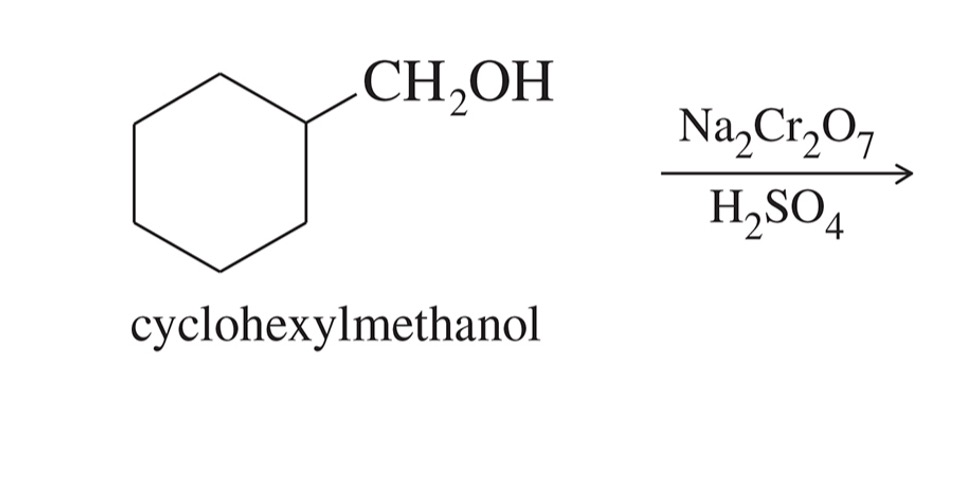
<p>Oxidation of Alcohols</p>

Oxidation of Alcohols

knowt flashcard image
53
New cards
<p>Oxidation of secondary alcohols</p>

Oxidation of secondary alcohols

knowt flashcard image
54
New cards
<p>Swern Oxidation</p>

Swern Oxidation

The ketone is main product

<p>The ketone is main product </p>
55
New cards
<p>Dess-Martin oxidation</p>

Dess-Martin oxidation

knowt flashcard image
56
New cards
<p>Oxidation of primary alcohol to carboxylic acids</p>

Oxidation of primary alcohol to carboxylic acids

Same w CrO3/H2SO4/H2O, KMnO4/H2O, and HNO3, PCC

<p>Same w CrO3/H2SO4/H2O, KMnO4/H2O, and HNO3, PCC</p>
57
New cards
<p>Grignard reagent prep</p>

Grignard reagent prep

knowt flashcard image
58
New cards
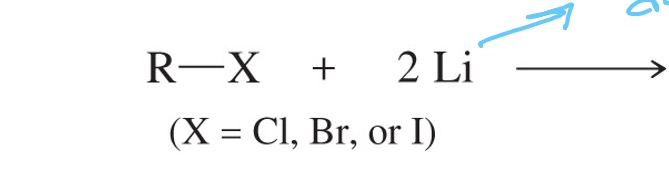
<p>Organolithium</p>

Organolithium

knowt flashcard image
59
New cards
<p>Gilman reagent </p>

Gilman reagent

knowt flashcard image
60
New cards
term image
knowt flashcard image