unit 3 bio test
 Call Kai
 Learn
 Practice Test
 Spaced Repetition
 Match
 Flashcards
 Knowt Play
1/39

There's no tags or description
Looks like no tags are added yet.
40 Terms
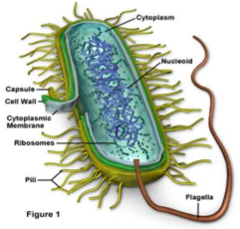
Prokaryotes
Are single-celled organisms that contain:
1. A cell membrane
2. Cytoplasm or cytosol
3. DNA but NO nucleus
4. Ribosomes: molecular machines that produce proteins
5. Does not contain organelles *
All are UNICELLULAR and carry out all of life processes
all bacteria (Archaebacteria or Eubacteria)

Eukaryotes
Usually larger and more complex (up to 10x wider and 1000x greater in volume)
- Genetic material is inside a nucleus
- Contains many internal structures & membranes (specialized organelles)
- Great variety! Examples include unicellular protists, algae, multicellular animals, fungi, plants
Endosymbiotic Hypothesis
Explains How Eukaryotic Cells Evolved from Prokaryotic Cells ~1.5 billion years ago
Steps to Endosymbiotic Hypothesis
- Simple Prokaryotic Cells acted as "Ancestral Prokaryote"
- Engulfed other Prokaryotic Cells
- Not destroyed or digested
- Both cells benefited, partnership (symbiosis)
- Plasma membrane folded in=nucleus
- Larger cell provided protection, and the smaller cells helped produce energy (mitochondria) or conduct - photosynthesis (chloroplasts).
- Became organelles
mitochondria and chloroplasts
What are the organelles in the Endosymbiotic Hypothesis
Nucleus
Function: Contains the cell's DNA and all instructions for making proteins
Structure: 3 Parts:
- Nuclear envelope
- Chromatin and Chromosomes
- Nucleolus
Nuclear envelope
Function: allow things in and out of the nucleus
Structure: 2 layers of membrane, cover the nucleus, contain small pores (or holes)
Chromatin and Chromosomes
Function: Heredity
Structure: Made of DNA material
Nucleolus
Function: makes ribosomes
Structure: Small, dense core
Cytoplasm
Function: provides structure to the cell
Structure: is the gelatinous liquid that fills the inside of a cell
Cell Membrane
Function: found in all cells and separates the interior of the cell from the outside environment=allows things in and out of cell
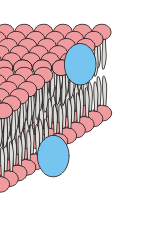
Structure: Made of a phospholipid bilayer
Cytoskeleton
Function:
- Forms the structure of a cell
- Organizes the interior of a cell
- Gives shape to cells without cell walls (like animal cells)
Structure: a network of protein cylinders and filaments
Ribosomes
Function: Make proteins
Structure:
- Made of RNA (rRNA)
- Found in the cytoplasm and the endoplasmic reticulum (rough ER)
Rough ER
Function: Protein synthesis, folding, transport
Structure: Contains ribosomes
Smooth ER
Function: Make lipids and hormones that help detoxify substances particularly drugs and alcohol
Structure: No Ribosomes
Golgi Apparatus
Function: Modifies, sorts, and packages molecules
Structure: Stack of membranes
Lysosomes
Function: The garbage and recycling center of the cell
Structure: Small sacs filled with enzymes to breakdown/recycle molecules
Vacuoles
Function: stores water, salts proteins and carbohydrates
Structure: Sac-like structure
- Plant cells have a single large one to store water
- Animal cells have smaller ones that assist with waste disposal
Mitochondria
Function: Convert chemical energy (food) into energy that can be used by cell (ATP)
in a process called cellular respiration
Structure: Surrounded by a double membrane and has its own circular DNA!
Chloroplasts
Function: capture energy from sunlight and convert it to food via photosynthesis
Structure: Found only plants and algae only and has its own DNA
- Contain chlorophyll
Cell Wall
Function: structural support and protection
Structure: Found only in plants and some prokaryotes
Cell membrane
Function:
- Regulates what enters and leave the cell
- Provides protection and support
Structure:
- Phospholipid Bilayer
- 2 layers of phospholipids
- Hydrophobic tails
- Hydrophilic Heads

Phospholipids
Maintains structural integrity

Cholesterol
Acts as a buffer and stabilizes the membrane
Peripheral proteins
Connecting points for the cytoskeleton and help transmit signals that come from outside the cell

Integral proteins
Serve as transport channels or pumps

Glycoproteins and glycolipids
Identification and cell-cell recognition
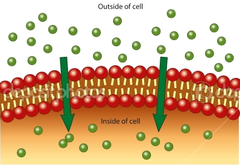
Passive Transport
- Moving Without Energy
- Movement of substances across the cell membrane without using energy from the cell.
- Examples: Diffusion, and Osmosis (special case of diffusion involving water)

Diffusion
- Small, nonpolar and some water
- Molecules can pass between phospholipids
Molecules move from areas of high concentration to areas of low concentration
- Move until concentration of molecules are equal = equilibrium
- Does NOT require any energy=PASSIVE

Osmosis
- Diffusion of water across a selectively permeable membrane
- Some membranes do not allow molecules to pass across = selectively permeable
- Water can move to help equalize the concentration if the molecules can't move
- Water moves from High to Low concentration
- Does not require energy = passive

Facilitated Diffusion
- Molecules move with the help of a carrier protein across the membrane
Types:
- Movement is from high to low concentration
- No energy is needed

Active transport
- Moves molecules from low concentration to high concentration
- Like pushing a rock uphill
- Against the concentration gradient
- Requires energy=ATP
- Usually uses protein pumps in the membrane

Isotonic solution
- Concentration of solutes is equal inside/outside of the cell
- Equal concentration
- Water moves in and out equally
- Cell size remains stable in animal cells; flaccid in plant
hypotonic
- Concentration of solutes is lower outside the cell than inside and water rushes in the cell
- Lower concentration in solution
- Higher concentration in cell
- Water moves in=cell swells
- Cell potentially explodes (lyses)
- In plant cell, cell swells = turgid
hypertonic
- concentration of solutes is higher outside the cell than inside and water rushes out of the cell
- Higher concentration in solution
- Lower concentration in cell
- Water moves out
- Cell shrinks or plasmolysis occurs
Cell Theory: Summary of the basic knowledge of cells
Modern Cell Theory:
1. All living things are made of cells
Cells are the basic unit of life
Can be unicellular or multicellular
2. New cells are made from
existing cells
3 scientists:
- Schleiden: 1838
Cells are basic unit of plants
- Schwann: 1839
Cells are basic unit of animals
- Virchow: 1855
All cells come from the division of pre-existing cells
Describe the cell theory. Include at least 3 scientists that contributed to the cell theory
Fluidity of Membranes
- Membrane fluidity depends on 2 types of fats
- Unsaturated Fats: (1 or more double bonds=kinks and more space) Fluid
- Saturated fats: (lack double bonds=straight and close) = viscous
- Can be altered by temp
Movement of Phospholipids
- Lateral Movement
- Side to Side within same layer
- Occurs often and rapidly
Flip flop
- Moves from one bilayer to the other
- Helped by enzymes: flippases, floppases, and scramblases
Cholesterol
- Acts as a buffer
Stabilize membrane
Fluid Mosaic Model
The cell wall is a rigid outer layer that provides support, protection, and shape to a cell. It is located outside the cell membrane. Is in plants, in fungi,and in bacteria. Animal cells do not have cell walls.
Describe the cell wall, including function, location, and molecular composition in different types of organisms.
Endocytosis
Moving material IN cell
- In folding of the cell membrane
- Phagocytosis: solid particles
- Pinocytosis: liquid particles
Example: Used to internalize nutrients and in gene therapy -
Exocytosis
Moving material OUT of cell
- Out folding of the cell membrane
Examples: Protein hormones like insulin or antibodies, enzymes, glycoproteins and neurotransmitters (chemical messengers in nerve cells)