Physio B Lab - Exam 2
 Call Kai
 Learn
 Practice Test
 Spaced Repetition
 Match
 Flashcards
 Knowt Play
1/93

There's no tags or description
Looks like no tags are added yet.
94 Terms

what does this photo show?
patent foramen ovale (PFO)

what does this photo show?
subcostal 4 chamber view

what is this image?
Parasternal Long Axis (PLAX) View

pericardial effusion

Parasternal Short Axis (PSAX) View w/
Mitral Valve (fish mouth)

Bicuspid Aortic Valve (BAV)

Apical 4 Chamber (A4C) View

Parasternal Short Axis (PSAX) View w/
Aortic Valve (Mercedes Benz sign)
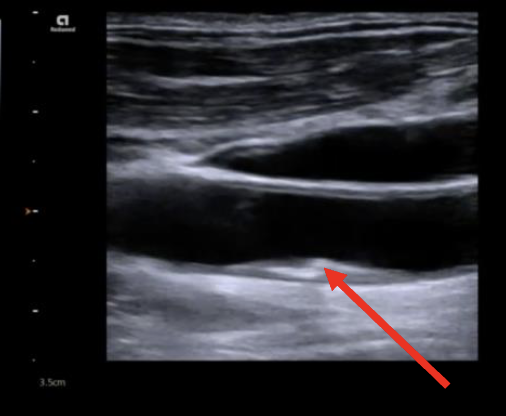
Atherosclerotic Plaque

Pericardial Effusion in
Subcostal 4 Chamber View

Pleural Effusion in
Parasternal Long Axis View

subcostal 4 chamber view
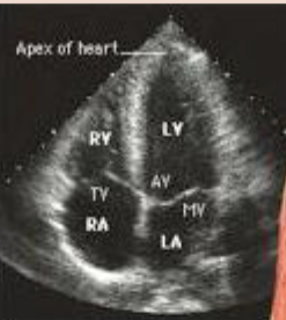
apical 4 chamber view

parasternal short axis view -PSAX fish mouth

parasternal long axis view
normal axis
all leads positive
right axis deviation
lead I - negative, Lead II and III - positive
right axis deviation can mean…
normal in children or tall and thin adults; or a thoracic/spinal deformity, or enlarged heart
left axis deviation can mean…
normal in short stocky people; emphysema, hyperkalemia, tricuspid atresia
left axis deviation
lead I - positive, lead II and III - negative
PR interval
beginning of P wave to beginning of QRS complex

normal range for pr interval (range and num boxes)
0.12 - 0.20 s; 3-5 small boxes
what does a prolonged pr interval mean
heart block
what does a shortened pr interval mean
reduced ventricular filling/blood flow and reduced cardiac output
korotkoff sounds - 1
faint tapping - systolic pressure
korotkoff sounds - 2
louder, swishing sound
korotkoff sounds - 3
distinct, loud sounds
korotkoff sounds - 4
softer, muffled - diastolic pressure
korotkoff sounds - 5
sound disappears
normal BP (systolic, diastolic)
less than 120; less than 80
elevated BP
120-129; less than 80
high bp - hypertension - stage 1
130-139; 80-89
high bp - hypertension - stage 2
140+; 90+
hypertensive crisis
180+; 120+
problems caused by hypertension
stroke, blood vessel damage, heart attack, heart failure, kidney failure
treatments for hypertension
healthy diet and exercise, diueritics, ace inhibitors, beta blockers, vasodilators
normal patterns during exercise
systolic pressure goes up —> lv wall stretch and stronger pump
diastolic pressure goes down —> arterial vasodilation
abnormal patterns during exercise
systolic pressure fails to increase or decreases with greater workload —> heart disease impairs the contraction
diastolic pressure increases as workload increases —> vessel pressure stays high during diastole
normal respiratory rate
12-20 breaths per minute
pulse/heart rate
60-100 bpm
sp02
97-100%
blood pressure
120/80 mmHg
temperature
98.6 +- 1
cap refill
2 seconds
shallow breaths
slight expansion of chest/abdomen
labored
using accessory muscles, abnormal sounds
central pulse sides
carotid, femoral
peripheral pulse sites
radial, brachial, popliteal, dorsalis pedis, posterior tibial
what peripheral pulse do you check for someone older than 1 yr
radial pulse
what peripheral pulse do you check for someone younger than a year
brachial
thready pulse
weak, rapid
bounding
strong
0 - pulse rating
absent
1+ pulse rating
weak/difficult to palpate
2+ pulse rating
normal
3+ pulse rating
bounding/abnormally strong
pallor
white - vasoconstriction, blood loss, shock, heart attack, fright, anemia
cyanosis
blue/grey - serious impaired oxygenation/perfusion
jaundice
yellow - liver diseases
flushing
red - heart, peripheral vasodilation, late carbon monoxide poisoning
mottled skin
shock states/peripheral pooling
diaphoresis
profuse sweating
wet skin
shock/poisoning, heart, cardiac and diabetic emergencies
extremely dry
severe dehydration/spinal injury
what does a pulse ox below 90% mean
definite hypoxia
levels for distress
none, mild, moderate, severe
how to assess orientation?
PPPT
what do the ABCs stand for?
airway, breathing, circulation
what is the markle test
stand on balls of feet and drop onto heels; pain means a positive sign
normal specific gravity for adult urine
1.005 - 1.030
normal range for eGFR
>90
formula for eGFR
eGFR cr = 142 min (Scr/k1)^a max (Scr/k1)^-1.2 × 0.9938^age * sex
sex multiplier for female and male
f - 1.012; m - 1.000
k value for female and male
f - 0.7
m - 0.9
a value for female and male
f = -0.241
m = -0.302
stage 1 eGFR
>= 90; possible kidney damage with normal kidney function
stage 2 eGFR
60-89; mild loss of kidney function/damage
stage 3a
45-59; mild to moderate loss
stage 3b
30-44; moderate to severe loss
stage 4
15-29; severe loss
stage 5
<15; kidney failure
what does an ecg measure
electrical activity produces a waveform tracing
what does an echo measure
high frequency ultrasound; measures mechanical pumping function + movement of chambers and valves
transthoracic echo
tte
transesophageal echo (TEE)
endoscope; clots prior to cardioversion
doppler ultrasound
shows how fast blood flows and in what direction
color doppler ultrasound
shows blood flow, uses color to show direction
strain ultrasound
tracks changes in heart muscle motion
contract ultrasound
contrast agent injected into the vein to show the anatomy
transducer
device that produces sound waves and shows the echo
what transducer do we use
phased array transducer
saggital plane
slices heart in saggital plane, like stabbing someone with a sword
transverse plane
below pec, slice top and bottom
coronal plane
placed along the mid axillary line; slice front and back