Photosynthesis 1-3 EXAM take home
 Call Kai
 Learn
Learn Practice Test
 Spaced Repetition
 Match
Match Flashcards
 Knowt Play
1/63

There's no tags or description
Looks like no tags are added yet.
Name | Mastery | Learn | Test | Matching | Spaced | Call with Kai | Chat |
|---|
No analytics yet
Send a link to your students to track their progress
64 Terms
Photosynthesis is- (extended)
Conversion of light energy into chemical energy and manufacturing of carbohydrates
(CHO) by the green plants, using atmospheric CO2 and water
Overall Photosynthesis Reaction-
6 CO2 + 12 H2O → C6H12O6 + 6 H2O + 6O2 ^

EUdicot is different from dicots how?
eudicots have 4 parts in pollen grain compared to dicots which have 3
Chloroplasts in leaf mesophyll cells are-
the primary site of photosynthesis
Calvin cycle is also the-
dark cycle (the cycle during the night)
Chloroplasts contain ____ pigment which-
chlorophyll pigment which absorbs specific light (wavelengths) from the visible part of solar spectrum

What type of light is important for photosynthesis?
All visible light

Note the difference between Absorption versus Action Spectrum
which wavelengths of light lead to which specific light- responsive / light-requiring processes
absorption spectrum:
The light absorption pattern of pigments (e.g. chlorophyll)
which defines light-absorbing property of a pigment
Absorption spectrum wavelengths-
wavelengths at which a pigment maximally absorbs
Ex. chlorophyll absorbs maximally at:
~400-500 nm
~660 nm

Action spectrum:
response by a particular process to given wavelength(s) of light
ex: Peak photosynthesis at
~ 400-500 nm & ~ 660 nm
What is Kranz anatomy?
the bundled sheaths which surround the xylemphloem (only in C4 plants)
Action spectrum reveals-
the relative rate of a particular light requiring processes as a function of light wave-lenghts (in other words, the relative effectiveness of the different wave-lengths in effecting a particular light- responsive process)
PAR:
Photosynthetically Active Radiation; photons
PAR of Action Spectrum
400-700 nm (nanometers)
Chlorophyll b does what
broadens the range of light that can be used for photosynthesis - broadens the absorption and action spectrum
Chlorophyll a does what
is essential for converting light energy into chemical energy during photosynthesis
ratio of Ch a to b
3:1, a:b
Ch b is a ___ pigment
Ch b is accessory pigment that transfers the light energy absorbed to Ch a for PS
Carotenoids:
orange, yellow pigments in carrots (carotene), tomato (lycopene), brilliant orange/yellow fall color in leaves (carotenes and xanthophylls)
chlorophyll is broken down, carotenoids manifest-
fall color
orange/yellow color is masked by chlorophyll during spring/summer, but in fall, as chlorophyll is broken down
Carotenoids are ___
are not directly involved in photosynthesis
BUT some carotenoids (e.g. Xanthophylls) play an important role in photoprotection
photoprotection:
protect chlorophyll and photosystems from high light stress by dissipating excess light energy as heat (xanthophylls do this)
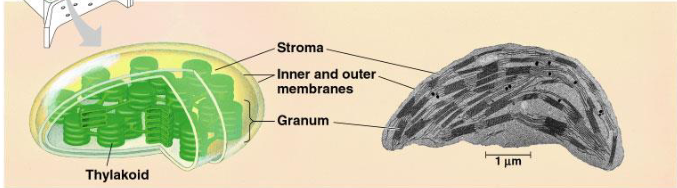
Grana (Granum):
stacks of THYLAKOID membranes (like stacks of pancakes)
Stroma:
region of the chloroplast that surrounds the grana
Light reactions (Hill Reaction):
• Light energy is converted into chemical energy (ATP )- photophosphorylation
• Water is split; e- & O2 are released
• Reducing power (NADPH) is produced
• Occur in the GRANA of chloroplast
Light reactions aka what?
Hill Reaction
Dark reactions (Calvin-Benson Cycle):
•Chemical energy and the reducing power are used in a cycle of carbon-fixing reactions that convert CO2 into carbohydrates (sugars, starch, or other forms of carbohydrates)
•Occur in the STROMA of chloroplast
Dark reactions aka what?
Calvin-Benson Cycle
Light reactions and dark reactions are part of what 2 step process?
Photosynthesis
Where does Electron Flow during Light Reactions take place?
thylakoid membranes / GRANA in the chloroplasts
thylakoids:
the pancakes of the chloroplasts

what do these diagrams represent?
Light energy harvested in chlorophyll-protein complexes of PSII & PSI of thylakoids
(Light harvesting complex (LHC) and Reaction Centers (RC)
Reactions in PSII of thylakoids
- Chlorophyll molecules energized by light – high-energy electrons go through several redox steps in an electron transport chain
- water is oxidized; and O2 released
PSII & PSI stand for?
photosystem 2 and 1
Overall Light Reactions (PSII & PSI)-
• O2 released as water splits
• Reducing power (NADPH) produced
• Electron transport provides energy for
ATP synthesis (light → chemical energy) turns into:
photophosphorylation (by a protein complex in thylakoids ATP synthase
PS I-
NADP+ accepts electrons to generate reducing power (NADPH

In and across thylakoid membranes: (4 parts)
•Two photosystems (PSII & PSI); generate energetic electrons, energized by light
•Electron acceptors and donors located in thylakoid membrane (perform redox steps)
•ATP making protein, ATP synthase (uses energy of downhill H+ gradient to make ATP)
•NADPH produced (reducing power)

what does this diagram represent?
Light reactions (Hill reaction)

Dark Reactions (Calvin cycle): (4 parts)
•Use ATP and NADPH generated from Light Reactions, and convert carbon dioxide into sugars / carbohydrates, i.e. carbon- fixation (in the STROMA of chloroplast
•These reactions are catalyzed by several enzymes
•The first reaction in this cycle is catalyzed by an enzyme – RuBISCO, the key enzyme
• RuBISCO represents about 50% of the total soluble proteins of a leaf cell; the most abundant protein on earth

Calvin cycle must take place in ___
must take place in light because many enzymes , including RuBISCO require light to be active. Hence, the term “Dark Reactions” is a misnomer
___ is an important nutrient for plant health
Nitrogen
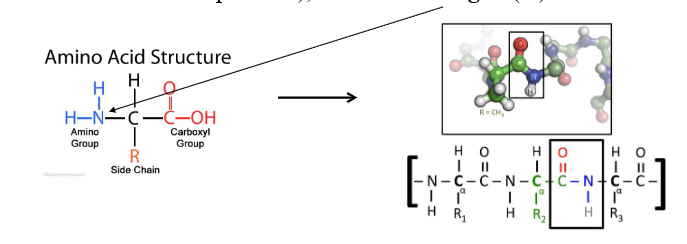
Amino acids make proteins and need ___
Amino acids make proteins (Ex. Rubisco, and many other important
structural & functional proteins), and need nitrogen (N)
Chlorosis:
yellowing of leaves (lack of ‘N’ and / or ‘Mg’)

what are the Three Photosynthetic Mechanisms
(based on the differences related to Calvin cycle)
C3- CO2 is first fixed in a 3 carbon compound
C4- CO2 is first fixed in a 4 carbon compound
CAM- Crassulacean Acid Metabolism; a version of C4
what does CAM stand for?
Crassulacean Acid Metabolism
___ become ‘stressful’ even at relatively normal irradiance in the
presence of other stresses, such as __
Light can become ‘stressful’ even at relatively normal irradiance in the
presence of other stresses, such as under cold / freezing conditions
Light stress:
➢ Light harvesting (or Light reaction) remains un-interrupted
➢ while photosynthesis biochemistry (Dark reaction) becomes sluggish under
cold / freezing temps. (because enzymes are less active or almost inactive)
➢absorption of light exceeds its utilization
absorption of light exceeds its utilization-
over-excited state of chlorophyll (i.e. energy not dissipated / not quenched)
Excited chlorophyll molecule reacts with O2 and produces free radicals (reactive oxygen species, ROS); ROS are unstable, oxidize proteins, lipids, etc., causing damage.
Plants employ various strategies to manage excess light stress
Xanthophyll cycle in plants (one of the strategy):
– Xanthophylls are type of ‘carotenoids’ (recall earlier discussion)
– Can exist in 3 alternate forms (with two, one, or none ‘oxygen’ at the aromatic ring)
•Inter-conversion of these three forms constitutes xanthophyll cycle
Xanthophyll cycle-
helps dissipate excess light energy in the form of heat (non-photochemical quenching; NPQ), and protects leaves from photooxidation damage

how does xanthophyll protect leaves?
Zeaxanthins promote structural changes in PSII & heat dissipation
The structural changes cause more light energy to be dissipated as heat

In which type of plants ‘xanthophyll cycle’ might play a particularly important adaptive role?
-- Evergreens, especially ‘Broad leaved evergreens’
--‘Sun plants’ (as opposed to ‘shade-adapted’ ones)
In general stress-management by plants involves one or both strategies
Avoidance
Tolerance
Avoidance:
plants / organs escape stress due to certain unique aspects of the life cycle or cellular structures or physiology
Tolerance:
must develop tolerance mechanism
Light stress-management by plants
Stress Avoidance- Thermonasty in rhododendrons
• – helps these plants escape / avoid:
• wind-desiccation (recall boundary layer discussion earlier)
• Light stress
Stress Tolerance –
– Activation of Xanthophyll cycle: a strategy by plants to tolerate light stress
Additional mechanisms for light stress tolerance:
• Activation of antioxidant machinery*, (to scavenge / detoxify free radicals*)
• special leaf anatomical features* (additional cell layers as light screen*)
*research topics under investigation in Arora lab
*cellular mechanism of thermonasty?
*antioxidant status in overwintering rhododendrons – thermonastic vs. nonthermonastic spp.
*seasonal changes in xanthophyll cycle dynamics in low vs. high elevation rhododendron
*anatomical features of rhododendron leaves in relation to light stress - thermonastic vs. non-thermonastic spp
majority of plants fall in these two categories-
C3 plants and C4 plants
C3 Plants
- Total of ~ 250,000 sp; Most horticultural species (monocots and eudicots):
-- (spinach, lettuce, tomato, potato, bean, sunflower, sugar-beets, soybean)
Cool-season turfgrasses (Kentucky bluegrass, creeping bentgrass), many
common weeds quackgrass, lambsquarters, cocklebur jimson weed);
majority of trees (fruits, shade) C3 plants dominate our landscapes
C4 Plants:
Total of ~1500 sp. Many important horticultural species – (monocots & eudicots)
Among ~ 600 grass species surveyed in N. America roughly 50% are C4
Of mostly tropical or subtropical origin –-
Warm season turfgrasses Zoysiagrass, Bermudagrass, Buffalo grass, Fescue, Bahiagrass, corn, sorghum, sugarcane, many common (troublesome) weeds crabgrass, barnyard grass, Foxtail, goose grass, common thistle, redroot, pigweed etc.)
C3 Photosynthesis (ex. cool-season grasses; beans)
• First carbohydrate ‘fixed’ in CALVIN CYCLE (in chloroplast stroma of mesophyll cells) is a 3-C compound (3-PGA)
3-PGA further reduced- G3P which exits the stroma of chloroplast and enters the cytoplasm of mesophyll cells where it is converted to 6-C sugar (glucose), and then to sucrose, starch, other CHOs etc.
Important: CALVIN CYCLE (CO2 fixation, reduction) takes place in mesophyll cells during the day-time since RuBISCO requires light to be active (stomata are also open)
Remember, CO2 fixation is catalyzed by RuBISCO in chloroplast stroma

C4 Photosynthesis (e.g. warm-season grasses, corn)