Bio Bases
 Call Kai
 Learn
Learn Practice Test
 Spaced Repetition
 Match
Match Flashcards
 Knowt Play
 Podcast
1/73

Earn XP
Description and Tags
Up to Midterm
Name | Mastery | Learn | Test | Matching | Spaced | Call with Kai | Chat |
|---|
No analytics yet
Send a link to your students to track their progress
74 Terms
Factors Contributing to Abnormalities
Hormones, peri/pre-natal experience, early experiences, genes, environment, abuse, neglect, maternal substance abuse
Conceptualizing Behavior
What is the manifested behavior? (Behavior occurs → hormones)
What triggered the nervous system? (Seconds before? → uncon. sensory processing)
What went on secs-mins before and what parts of the brain were prompted? How much were you aware of outside stimulus? (80% of stimulus influences you unknowingly → unconscious processing)
What happened in hours/days before behaviors? (hormones come into play here)
Days/months before?
What does the frontal lobe development look like? → learning hx, base rate of trauma/PTSD
Sensory triggers
most are subliminal
Fusiform gyrus
Responsible for face recognition; heavily connected to amygdala and wired to go against threats
Interoceptive
the perception and interpretation of signals originating from inside the body, such as heartbeat, hunger, pain, and emotional states
Galen’s understanding of body
fluid/hydraulic driven model wherein cardio and organ systems acted as open-ended network of fluids (like localized factories and aqueducts) rather than a closed, circulatory system.
Golgi’s contributions
staining methods giving greater understanding of cellular structure → revealed neurological networks are a web and not a mosaic
Ablation
the electrical shocks used to map out brain
Cajal’s contributions
every cell has a cell body → axons + dendrites → neurons are building blocks and signaling elements (early understanding of networks) → Neuron doctrine
Neuron Doctrine
individual neurons are the basic building blocks (structural, functional, organizational) of the brain
Harrison’s contribution
axons + dendrites grow from neurons + identified network feasibility → they have an inherent DNA process and function (as observed via growing in petri dish)
Palay’s contributions
synapses identified via electron microscopy images → reaffirmed Neuron Doctrine → discovered synaptic vesicles
The soul (as per Descartes)
internal, unconscious self that we’re unaware of
Flourens’ Contribution
Produced a holistic view of the brain and neural functioning by challenging the view of separate, functional centers of the brain and arguing for more unified, higher cortex processes
Warnecki and Jackson’s contributions
Argued specific parts of the brain do specific things → cellular connection cortex perspective. Proposed the brain is arranged in functional units that are organized and connected in precise ways
Luria’s 3 Functional Units
Regulation of cortical tone (mental alertness/wakefulness) → involves the brain stem, reticular activating system. Regulates how much arousal/activation for a particular stimuli. Operates according to the Law of Strength (strong act → strong response)
Responsible for receiving/analyzing storing info → asks what sense is this? Operates via simultaneous operation/successive & simultaneous processing. Involves parietal, occipital, and temporal lobe. Operates Law of Sequence (creates sequential/series order)
Promotes/regulates intentions/plans. Executes plans/verifies outcome compared to plan → frontal lobe/prefrontal area
Issues w/Luria’s 3 Functional Units
can lead you down mosaic thinking
Neuron cell types
neurons and glia
name for presynaptic terminals
end button (with an accent)
cell body/soma
metabolic center, nucleus, genes, endoplasmic reticulum (extension of nucleus, site of protein synthesis)
end button
releases neurotransmitters on the synaptic cleft and connects w/dendrite of other neurons, at end of presynaptic terminals
purpose of dendritic spines
exposure
purpose of myeline sheath in AP
propagates speed and conduction, keeps electricity inside the axon
nodes of Ranvier
unsheathed and exposure to opposing charge of outside environment here causes propagation of AP down the axon (located in myelin sheath)
electrical signal path
dendrite → cell body → axon → end button → vesicle/release/cleft → post-synaptic cleft → next neuron
Classification of neurons
unipolar: single primary process, gives rise to many branches
highly sensory, efficient, found in ANS of vertebrates
bipolar: oval soma/cell body
2 distinct processes
dendritic structure receiving signals from other neurons
axon carries info towards CNS
largely sensory
short, efficient
pseudo unipolar: receptor neurons, convey touch/pressure/pain
start as bipolar, but extension from soma fuse into one
one axon carries sensory info from receptor to spinal cord
anaxonic
absence of axon
signals from cell body, doesn’t transmit long distance info
modulates to integrate info in short distances
multipolar
multiple dendrites + single extension axon
info from multiple sources
most abundant
vary in size + length + very efficient
Teuber’s Principle
someone help me here
Glial cells
surround cell bodies, axons, dendrites
6 Action Potential (AP) steps
Na+ enters cell as cell channels open
K+ channels open and exits cell via electrostatic diffusion
Na+ channels become refractory = no more Na+ can enter the cell because no more electrical charge is needed for AP
K+ channel remains open, K+ continues to leave (polarizing cell)
K+ channels close, Na+ channels reset
Excess of K+ outside cell are cleaned up by microglia
resting potential is -70/65mv, critical threshold is reached at -55mv.
Graded potential
can hyper-polarize a cell making it more or less likely to fire an AP
astrocytes
provide nutrition and neuronal signaling to neurons
irregular, star shaped, large number of processes extending from them
envelope and support capillaries + CNS blood vessels
reduce inflammation/toxicity post-injury/disease
susceptible to diseases
Oligodendrocytes
from the myelin sheath, surround cell bodies, keep things in place
Microglia
the little pac-men of the brain, eat pathogens/debris
flexibility in future jobs, 10% derived from progenitor cells
colonize in early embryonic development and already knows its future job upon leaving yolk sac
sculpt neurocircuits
increase in number following injury/disease (brought in to site of damage and bring in lymphocytes)
Anaxonic synapse
have an end button which connects and triggers next cell but no dendrite is involved in process
Longitudinal brain fissure
divides brain into two hemispheres
Corpus callosum
connects the 2 brain hemispheres
White matter
Myelin (surrounding axons)
3 Sources of Arousal/Activation
environment (PNS senses it w/somatic markers)
Internal (ex. stomach growls, sexually aroused)
Intention created by brain (plan + intention + execution + verification)
Central sulcus
separates parietal + temporal lobes
Sulci
Shallow grooves in brain
gyrus
bumps along cerebral cortex
motor strip
in front of central sulcus and part of the front lobe/precentral gyrus, controls + plans + executes voluntary muscle movement

Sensory strip
anterior (front) portion of parietal lobe, posterior (behind) to central sulcus, postcentral gyrus, processes touch/sensation
Internal capsule
subcortical, white matter structure
Damage of any kind in this location will affect multiple areas of brain
mainly composed of myelinated nerve fibers of ascending and descending tracts of the central nervous system

Frontal rectus gyrus
Anatomical directional terms when looking at cerebral cortex
superior/dorsal
posterior/caudal
anterior/rostral
ventral/inferior
Anatomical directional terms from spinal cord down
rostral/superior
ventral/anterior
dorsal/posterior
caudal/inferior
Horizontal plane
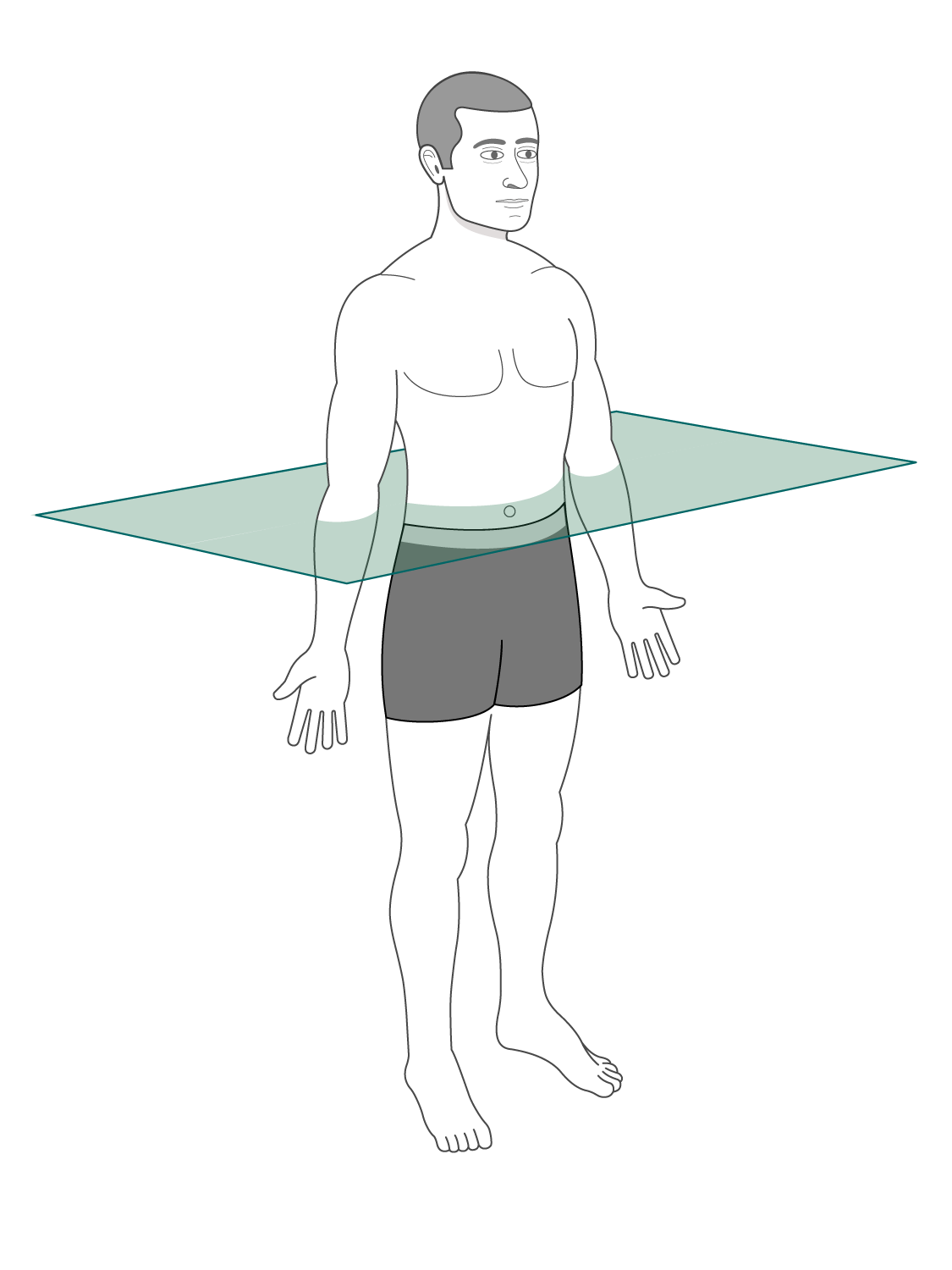
Coronal plane

sagittal plane

Oligodendrocyte vs Scwann cell location
Oligodendrocyte is in CNS myelin sheath, Scwann is in PNS myelin sheath