Market Access + Policy
 Call Kai
 Learn
Learn Practice Test
 Spaced Repetition
 Match
Match Flashcards
 Knowt Play
1/25

There's no tags or description
Looks like no tags are added yet.
Name | Mastery | Learn | Test | Matching | Spaced | Call with Kai | Chat |
|---|
No analytics yet
Send a link to your students to track their progress
26 Terms
review coverage and access responsibilities
coverage: formulary inclusion, benefit design
access: prior auth, step therapy, cost sharing
review pharmaceutical policy questions

What 3 things create the foundation for access success?
policy, evidence, pricing
as time passes, do cost containments increase/decrease? Why is this important?
increases; healthcare budgets are tightening → marketing access and value demonstration is very critical
review different types of values: manufacturers, private payers, govt/regulators, pt/caregiver, employer, physicians/health systems
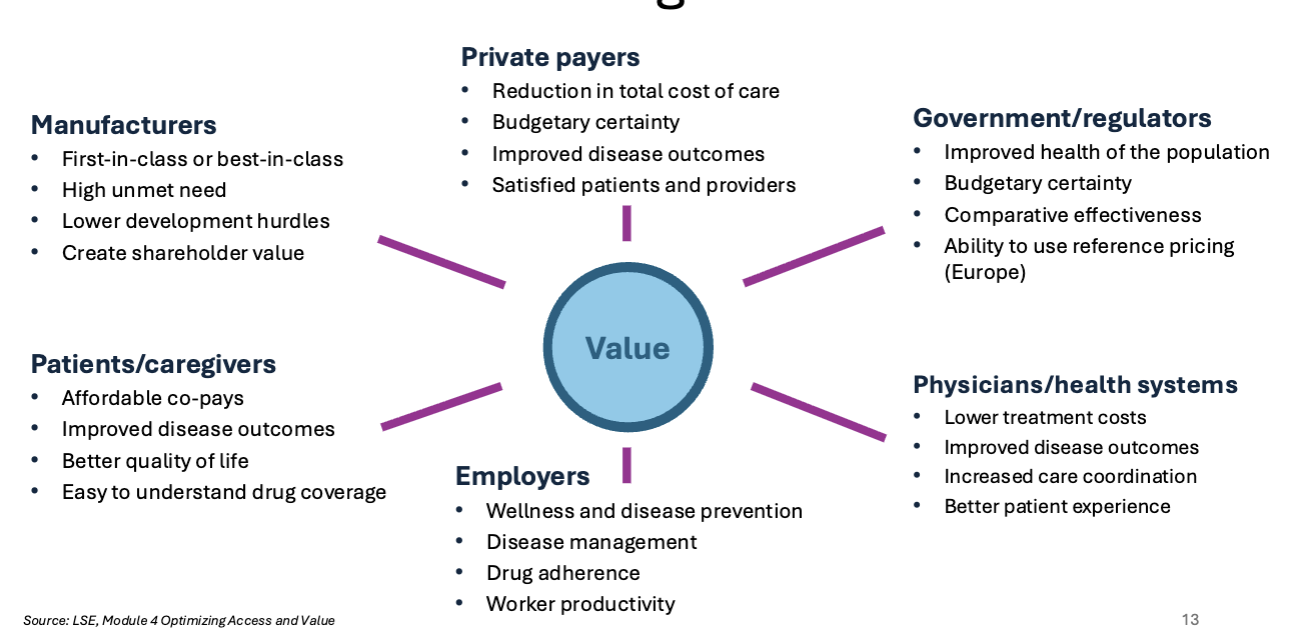
Some countries have a more decentralized evaluation involving cash pay. What is cash pay and which countries participate?
pts pay majority of drug costs out of pocket or through private insurance, and are the primary decision makers
Brazil, India, China, Russia
Some countries have a more decentralized evaluation involving health plans/HMOs. What are health plans/HMOs and which countries participate?
typically private payers/insurers (employer sponsored insurance); each payer may determine formulary and coverage for drugs and negotiate individual contracts
US, Argentina
Some countries have a more centralized evaluation involving regional/subnational decisions. What are regional/subnational decisions and which countries participate?
P&MA decision making is devolved to regional/subnational payers; level of region autonomy varies where some payers bound by national guidelines and others are primary decision makers
Spain, Italy, Mexico, Saudi Arabia
Some countries have a more centralized evaluation involving national decisions. What are national decisions and which countries participate?
typically single payer systems; national agencies evaluate new products; level of reimbursement and access is determined centrally and applies across the country
China, France, Germany, UK
What is the primary goal of the comparative clinical effectiveness archetype? give country examples.
comparing clinical evidence of a new product to an existing comparator
France, Germany, Italy, Japan
What is the primary goal of the cost effectiveness archetype? give country examples.
understanding value for money of new treatment vs an existing treatment
UK, Canada, Sweden, Austrailia, USA (ICER), South Korea
What is the primary goal of the budget optimization archetype? give country examples.
efficiently allocating the limited budget/resources
Brazil, China, Italy, Spain
What is the primary goal of the comparative free market archetype? give country examples.
commercial viability — attractive plan design that generates business and profit
USA, Canada
Why do we need to document evidence across drug lifecycle and include real world evidence post launch?
healthcare is shifting from volume based to value based payment so the planning begins a lot earlier
SEQ Pricing, Reimbursement, and Access Strategy Development
Early Development: map out development and commercialization; ID gaps and opportunities
Phase I: understand early product value proposition; set early payer and access assumptions
Phase II: early stakeholder engagement to validate value proposition
Phase III: generate evidence to support proposition, develop price and access strat, refine payer requirements and access through evidence
Filing: final payer value proposition and value dossier, execute market access strat
Launch
Post Launch: post launch data and real world evidence generation
What are the key Payer Questions related to Trial Design, and what corresponding Evidence Planning strategies address them?
Payer Questions:
Is there additional benefit versus the SoC (Standard of Care)?
Is there evidence of additional benefit across some/all relevant sub-populations?
Does trial population reflect 'label' population?
Evidence Planning:
Randomized controlled trials rather than single arm
Choice of comparator / head-to-head
Powering for sub-group analysis
Study cohort which reflects real-world patients
What are the key Payer Questions regarding Outcomes & Endpoints, and what Evidence Planning actions should be taken?
Payer Questions:
Does the primary endpoint impact patient mortality, morbidity or quality of life?
What is the healthcare resource-use benefit?
How long does benefit last?
Evidence Planning:
Consider outcomes used in other HTA evaluations
Measure PROs (Patient-Reported Outcomes) / quality of life
Capture resource use/workflow data
Conduct longer-term studies
What Health Economics questions do payers ask, and what Evidence Planning is required to answer them?
Payer Questions:
Do we need it? What are the alternatives?
What is the budget impact? Can we afford it?
Is the product cost effective overall?
Evidence Planning:
Target population / costs per patient
Health economic data to demonstrate cost per QALY gained
What is the core formula for Value (V) in terms of Competitive Alternative (R) and Incremental Value (D)?
V = R ± D
What is the Competitive Benchmark (R)?
The price of the gold standard for a specific line of therapy, including its positive and negative features.
How is Incremental Value (D) determined and defined
Based on the relative importance of Value Drivers to customers.
Quantified evidence of clinical, humanistic, economic, and societal benefits relative to the gold standard.
What are the four key Stakeholder Considerations when evaluating value?
Perceptions of value
Ability and willingness to pay
Disease and economic priorities
Cost-minimization
What are the key trade off in determining the optimum pricing and access strategy?

Market Access in industry…
ensures that appropriate payer strategies are developed and executed
is shifting from a function P&R role to a shared, organization-wide objective
has become of the agenda of multiple functions
market access summary
