Genetics
 Call Kai
 Learn
Learn Practice Test
 Spaced Repetition
 Match
Match Flashcards
 Knowt Play
1/31

There's no tags or description
Looks like no tags are added yet.
Name | Mastery | Learn | Test | Matching | Spaced | Call with Kai | Chat |
|---|
No analytics yet
Send a link to your students to track their progress
32 Terms
What occurred in the Avery Macleod Mcarty experiment?
used a bacteria called streptococcus pneumonia
S strain = harmful and has protective capsule
R strain harmless and lacks a capsule
They took dead S bacteria and broke them open. This gave them a mixture containing things from the S bacteria, including:
DNA + RNA + proteins + other molecules. They then separated the different components.
Dead S bacteria
↓
Break them open
↓
Get their cellular contents
↓
Treat the contents with different enzymes
↓
Mix the contents with live R bacteria
↓
See whether the R bacteria become S bacteria
What was the conclusion from this experiment?
Protease → destroys protein → transformation still occurred
RNase → destroys RNA → transformation still occurred
DNase → destroys DNA → transformation stopped
Conclusion: DNA, not protein or RNA, carries the genetic information responsible for transformation.
What did the Hershey–Chase experiment show?
Bacteriophages → made of DNA + protein
³²P (radioactive phosphorus) → labels DNA because DNA contains phosphorus
³⁵S (radioactive sulfur) → labels protein because proteins can contain sulfur
Made one batch of phages with ³²P-labelled DNA. Made another batch with ³⁵S-labelled protein. Allowed both types of phages to infect E. coli bacteria.
³²P (DNA) was found inside the bacteria.
³⁵S (protein) remained outside the bacteria with the phage coats.
What are the requirements for genetic information?
stable over time
faithfully replicated
make proteins (essential to carry out life)
change in a controlled way (so evolution can occur)
What did Rosalin Franklin discover?
she used X ray crystallography to study the structure of DNA. This X-ray diffraction photograph showed:
DNA has a helical (spiral) shape.
The helix has a constant width.
The bases are on the inside of the molecule.
The phosphate backbone is on the outside
What is the structure of DNA?
DNA is a polynucleotide, this means it comprised of many nucleotides joined together via phosphodiester bonding
a nucleotide contains a phosphate, sugar and a base (thymine, adenine, guanine and cytosine)
How is the double helix formed?
the double helix is held in place by hydrogen bonding between complementary base pairs (C and G 3 hydrogen bonds) and (A and T 2 hydrogen bonds)
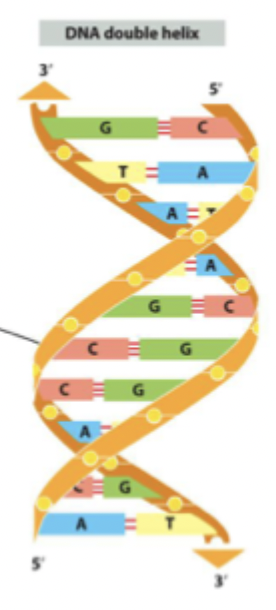
Explain the antiparralel strands of DNA
DNA has two strands that run alongside each other, but they run in opposite directions. This is called antiparallel
The numbers refer to carbon atoms in the sugar (deoxyribose) of each nucleotide.
5′ end = the end with the phosphate attached to the 5′ carbon
3′ end = the end with an available OH group on the 3′ carbon
DNA polymerase can only add a new nucleotide to the 3′ OH, so new DNA is always made 5′ → 3′.
What are minor and major grooves?
Gaps formed by DNA's twisted double helix. The major groove is wider, while the minor groove is narrower. Proteins can bind to them

What is the genome?
A genome is all of the genetic material (DNA) in an organism.
What are chromosomes and homologous chromosomes?
A chromosome is one long, organised piece of DNA wrapped around proteins
two chromosomes that carry the same types of genes, but these can be different versions of the same genes (alleles) this is what provides individuals with different characteristics.
one chromosome from mother
one chromosome from father
What is a chromatid?
A chromatid is one copy of a chromosome.
Before DNA copies itself:
1 chromosome → 1 chromatid
After DNA copies itself:
1 chromosome → 2 identical sister chromatids
They are joined together in the middle via the centromere
What are histones?
Hstones are proteins which DNA wraps around
there are 4 main types:
H2A
H2B
H3
H4
Two copies of each form a group of 8 histone proteins called a histone octamer. the DNA wraps around each histone twice in order to form the nucleosome
Histone 1 = H1 is called a linker histone. This brings nucleosomes together to form chromatin fibres. It sits on the linker DNA between each nucleosome and holds the arrangement together tightly and compactly
What is the role of scaffold proteins?
Chromatin forms loops, these loops then attach to scaffold proteins and this helps keep the chromosomes highly condensed
What are the types of chromatin?
Euchromatin - less compact DNA form, contains genes that are frequently expressed (genes switched on)
heterochromatin - highly packed DNA, therefore DNA cannot be transcribed (gene switched off)

What did the pulse chase experiment conclude?
RNA only discovered in 1950s
Uracil was made radioactive and therefore could be tracked.The RNA moved from the nucleus to the cytoplasm in order to make proteins
This suggested that RNA was a messenger
What is the central dogma?
Central dogma - describes the flow of genetic information
DNA --> transcription --> RNA --> translation --> protein
How does RNA and DNA differ?
DNA | RNA |
Ribose sugar | Deoxyribose sugar |
Double helix | Single stranded |
Thymine | Uracil |
Chemically less reactive as deoxyribose contains one less hydroxyl group on the carbon 2' of the sugar | Chemically more reactive as ribose contains one more hydroxyl group on the carbon 2' of the sugar |

What are promoter and termination regions?
Promoter region - specific sequence of DNA that is located upstream of a gene, this determine where transcription actually begins (TATTA RNA polymerase binds and starts transcription)
Terminator region - section of DNA that tells RNA polymerase to stop transcription
What are NTPs?
NTP - nucleoside triphosphate
For RNA NTPs include:
Adenine ATP
Guanine GTP
Cytosine CTP
Uracil UTP
Each one of these NTPs has 3 phosphate groups
Alpha
Beta
Y
During transcription, RNA polymerase uses NTPs to build an RNA strand
How is pre-mRNA synthesised?
An enzyme called RNA polymerase binds to the DNA at a specific region called the promoter.
RNA polymerase reads the template DNA strand in the 3′ → 5′ direction. It builds the new RNA strand 5′ → 3′
This is important because RNA polymerase can only add new nucleotides to the 3′ end of the growing RNA
The NTP loses two of its phosphates when it is incorporated, and the released energy helps form the phosphodiester bond between nucleotides.
How does splicing occur and what is the spliceosome?
The pre-mRNA contains:
Exons = sections that are kept
Introns = sections that are removed
The spliceosome is a large complex made mainly of:
Proteins
snRNAs = small nuclear RNAs
Together these form snRNPs ("snurps"), which recognise the intron and help cut it out.
The spliceosome basically acts like the molecular scissors + machinery for splicing.
What is an amino acid?
An amino acid is a protein monomer, these join via peptide bonds to form a polypeptide. there are 20 amino acids and each one contain 3 triplet of bases known as a codon
What are the rules of the genetic code?
universal - same codons specify the same amino acid in all organisms
degenerate - more than one triplet of bases can code for the same amino acid
non overlapping - each base is part of only one codon
What did Crick, Brenner experiment conclude?
Helped to show that groups of 3 bases are known as codons.
Bacteriophage - virus that infects bacteria
They used a mutation called frameshift mutation. They added or removed an individual base from a gene (r11 in bacteriophages genome)
If there was a mutation in this gene it would make plaques which are distinctive and large
If there were no mutation in this gene it would make smaller normal plaques
they generated mutants in the R11 gene of bacteriophages T4 using Proflavine - a chemical mutagen which can add or remove a single nucleotide from DNA
This proflavine molecule is planar (flat) this means it is able to slide in between base pairs, then this causes a single nucleotide to be added or deleted. --> frameshift effect and therefore changes how the genetic code is read
If you add or remove ONE nucleotide then it shifts the entire reading frame. However if you make 3 nucleotide changes then the reading frame is restored.
What is the structure and role of rRNA in translation?
It is RNA that makes up a major part of the ribosome, the structure that makes proteins. rRNA + proteins → ribosome → makes proteins
The ribosome has two subunits:
Small subunit (33 proteins and 1 RNA molecule)→ holds and reads the mRNA
Large subunit (49 proteins and 3 RNA molecules)→ helps join amino acids together
rRNA is found in both subunits and has two main jobs:
Provides the structure of the ribosome.
Helps form peptide bonds between amino acids
What is the structure of a ribosome?
The ribosome has two subunits:
Small subunit (33 proteins and 1 RNA molecule)→ holds and reads the mRNA
Large subunit (49 proteins and 3 RNA molecules)→ helps join amino acids together
rRNA is found in both subunits and has two main jobs:
Provides the structure of the ribosome.
Helps form peptide bonds between amino acids
The ribosome has three important sites:
A → P → E
Site | Meaning | What happens |
|---|---|---|
A site | Aminoacyl | New tRNA enters carrying an amino acid |
P site | Peptidyl | Holds the tRNA carrying the growing polypeptide |
E site | Exit | Empty tRNA leaves |
What is the structure and function of a tRNA molecule?
tRNA molecules are made up of important sites:
1. Anticodon
A sequence of 3 RNA bases
Binds to a complementary codon on mRNA
2. Amino acid attachment site
The other end carries one specific amino acid
So tRNA basically acts like a delivery vehicle:
tRNA = brings the correct amino acid → to the ribosome
Explain the initiation process of translation?
The small ribosomal subunit, translation initiation factors and initiator tRNA join
This complex then binds to the mRNA molecule
The small subunit moves along the mRNA searching for the first AUG start codon
Once AUG is found, the translation iniation factor dissociates and the large ribosomal subunit binds
Charged tRNA binds to the a site and the first peptide bond forms between the 2 adjacent amino acids

Explain the elongation process of translation?
Step 1
Newly bound charged tRNA binds to the a site
The growing polypeptide chain is held by the tRNA sitting in the p site
Step 2
The ribosome catalyses the joining of the amino acids and forms a peptide bond
The polypeptide chain is now transferred to the tRNA sitting in the a site
Step 3
The large ribosomal shifts
This movement shifts the new tRNA into new positions within the larger subunit, the uncharged tRNA (without an amino acid) moves into the E site and the tRNA carrying the growing polypeptide moves into the p site
Step 4
The small subunit shifts to realign with the larger subunit, this pulls the mRNA along by one codon (3 bases)
The uncharged tRNA in the e site is ejected and the a site is now empty again

Explain the termination process of translation?
The ribosome reaches the stop codon UAG at the site A. since no tRNA matches this codon translation is halted
A release factor then binds to this a site where the stop codon is
The release factor then triggers a hydrolysis reaction using h20 in order to break the bond between the polypeptide chain and the tRNA. This frees the polypeptide chain
The entire complex breaks apart, the mRNA, small and large ribosomal subunits and last tRNA and release factor all separate so they can be recycled
