Chapter 5: Consolidated Financial Statements with less than 100% ownership
 Call Kai
 Learn
 Practice Test
 Spaced Repetition
 Match
 Flashcards
 Knowt Play
1/23

There's no tags or description
Looks like no tags are added yet.
24 Terms
Overview
-In this chapter we consider the cse in which other shareholders own a minority or noncontrolling, interest in that subsidiary
-if the parent still controls the sub, it msut still consolidate the financial statements of the sub with its own
-but ow we need to keep track of the equity that the noncontrolling shareholders have in that subsidiary
Income Statement with Noncontroling interests
-consolidated revenues and expenses remain unchanged in the presence of noncontrolling shareholders
-net income is allocated to the two groups of shareholders
consolidated net income attributed to the noncontrolling shareholders
consolidated net income that is available to the parents shareholders
-consolidatated assets and liabilities remain unchanged in the presence of noncontrolling shareholders
-stockholdrs equity section will clearly seperate the interests of the two groups of shareholders
shareholders of the parent company who have claim on the net assets of the total consolidated entity by virtue of their ownership of the parent company
Noncontrolling shareholders of the sub who only have a claim on the net assets of the sub call the noncontrolling interests or NCI

Apportionment of BSVE and Identifiable Assets
-Generally speaking, the book value of the sub and the AAP assets and liab other than goodwill are apportioned between the parent’s shareholders and the noncontrolling interests in proportion to their ownership in the company
-so if the NCI own 20% of the company, they are apportioned 20% of the sub’s book value and 20% of the AAP other than goodwill in out [E] and [A] consolidation elemination entries
Goodwill allocation example
Assumptions:
acquisition of 80% of a sub for $1570000
NCI has a fair value of $380000
FV of the identifiable net assets is $1800000
Goodwill is allocated to the controlling and noncontrolling interests as follows:
fv of controlling interest + fv of noncontrolling interest = total fv of the investee company minus fv of the identifiable assets aquired and the liab assumed = goodwill

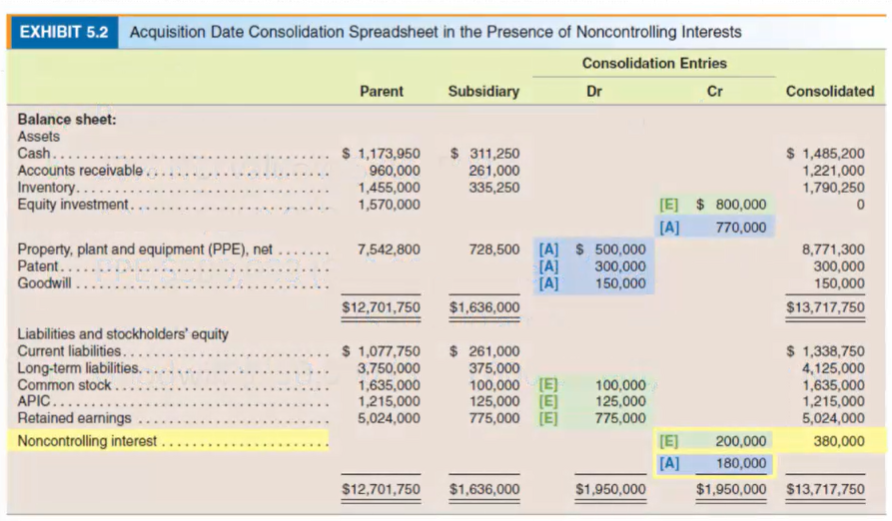
Acquisition Date consolidation with NCI example
Assume:
a. purch of 80% interest on 1/1/2016 fir $1570000
b. 20% nci value is $380000
c. AAP is $950000
d. PPE $500000 (10000 dep per year)
e. Patent $300000 (3000 amort per year)
f. Goodwill $150000 (130000 parent and 20000 nci)
Look at picture for examples of E and A entries
Consolidation Subsequent to Acquisition
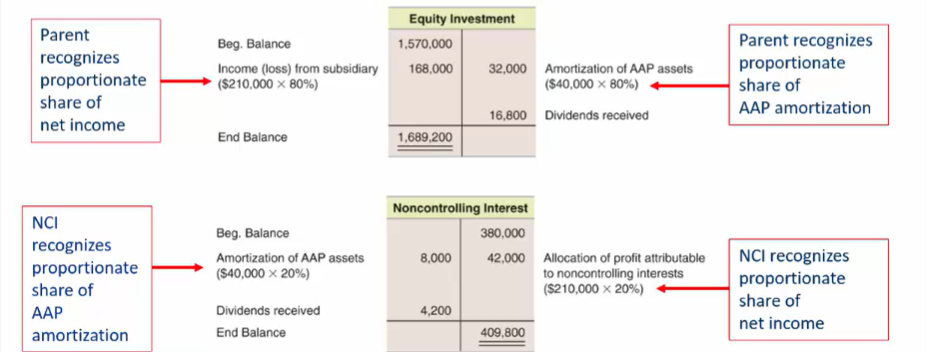
Assume:
Sub reports NI of 2100000
Pays div of 21000
The AAP amort is 40000 for the year
—> look at pic to find what the eq inv and noncontrolling interest would look like on the consolidation workpapers
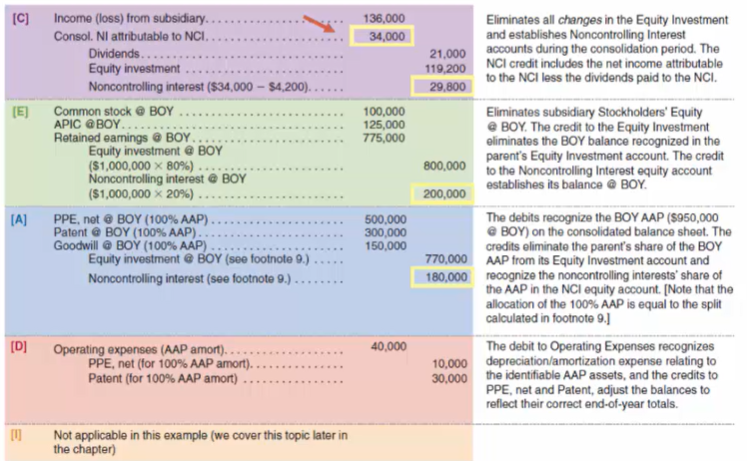
CEADI Entries Subsequent to Acquisition
Look at picture of updates CEADI entris with the new things highlighted yellow
Consolidation spreadsheet in the presence of noncontrolling interests

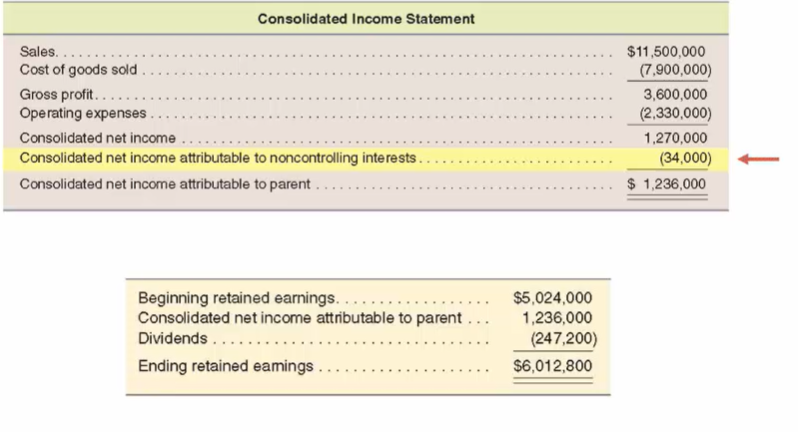
Consolidated income statement and RE
Consolidated Balance Sheet
The noncontrolling interest equity account is reported on the consolidated balance sheet seperatly from the parent’s equity, and should be clearly identified and labled

Intercompany transfers of inventory when Parent owns less that 100% of Sub
-Whether the intercompany transfer is upstream or downstream
—> 100% of the intercompany deferred profit is always eliminated from the consolidated financial statemetns at the date of intercompany transfer
—> the reduction of ending inventory for the deferred profit will increase COGS
BI + Purchase -EI = COGS
__> When the investory is treansfered to an unaffiliated party, the deferred profit is recognized as decrease of COGS
BUT
When the investory transaction is UPSTREAM, the deffered inv profit adj also affects the noncontrolling interest balances by the noncontrolling interest percentage
When the inventory transaction is DOWNSTREAM, the noncontrolling interest is unaffected by deferred profit
Profit elimination for upstream inventory sales

Consolidation Spreadsheet: Reflecting Continuous Upstream Intercompany Inventory sales

Profit Elimination for Downstream Inventory Sales
-for downstream inventory sales, the adj sub income does not reflect the gross profit on the sale
-noncontrolling interests are only affected by the subs net income

Compare deferred inventory profit conditions (non, upsteam, adnd downstream

Intercompany transfers of the depreciable assets when the parent owns less than 100% lof sub
-whether the intercompany transfer is upstream or downstream,
-the intercompany deferred profit is always 100% eliminated from the consolidated financial statements at the date of intercompany transfer
-as the asset is depreciated during the periods after the intercompany sale, 100% of the deferred proit is ratably amortized and recognized in the consolidated financial statements as an adjustment of depreciation expense
When the depreciable asset sale is upstream, the deferred profit adjustments also affect the noncontrolling interest balances by the noncontrolling interest percentage
When the assets sale transaction is downstream, the noncontrolling interest is unaffected by the deferred profit
Intercompany profit elimination for upstream depreciable asset sales
parent JE relating to an upstream sale:
DR eq income and cr eq investment to defer the intercopmany gain on the sate of the intercompany transfer but only x% of it)
for the next however many years DR eq inv and CR eq income to confirm the annual intercompany fain during the useful life x% of it
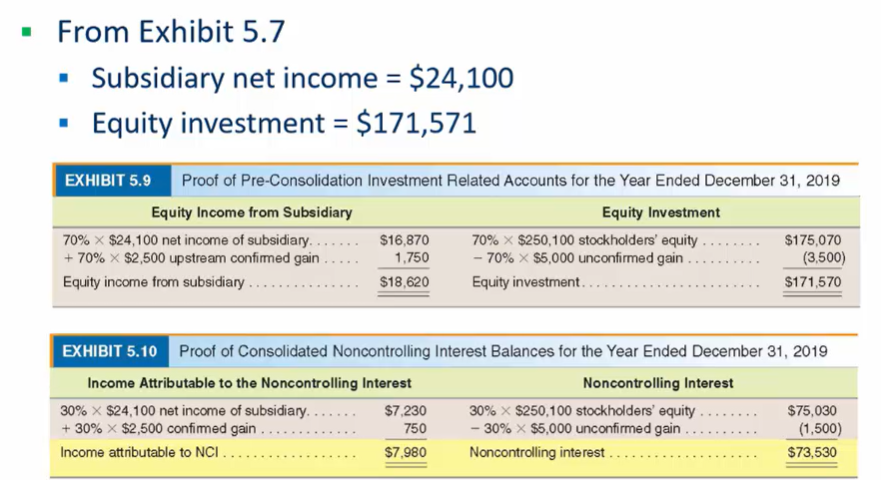
Upstream intercompany depreciable asset sale in presence of noncontrolling interest

Downstream equity income journal entries
the parent starts with the same journal entry as before but this time its 100% and the second is the same except its 100%

Comparison of upstream vs downstream
If the gain is in the subsidiary, allocate to the parent and NCI a percentage
If the gain is in the parent, no allocation to NCI


post-acquisition Parent owns less than 100% of the sub - cost method -

Income attributable to NCI cr of entry calc
adj for parents interest and know what statement is affected

consolidated NCI dr of entry

Suggested Integrated appraoch for mastering complex consolidation
dissaggregate and document the activity for the 100% AAP the controling interest AAP and the noncontrolling interest AAP
calculate and organize the profits and lossses on intercompany transactions and balances
compute the preconsolidation equity investment account beginning and ending balances starting with the stockholders equity of the sub
reconstruct the activity in the parent’s preconsolidation equity investment t account for the year of consolidation
independantly compute the owners equity attributable to the noncontrolling interest beginning and ending balances starting with the owners equity of the sub
independnantly calculate consolidated, controlling, and noncontrolling net income
complete the consolidating entries according to the CEADI sequence and complete the consolidation worksheet