C3 Wave Phenomena
 Call Kai
 Learn
 Practice Test
 Spaced Repetition
 Match
 Flashcards
 Knowt Play
 Podcast
1/29

There's no tags or description
Looks like no tags are added yet.
30 Terms
What are wavefronts?
Wavefronts are imaginary surfaces that connect points on a wave that are in phase

What is reflection?
When a wave hits a boundary between two different media, it can bounce off the boundary.

What is refraction?
This is the change in speed of a wave as it enters a new boundary.

Velocity equation
v=fλ=Tλ
If a wave slows down…
it bends towards the normal.
If a wave speeds up…
it bends away from the normal.
Draw a diagram showing:
Reflection
Direct transmission
Absorption
Refraction

What is diffraction?
Diffraction is the bending of light, when the light waves encounter a barrier with an opening with limited width.

What is the formula for refractive index?
n=vc
(1≤n≤2)
where:
𝑛 is the refractive index of the medium (𝑛 is a ratio so it is doesn't have units)
𝑐 is the speed of light in a vacuum (3.00 × 10⁸ m s−1)
𝑣 is the speed of light in the medium in metres per second (m s−1)
The greater the refractive index of a medium, the more it slows down light, and the more the light is bent.
What is Snell’s Law?
n2n1=sin𝜃1sin𝜃2=v1v2

What is the critical angle?
The angle of incidence at which light is refracted along the boundary between a medium with a greater refractive index and a medium with a smaller refractive index.

What is Total Internal Reflection (TIR)?
When the angle of incidence is greater than the critical angle at the boundary between a medium with a greater refractive index and a medium with a smaller refractive index. Light is completely reflected back into the medium with the greater refractive index.

What is the refractive index of air?
n=1
What is the formula for finding the critical angle of a medium?
sinθc=n1n2

Label this diagram
Crest: The highest point of a wave, where the maximum displacement from its equilibrium position occurs.
Trough: The lowest point of a wave, where the minimum displacement from its equilibrium position occurs.
Amplitude: The maximum displacement of a wave from its equilibrium position.
Wavelength, λ: The distance between two consecutive crests (or troughs) in a wave, measured in metres (m).
Frequency, f: The number of oscillations a wave makes in one second, measured in hertz (Hz).
Wave speed, v: The speed at which a wave travels through a medium, measured in metres per second (m s−1).
What is superposition?
Two waves meet and their displacements add together at every point in space to produce a combined wave with a resultant displacement.
What is constructive interference?
Occurs when two waves meet in phase (crests meet crests and troughs meet troughs), resulting in a wave with increased amplitude.

What is destructive intereference?
Occurs when two waves meet out of phase (crests meet troughs), resulting in a wave with decreased or zero amplitude.

What is path difference?
The path difference between two waves is the difference in distance travelled by one wave compared to the other wave. It is measured in terms of wavelength.

What is Young’s double slit interference experiment?
In the double-slit experiment, a monochromatic coherent light source (such as a laser) emits light waves towards a screen with two narrow slits. When the light waves pass through these slits, they act as two coherent light sources. The light waves interfere, creating an interference pattern on the optical screen. The interference pattern consists of alternating dark and light fringes (bands).
The light fringes (maxima) are where the light waves interfere constructively and the dark fringes (minima) are where the light waves interfere destructively.

Draw the diagram showing the 2 slit interference showing path difference

What is the equation for finding the distance between 2 bright fringes or 2 dark fringes?
s=dλD

What is the single slit diffraction?
When monochromatic coherent light waves pass through a single narrow slit, the waves diffract and interfere, forming a pattern.
What’s the differencer between these diagrams?
A single-slit interference pattern has a central bright fringe (central maximum), with smaller, dimmer fringes on either side. The bright fringes are due to constructive interference and the dark fringes are due to destructive interference.
The intensity of light is greatest in the central maximum and decreases with each successive maximum.

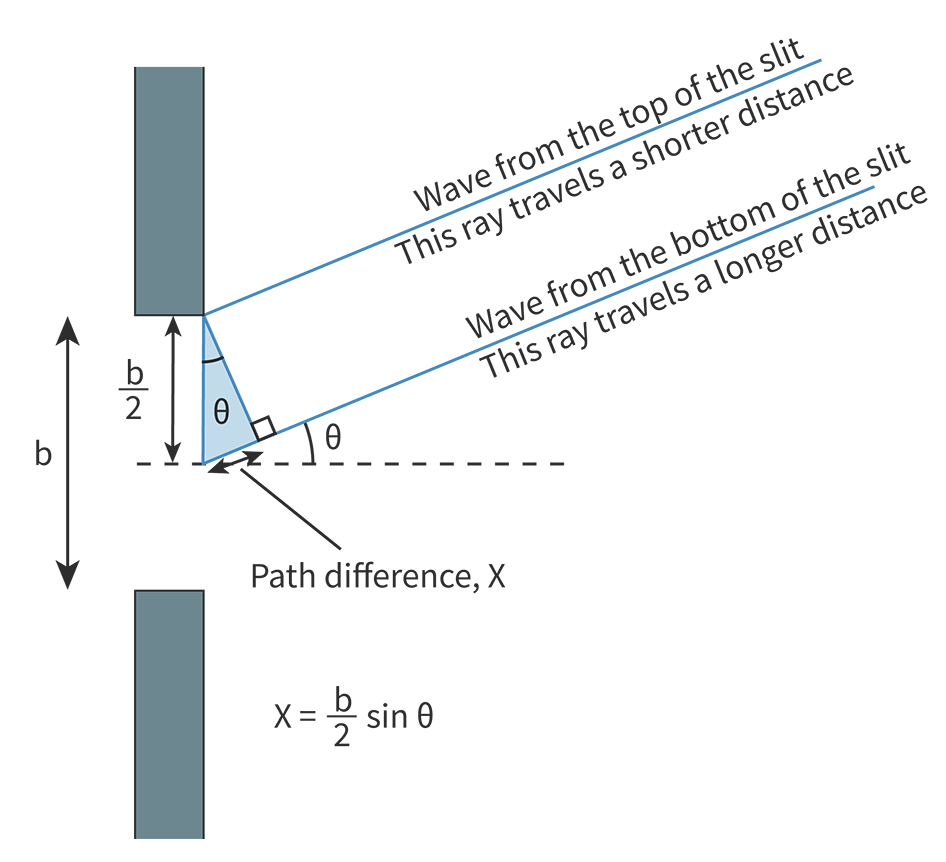
Path difference in single slit interference
What is the equation for angle between central maximum and first dark fringe?
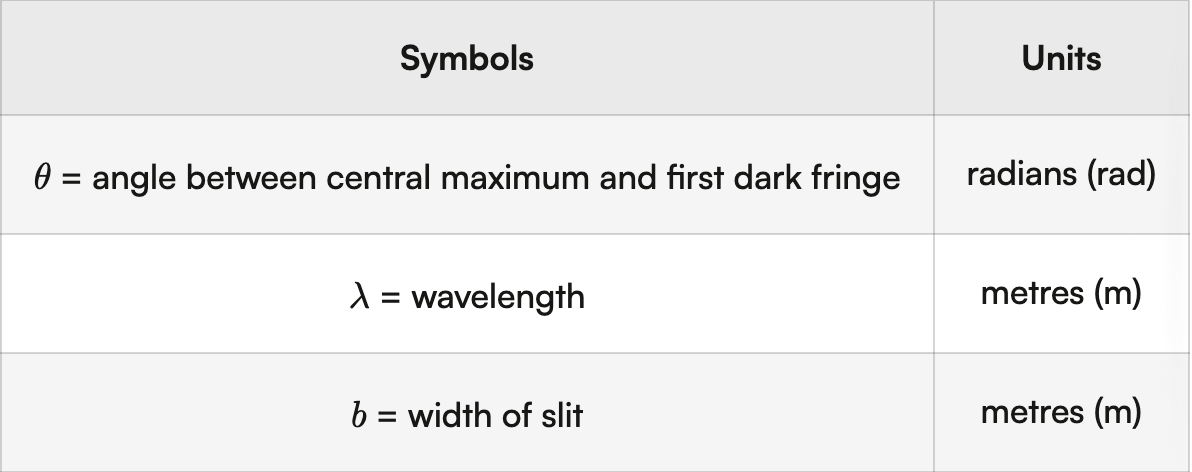
θ=bλ
You can see from the equation that the larger the slit width, the smaller the angle between the central maximum and the first dark fringe:
The larger the slit width, the narrower the width of the central maximum and the greater the intensity of the central maximum.
The smaller the slit width, the greater the width of the central maximum and the lower the intensity of the central maximum.

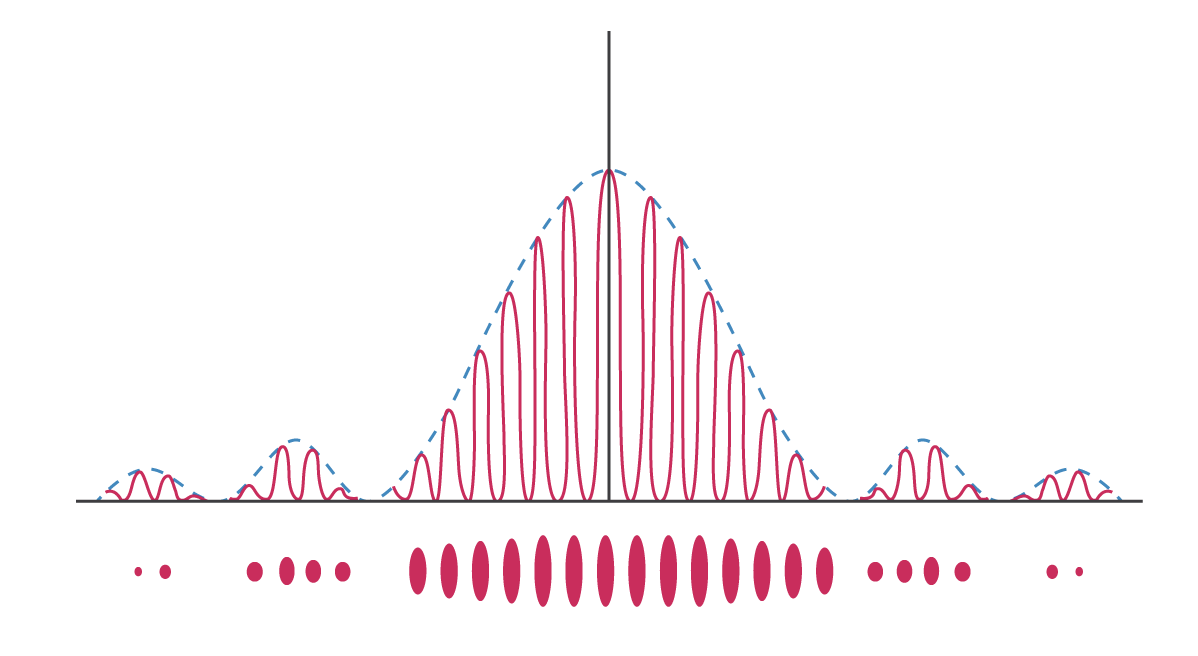
Pattern of light intensity for single-slit diffraction and double-slit diffraction.
You can observe a highly intense central maximum, less intense secondary maxima, and the same position for these maxima. However, there are also additional maxima and minima within the original pattern.
What is modulation?
In double-slit diffraction, the pattern created by the double slits overlaps the patterns of each single slit. This is known as modulation.
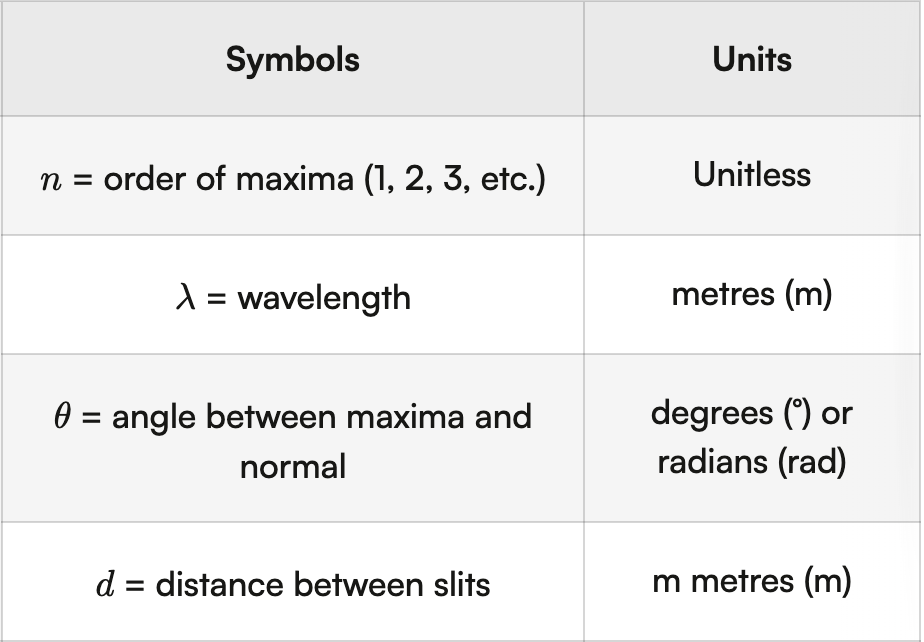
Equation for multi-slit diffraction
nλ=dsinθ
What will happen if the central of three slits is covered?
By covering one of the three slits, less light is getting through so it will not get brighter. As the separation increases (as it effectively does in this question) so the fringes get closer together. The relative intensity of adjacent maxima is controlled by the diffraction pattern and this has not changed as the width of each slit has not changed.
This leaves the maxima becoming less sharp as the only feasible answer. You know that as the number of slits increase so the maxima become sharper and the question is the opposite of this.