Medicine year 2
 Call Kai
 Learn
 Practice Test
 Spaced Repetition
 Match
 Flashcards
 Knowt Play
1/63

Earn XP
Description and Tags
Stability kinetics
64 Terms
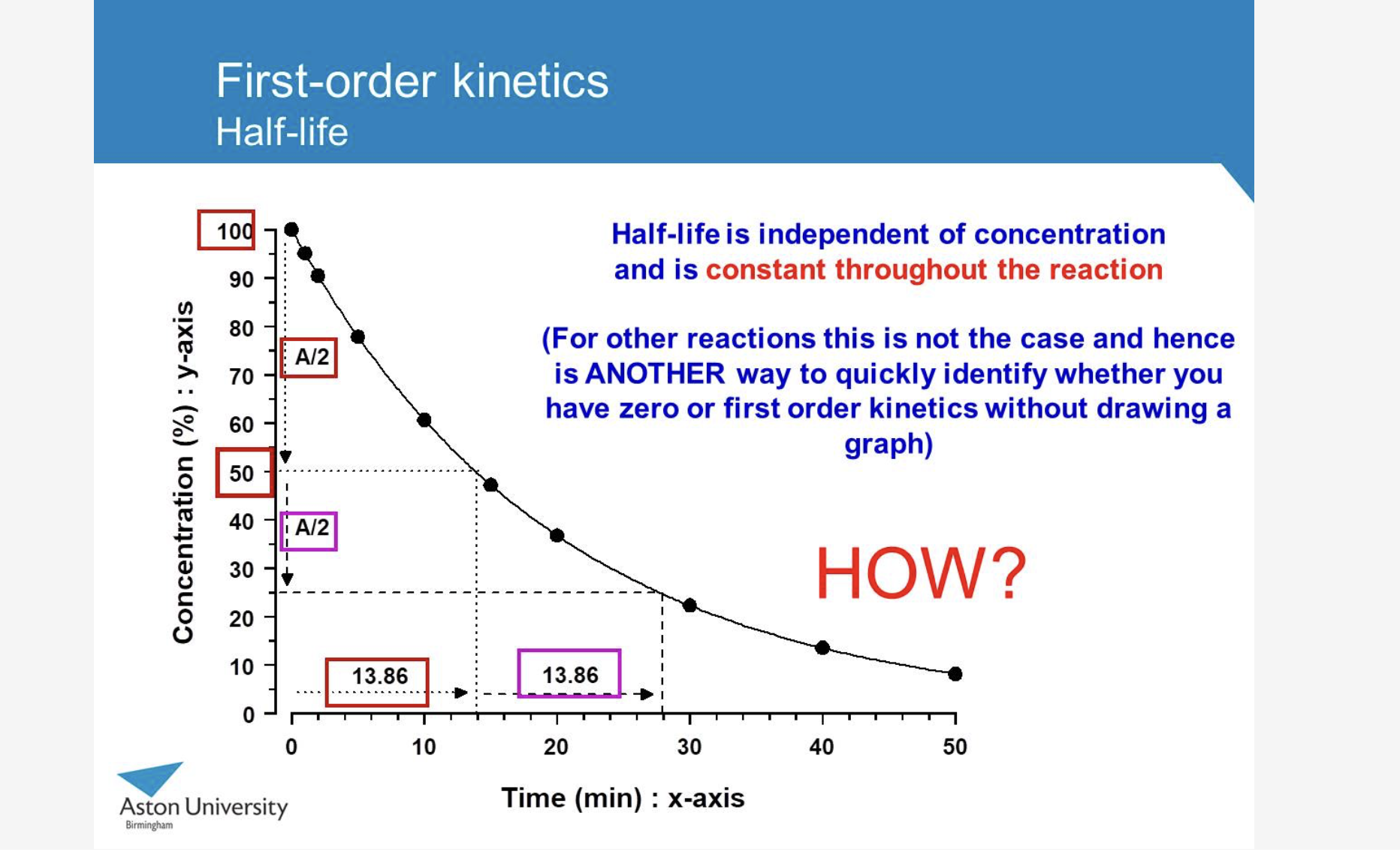
working out rate of reaction from a graph = change in concentration over time
The gradient/slope is:
Slope=change in concentrationchange in time
More specifically:
Slope= A2−A1
—————
t2−t1
Where:
A1 = initial concentration
A2 = final concentration
t1 = initial time
t2 = final time
⭐ Remember:
CHANGE=FINAL−INITIAL

When calculating the rate of reaction from the slope of a graph why does the rate become positive when at first it was negative ?
The slope is negative because the concentration is decreasing.
But when we're talking about the rate of disappearance of the drug, we normally wantthe rate expressed as a positive number.
Therefore:
Rate= −ΔAΔt
So:
Rate=−(−2)
Rate=+2%/h
straight line on a rate time graph indicates what order of reaction
first order
horizontal line is zero order

DTM salbutamol what functional groups
aromatic = benzene
aliphatic =sp3 from methyl
phenol= acidity adding base changes UV
secondary amine = is basic so can become protonated to become positive charge important for ion-ion interactions between drug and target site
hydrogen bonding
primary alcohol + secondary alcohol


which has highest wavelength and highest envy vs shorter wavelength and lower energy
light with highest energy at top = highest frequency and shortest wavelength
light at bottom least energy =smallest frequency = longer wavlength

explain the graph
absorbance = intensity of transition = in this graph is 2
UV-visible region = 200 to 800 nm in this instance its 200 to 400
if a drug isCOLOUREDit has someUV absorption>400 nm-800
VacuumUV region is from 200nm


like in the diagram HOMO TO LUMO would that need more energy or less
more energy to be put in
resonance look at videos
created pehnoxide ion from salbutamol Oh group reacted with base
phenoxide anion is more conjugated than normal phenol

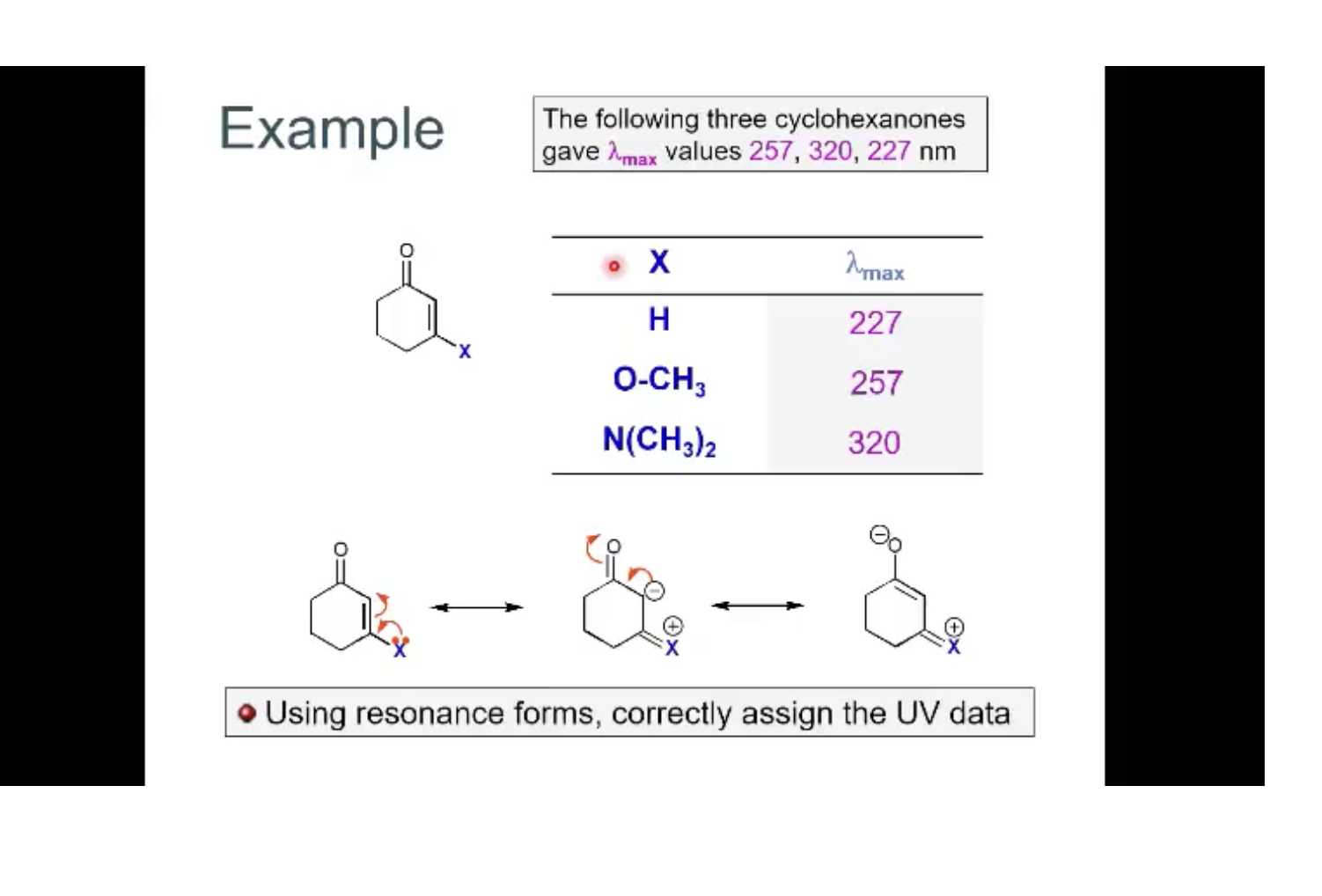
look at resonance question in exam like this


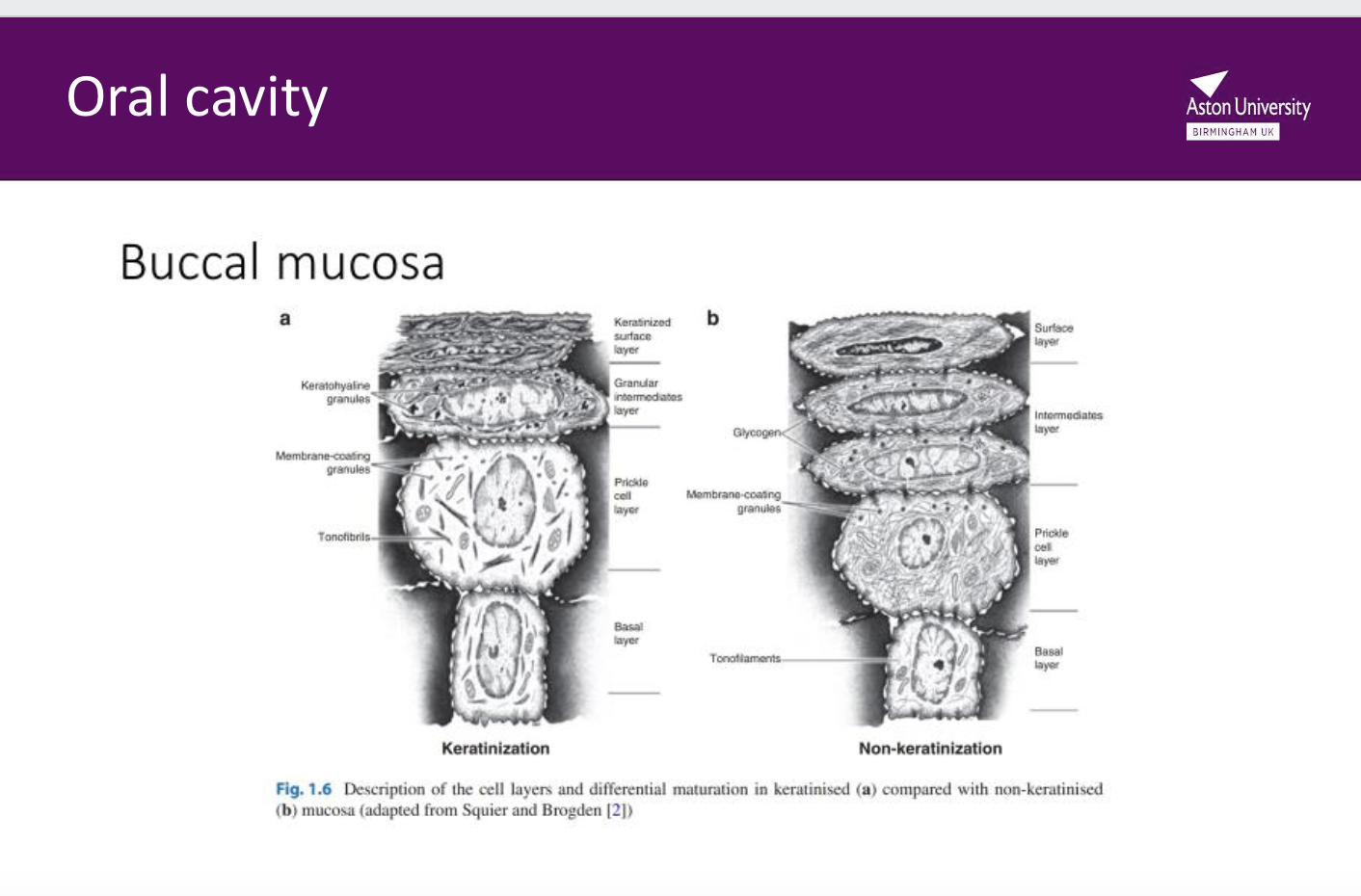
POP
cna swap g for c or a for t
but if g swapped with a changes code upwards or backwards
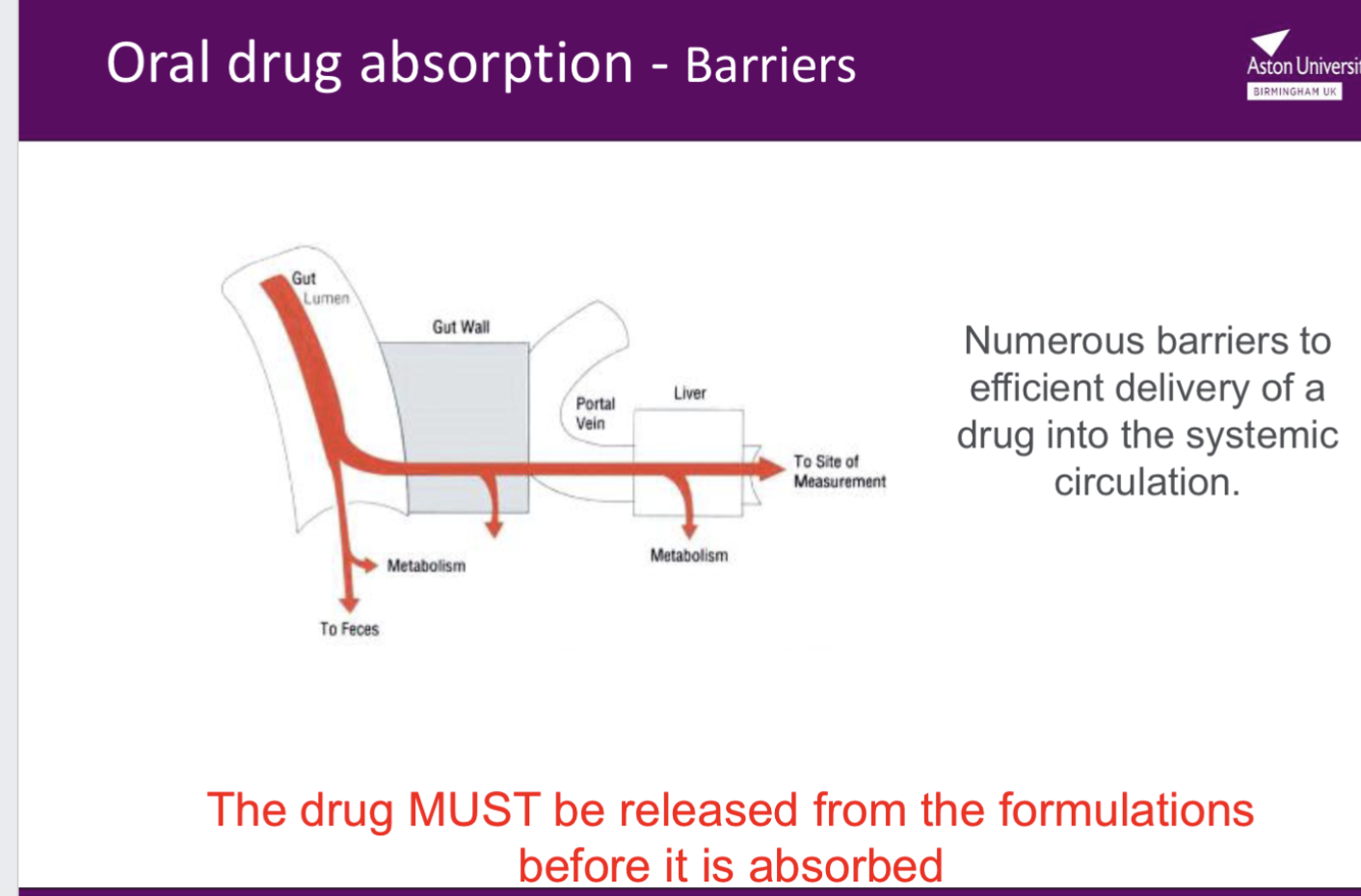
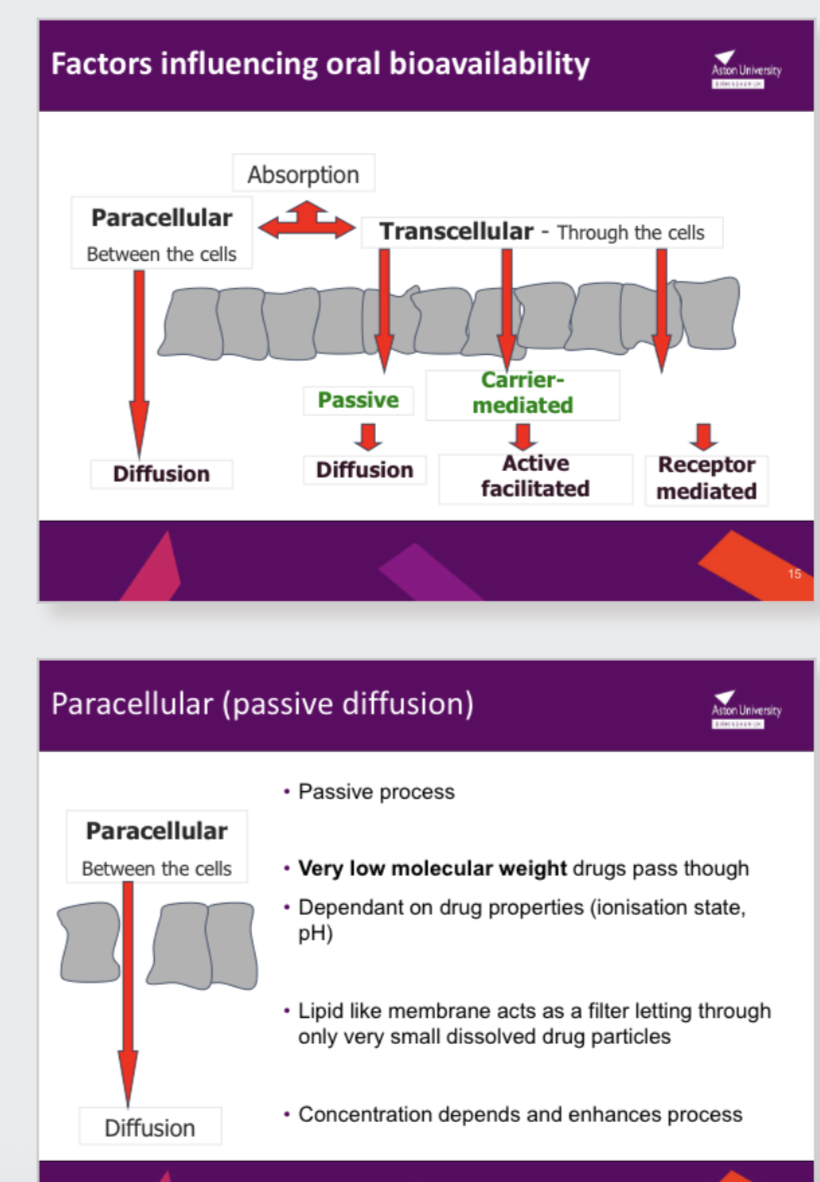
bioavailability

oral absorption


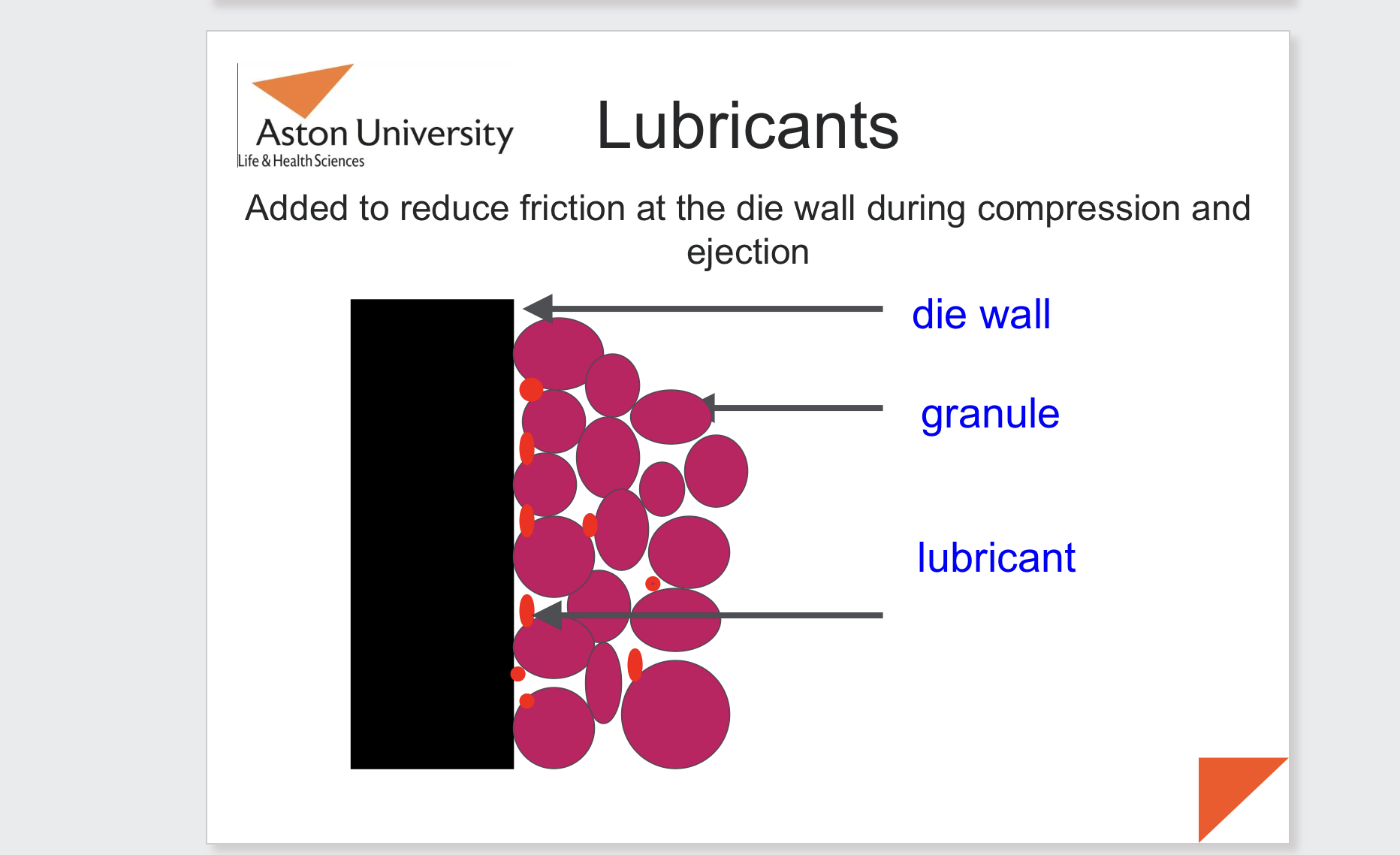
angle of repose diagram

measuring bulk density

Carrs index values


single punch machine

rotary press
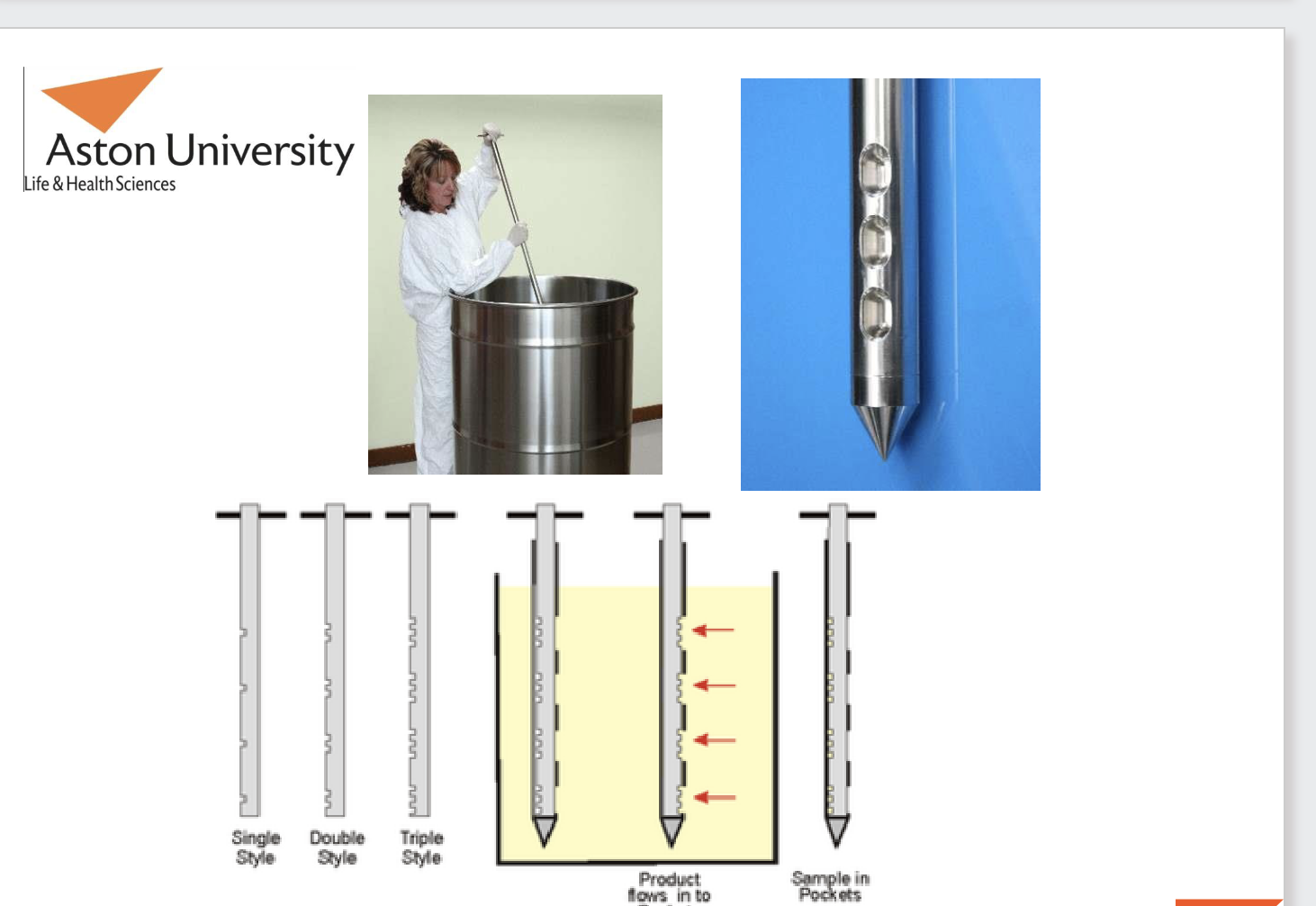
sample thief



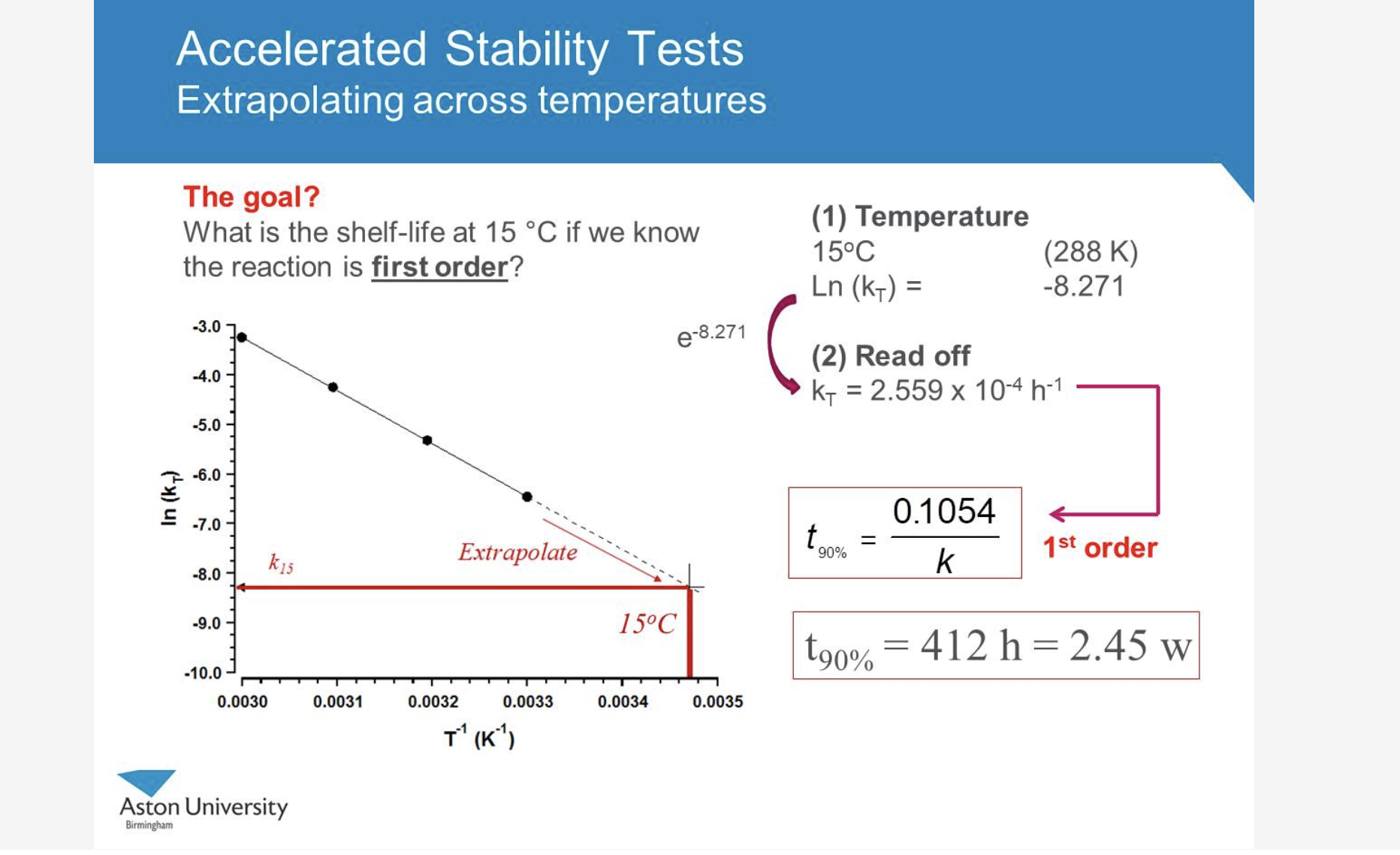
What is the rate constant at 45∘C45∘C?
The red lines help you read the answer from the graph.
Convert the temperature into kelvin.
T=45+273=318 KT=45+273=318 K
Calculate the reciprocal temperature.
1T=1318=0.003145 K−1T1=3181=0.003145 K−1
Find 0.0031450.003145 on the horizontal axis.
Move vertically up to the black line, then horizontally across to the vertical axis. The red lines show this process.
You read approximately:
ln(k)=−4.760ln(k)=−4.760
Convert the natural logarithm back into kk.
This is the most important final step!
4.Howdowegetkkfromln(k)ln(k)?
You have:
ln(k)=−4.760ln(k)=−4.760
To undo a natural logarithm, use the exponential function exex.
So:
k=e−4.760k=e−4.760
Using a calculator:
k=0.008563k=0.008563
The slide writes this in scientific notation:
k=8.563×10⁻³ h−1k=8.563×10⁻³ h−1
This is called taking the antilog of the natural log. On a calculator, use the exex function, not 10x10x.


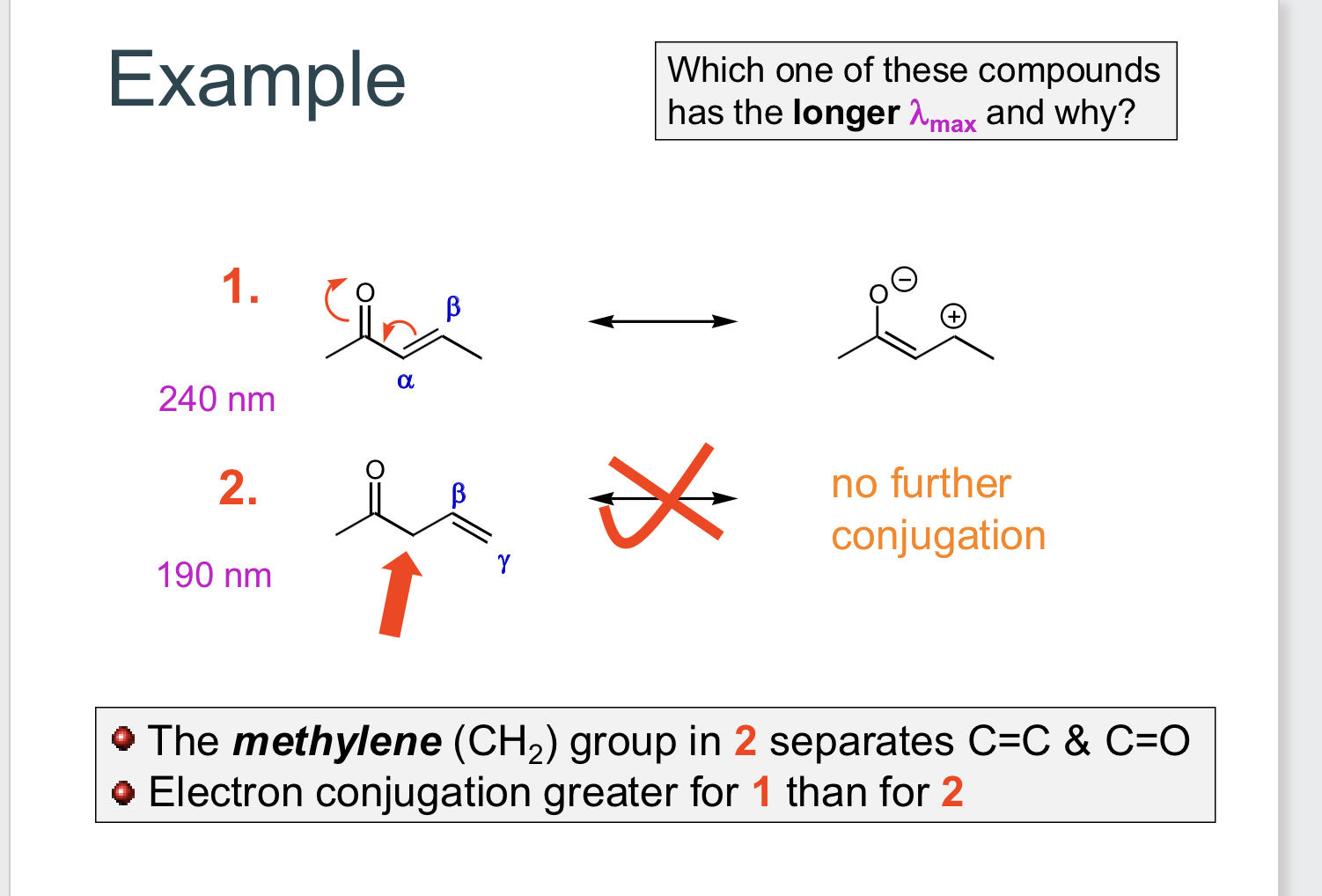
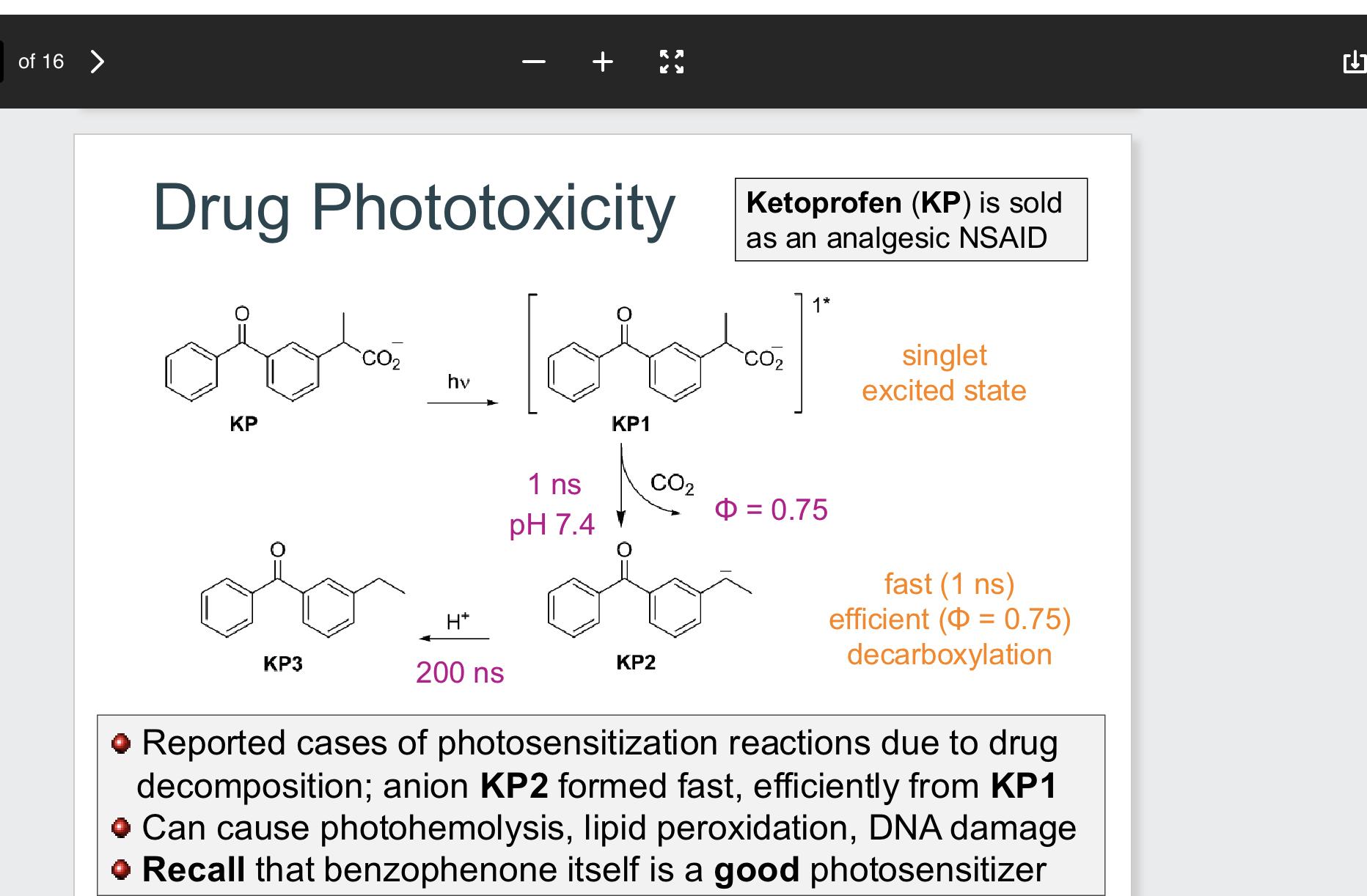
that longer conjugation effected by the addition of subitiuents means longer wavelength and longer lambda max
oes the subistutent allow conjugated system to be extended and if it does that means higher lambda m
Benzene with one –NH₂ group (aniline)
Nitrogen has a lone pair of electrons.
This lone pair can overlap with the benzene ring's ππ system.
It donates electron density into the ring by resonance.
Strong resonance donation (+M effect)

2. Benzene with two –NO₂ groups (dinitrobenzene)
Each –NO₂ group is strongly electron-withdrawing.
They pull electron density away from the benzene ring through resonance and induction.
They do not donate a lone pair into the ring like –NH₂ does.
I think you might mean why do opposing electron effects cancel each other out — for example, an electron-donating group (–NH₂) and an electron-withdrawing group (–NO₂)?
The key is that they don't necessarily cancel out!
Imagine this molecule:

p-nitroaniline: H₂N–benzene–NO₂
–NH₂ donates electrons into the benzene ring through resonance.
–NO₂ withdraws electrons from the ring through resonance.
Rather than cancelling, these effects can work together to allow electrons to delocalise from the –NH₂ end towards the –NO₂ end.
This is called a push–pull system, and it can lead to a longer λmaxλmax.

phenol lambda max increases because when it reacts with a an acid the oxygen lone pair is delocalised into he ring causing more conjugation , more conjugation means longer wavelength shorter energy difference longer lambda max
aniline when it reacts with acid to form nh3 pf course it’ll decrease because the lone pair on the nitrogen disspapera no longer increasing electron density + conjugation , decreasing wavelength and decreasing lambda max
if opposite nh3 added base means lone pair added longer lambda maxxx

ionisable groups are not attached to the donannt chromophore of benzene therefore adding acid or bae dwouldbt change wavelength or lambda amaxxxx

adding lamb Ama increases wavelength due to h plus leaving and lone pair of oxygen extending conjugation andwavelngth
NH would have been affected to nh2 but its not connected to dominant chromophore of phenol so no change

Conversely, adding a base to a carboxylic acid decreases its \(\lambda _{max}\) because the negative charge is locked into a highly stable, symmetrical resonance hybrid shared tightly between the two oxygen atoms, which increases the energy required for electronic transitions. [1, 2, 3]

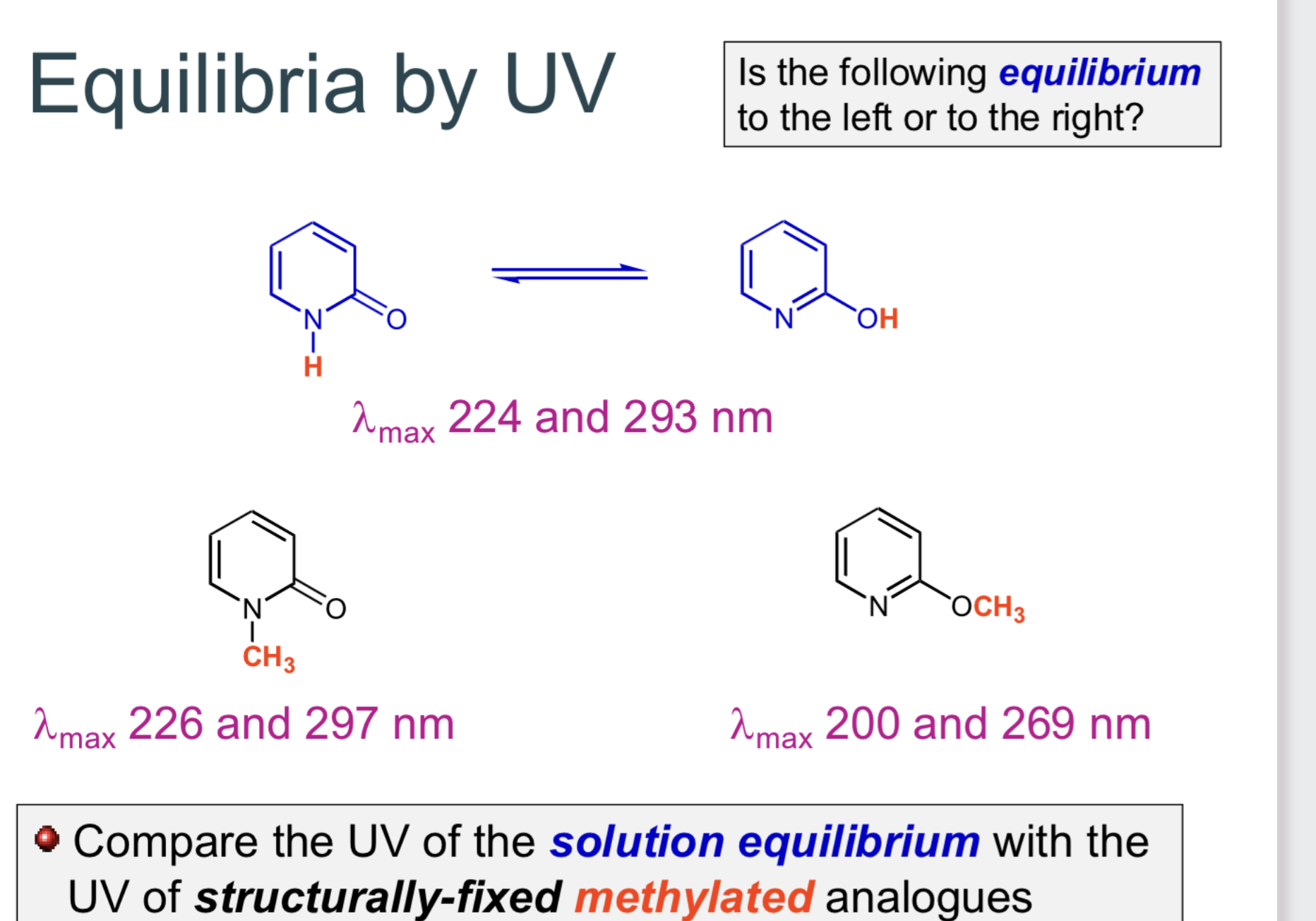
These are your reference spectra because methylation prevents the hydrogen frommoving betweennitrogenand oxygen in the same way.
Step2:Lookatthespectrumoftheequilibriummixture
You would measure the UV absorption of the solution containing both tautomers.
If its spectrum matches the N–CH₃ reference more closely, that suggests more ofthe left-hand N–Htautomer.
If its spectrum matches the O–CH₃ reference more closely, that suggests more ofthe right-hand O–Htautomer
so left molecule has similar wavelengths so equilibrium shifts left


research the trans thing if u want

if you look at the bottom diagrams I can flip this and say they’re not endocylic but exocylic to the neighbouring ring because its not in the same one

the acyclic triene is bascically 215 + 30 from the subistuents sits the same thing 245
alkyl group = sp3 hydrbirdised ,
ch3,ch2,ch , c

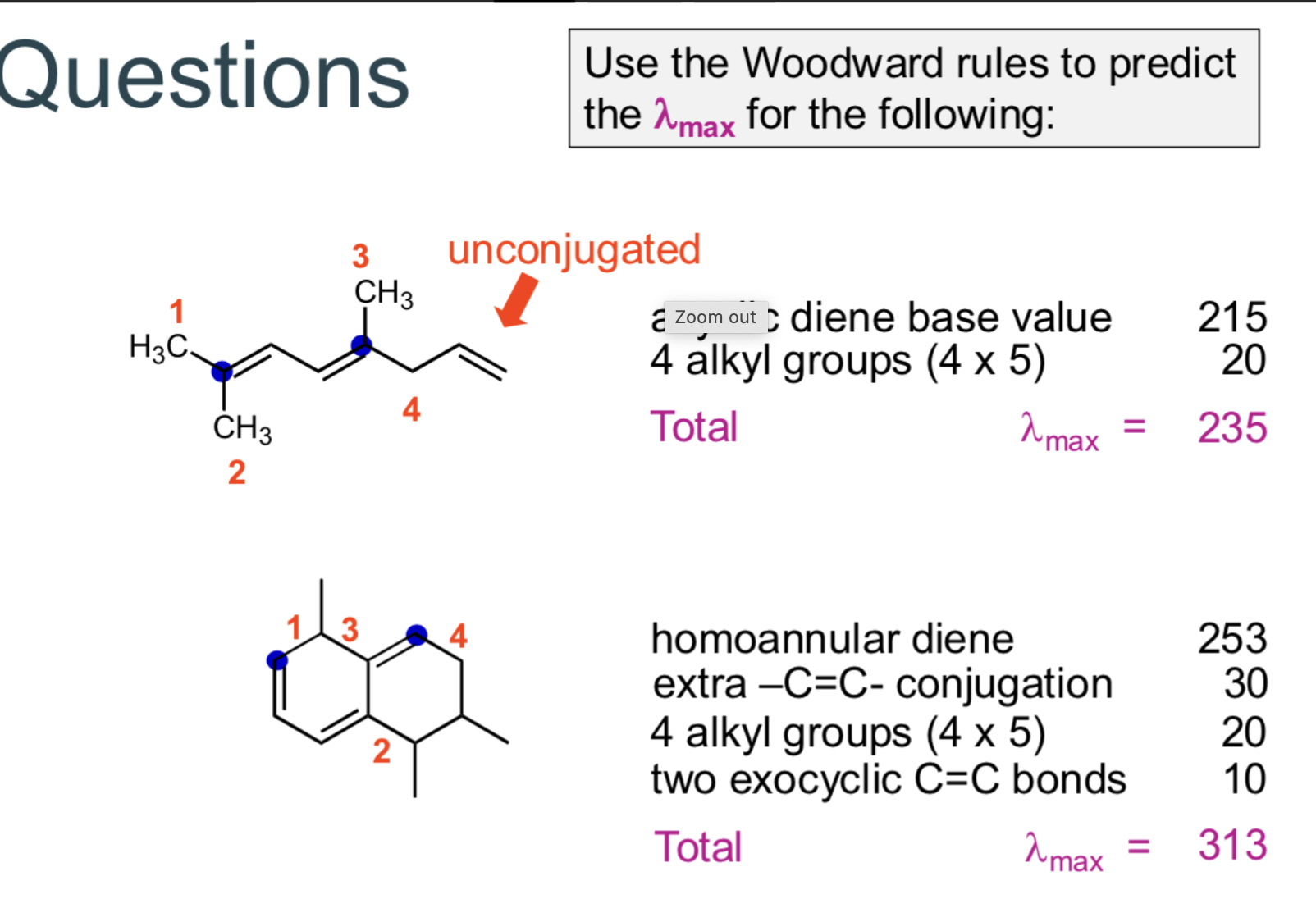
not a triene as its not in conjugation
two double bonds are considered excocyclic to each other


A stronger magnetic field increases the energy gap between the two proton spin states, increasing the population difference and therefore the sensitivity of the NMR signal.
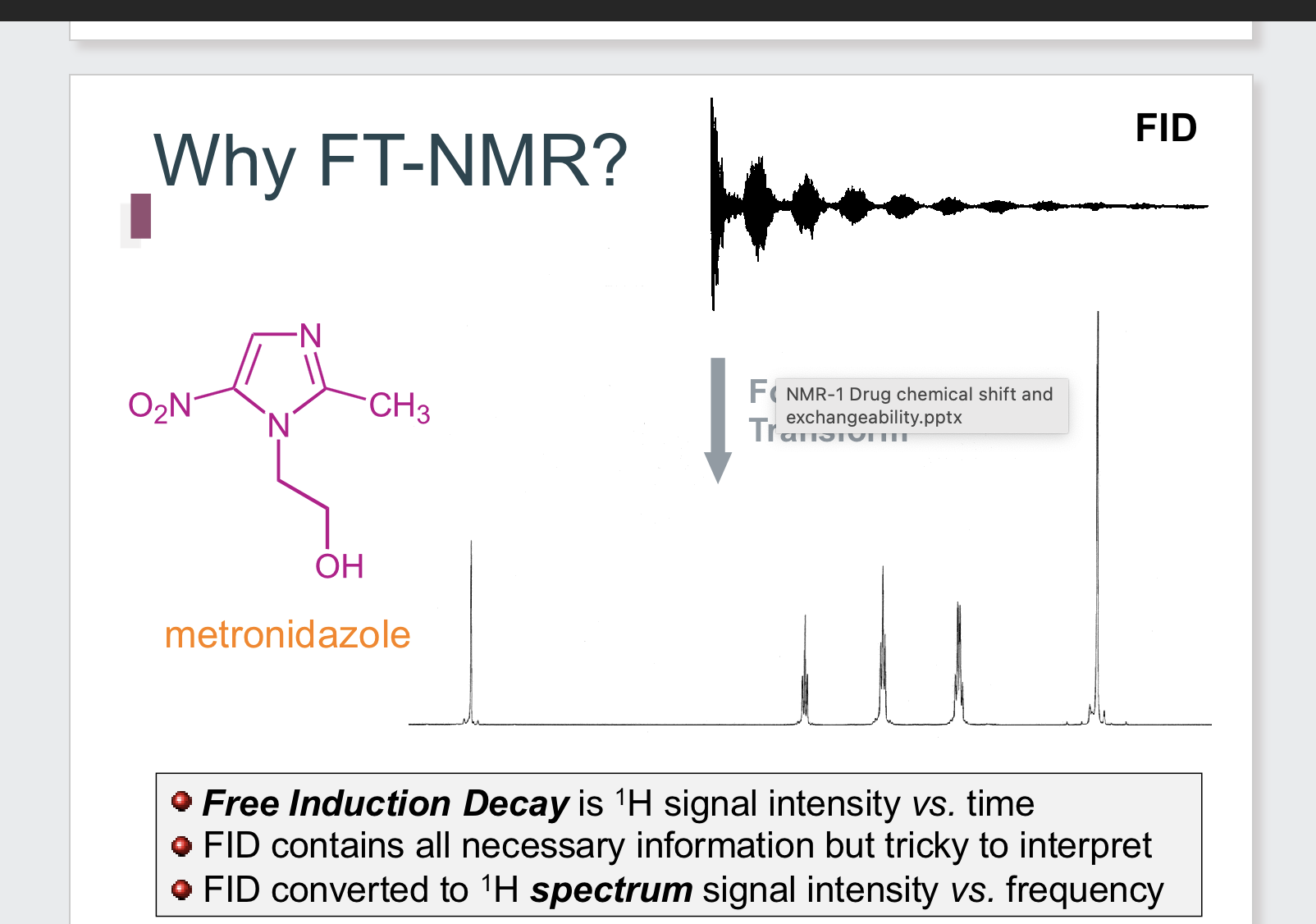
-protons receive the radio frequency and release energy is recorded as free induction decay
- includes signal intensity over time
- converted to signal intensity vs frequency
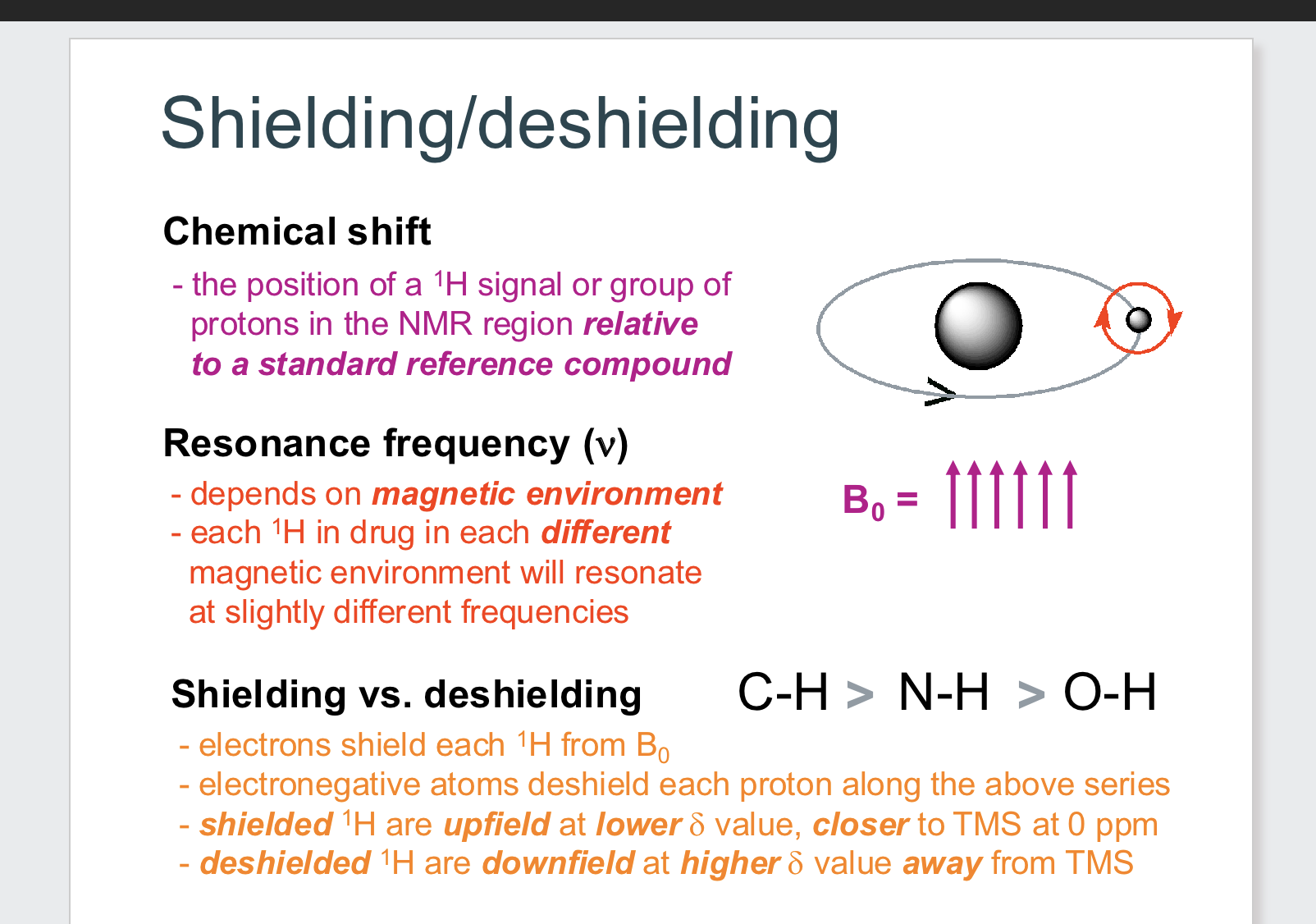

4 protons

anki
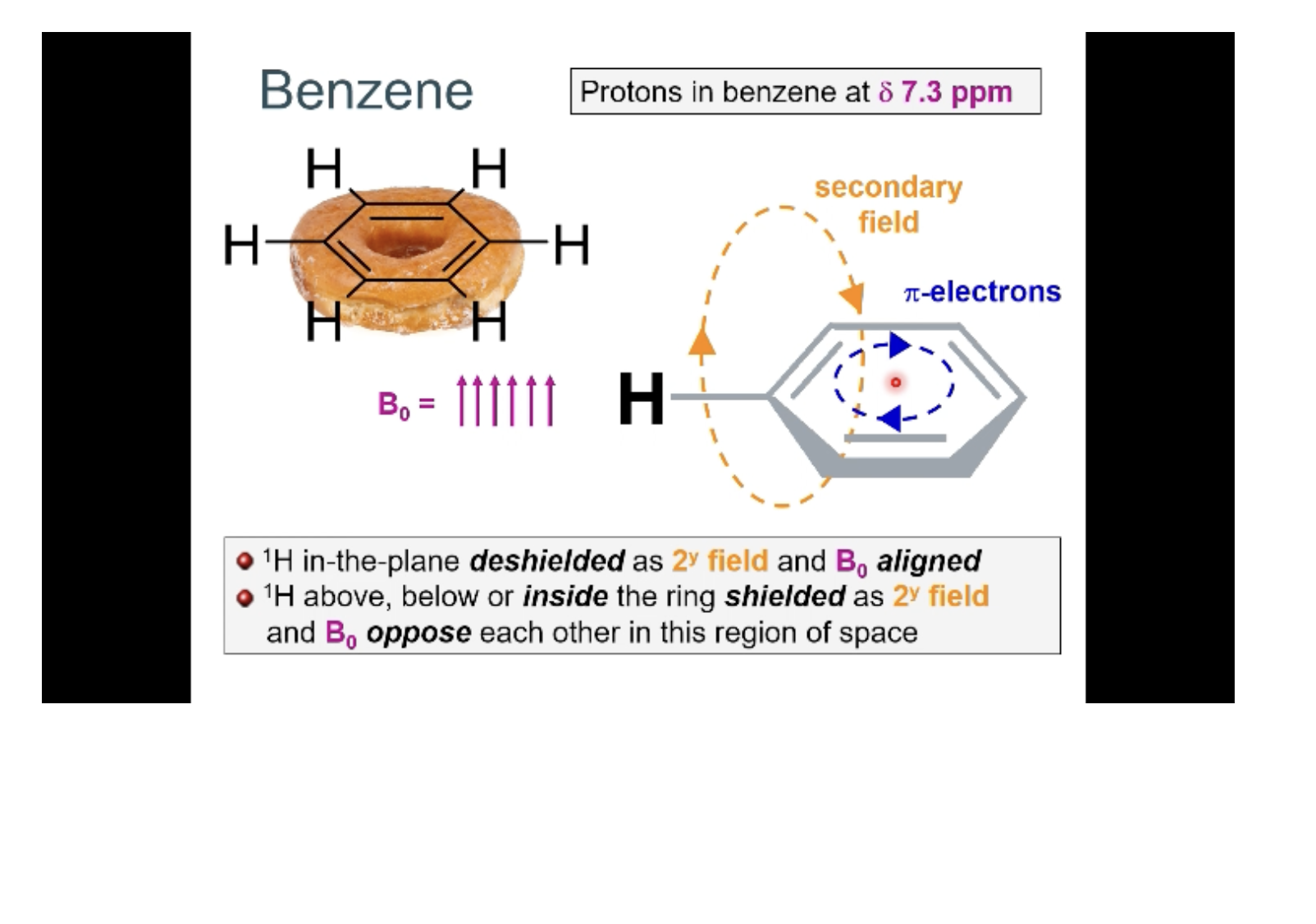
anki

Benzene has electrons that can move around the ring. When we apply a magnetic field in NMR, these electrons circulate and create their own small magnetic field, called the induced magnetic field.
This induced field affects the protons (H atoms) around the ring.
2.Whathappenstotheprotons?

A. Protons in the plane of the ring
The induced magnetic field adds to the external magnetic field.
The proton feels a stronger magnetic field.
It becomes deshielded.
It appears further to the left on an NMR spectrum (higher ppm).

B. Protons above or below the ring
The induced magnetic field opposes the external magnetic field.
The proton feels a weaker magnetic field.
It becomes shielded.
It appears further to the right on an NMR spectrum (lower ppm).
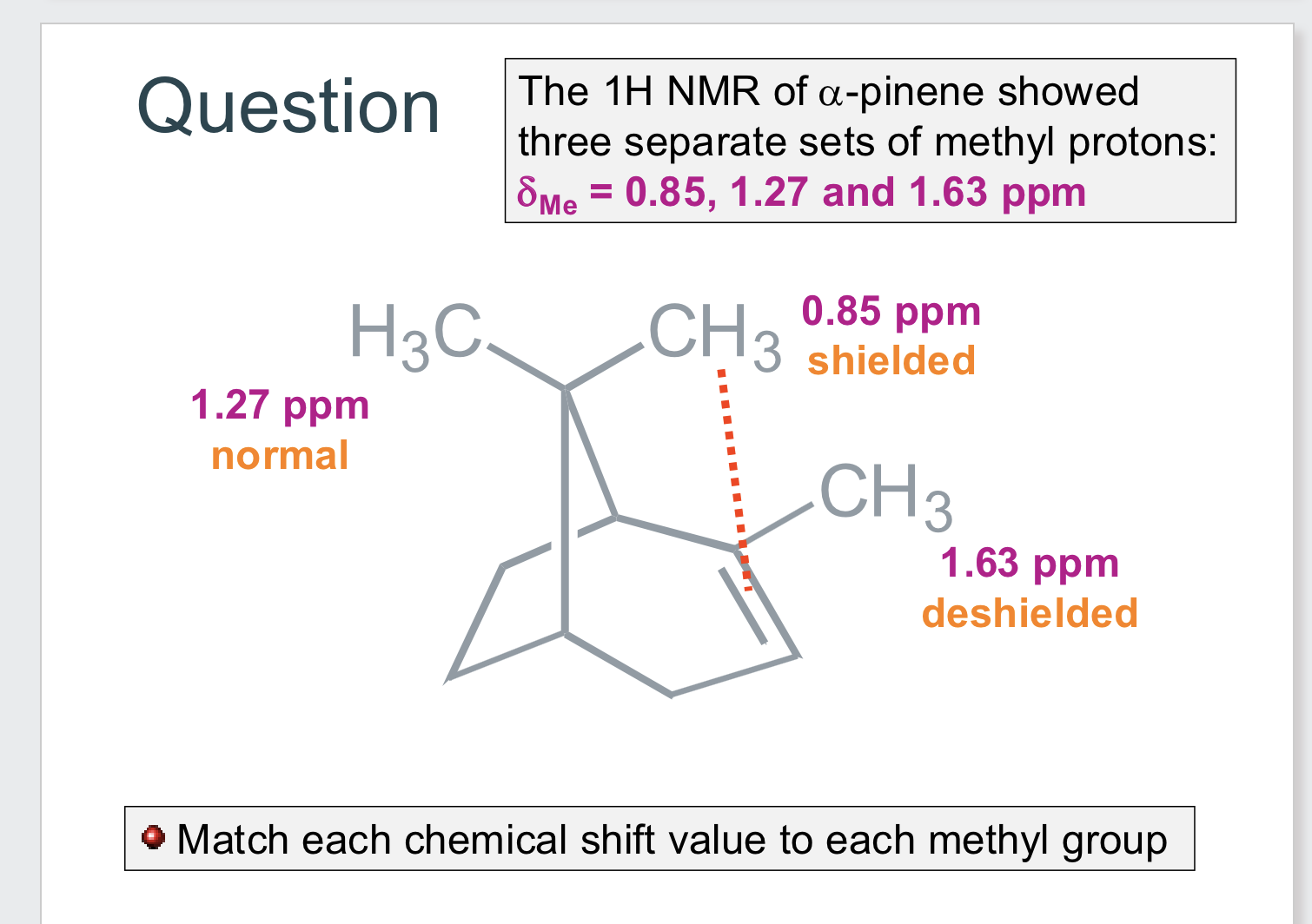
Top-right CH₃ — shielded
This methyl group is positioned in the shielding region created by the nearby double bond. The double bond's electrons generate an induced magnetic field that reduces the effective field experienced by these protons.
1.27 ppm
Top-left CH₃ — normal
This methyl group is not strongly affected by the double bond's shielding or deshielding regions, so it has a typical methyl chemical shift.
1.63 ppm
Right-side CH₃ — deshielded
This methyl group is close to the double bond and lies in its deshielding region. The induced magnetic field increases the effective field experienced by these protons, so the signal moves to a higher ppm.
Step 3: Why does the double bond matter?
The double bond in α-pinene has π electrons. When the NMR magnetic field is applied, these electrons circulate and create an induced magnetic field.
That field has different effects in different places around the double bond:
Some positions experience shielding → lower ppm.
Other positions experience deshielding → higher ppm.
This is called the magnetic anisotropy effect.
Magnetic anisotropy is the effect whereby circulating π electrons create an induced magnetic field that shields or deshields nearby protons depending on their position relative to the π bond.
anisotropy = different effects in different positions
isotropy = same in all directions

- mark on the integral where each peak begins/ends
- draw horizontals where marks coincide
- measure the distance between each horizontal
- divide through by the smallest value
- for ratio of whole protons, multiply by integer 1,2,3
here he divided all distances by 18 as its the smallest number
gives 1;1;2; ratio etc

multiplicity

Integration does NOT tell you how many peaks you see. It tells you how many protons the signal represents.
The three neighbouring protons split the CH₂ signal according to the \(n+1\) rule.
Here, \(n=3\), because the neighbouring CH₃ group has 3 protons.
\[ \text{Number of peaks}=n+1=3+1=\boxed{4} \]
Four peaks = a quartet.
The CH₂ signal is therefore a quartet that represents 2 protons.
3.WhydoesCH₃show3peaks(atriplet)?
Now look at the CH₃ group.
Its neighbouring CH₂ group has 2 protons.
\[ \text{Number of peaks}=n+1=2+1=\boxed{3} \]
Three peaks = a triplet.
So the CH₃ signal represents 3 protons, but appears as 3 peaks.
4.Puteverythingtogether
CH₂ group
Integration = 2H
3 neighbouring H → quartet
4 peaks
CH₃ group
Integration = 3H
2 neighbouring H → triplet
3 peaks
One important correction: In the image, CH₂ is a quartet and CH₃ is a triplet. Your lecturer is saying that the CH₂ group integrates to 2, while its signal is split into a quartet because it has 3 neighbouring protons.
Also, both signals have the same coupling constant, \(J=7.5\text{ Hz}\), because the CH₂ and CH₃ protons are coupled to each other.

No worries — let’s start right at the beginning, using your furan ring. We’ll leave doublets and quartets aside for a moment.
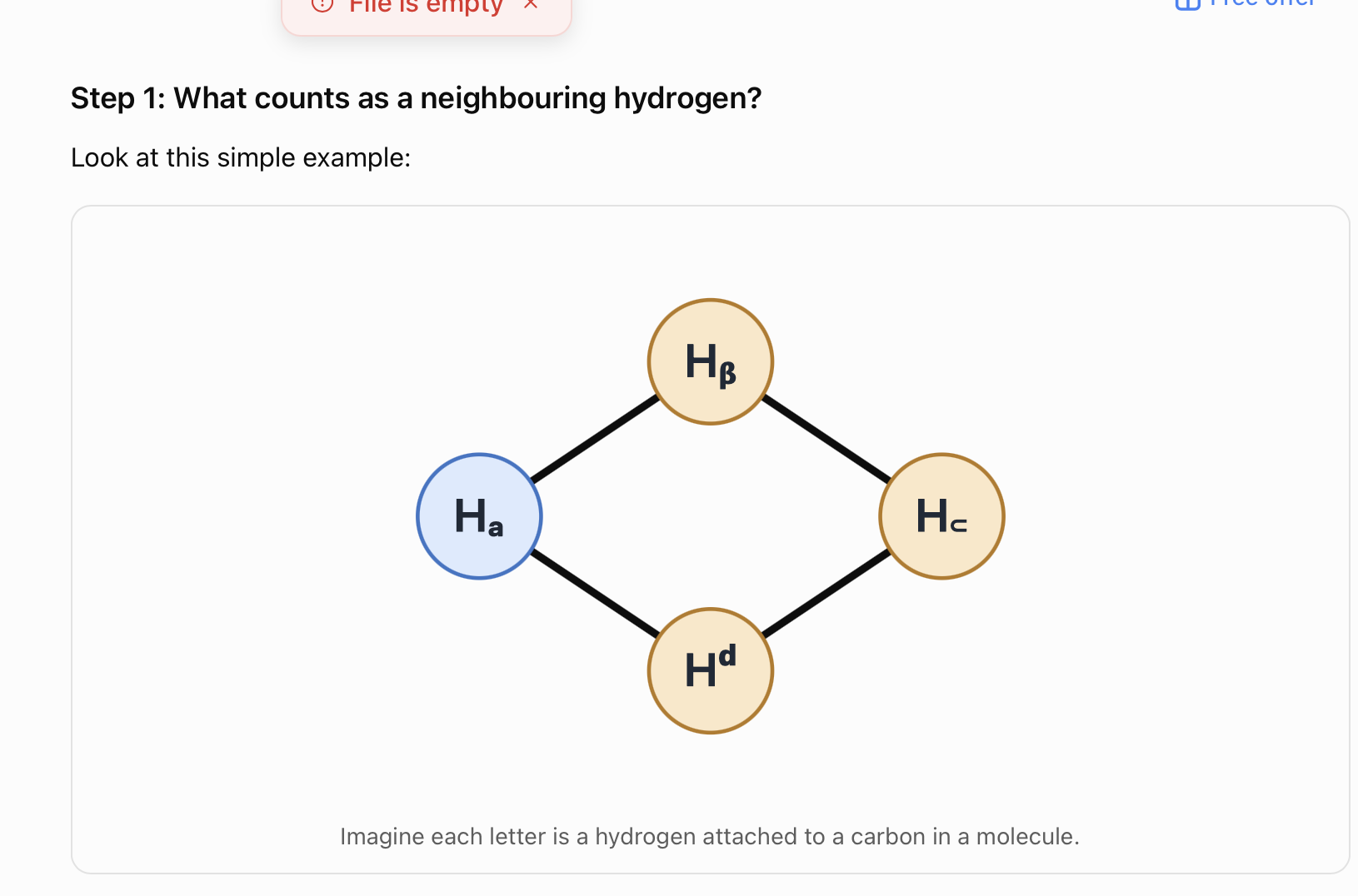
Step 1: What counts as a neighbouring hydrogen?
Look at this simple example:
Imagine each letter is a hydrogen attached to a carbon in a molecule.
Hᵦ is a neighbour of Hₐ if their carbons are directly connected to each other (in a typical simple proton NMR example).
Think of it like houses on a street: the houses directly next door are neighbours; houses farther down the street are not immediate neighbours.
Step 2: Try one together
If we are looking at Hₐ, which hydrogen is directly next to it in the drawing?
Hᵦ only
Hᵦ and Hᵈ
Hᵦ, H꜀ and Hᵈ
Once this part clicks, we can use the neighbouring hydrogens to understand splitting — one step at a time.
okay got that now
Yay! 😊 That’s the first step sorted.
Now let’s connect it to NMR splitting, one step at a time.
Step 2: How many neighbouring hydrogens?
Remember our drawing? We were looking at Hₐ, which had two neighbouring hydrogens: Hᵦ and Hᵈ.
Here’s the basic rule:
Neighbouring hydrogens | Signal |
|---|---|
0 | Singlet (s) |
1 | Doublet (d) |
2 equivalent hydrogens | Triplet (t) |
3 equivalent hydrogens | Quartet (q) |
2 non-equivalent hydrogens | Often a doublet of doublets (dd) |
The key word is equivalent: the two neighbouring hydrogens must behave the same way for the usual triplet rule to apply.
Your turn!
If the hydrogen we’re looking at has just one neighbouring hydrogen, what signal does it usually produce?
Singlet
Doublet
Triplet
okay
Great 😊 Let’s do one more small step.
If the hydrogen we’re looking at has two neighbouring hydrogens that are equivalent (they behave the same way), what signal does it usually produce?
Doublet (2 lines)
Triplet (3 lines)
Doublet of doublets (4 lines)
Correct! Two equivalent neighbouring hydrogens usually give a triplet.
They behave together, creating three signal lines.
ok
You’re doing fine 😊 Now let’s connect this to the part that was confusing you.
If a hydrogen has two neighbouring hydrogens that are NOT equivalent, what can its signal look like?
Triplet (3 lines)
Doublet of doublets (4 lines)
Singlet (1 line)
ok
You’re getting there! 😊 Let’s try one final question using your original furan ring.
Remember:
d = 2 lines
t = 3 lines
dd = 4 lines from two different splitting interactions
If a hydrogen couples to two non-equivalent neighbouring hydrogens, why can it give a dd instead of a triplet?
Because both neighbours split the signal by different amounts. this
Because the hydrogen splits into four pieces.
Because there are four neighbouring hydrogens.

Look at the ring in your diagram. Each hydrogen has two other ring hydrogens it can couple with.
1. Signal for Hₐ
Hₐ couples with Hₘ and Hₓ.
Hₘ splits Hₐ's signal into 2.
Hₓ splits those 2 lines into 4.( 2 from before is added to make 4)
Result: dd (4 lines)
2. Signal for Hₘ
Hₘ couples with Hₐ and Hₓ.
Hₐ splits Hₘ's signal into 2.
Hₓ splits those 2 lines into 4.
Result: dd (4 lines)
3. Signal for Hₓ
Hₓ couples with Hₐ and Hₘ.
Hₐ splits Hₓ's signal into 2.
Hₘ splits those 2 lines into 4.
Result: dd (4 lines)
But why a dd instead of a triplet?
Because the two neighbouring hydrogens are not equivalent. They couple with the hydrogen you’re observing by different amounts.
Two equivalent neighbours → usually a triplet.
Two non-equivalent neighbours → potentially a dd.
Remember, the letters A, M and X just label the three different hydrogens. Each hydrogen has its own signal and can couple with the other two.
Quick check: If Hₐ couples with Hₘ and Hₓ, how many other hydrogens is Hₐ coupling with?
Each neighbouring hydrogen splits the signal separately, and the two splittings can have different spacings.
dd = 4 lines from two different splitting interactions

how do you know which proton to start the splitting from?
Greater the coupling constant, more the splitting strong.. so start with the proton of high coupling constant.
One signal
We begin with one signal for \(H_A\).
First
\(H_M\) splits it
One signal becomes two lines. This is a doublet.
Second
\(H_X\) splits it too
Each of those two lines splits again, giving four lines in total.
Result
Doublet of doublets (dd)
Two separate splitting interactions produce four lines.
The same reasoning applies to \(H_M\) and \(H_X\): each can couple to the other two hydrogens, giving a dd when both couplings are resolved.
3. What do \(J_{AM}\), \(J_{AX}\) and \(J_{MX}\) mean?
The pink labels are called coupling constants, written as \(J\). They tell you the strength of the interaction between two particular hydrogens, measured in hertz (Hz).
Label | Meaning |
|---|---|
\(J_{AM}\) | Coupling between \(H_A\) and \(H_M\) |
\(J_{AX}\) | Coupling between \(H_A\) and \(H_X\) |
\(J_{MX}\) | Coupling between \(H_M\) and \(H_X\) |
Each hydrogen has two different coupling interactions:
\(H_A\) couples to \(H_M\) and \(H_X\).
\(H_M\) couples to \(H_A\) and \(H_X\).
\(H_X\) couples to \(H_A\) and \(H_M\).
That is why each can produce a dd.
4. What does AMX mean at the bottom?
AMX is simply a way of labelling three chemically different hydrogens whose signals occur at different chemical shifts.
A and X are furthest apart in chemical shift.
M lies in between them.
Chemical shift tells you where a signal appears on the NMR spectrum. Coupling tells you how that signal splits.
These are two different things!
The one thing to remember
Chemical shift = where the signal appears.
Coupling = how the signal splits.
dd = two different coupling interactions, each splitting the signal into two.
You don't need to calculate the \(J\) values just to understand why the signals are labelled dd.
Look at the ring in your diagram. Each hydrogen has two other ring hydrogens it can couple with.
1. Signal for Hₐ
Hₐ couples with Hₘ and Hₓ.
Hₘ splits Hₐ's signal into 2.
Hₓ splits those 2 lines into 4.
Result: dd (4 lines)
2. Signal for Hₘ
Hₘ couples with Hₐ and Hₓ.
Hₐ splits Hₘ's signal into 2.
Hₓ splits those 2 lines into 4.
Result: dd (4 lines)
3. Signal for Hₓ
Hₓ couples with Hₐ and Hₘ.
Hₐ splits Hₓ's signal into 2.
Hₘ splits those 2 lines into 4.
Result: dd (4 lines)
But why a dd instead of a triplet?
Because the two neighbouring hydrogens are not equivalent. They couple with the hydrogen you’re observing by different amounts.
Two equivalent neighbours → usually a triplet.
Two non-equivalent neighbours → potentially a dd.
Remember, the letters A, M and X just label the three different hydrogens. Each hydrogen has its own signal and can couple with the other two.
Quick check: If Hₐ couples with Hₘ and Hₓ, how many other hydrogens is Hₐ coupling with?
uick check: If Hₐ couples with Hₘ and Hₓ, how many other hydrogens is Hₐ coupling with?
two hydrogens ?
YES! Exactly right! 🎉
Hₐ couples with two other hydrogens: Hₘ and Hₓ.
Now the next step:
Hₘ splits Hₐ’s signal into 2 lines.
Hₓ splits each of those lines into 2 more.
You get 4 lines altogether = a dd.

Look at the molecule on the left. It has an OH group and two CH₂ groups.
The important part is the chain:
NCH2CH2OH
The diagram shows three signals:
OH = triplet (t) in this example.
NCH₂ = triplet (t).
CH₂O = quartet (q).
Why is CH₂O a quartet? Because the CH₂ group next to oxygen couples with:
The two hydrogens on the neighbouring NCH₂ group → usually gives a triplet, if those two hydrogens are equivalent.
The OH hydrogen → can split it further, giving a quartet if that coupling is resolved.
So the CH₂O signal changes from a triplet to a quartet because of the extra OH coupling.
2.WhathappenswhenD₂Oisadded?
D₂O is heavy water. It exchanges the hydrogen in OH for deuterium (D):
\
The OH hydrogen is replaced by D.
Why does that matter? The OH proton no longer provides the same splitting of the CH₂O signal. Deuterium behaves differently from ordinary hydrogen in a ¹H NMR spectrum, and its coupling to nearby protons is usually not resolved in the same way.
3.WhydoesCH₂Ochangefromaquartettoatriplet?
Before adding D₂O:
Two neighbouring NCH₂ hydrogens give a triplet.
Coupling to OH splits those lines further, giving a quartet in the simplified example.
After adding D₂O:
The OH proton is replaced by D.
That OH-related splitting disappears.
The two neighbouring NCH₂ hydrogens now give a triplet.
The OH signal also disappears from the ¹H NMR spectrum because the OH proton has been exchanged for deuterium.
Themainthingtoremember
D₂O replaces exchangeable OH hydrogens with deuterium. This makes the OH signal disappear and can remove splitting caused by the OH proton.
One small correction to the diagram’s shorthand: the quartet-to-triplet change is best understood as loss of the resolved coupling to OH, leaving the usual triplet from the two neighbouring CH₂ hydrogens.