Cancer - 13
 Call Kai
 Learn
 Practice Test
 Spaced Repetition
 Match
 Flashcards
 Knowt Play
1/43

There's no tags or description
Looks like no tags are added yet.
44 Terms
3 theories as to what caused cancer
-virus
-environment
-genetics
Rous sarcoma virus
The first animal virus implicated in cancer, it was discovered in 1908 in chickens → causes cancer in connective tissue
What did Rous do to discover Sarcoma?
-studied chickens with tumours
-transplanted tumour cells into a new chicken and chicken developed a tumour
Michael Bishop and Harold Varmus (studied RSV)
(1989 nobel prize) Cancer-inducing genes carried by viruses are derived from the animal cells genome
where did the Src oncogene come from?
a virus brought it from chickens. There is an Src gene in normal chicken genes.
Oncogenes
genes which when mutated or overactivated drive a cell towards uncontrolled growth (gain of function mutations).
Proto-oncogenes
the corresponding normal cellular genes that are responsible for normal cell growth and division
how can a proto-oncogene be converted into an oncogene?
-Mutation of the DNA
-Duplication of the gene (leads to higher amount of a protein than normal)
-chromosome rearrangement to alter expression of the gene and result in higher amount of proten
Tumour suppressor genes
Genes in normal cells that encode products that suppress uncontrolled cell proliferation.
what happens when tumour suppressor genes are mutated to a non-active form?
-drive cell towards uncontrolled growth
examples: Rb, p53
Are oncogenes dominant or recessive?
dominant (only need one copy for cell to become cancerous)
Are tumour suppressor gene mutations dominant or recessive?
recessive
what are the properties of cancer cells?
-grow in clumps
-produce own growth factors (autocrine growth stimulation)
-accumulate mutations
-colonize areas where other cells normally grow (cancer cells can digest/penetrate through other cell membranes)
-don’t undergo apoptosis
-don’t use oxidative phosphorylation → produce lactate for energy (high need for glucose, import at a rate 100 times higher than normal cells)
density-dependent inhibition
The arrest of cell division that occurs when cells grown in a laboratory dish touch one another. Cancerous cells don’t adhere to this and grow regardless, in clumps.
cancer cell growth factors
some produce their own and use autocrine growth signalling. therefore continuous cell growth.
what are the 3 main pathways implicated in cancer?
-Rb pathway (initiation of cell division)
-Ras pathway (RTK-Ras-PI3K) proto-oncogene
-p53 pathway (cell cycle arrest due to DNA damage) tumour suppressor
Ras-Raf-MEK-ERK Pathway
1. Growth factor mitogen binds to RTK
2. Phosphorylated tyrosine groups recruit GEF, binding on SH2 domain to phosphorylated tyrosines
3. GEF interact with inactive Ras protein, activates to Ras-GTP (GTPase)
4. Active Ras binds/activates Raf → activates MEK (via phosphorylation) → activates MAP kinases ERK 1/2
5. ERK can enter nucleus once phosphorylated, can phosphorylate a target protein/TF which leads to activation of transcription and mitosis
which pathway activates early response genes?
Ras-Raf-Mek-ERK
what are some of the genes activated by the Ras pathway and how could they turn cancerous?
some Ras pathway genes regulate delayed response genes (i.e. Cdks and cyclins)
if Ras pathway always on → UNCONTROLLED GROWTH
how do cancer cells colonize other cells?
secrete proteases that digest extracellular matrix components, allowing cancer cells to digest and penetrate through laminae
how are cancer cells similar to embryonic cells?
rely on lactate production for energy.
cancer cell metabolism requires an abnormal amount of
glucose, 100x more than other cells because fermentation
if Ras is constitutively activated....
cells progress through cell cycle → uncontrolled cell growth
if Rb is inactivated.......
cells progress through cycle
if p53 is mutated
no cell cycle arrest or apoptosis
what are the 4 therapies for cancer?
1- radiation
2- chemotherapy
3- target-specific inhibition
4- immunotherapy
how does radiation work? what are the two main varieties of cell death?
-intense beams of radiation damage the DNA (either ss or ds)
a. apoptosis: before mitosis
b. mitotic catastrophe: mis-segregation of chromosomes after mitosis. signalling pathway leading to cell death.
chemotherapy? how does that work
kills rapidly-dividing cells but also normal rapidly dividing cells (bone marrow and hair follicle)
name 5 types of chemotherapeutics
-alkylating agents (cross link DNA strands
-antimetabolites (nucleotide agonists)
-antifolates (Dihydrofolate → tetrahydrofolate, inhibition of DHFR)
-anti-MT agents (disruption of mitotic spindle formation)
-topoisomerase inhibitors (additional tension on DNA strands)
Alkylating agents
synthetic chemicals containing alkyl groups that attack DNA, causing strand breaks because of irreparable base cross linkage. Causes apoptosis
Antimetabolites
agonist nucleotides that resemble bases used for DNA and RNA synthesis. When incorporated into the nucleic acid they prevent further cell division, or can induce apoptosis.
Antifolates
a compound called methotrexate inhibits the enzyme (DHFR) that catalyzes the reaction that takes dihydrofolate and turns it into purines and thymidine
anti-microtubule agents
interfere with MT dynamics, spindle formation is disturbed; mistakes during mitosis
i.e. kinetocore, astral (uses dynein), interpolar (use spindle kinesins)
Topoisomerase inhibitors
inhibition puts additional stress on the DNA resulting in double-stranded breaks, arresting cell cycle
Topoisomerase
corrects "overwinding" ahead of replication forks by breaking, swiveling, and rejoining DNA strands. TORSIONAL STRESS RELIEF
Target-specific inhibition
find a target in or on a cancer cell and inhibit its action with small molecules or antibodies
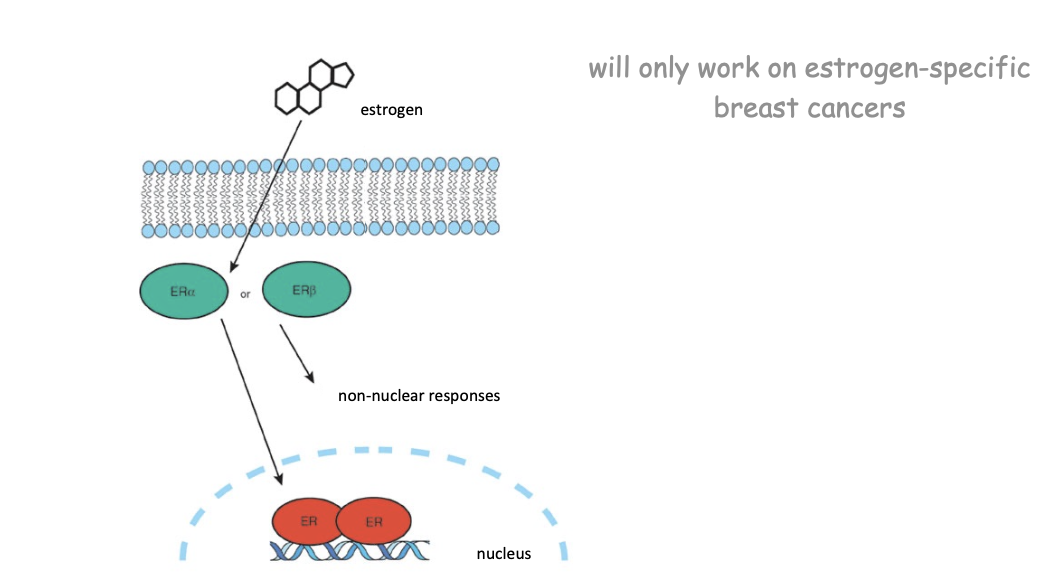
Tamoxifen
First targeted therapy for breast cancer. Binds to estrogen receptor found in cytosol
When bound to estrogen, it translocates to the nucleus and activates expression of specific genes.
Gleevec
Inhibits the ABL tyrosine kinase domain
Binds to the ATP binding site of ABL
For chronic myelogenous leukemia (CML) because it binds to the constitutively active fusion protein BCR/ABL to shut it off
how does Abl become oncogenic?
proto-oncogene tyrosine kinase that becomes oncogenic after chromosomal rearrangement (J. Rowley’s “Philadelphia Chromosome”, 70s)
inhibited by Gleevec
constitutive activity causing proliferation of white blood cells.
Demonstrated by Druker & Sawyer to treat Chronic Myeloid Leukemia
4. Immunotherapy
many ways immune system could possibly fight it
T cell scientists in the 80s
Rosenberg: T-cell could fight cancer, but was outnumbered by the cancer.
Eshhar: Chimeric Antigen Receptor T cells
Chimeric antigen receptor (CAR) T cells
Normally, T cells recognize a peptide antigen on an antigen presenting cell → signaling pathway that “activates” the T cell allowing it to proliferate and become a cytolytic T lymphocyte (CTL) that can recognize and kill cells with that antigen.
CAR T = cells are removed from a cancer patient and modified so they express receptor specific to the patient's cancer, then are reintroduced to patient.
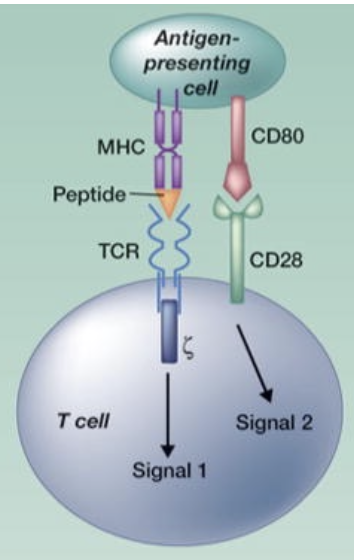
how do T cells normally work?
-recognize a peptide antigen on antigen presenting cell
-signalling pathway that activates the T cell allowing it to proliferate and become a cytolytic T lymphocyte (CTL) that can recognize and kill cells with that antigen
In CAR T cells, what is the T cell receptor replaced with?
replaced with a chimeric protein composed of extracellular antibody-like region that recognizes a tumour antigen and a cytoplasmic tail that does normal T signalling