Chapter 12.3–12.4
 Call Kai
 Learn
 Practice Test
 Spaced Repetition
 Match
 Flashcards
 Knowt Play
1/52

There's no tags or description
Looks like no tags are added yet.
53 Terms
What is the key difference in operon structure between prokaryotes and eukaryotes?
Eukaryotes have very few to no operons.
What is chromatin and its role in gene expression?
Chromatin is chromosomal DNA plus proteins, and it can condense to hamper transcription.
What separates transcription from translation in eukaryotic cells?
The nucleus separates transcription (in the nucleus) from translation (in the cytoplasm).
What are the four levels of eukaryotic gene expression regulation covered?
1. Changes in chromatin structure, 2. Transcription initiation, 3. Co- and post-transcriptional control, 4. Translational and post-translational control.
What is chromatin remodeling?
Chromatin remodeling involves repositioning nucleosomes to make DNA accessible for transcription.

What are histone modifications and their effects?
Histone modifications include methylation (which can activate or repress transcription) and acetylation (which promotes transcription).

What is DNA methylation?
DNA methylation involves adding methyl groups to cytosines, making DNA less accessible for transcription.
What is the role of acetyltransferases in gene expression?
Acetyltransferases add acetyl groups to histone tails, promoting open chromatin and increased transcription.
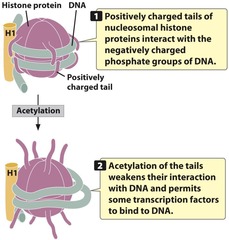
What happens during deacetylation of histones?
Deacetylation promotes chromatin condensation, repressing transcription.

What is the function of the FLC gene in Arabidopsis?
The FLC gene encodes a transcription factor that represses flowering-related genes.
How does the FLD gene affect flowering in Arabidopsis?
FLD encodes a deacetylase that represses FLC transcription, allowing flowering to occur.
What is the core promoter in eukaryotic transcription?
The core promoter contains consensus sequences, including the TATA box, where the basal transcription apparatus binds.

What are enhancers and their role in transcription?
Enhancers are DNA sequences that bind transcriptional activators to stimulate transcription from a promoter.
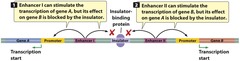
What is the function of insulators in gene regulation?
Insulators block enhancer action on promoters, preventing transcription stimulation.
What is the effect of a temperature-sensitive mutation in an acetyltransferase gene?
At high temperatures, the mutation leads to nonfunctional acetyltransferase, stabilizing chromatin and blocking transcription.
What is the significance of mRNA processing in eukaryotic gene regulation?
mRNA processing affects RNA stability and post-transcriptional control mechanisms that impact gene expression.
What are transcriptional activators?
Transcriptional activators are proteins that bind to enhancers and regulatory promoters to stimulate transcription.
What is the role of coactivators in transcription?
Coactivators assist in the assembly and stability of the transcription apparatus at the core promoter.
What is the difference between euchromatin and heterochromatin?
Euchromatin condenses and decondenses during the cell cycle, while heterochromatin remains highly condensed.
What is the impact of mutations in regulatory genes on gene expression?
Mutations in regulatory genes can alter the expression levels of target genes, affecting cellular functions.
What is the role of regulatory sequences in eukaryotic gene expression?
Regulatory sequences are DNA elements that bind regulatory proteins to control transcription initiation.
What is the function of transcription factors (TFs)?
Transcription factors bind to promoters or other TFs to enhance or inhibit transcription.
How do regulatory promoters differ from core promoters?
Regulatory promoters contain several consensus sequences for different transcriptional activators, while core promoters are where the basal transcription apparatus binds.
What is the acetylation-deacetylation cycle?
It is a regulatory mechanism where histone acetylation promotes transcription, while deacetylation represses it.
What is the significance of the TATA box?
The TATA box is a consensus sequence in the core promoter that is crucial for the binding of RNA polymerase II.
What is the role of an insulator in gene expression?
An insulator blocks enhancer action when positioned between an enhancer and a promoter.
What happens when an insulator is placed between Enhancer 1 and the promoter of Gene A?
It prevents Enhancer I from stimulating transcription of Gene A.
What are repressors in the context of gene expression?
Repressors bind to silencers or regulatory promoter sequences to inhibit transcription initiation.
How do repressors inhibit transcription?
By competing with activators for binding sites, preventing activator binding, or interfering with basal transcription apparatus assembly.
What is a transcriptome?
The set of genes expressed into mRNA in a specific tissue or developmental stage.
What is co-transcriptional control?
Regulation that occurs during transcription, such as alternative splicing of pre-mRNA.
What is alternative splicing?
A process that allows a single pre-mRNA to be spliced in different manners to produce multiple unique transcripts.
What influences gene expression post-transcriptionally?
mRNA stability, degradation, and mechanisms like RNA interference.
What is the effect of shorter mRNA half-life on protein production?
It results in lower protein levels due to reduced mRNA availability for translation.
What are microRNAs and how do they function?
MicroRNAs are small RNAs that target homologous transcripts for degradation, regulating gene expression.
What is RNA interference (RNAi)?
A mechanism where small RNAs, like siRNAs, target and degrade specific mRNA transcripts.
What is the role of the RNA-Induced Silencing Complex (RISC)?
RISC acts on siRNAs and microRNAs to silence target mRNA sequences.
What is epigenetics?
The study of heritable changes in gene expression that do not involve changes to the underlying DNA sequence.
What are epigenetic marks?
Changes to chromatin structure that affect gene expression without altering the DNA sequence.
How is DNA methylation maintained after DNA synthesis?
DNA methyltransferase enzymes add methyl groups to the newly synthesized strand based on the methylation pattern of the template strand.
What is the effect of DNA methylation on gene expression?
DNA methylation typically represses transcription.
What are histone modifications?
Chemical changes to histone proteins that can either promote or repress transcription by altering DNA accessibility.
How do histone modifications influence gene expression?
They can make DNA more accessible (e.g., acetylation) or less accessible (e.g., methylation).

What is the difference between mutations and epigenetic changes?
Mutations change the DNA sequence, while epigenetic changes affect gene expression without altering the sequence.
What is the significance of the Jorgensen team's experiment with petunias?
It demonstrated that overexpression of a gene can lead to unexpected results due to post-transcriptional regulation.
What is the FDA-approved RNAi therapy mentioned?
Patisiran, which treats transthyretin amyloidosis by reducing TTR protein production.
What are the levels of regulation of gene expression in eukaryotes?
1. Chromatin structure, 2. Transcription regulation, 3. Co- and post-transcriptional control, 4. Translational and post-translational control.
What is the role of ribonucleases in mRNA degradation?
They degrade mRNA, starting from the 5' end, affecting the stability and availability of mRNA for translation.
What is the function of PABP in mRNA stability?
PABP protects the poly(A) tail and 5' cap from degradation by exonucleases.
What are the different contexts of DNA methylation in animals and plants?
Animals primarily use CpG methylation, while plants utilize CG, CHG, and CHH contexts.
How do parental histones contribute to the heritability of epigenetic marks?
Parental histones interact with newly replicated DNA to maintain similar chromatin structures and epigenetic marks.
What is the effect of histone acetylation on transcription?
Histone acetylation stimulates transcription by making DNA more accessible.
What are the potential outcomes of mutations in regulatory genes?
They can disrupt normal gene expression patterns, potentially leading to diseases or developmental issues.