L17/L4 RH steroid hormone receptors 1
 Call Kai
 Learn
 Practice Test
 Spaced Repetition
 Match
 Flashcards
 Knowt Play
1/15

Earn XP
Description and Tags
print biosynthesis
16 Terms
learning outcomes

adrenal gland
cortisol & aldosterone
ovaries
oestrogen & progesterone
testes
testosterone
what are steroid hormones
lipid-soluble chemical messengers
syn in glands
steroid hormone sysnthesis
synthesised primarily in the adrenal glands and gonads (ovaries and testes)
synthesised from cholesterol
synthesis largely regulated at the initial steps of cholesterol mobilisation and transport into the mito matrix for conversion into pregnenolone
steroid hormone function
regulate energy metabolism and stress response - glucocorticoids
salt balance - mineralocorticoids
sexual devel and function - androgens and oestrogens
SH biosynthesis
derived from cholesterol
first step in rate-limiting: cholesterol → pregnenolone

IC receptors types image

Class I IC receptors
SH receptors
cytosolic monomers bound to heat-shock prots
once activated, form dimers and transloc. to nucleus to induce transcription of target genes
Class II IC receptors
e.g. TR, RAR, VDR
retained in nucleus
assoc. with DNA
actively repressing transcription until ligand arrives
classification of nuclear receptor superfamily
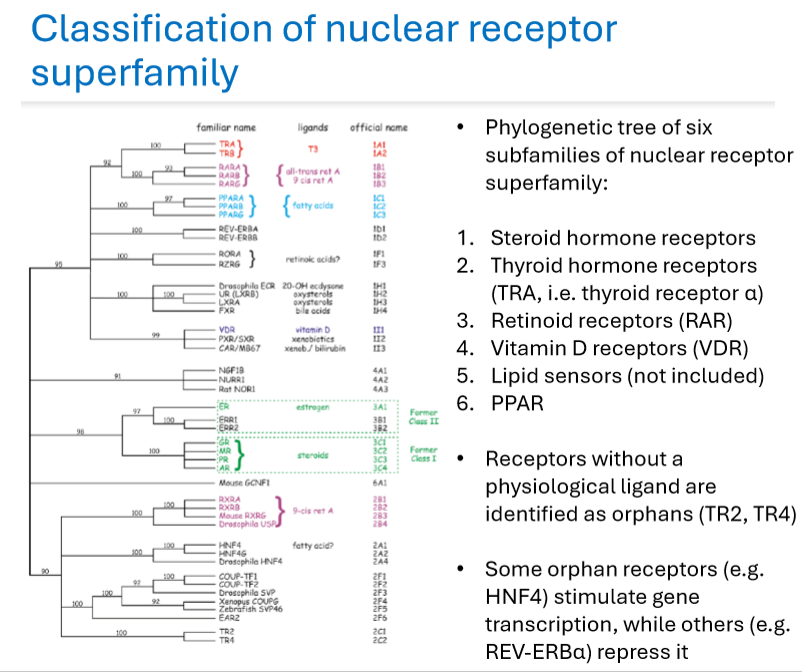
IC SHRs
upon ligand binding, SHRs transloc. into nucleus
pattern similar for all SHRs (except oestrogen)
oestrogen receptor is principally nuclear

examples of ligands for SHRs

activation of cytosolic-resident receptors
ability of cytosolic resident Rs to bind to ligand dependent on chaperone proteins (e.g. HSP90) and accessory molecules (e.g. regulatory chaperone p23)
enables R complex to transloc. to nucleus
complex dissociates and enables dimerised Rs to bind to the DNA response element on target promoter
induces transcription of target genes
the used R loses it’s hormone, associates with chaperone where they are degraded or exported back to cytoplasm
activation of cytosolic-resident receptors image
