Mock test 3
 Call Kai
 Learn
 Practice Test
 Spaced Repetition
 Match
 Flashcards
 Knowt Play
1/22

There's no tags or description
Looks like no tags are added yet.
23 Terms
1. For which one of the following may net asset value be the most inappropriate measure of share value?
A A property investment company.
B An oil production company.
C A satellite television broadcaster.
D An investment trust.
C A satellite television broadcaster.
2. Which one of the following most accurately describes capital gearing?
A The ratio of capital employed to sales.
B The ratio of current borrowing to this year’s capital repayments.
C The ratio of debt to shareholders’ funds or total assets.
D The ratio of interest charges to profits.
C The ratio of debt to shareholders’ funds or total assets.
3. Agency costs in finance theory are most accurately described by which of the following definitions?
A The costs of buying an asset through an agent such as a stock broker or estate agent.
B The costs of allowing financial intermediaries to take decisions on your behalf which may not be
optimal for you.
C The direct and indirect costs of ensuring that agents (e.g. managers of firms) act in the best interests
of principals (e.g. shareholders of firms).
D The initial cost of purchasing an asset through an agent, e.g. a travel agent’s fee.
C The direct and indirect costs of ensuring that agents (e.g. managers of firms) act in the best interests
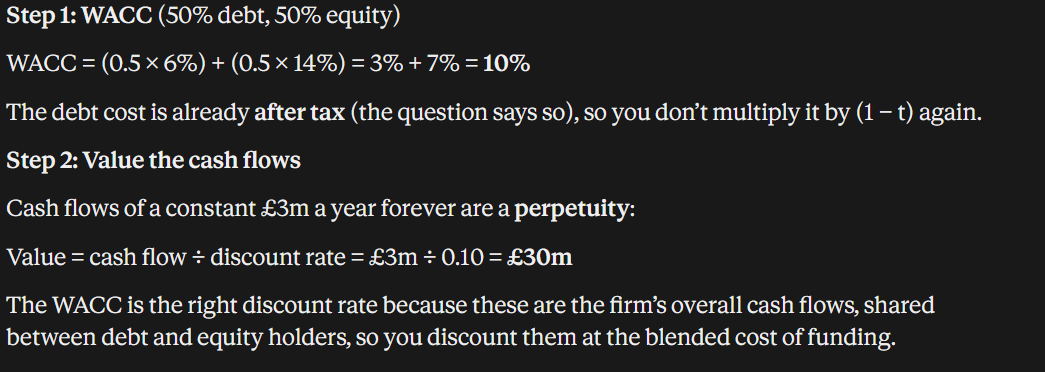
4. What is the value of the following firm where:
• free net cash flows are expected to be a constant £3m per year to infinity;
• cost of debt capital after tax is 6 per cent per annum;
• the cost of equity capital is 14 per cent per annum;
• half the firm’s capital is debt and half is equity (market values)?
A £20m.
B £50m.
C £21.4m.
D £30m. [= 3 / (0.5*6 + 0.5*14)]
D £30m. [= 3 / (0.5*6 + 0.5*14)]
5. Which one of the following factors does not promote a stable, rather than fluctuating, dividend policy
by firms?
A Dividends as a residual - the availability of positive NPV projects.
B Clientele preferences.
C Signalling.
D Agency theory.
A Dividends as a residual - the availability of positive NPV projects.
6. Which one of the following best describes the concept of stock market pricing efficiency?
A In an efficient market the current price of all shares accurately reflects the future cash flows that
will accrue to the shareholders.
B In a pricing efficient market the costs of buying and selling shares are very low.
C In an efficient market it is possible to use inside knowledge to make abnormally high returns on
invested money.
D In an efficient market prices rationally reflect available information.
D In an efficient market prices rationally reflect available information.
7. Which of the following is not an advantage of an efficient share market?
A It encourages share buying.
B It gives correct signals to company managers.
C It helps allocate society’s resources.
D It ensures that investors can never achieve a return greater than that on a broadly-based market index.
D It ensures that investors can never achieve a return greater than that on a broadly-based market index.
8. To say that share prices move in random walk is to mean which of the following?
A The share market is irrational and akin to a casino.
B Share price moves are determined in the same random fashion as the outcome of tossing a coin –
there is no underlying rationale for a particular move.
C Share prices at any one time reflect all available information and the price will only change in response to new information
D Share prices respond to news events in a random fashion.
C Share prices at any one time reflect all available information and the price will only change in
response to new information; successive price changes will be independent and prices will follow a random walk because the next piece of news is independent of the last piece of news.
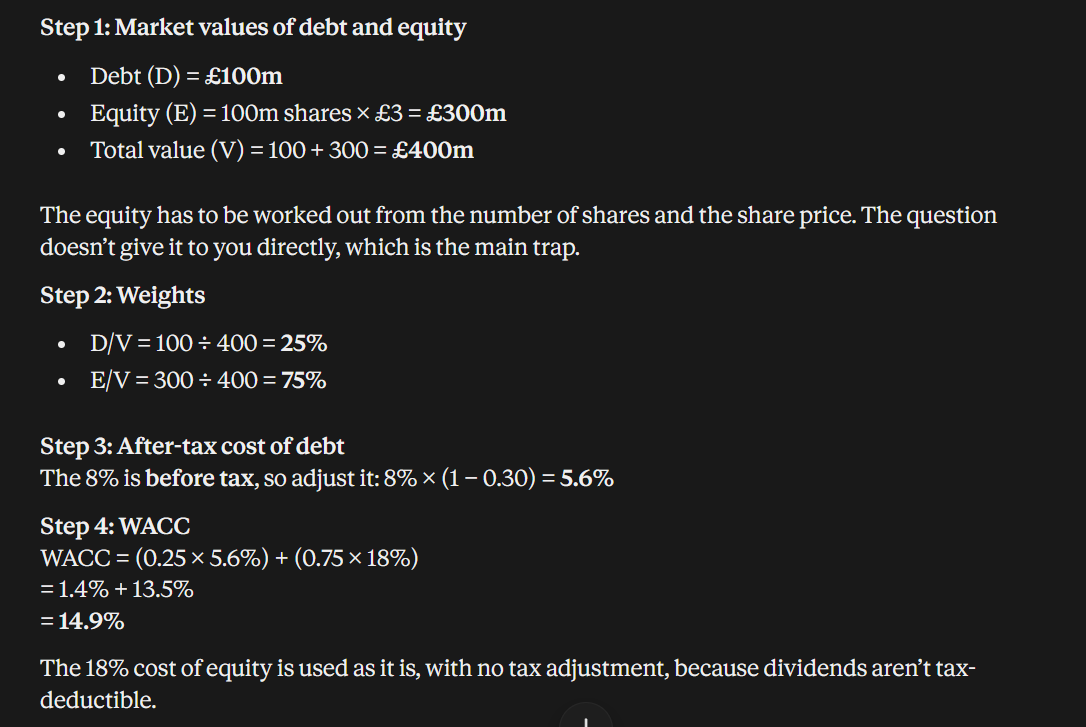
9. The corporation tax rate is 30 per cent. Firm Y has borrowings with a market value of £100m with
annual rate of return of 8 per cent (before tax). It also has 100m shares in issue traded on the
Alternative Investment Market. These are currently priced at £3 each. The shares are in a risk class
which means that investors require an annual return of 18 per cent. What is the weighted average cost
of capital?
A 13%.
B 14.9%
C 15.5%
D 8.7%
B 14.9% {= [100/(100+100*3)]*[8*(1-0.3)] + [(100*3)/(100+100*3)]*18}
10. If a business pays a fixed proportion, p, of its after-tax profit as a dividend each year, has a reinvestment rate, r, and a dividend growth rate g. The relationship between these factors is:
A g = (1 - p)/r
B g = (1 - p)r
C g = p(1 - r)
D g = p/r
B g = (1 - p)r
11. Cheng plc consistently pays 40% of its after-tax profit as an ordinary dividend. The return on investment is 18% a year and it is expected to remain at this level. What is the growth rate of the business’s dividends?
A 7.2%
B 10.8% = (1 - 0.4) x 18
C 18.0%
D 60.0%
B 10.8% = (1 - 0.4) x 18
12. If P is the current share price, d is the dividend per share just paid, k is the cost of equity and g is the rate of growth, the Gordon dividend growth model can be stated as:
A P = d/(k - g)
B P = g/(k - d)
C k = (g/P) + d(1 + g)
D k = [d(1 + g)/P] + g
D k = [d(1 + g)/P] + g
13. Use of weighted average cost of capital (WACC), to determine the discount rate at which to deduce the NPV of a particular project, requires that certain assumptions be made. Which of the following is not one of those required assumptions?
A Use of the capital asset pricing model to deduce costs of capital is inappropriate.
B There is a known target gearing ratio.
C The costs of the elements of finance will not alter in the future from the costs being used in the WACC calculation.
D The project is of similar risk to others undertaken by the business.
A Use of the capital asset pricing model to deduce costs of capital is inappropriate.
14. In Modigliani and Miller’s original (no taxes) assertion on capital gearing, they show that, increasing the proportion of debt:
A decreases the weighted average cost of capital.
B increases the value of each of its equity shares.
C increases the cost of equity.
D increases the value of the business
C increases the cost of equity. (The cost of equity would increase, but this would be precisely offset by the lower cost of debt finance to leave the value of the business, WACC and the value of each share the same.)
15. In Modigliani and Miller’s revised (with taxes) assertion on capital gearing, which one of the following will not result from increasing the proportion of debt?
A A decrease in the cost of debt.
B An increase in the value of the business.
C A decrease in the weighted average cost of capital.
D An increase in the value of each of its equity shares.
A A decrease in the cost of debt.
16. The traditional view of capital gearing is that:
A a business with zero debt can increase its weighted average cost of capital by substituting some debt for equity in its capital structure.
B a business with zero debt can increase its value by substituting some debt for equity in its capital structure.
C a business with zero debt will increase its business risk by substituting some debt for equity in its capital structure.
D there is no optimal capital structure.
B a business with zero debt can increase its value by substituting some debt for equity in its capital structure.
17. According to Modigliani and Miller, in their ‘with taxes’ analysis, the relationship of the value of a geared business (VG), the value of its ungeared counterpart (VU), the business’s Corporation Tax rate (T) and the value of the debt in the geared business (D), is:
A VU = VG + TD
B VG = D + TVU
C VG = VU + TD
D VU = D + TVG
C VG = VU + TD
18. A business which has high ‘operating gearing’ has:
A a large proportion of debt in its capital structure.
B high interest charges compared to its pre-interest profit.
C a high proportion of fixed costs in its total costs figure.
D a high proportion of variable costs in its total cost figure.
C a high proportion of fixed costs in its total costs figure.
19. The existence of potential bankruptcy costs, when coupled with Modigliani and Miller’s (with taxes) assertion on capital gearing, tends to mean that:
A businesses regard capital gearing as of no net benefit.
B capital gearing has little or no effect on the business’s weighted average cost of capital.
C businesses seek to gear up to very high levels.
D there is likely to be an optimum capital gearing level.
D there is likely to be an optimum capital gearing level. (The tax benefit of debt financing would tend to encourage businesses to use debt finance, but above some level of gearing potential bankruptcy costs would cancel out this tax benefit. There seems likely to be some level of gearing which strikes an acceptable balance.)
How do you assess the following two statements?
1. The traditional view of dividends is that shareholders prefer immediate dividends and high payout ratios.
2. The Modigliani and Miller view on dividends includes the notion that individual shareholders who do not like a business’s dividend policy can alter it by buying or selling shares in that business.
Statement (1) Statement (2)
A False False
B False True
C True False
D True True
D True True
21. The central point in Modigliani and Miller’s assertion on dividends is that:
A shareholders tend to be indifferent between dividends and capital gains.
B the payment of dividends is irrelevant to valuation.
C it is always open to shareholders to create ‘home made’ dividends by selling some of their shares.
D the pattern of dividends is irrelevant to valuation.
D the pattern of dividends is irrelevant to valuation.
22. Which one of the following was not one of the assumptions made by Modigliani and Miller on which their dividend theory was based?
A There are no transactions costs.
B Shares are efficiently priced.
C Shareholders are risk averse.
D Taxes do not exist.
C Shareholders are risk averse.
Under the ‘pecking order’ theory on raising finance, in which order will businesses tend to favour raising finance for investments?
A Retained profit, new shares, debt.
B Retained profit, debt, new shares.
C New shares, debt, retained profit.
D Debt, retained profit, new shares.
B Retained profit, debt, new shares.