chem 2 hard
 Call Kai
 Learn
 Practice Test
 Spaced Repetition
 Match
 Flashcards
 Knowt Play
1/37

There's no tags or description
Looks like no tags are added yet.
38 Terms
How do oxidation numbers change during redox?
Oxidation → oxidation number increases. Reduction → oxidation number decreases.
What are the most important oxidation-number rules?
Free element =
Group 1 =
Group 2 =
F =
Oxygen usually =
Hydrogen usually =
Free element = 0
Group 1 = +1
Group 2 = +2
F = −1
Oxygen usually = −2
Hydrogen usually = +1
How do you calculate an unknown oxidation number?
Multiply each oxidation number by its number of atoms. Add everything and set equal to 0 for a neutral compound or the ion's charge

How do you identify what was oxidized and reduced in a reaction?
Find each element's oxidation number on both sides. Increasing = oxidized; decreasing = reduced. Unchanged = neither
Example: Mg: 0 → +2 (oxidized); O: 0 → −2 (reduced).

How do you balance redox half-reactions?
Balance atoms, balance charge using electrons, multiply half-reactions so the electrons lost equal electrons gained, then add and cancel.

How do you predict a metal displacement reaction using the activity series?
A metal higher on the activity series can displace ions of a metal below it. Otherwise, no reaction.
How do you find the pressure of gas collected over water?

How do you calculate partial pressure from mole fraction?
Mole fraction (Xₐ): Moles of gas A / by total moles of all gases.
Partial pressure (Pₐ): Mole fraction of gas A * by total pressure.
What are the two real-gas corrections in the van der Waals equation?
The a term corrects for intermolecular attractions. The b term corrects for the finite volume of gas particles.

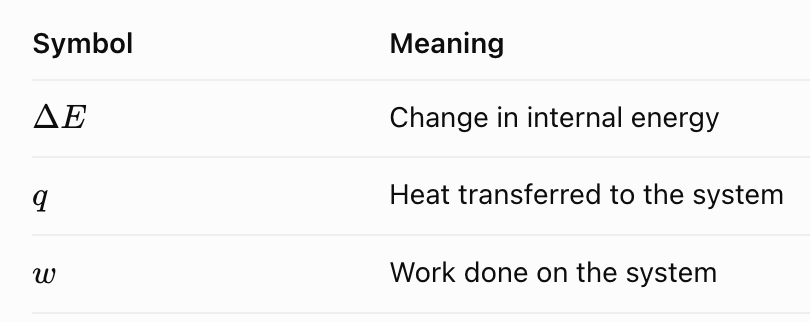
Change in internal energy = heat added to the system + work done on the system.
What are the signs for heat and work?
Heat absorbed =
Heat released =
Work done ON system =
Work done BY system =
Heat absorbed = positive q.
Heat released = negative q.
Work done ON system = positive w.
Work done BY system = negative w.
How do you calculate the heat released by a reaction in a calorimeter?

What's the difference between constant-pressure and bomb calorimetry?

How do you convert reaction heat into kJ/mol?
Convert heat from J to kJ, then divide by moles of reaction. Use the balanced equation coefficients to find moles of reaction.
What are the two main Hess's law rules?
Reverse reaction → change ΔH sign.
Multiply coefficients by a factor → multiply ΔH by the same factor.
Add the adjusted ΔH values.
What is the standard enthalpy of formation of an element in its standard state?
Zero. Examples: Al, Fe, O2
How do you calculate heat released when given grams of reactant and ΔH?
Convert grams to moles, divide by the reactant's coefficient to find moles of reaction, then multiply by ΔH for the reaction as written.

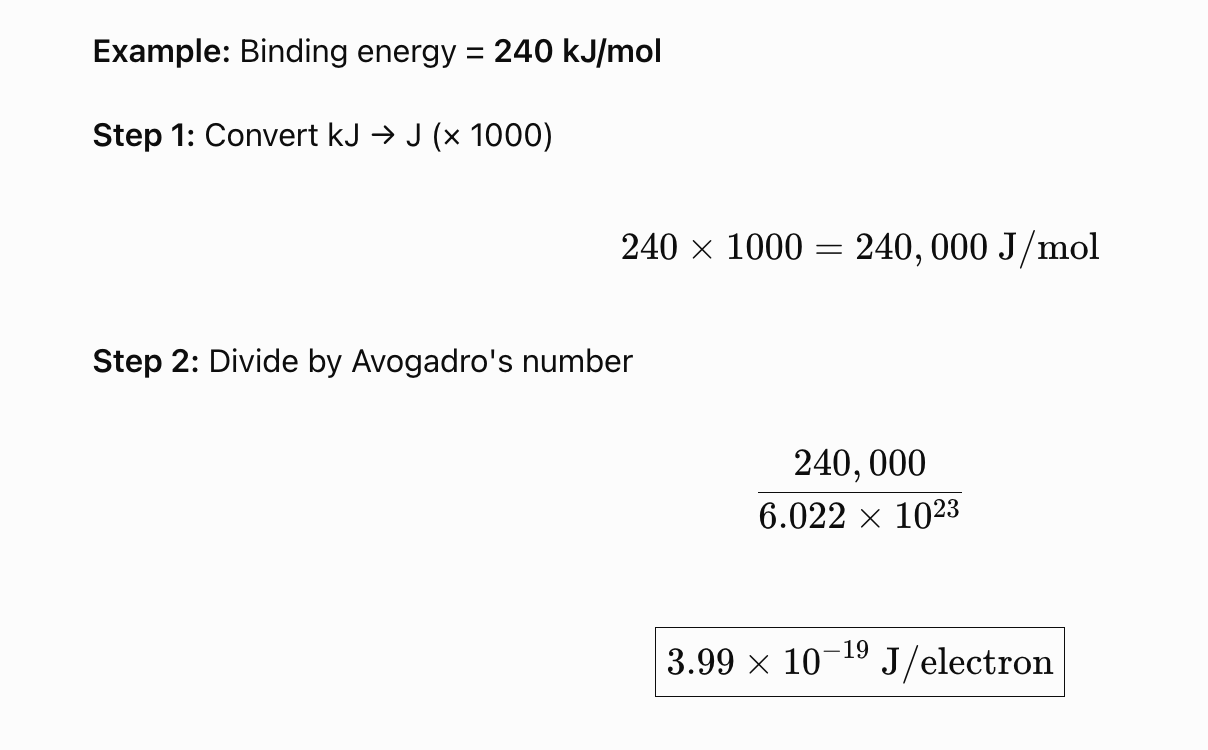
How do you convert photon binding energy from kJ/mol to J/electron?
Multiply by 1000 to get J/mol, then divide by 6.022 × 10²3 to get joules per electron
What is the photoelectric effect?
Electrons are ejected from a metal when incoming photons have sufficient energy to overcome the metal's binding energy.
How do you determine whether light can eject electrons?

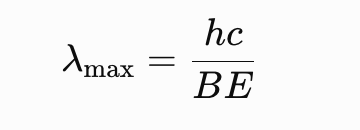
How do you calculate the longest wavelength that can eject an electron?
Does increasing light intensity always cause electrons to be ejected?
No. Frequency must reach the threshold. Above threshold, increased intensity increases the number of electrons ejected per second, not their maximum kinetic energy at fixed frequency.
What are elastic collisions?
Collisions that conserve total kinetic energy.
What is the First Law of Thermodynamics?
Energy is conserved.
Is enthalpy a state function?
Yes
Are heat and work state functions?
no
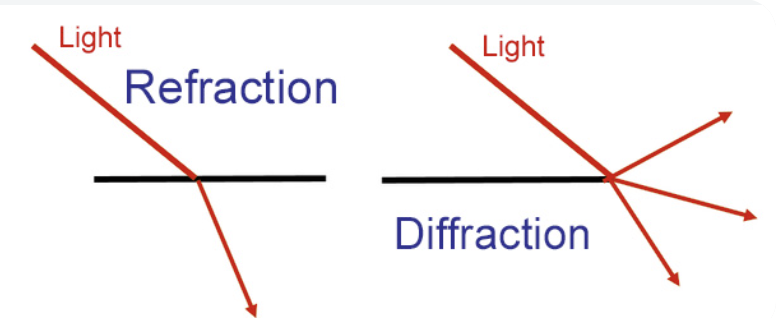
What is refraction?
A wave changing direction when its speed changes between media.

What is diffraction?
Bending and spreading of waves around obstacles or through openings.
What is interference?
The combination of overlapping waves.
What does quantization mean?
Energy is exchanged in discrete amounts.
define each


define each

What is BE, and how is it used in the photoelectric effect?
BE = binding energy (work function), the minimum energy needed to eject an electron.

Coffee-cup calorimetry fornula

Bomb calorimetry equation

how to find Minimum frequency to eject an electron

how to find Longest wavelength that ejects electrons

When do you switch MMₐ and MMᵦ in Graham's law?
Molar masses go in the OPPOSITE order of rates.
