VM 651 - Theriogenology
 Call Kai
 Learn
 Practice Test
 Spaced Repetition
 Match
 Flashcards
 Knowt Play
1/122

There's no tags or description
Looks like no tags are added yet.
123 Terms
Where is the reproductive tract located in the female parrot?
usually only the LEFT ovary and oviduct are functional in most species
site of fertilization in the bird
infundibulum (captures ovulated yolk)
which part of the oviduct secretes albumen (egg white)
magnum
which part of the female reproductive tract deposits the calcium carbonate shell?
uterus (shell gland)
what is the cloaca
Common exit for GI, urinary, and reproductive tracts.
T/F: Male parrots do not have a phallus.
True
what are some species with sexual dimorphism in parrots
1. Eclectus parrots - males bright green, females red/purple.
2. Cockatoos - differences in iris color (females often red/brown, males dark brown/black).
3. Cockatiels - males usually brighter, with yellow face/orange cheek patches.
4. Budgerigars (parakeets) - males usually blue cere, females brown/tan cere.
Sexual dimorphism is much more common in passerines and waterfowl.
what changes would you expect to see in a CBC of a bird who is upregulated?
- leukocytosis (increased WBC)
- increased total protein
what changes would you expect to see in a chemistry panel of a bird who is upregulated?
- increased calcium increased total and ionized calcium (for eggshell production)
- increased phosphorus
- increased cholesterol
- increased globulins
what are some environmental stimuli for reproductive upregulation in birds
- photoperiod - longer days stimulate repro hormone release
- rainfall - associated with breeding season in wild species
- abundant food availability - signals good conditions to raise young
- presence of a mate (or perceived mate) - visual and behavioral cues to encourage repro activity
- nesting materials
Which of the following is true about the male parrot reproductive tract?
A. Testes are external, located in a scrotum
B. They possess a phallus for copulation
C. Sperm is stored in the seminal glomus before ejaculation
D. The epididymis lies outside of the coelomic cavity
C. Sperm is stored in the seminal glomus before ejaculation
Testes are internal (not external).
Parrots do not have a phallus (unlike ducks/geese).
All structures are internal.
A client presents a bright green Eclectus parrot and wants to know the sex. Which is most likely true?
A. The bird is female, since Eclectus females are bright green
B. The bird is male, since Eclectus males are bright green
C. This species is monomorphic, so external features are unreliable
D. A DNA probe is required since all parrots are monomorphic
B. The bird is male, since Eclectus males are bright green
Eclectus parrots: Males = green, Females = red/purple.
A cockatiel presents with dull grey plumage, no bright yellow face mask, and faint cheek patches. This is most consistent with:
A. Adult male cockatiel
B. Adult female cockatiel
C. Juvenile of either sex
D. Cannot be determined without DNA sexing
B. Adult female cockatiel
Males = bright yellow face + orange cheek patches.
Females = duller, grey tones, muted markings.
Which CBC change is most characteristic of a reproductively up-regulated female parrot?
A. Leukocytosis with increased total protein
B. Neutropenia
C. Anemia of chronic disease
D. Thrombocytopenia
A. Leukocytosis with increased total protein
A 5-year-old cockatoo is presented for routine bloodwork. She has elevated calcium, phosphorus, cholesterol, and globulin levels. Which is the best interpretation?
A. Egg-binding emergency
B. Severe renal failure
C. Reproductive upregulation consistent with egg-laying physiology
D. Hyperparathyroidism
C. Reproductive upregulation consistent with egg-laying physiology
Which environmental factor is least likely to stimulate reproductive upregulation in parrots?A. Long photoperiod
B. Rainfall
C. Abundant food supply
D. Isolation from other birds
D. Isolation from other birds
Presence of a mate/social cues are stimulatory, not isolation
A parrot with chronic egg-laying is being managed. Which husbandry change is recommended to down-regulate reproductive drive?
A. Provide additional nest boxes
B. Increase high-calorie diet items (e.g., seeds, nuts)
C. Reduce photoperiod and remove nesting material
D. Introduce a new mate
C. Reduce photoperiod and remove nesting material
Husbandry manipulation is a first-line control strategy.
During endoscopic sexing of a 6-month-old blue and gold macaw, which positioning is correct and why?
A. Left lateral recumbency, because the right ovary is functional
B. Right lateral recumbency, because the left ovary is functional
C. Dorsal recumbency, to visualize both ovaries
D. Sternal recumbency, because parrots lack ovaries
B. Right lateral recumbency, because the left ovary is functional
Most birds have only a left ovary/oviduct → position on right side for visualization.
Which feature is used to distinguish sexes in many cockatoos?
A. Beak size
B. Iris color
C. Feather pattern
D. Tail length
B. Iris color
Males = dark brown/black, Females = reddish-brown.
In budgerigars, the cere color of a reproductive male is typically:
A. Pink
B. Tan/brown
C. Blue
D. Black
C. Blue
Which drug acts as a GnRH agonist to suppress reproductive activity in parrots?
A. Leuprolide acetate
B. Meloxicam
C. Enrofloxacin
D. Deslorelin
A. Leuprolide acetate
Deslorelin implants are also used.
A 2-year-old intact male dog presents with unilateral abdominal cryptorchidism. Which of the following is the most important reason to recommend orchiectomy?
A. Decreased libido
B. Increased risk of testicular torsion and neoplasia
C. Reduced sperm motility
D. Potential for congenital epididymal agenesis
B. Increased risk of testicular torsion and neoplasia
Cryptorchid testes carry a significantly increased risk for torsion and malignant transformation
Which testicular tumor type is most likely to cause feminization syndrome in male dogs?
A. Leydig cell tumor
B. Interstitial granulosa tumor
C. Seminoma
D. Sertoli cell tumor
D. Sertoli cell tumor
Sertoli cell tumors secrete hormones that alter the E:T ratio, leading to feminization (alopecia, gynecomastia, penile atrophy, marrow suppression).
A 10-year-old intact dog presents with symmetrical, non-painful prostatic enlargement noted on rectal exam. No dysuria or systemic illness is present. Which condition is most likely?A. Benign prostatic hypertrophy
B. Prostatic adenocarcinoma
C. Prostatitis
D. Prostatic abscessation
A. Benign prostatic hypertrophy
BPH = common in intact older males, symmetrical and non-painful.
A castrated male dog presents with dysuria and rectal exam reveals an enlarged, asymmetrical, painful prostate. Abdominal radiographs reveal prostatic mineralization. What is the most likely diagnosis?
A. BPH
B. Prostatic cyst
C. Prostatic carcinoma
D. Prostatitis
C. Prostatic carcinoma
Prostatic mineralization in a castrated male is highly suspicious for neoplasia.
Which of the following clinical findings would most strongly support a diagnosis of Sertoli cell tumor with estrogen toxicity?
A. Hypercalcemia and PU/PD
B. Bilateral alopecia, gynecomastia, bone marrow suppression
C. Urinary obstruction and tenesmus
D. Dysuria with recurrent UTIs
B. Bilateral alopecia, gynecomastia, bone marrow suppression
Classic feminization + myelotoxicity from Sertoli tumors.
A cat presents with inability to retract the penis into the prepuce after grooming. There is mild swelling and a hair ring at the preputial orifice. What is the best initial treatment?
A. Partial penile amputation
B. Indwelling urinary catheter for 7 days
C. Lubrication, dextrose solution, remove constricting hair ring
D. Preputial reconstruction surgery
C. Lubrication, dextrose solution, remove constricting hair ring
Hair rings cause paraphimosis; initial management = release constriction, reduce edema, lubricate and replace.
Which statement best distinguishes BPH from prostatic carcinoma in dogs?
A. BPH occurs more often in neutered dogs
B. Prostatic carcinoma is symmetrical and painless
C. BPH resolves rapidly after castration, while carcinoma is aggressive and metastatic
D. BPH commonly metastasizes to bone, carcinoma does not
C. BPH resolves rapidly after castration, while carcinoma is aggressive and metastatic
A dog presents after routine castration with marked scrotal swelling and bruising. Which of the following is the most likely complication?
A. Orchitis
B. Testicular torsion
C. Scrotal hematoma
D. Prostatitis
C. Scrotal hematoma
Which prostatic disease is the only one that is more common in castrated males?
prostatic neoplasia
Which penile abnormality is most commonly asymptomatic but associated with Boston Terriers?
A. Preputial hypoplasia
B. Hypospadias
C. Persistent penile frenulum
D. Os penis deviation
B. Hypospadias
Hypospadias, often incidental, overrepresented in Boston Terriers.
A 9-year-old intact male cat presents with acute abdominal pain, vomiting, and lethargy. Ultrasound reveals a large hypoechoic abdominal mass with absent vascular flow on Doppler. What is the most likely diagnosis?
A. Testicular torsion in cryptorchid testicle
B. Sertoli cell tumor
C. Seminoma with metastasis
D. Splenic hematoma
A. Testicular torsion in cryptorchid testicle
Abdominal cryptorchid testicles are predisposed to torsion.
Which testicular tumor type is most often associated with myelotoxicity and bone marrow suppression?
A. Seminoma
B. Sertoli cell tumor
C. Leydig cell tumor
D. Interstitial granulosa tumor
B. Sertoli cell tumor
BSertoli tumors → estrogen toxicity → feminization + marrow suppression.
Which testicular tumor secretes testosterone, predisposing dogs to perianal adenomas and perineal hernias?
A. Seminoma
B. Leydig cell tumor
C. Sertoli cell tumor
D. Teratoma
B. Leydig cell tumor
A male dog presents with inability to urinate, dripping urine, and a history of preputial inflammation. Exam reveals a narrowed preputial opening. Diagnosis?
A. Phimosis
B. Paraphimosis
C. Hypospadias
D. Priapism
A. Phimosis
Phimosis = inability to extrude penis (narrow orifice).
Which condition is characterized by persistent erection without sexual stimulation?
A. Phimosis
B. Priapism
C. Paraphimosis
D. Hypospadias
B. Priapism
Which congenital abnormality may cause pain during breeding due to retained tissue between penis and prepuce?
A. Hypospadias
B. Persistent penile frenulum
C. Os penis deviation
D. Phimosis
B. Persistent penile frenulum
Which therapy is most appropriate for a dog with prostatic abscessation and septic abdomen?
A. NSAIDs and castration only
B. Prostatectomy
C. Abscess drainage with omentalization and supportive care
D. Antibiotics only
C. Abscess drainage with omentalization and supportive care
Surgical drainage/omentalization + antibiotics for septic abdomen.
What is the most common prostatic tumor in dogs?
A. Transitional cell carcinoma
B. Adenocarcinoma
C. Squamous cell carcinoma
D. Lymphoma
B. Adenocarcinoma
what is paraphimosis
inability to retract penis
Traumatic preputial stenosis/phimosis is common in what species?
kittens! - due to suckling behavior leading to inflammation and stenosis of the preputial orifice
what is preputial hypoplasia
failure of the prepuce to fuse over the penis --> abnormal shortening or malformation of the prepuce
clinical signs of BPH
- generally asymptomatic - urination not typically affected
- rarely causes tenesmus
what to consider when treating prostatic abscessation
choose antibiotics that will cross the blood-prostate barrier (enro, marbo, TMS, chloramphenicol)
surgical treatment for cryptorchidism
NEUTER - take both testicles plzzz
Which of the following best describes an ovoviviparous reptile?
A. Produces live young nourished via placental exchange
B. Produces live young hatched internally from yolk-dependent eggs
C. Produces eggs incubated externally until hatching
D. Produces young by parthenogenesis
B. Produces live young hatched internally from yolk-dependent eggs
Ovoviviparous reptiles retain eggs in the female; embryos depend on yolk, not a placenta.
Parthenogenesis in reptiles results in offspring that are:
A. Genetically identical to the female
B. Sterile hybrids
C. Haploid and non-viable
D. Genetically identical to the male
A. Genetically identical to the female
Parthenogenesis produces female offspring genetically identical to the mother. (she doesn't need no man)
Which is NOT a reliable sex characteristic of male lizards?
A. Prominent femoral pores
B. Presence of tarsal spur (in veiled chameleons)
C. Concave plastron
D. Hemipenal bulges
C. Concave plastron
Concave plastrons are a feature of male chelonians, not lizards.
In chelonians, which feature helps distinguish males from females?
A. Presence of hemipenes
B. Spur length near the cloaca
C. Longer tails with more distal vents
D. Larger femoral pores
C. Longer tails with more distal vents
In snakes, probing more than 6-10 subcaudal scales usually indicates:
A. Female
B. Juvenile of either sex
C. Gravid female
D. Male
D. Male
Deep probing reveals the hemipenal sac in males, typically extending 6-10 subcaudals.
Name the three segments of the cloaca.
1. coprodeum
2. urodeum
3. proctodeum
Which cloacal segment primarily receives material from the colon?
A. Coprodeum
B. Urodeum
C. Proctodeum
D. Mesodeum
A. Coprodeum
The coprodeum receives feces from the colon.
Which cloacal segment contains openings for the ureters and reproductive tracts?
A. Coprodeum
B. Urodeum
C. Proctodeum
D. Hemipene sac
B. Urodeum
The urodeum receives urine and reproductive secretions.
Which is an appropriate first-line intervention for delayed oviposition?
A. Immediate plastronotomy
B. Providing a quiet nesting area with proper substrate
C. High-dose oxytocin without diagnostics
D. Hemipenile amputation
B. Providing a quiet nesting area with proper substrate
Environmental correction (quiet nesting with substrate, hydration, Ca support) is often successful before drugs/surgery.
define oviparous
egg laying
define viviparous
live birth after a time in the placenta
3 ways to identify male chelonians
1. identification of phallus (lives in the cloaca)
2. concave plastron (to aid in mounting eww)
3. tail length/vent position: males have longer tails with more distal vents
ways to identify male lizards
1. paired hemipenes (at base of the tail)
2. femoral pores more pronounced
3. more species specific traits (veiled chameleon has tarsal spurs)
ways to identify male snakes
- presence of hemipenes
- length of hemipenal sac (probing)
- other characteristics depending on species (female anacondas are larger than males, etc.)
four risk factors for delayed oviposition in reptiles
1. inappropriate nesting opportunity
2. insufficient hydration, calcium, or glucose
3. obese BCS or poor BCS
4. infectious diseases
four intervention strategies for delayed oviposition in reptiles
1. Provide quiet, appropriate nesting substrate and environment.
2. Fluid therapy (e.g., LRS).
3. Calcium supplementation (Ca gluconate).
4. Pharmacologic induction (oxytocin, vasotocin, prostaglandins, beta-blockers) after ruling out obstruction.
Which drug is commonly used to induce oviposition in reptiles?
A. Oxytocin
B. Dopamine
C. Ketamine
D. Estrogen
A. Oxytocin
Oxytocin (though reptiles primarily use vasotocin) may stimulate oviposition, but obstruction must be ruled out.
four risk factors for hemipenile prolapse
1. Trauma/infection from rough or contaminated substrate.
2. Reproductive activity.
3. Nutritional secondary hyperparathyroidism (NSHP) → spinal deformity/trauma.
4. Hypovitaminosis A → squamous metaplasia → plugs.
2 interventions strategies for hemipenile prolapse
1. Reduction - clean with saline, apply hyperosmotic solutions (50% dextrose), local anesthetic, replace into hemipenile sac, possible suture.
2. Amputation - if necrotic, recurrent, or irreducible; plus addressing underlying husbandry/nutritional causes.
what are the four common important causes of early neonatal mortality in puppies and kittens?
1. neonatal hypoxia/dystocia
2. malnutrition
3. environmental causes
4. FPT
what are three common infectious diseases associated with early neonatal mortality in puppies?
1. canine herpesvirus
2. canine parvovirus type 1 and 2
3. bacterial septicemia
A litter of puppies is born after a prolonged labor. Several are weak, fail to nurse, and die within the first 48 hours.Which of the following is the most likely cause of death?
A. Hypothermia
B. Neonatal hypoxia due to dystocia
C. Canine parvovirus infection
D. Failure of passive transfer
B. Neonatal hypoxia due to dystocia
Rationale: Prolonged or difficult labor causes fetal hypoxia and stress, leading to early neonatal death ("fading puppies")
A queen gives birth to a litter, but the kittens show restlessness and continuous crying despite normal ambient temperature. The dam's milk is not flowing. What is the most likely underlying cause?
A. Environmental hypothermia
B. Nutritional deficiency due to lactation failure
C. Genetic abnormality
D. Viral infection
B. Nutritional deficiency due to lactation failure
Rationale: Early neonatal mortality can result from poor maternal milk production or inadequate lactation, causing hypoglycemia and dehydration.
Which of the following management factors most commonly contributes to early neonatal mortality?
A. Premature weaning at 9 weeks
B. Overfeeding
C. Poor husbandry and suboptimal environment
D. Exposure to sunlight
C. Poor husbandry and suboptimal environment
Rationale: The majority of early deaths in neonates are preventable and linked to husbandry issues (temperature, sanitation, supervision).
A breeder reports that several newborn kittens failed to thrive. Post-mortem reveals septicemia with E. coli. The dam was not vaccinated before breeding. Which of the following most likely contributed to the kittens' deaths?
A. Failure of passive immunity
B. Parasitic infection
C. Congenital heart defect
D. Hyperthermia
A. Failure of passive immunity
Rationale: Lack of adequate colostrum transfer or unvaccinated dams predispose neonates to bacterial septicemia.
Which of the following pathogens is most commonly associated with neonatal death during the first two weeks of life in puppies?
A. Canine Herpesvirus
B. Canine Distemper Virus
C. Canine Parvovirus 2
D. Bordetella bronchiseptica
A. Canine Herpesvirus
Rationale: Canine Herpesvirus causes fetal loss, abortion, and rapid neonatal death in pups under 2 weeks.
A 3-day-old kitten presents with hypothermia, abdominal distension, and bluish discoloration of the abdomen. The queen appears normal.What is the most appropriate differential diagnosis?
A. Congenital hepatic shunt
B. Feline calicivirus
C. Neonatal septicemia
D. Hypoglycemia
C. Neonatal septicemia
Rationale: Signs of abdominal discoloration and weakness are classic for neonatal sepsis from bacterial infection.
How does hookworm contribute to neonatal mortality?
hookworms are blood-sucking >> can cause anemia, nutrient depletion, and quick decline
Which of the following best describes appropriate environmental management to reduce neonatal mortality?
A. Maintain whelping room at 60°F to prevent hyperthermia
B. Provide direct sunlight and limited ventilation
C. Maintain temperature at ~85-90°F with good hygiene and ventilation
D. Avoid handling the pups for the first week
C. Maintain temperature at ~85-90°F with good hygiene and ventilation
Rationale: Controlled temperature, hygiene, and ventilation reduce hypothermia and infection
A breeder asks how to ensure puppies receive adequate immunity after birth. What is the most important recommendation?
A. Provide vitamin supplements
B. Ensure puppies nurse within 24 hours of birth
C. Delay nursing to allow the dam to rest
D. Bottle-feed with formula only
B. Ensure puppies nurse within 24 hours of birth
Rationale: Colostrum intake within the first 24 hours is critical for passive transfer of maternal antibodies
Which of the following monitoring tools is most useful in preventing early neonatal loss in a breeding kennel?
A. Pulse oximeter
B. Room and rectal thermometers with record-keeping system
C. Capnograph
D. Stethoscope
B. Room and rectal thermometers with record-keeping system
Rationale: Tracking temperatures of pups and the dam helps detect hypothermia and illness early.
A 4-day-old litter develops diarrhea and weakness. The dam has a foul-smelling vaginal discharge but no other signs. What condition should you suspect in the dam?
A. Eclampsia
B. Toxic metritis
C. Pyometra
D. Retained placenta
B. Toxic metritis
Rationale: Toxic metritis or "toxic milk syndrome" can cause neonatal death despite a clinically normal dam
Which of the following client education points is most important to emphasize to new breeders?A. Puppies should wear collars for early identification
B. Early weaning (
C. Safe, warm, and supervised housing reduces trauma and mortality
Rationale: Trauma and maternal neglect are preventable causes of neonatal death; safe supervision is key
To mitigate neonatal mortality, the best pre-breeding recommendation for the dam is to:
A. Delay vaccination until after whelping
B. Administer endo/ecto-parasite treatment and vaccines before breeding
C. Restrict caloric intake
D. Limit social interaction
B. Administer endo/ecto-parasite treatment and vaccines before breeding
Rationale: Preventative medicine and vaccination before breeding enhance passive immunity in offspring
The male guinea pig (boar) can be identified by which external characteristic?
A. Y-shaped perineal depression
B. Triangular vulva with slit orifice
C. Pubic symphysis fused before 1 year of age
D. Os penis and large scrotal pouches
D. Os penis and large scrotal pouches
Rationale: Boars have visible scrotal sacs, os penis, and open inguinal rings; sows have a Y-shaped perineum and a vulvar orifice
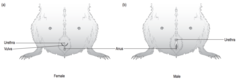
In the female chinchilla, which anatomic feature is often confused for a penis?
A. Urethral papilla
B. Vaginal membrane
C. Clitoral hood
D. Post-anal sac
A. Urethral papilla
Rationale: The urethral papilla in chinchilla females can be mistaken for a penis; however, the vagina is a separate opening located caudally
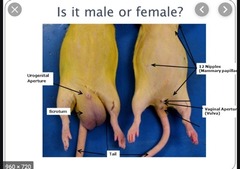
What external feature distinguishes the male rat from the female?
A. Two uterine horns
B. Shorter anogenital distance
C. Large oblong scrotum
D. Separate urinary and reproductive openings
C. Large oblong scrotum
Rationale: Male rats have long AG distance and large scrotum; females taper caudally (form triangle) and have two cervices with separate openings
Which of the following is most common in older unspayed female rabbits?
A. Mammary adenocarcinoma
B. Uterine adenocarcinoma
C. Vaginal leiomyoma
D. Endometrial sarcoma
B. Uterine adenocarcinoma
Rationale: Uterine adenocarcinoma is very common in older does, presenting with hematuria and serosanguinous discharge. OHE is curative if metastasis hasn't occurred
A female hedgehog presents with hematuria and a bloody vaginal discharge, but is bright and eating. Imaging reveals an endometrial polyp. What is the best treatment?
A. Chemotherapy
B. Antibiotics and NSAIDs
C. Ovariohysterectomy
D. Progesterone suppression therapy
C. Ovariohysterectomy
Rationale: Endometrial polyps and sarcomas are common in hedgehogs and can bleed excessively despite being benign. OVH is curative
Which statement about mammary adenocarcinoma in mice is CORRECT?
A. Usually benign and cured with surgery
B. Commonly malignant and ulcerated at diagnosis
C. Responds well to chemotherapy
D. Occurs rarely in aged females
B. Commonly malignant and ulcerated at diagnosis
Rationale: Up to 70% incidence in mice; tumors are malignant and often ulcerated. Surgery can be attempted but recurrence is high and prognosis is poor
What is the most significant risk factor for dystocia in guinea pigs?
A. Failure to breed before 7-8 months of age
B. Breeding too early (
F. Both A and E
Rationale: The pelvic symphysis fuses around 7-8 months; older sows cannot separate the pelvis adequately during parturition. Obesity also plays a role.
A sow is straining for over 20 minutes with no delivery, and her pubic symphysis is
C. Immediate cesarean section
Rationale: Prolonged unproductive labor (>20 min or >2 h of contractions) indicates dystocia. C-section is recommended
A sow has bilateral non-pruritic flank alopecia and mammary hyperkeratosis. Which cyst type is most likely?
A. Serous cyst
B. Follicular (hormone-producing) cyst
C. Parovarian cyst
D. Endometrial cyst
B. Follicular (hormone-producing) cyst
Rationale: Hormone-producing follicular cysts cause symmetrical flank alopecia and mammary hyperkeratosis due to estrogen excess
Which ovarian cyst type in guinea pigs is non-responsive to LH therapy and often asymptomatic until large?
A. Serous cyst
B. Follicular cyst
C. Corpus luteum cyst
D. Thecal cyst
A. Serous cyst
Rationale: Serous cysts do not respond to hormonal therapy and often remain subclinical until large enough to cause discomfort
Which hormonal therapy can be used to treat hormone-producing cysts in guinea pigs?
A. LH or FSH
B. GnRH or hCG
C. Prostaglandin F2α
D. Deslorelin implant
B. GnRH or hCG
Rationale: Follicular cysts respond to GnRH or hCG, but not to deslorelin implants
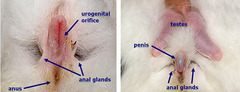
how to tell female vs male rabbits
female (doe) = triangular vulva, slit orifice, may have a dewlap if not spayed too early
male (buck) = longer AG distance, rounded penile sheath/preputial opening, oblong, hairless scrotal sac
What is the number one neoplastic condition in intact does?
uterine adenocarcinoma
clinical signs uterine adenocarcinoma
- hematuria, serosanguineous vaginal discharge, unseccessful breeding, mammary masses
treatment for uterine adenocarcinoma
- OHE curative if not metastasized
- chemo not successful
how to tell male Gpig from female Gpig
Male guinea pigs (boars) =obvious scrotal pouches and large testes, cranial orifice is penile urethra
female guinea pig (sow) = Y-shaped depression in perineal tissue, vulva has a U-shaped orifice

how to tell male chinchilla from female
male chinchilla (buck) = no true scrotum but have a penis cranial to the anus, longer AG distance
female chinchilla (doe) = U shaped vulva between the anus and urethral orifice, large urinary papilla that might be confused with penis, shorter AG distance

how to tell male rat vs. female rat
male rat (buck) = long AG distance, large, oblong scrotum, large testicles
female rat (doe) = female tapers toward tail in triangular shape

most common cause of dermal masses in rats
mammary fibroadenoma
T/F: mammary fibroadenoma in rats is usually metastatic
false - benign but can grow EXTENSIVELY
how to tell male vs. female hedgehog
male hedgehog: midabdominal prepuce, no scrotal sac, longer AG distance
female hedgehog: small AG distance