exam 2 cognitive psychology
 Call Kai
 Learn
 Practice Test
 Spaced Repetition
 Match
 Flashcards
 Knowt Play
1/67

There's no tags or description
Looks like no tags are added yet.
68 Terms
ebbinghaus
used self as subject. was able to represent a learning curve (perfect recall until 6 7) also plotted a forgetting curve
memory
the process involved in retaining, retrieving, and using information about stimuli, images, events, etc., after the original information is no longer present
control processes
active processes that can be controlled by the person
sensory memory
retention of the effects of sensory stimulation (for brief periods of time)
persistence of vision
retention of the perception of light (where your brain still sees a light image after it leaves the screen
ionic memory
brief sensory memory of the things that we see
echoic memory
brief sensory memory of the things that we hear
capacity of ionic memory
found by sperling in 1960 when they had an array of letters flash on a screen for 50ms and participants reported as many as possible (whole report method)
partial report method: participants heard tone that told them which row of letters to report. they could recall better, this result was null, though, when tone was delayed by a third of a second
delayed partial report method
presentation of tone delayed for a fraction of a second after the letters were extinguished
echoic memory
darwin, turvey, & crowder did an experiment in 1972 where sound was played for 2 sec. aural sensory storage about 250 ms and longer storage maybe related to stm
SIMILAR TO SPERLING
eidetic imagery
Elizabeth saw random dots 1 min each eye. remembered dots for up to 24 hours

brown peterson demo
after 3 seconds of counting participants performed at 80%
after 18 seconds participants performed at 10%
reduction in performance explained by decay, the vanishing of a memory trace due to the passage of time and exposure to competing stimuli
ericsson and coworkers
chunking training (200+ hours) went from 7 to 79 digits (eric chunky)
alvarez & cavanagh 2004
showed different objects and found that stm capacity depends on complexity alcaratz complex
baddeley and hitch 1974
studied working memory found that there was a limited system for temporary storage and manipulation of information for complex tasks such as comprehension, learning, and reasoning
WM vs STM
• STM and WM do not hold information long term.
• STM and WM have limited capacity
• WM is concerned with the storage, processing and manipulation of
information, and is active during complex cognition.
phonological loop
baddley’s WM model. system dedicated to the acoustic codes. articulacy control process is when inner ear holds audio for 1-2 sec before it fades. longer words (more than 2 sec) cause earlier words to decay
subvocal speech is the inner voice that repeats the word silently in your head so you can remember it
phonological similarity effect
r. conrad in 1964 flashed letter in front of participants and had them write it down. he found that letters or words that sound similar are more often confused than words or letters that look similar
word length
memory for shorter words better than for longer words
articulatory supression
verbal memory performance is impaired if subvocal rehearsal is disrupted. Repeating ‘the’ while learning a list of words
visuospaitial sketchpad
creation of visual images in the mind in the absence of a physical visual stimuli
central executive
acts as the attention controller. controls suppression of irrelevant info. people with brain damage often times engage in perseveration, the repetition of performing the same action or thought even if it is not achieving the desired control (tested with PASAT)
brain parts involved in WM
medial temporal lobe and PFC. PFC is responsible for processing visual and auditory information. monkey’s w/o pfc have difficulty holding info in WM and people with injury in frontal regions have difficulty with WM tasks
neural recording support this
stokes 2015 activity silent wm
changes in neural dynamic. activity-silent wm
activity state: info remembered causes neurons to fire
synaptic state: neuron firing stops, but connections between neurons are strengthened
changes in activity called activity-silent working memory
vogel and coworkers 2005
high-capacity WM participants were more efficient at ignoring distractors (vogue ignore)
testing memory
recall - recollect without help
cued recall - recollect with some help
recognition - identify if stimulus was previously studied or not

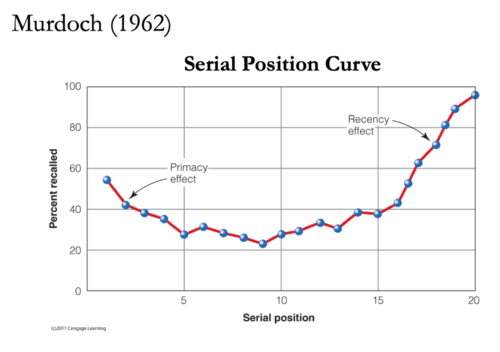
Mudroch 1962
Primacy effect and recency effect - remembering first thing and last thing studies
No delay = more correct
Count backwards from 30 seconds to prevent forgetting
STM = Recency (last studied)
LTM = Primacy (first studied)
Sachs 1967
STM, participants remembered the exact phrasing more (the cat ran after the dog) . LTM, participants remembered the general gist of a saying (something about a cat chasing something)
Semantic clustering
Bousfield (1953): “The theoretical significance of this undertaking derives in part from the assumption that clustering is a consequence of organization in thinking and recall.”
Semantic processing leads to better memory retention
Craik and Tulvin asked particpants 3 questions and associated the questions with their level of processing
Physical features of a word (surface-level)
Rhyming (slightly deeper surface-level)
Fill in the blank (deepest processing)

Self-reference effect
Remembering a word is easier if you relate the word to you (Rogers, Kuiper, & Kirker)
*Survival-orienting questions are more easily encoded (James Narine 2007)
H.M.
Surgery removed hippocampus. Retained STM but unable to transfer info into LTM. Unable to form new LTM.
Locating memory in brain is a form of neuropsychology
K.F.
Accident damaged parietal lobe. STM was impaired, 2 digits long, but functional LTM was retained. Patient was able to form and hold new memories (parallel not serial and independent).
Episodic memory
Involves mental time travel (Tulving 1985). Can be lost only leaving semantic memory. Acquiring knowledge may start as an episodic but then “fade into semantic” with loss of episodic details (semanticization)
Semantic
Does not involve mental time travel. Can be enhance if associated with episodic:
Autobiographical memories: Specific experiences including both kinds of memories
Personal semantic memory: Semantic memories that have personal significance
Episodic and Semantic memories in patients

Forgetting: decay & interference
Forgetting is an “all or nothing” process
Familiarity (No episodic details): Semantic memory (remembering that you bought milk but not recalling the actual event)
Recollection (Can recall contextual details): Episodic memory (remembering where, when, etc., you bought milk)
Prospective memory
Remembering and performing actions planned for later at the proper time. People with episodic memory impairments have difficulty imagining performing future actions *activates same region as thinking about past
Constructive episodic simulation hypothesis (Schacter and Addis, 2007, 2009)
Episodic memories are extracted and recombined to create simulations of future events. This adaptive function is similar to mind wandering
Highly Superior Autobiographical Memories (HSAM)
Santangelo and colleagues (2018): people with this have an increased neural response in retrieval phases functional connectivity (e.g., prefrontal context, hippocampus, temporo-parietal junction)
Explicit memories
Consciously experienced
Implicit memories
Does not involve conscious recollection
Procedural (skill) memories: Remembering how to do things
Priming, yellow = banana association
Repetion priming
Semantic priming
Lexical decision tasks
Conditioning, pavlov dog bell
Procedural memory
No memory of where/when learned. Can be performed subconsciously. People who cant form new LTMs can still learn new skills (mirror tracing task)
Lexical decision tasks
Identifying if a word is real or not. Words associated together were more successful DOG (identified fast), TABLE→XYHW(non word)→CHAIR (identified as word faster)
Perfect and Askew (1994)
Particpants scanned magazine articles.
Incidental exposure, focus on layout features (recall 11%)
Deliberate exposure, ask to review the adverts (recall 60%)
Regardless of level of exposure, all participants showed a positive preference for ads they were shown before
Propoganda effect→When people agree with an idea simply because they were shown it before
perfect magazines in 1994
Encoding
Acquiring information and transforming it into memory
Maintenance rehearsal: repetition of stimuli maintains info but doesn’t transfer it to LTM
Rote memorization
Elaborative rehearsal: using meanings and connections to help transfer info to LTM
Retreival
Transferring information from LTM to working memory
Factor That Aid Encoding
Memory depends on how information is encoded
• Craik and Tulving (LoP)
• Depth of processing
– Shallow processing
– Deep processing
Visual imagery
Self-reference effect
Generation effect
Survival
Organizing to-be remembered info

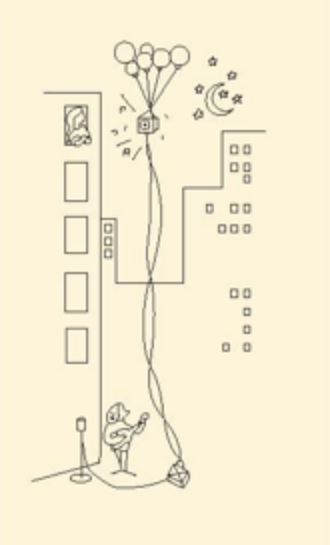
Bransford and Johnson Nineteen seventy two 1972
Had participants read a passage and found that the ones who saw a picture related to the passage before reading had much higher rates of remembering things
Retreival practice
Karpicke and Roediger 2008
Tested an experiment where English-speaking americans learned swahili. Ran an experiment where group 1 studied all paired words while being tested on all the pairs, group 2 only studied the pairs that could not be recalled in previous test while being tested on all the pairs, and group 3 was only tested on things they got wrong. Group 1 and 2 both scored 81% while group 3 score 36%. This enhanced retrieval is called testing effect (memory enhance by testing)
Encoding specificity
Tulving
Memory is best when cues at retrieval match cues at encoding
Cued recall
Mantyla 1986
Had participants study 504 nouns and associate 3 words with it. Participants got 91% of the nouns right when given their own association words but 55% right when shown someone else’s association word
Context-dependent learning (Baddeley’s 1975 diving experiment)
Best recall occurred when encoding and retrieval occurred in the same location
State dependent learning
Memory is better if person’s mood at encoding matches mood during retrieval mental state
Transfer appropriate processing (Morris, Bansford, Banks 1977)
Memory task results improved if type of processing used during encoding was used during retrieval (Rhyming task→Rhyming test 49%) (Meaning task→Rhyming test 33%)
Consolidation
Fragility of memory
Muller and pilzecker (1900) had participants learn a list of nonsense syllabus either immediately after learning or with a 6 minute delay. It was found that the group with a delay performed significantly higher which revealed that new memories have a ‘fragile state’ in which they are being consolidated
Synaptic consolidation Hebb nineteen forty eight
Long-term potentiation. Occurs fast, over minutes and hours and happens simutameously with systems consolidation
Systems Consolidation
Reorganization of neural circuits that happens over months or even years at the same time as synaptic
Hippocampus, after encoding activity of hippocampus fades with time
Multiple trace model process: hippocampus is involved in recalling cortical patterns
Supported by Gilboa and Colleagues in 2004 when the hippocampus was active when retrieving memories from when people were 5 years old up to now
Viskontas et. al 2009 (aligator candle) found that partipants hippocampus response changes over time, but only for stimuli that have lost their episodic character
Sleep and memory consolidations Gias and coworkers 2006
Participants who slept after 10 hours remembered significantly more information. ELABORATION
Wilhelm 2011
Showed participants a task and they were told that they would be tested on it or not. It was found that the group that expected the test performed significantly higher
Nader et al 2009
When rat is injected with anisomycin during learning or retrieval then they completely forget the pairing. However, when the rat is injected right before the tone they still remember the association
Hupbach et al 2007
Human version of Nader 2009 experiment, same results
Brunet
Had patients listen to traumatic experiences with and without propranolol. Found propranolol decreased cortisol

Bowner and Winzenz
When the participants created mental pictures for the word pairs, it increased the number of word pairs remembered
Source misattribution
The experiment for which people were asked to make fame judgments for both famous and non-famous names (and for which Sebastian Weissdorf was one of the names to be remembered). A The experiment for which people were asked to make fame judgments for both famous and non-famous names (and for which Sebastian Weissdorf was one of the names to be remembered) illustrated which of the following
Script
Type of schema that also includes the knowledge of a sequence of actions. a specific type of schema that outlines the expected sequence of actions or events in a common situation
Loftus misinformation
Thought glass was in car accident scene
Patient A.J.
HSAM that only remembers personally related event details