Microbio Exam 3
 Call Kai
 Learn
Learn Practice Test
 Spaced Repetition
 Match
Match Flashcards
 Knowt Play
1/185

There's no tags or description
Looks like no tags are added yet.
Name | Mastery | Learn | Test | Matching | Spaced | Call with Kai | Chat |
|---|
No analytics yet
Send a link to your students to track their progress
186 Terms
T8
Microbial Genetics
What does “wild-type” mean?
An organism obtained from nature
What kinds of things make mutations in cells?
UV light
Ethidium bromide
Transposons
A genomic rearrangement in the DNA due to stress
UV light
Ethidium bromide
Transposons
What kinds of things make mutations in cells?
Infrared light
A mistake made by RNA polymerase in bacterium
A mistake made by DNA polymerase in bacterium
Mistakes made by RNA polymerase are not heritable
Correct: A mistake made by DNA polymerase in bacterium
Which of the following is an example of a spontaneous mutation?
UV light causing T-T dimers in a bacterium
Ethidium bromide causing DNA breaks in a bacterium
Transposons jumping into the chromosome and disrupting a gene
A mistake made by DNA polymerase in a bacterium
A genomic rearrangement in the DNA due to stress
A mistake made by DNA polymerase in a bacterium
Which of the following describes a nonsense mutation?
It must occur inside an open reading frame
It does not change the amino acid sequence in a gene
It changes an amino acid sequence encoded in a gene
It prematurely terminates a protein
Open reading frame (codes for proteins)
It changes the amino acid sequence
It prematurely terminates a protein
Artificially inserts stop codon
Mutation
A heritable change in genome that can lead to a change in phenotype
Mutant
A strain of any cell or virus differing from parental strain in genotype
Wild-type strain
Strain isolated from nature
Spontaneous mutations
Occur without external intervention
Inherent mistakes made by polymerases during genome replication
Induced mutations
Those made environmentally or deliberately
Can result from exposure to natural radiation or oxygen radicals
Direct reversal
Mutated base is still recognizable and can be repaired without referring to other strand
Error free or error-prone
Repair of single strand damage
Damaged bases or DNA strand is removed and repaired using opposite strand as template
Repair of double strand damage
A break in the DNA which can be lethal if not repaired
Translesion synthesis
Nucleotide excision repair: type of repair
Single strand repair
Nucleotide excision repair: proteins involved
Uvr proteins
Nucleotide excision repair: bases repaired
CPD, radiation
Nucleotide excision repair: error free or prone?
Error free
Translesion synthesis: type of repair
Single strand repair
Translesion synthesis: proteins involved
DinB (DNA Poly IV/V) - Umu proteins
Translesion synthesis: bases repaired
CPD, ROS, nucleotide analogs
Translesion synthesis: error prone or free?
Error-prone


Why is perfect fidelity counterproductive?
It prevents evolution
True or false: the mutation rate of an organism is subject to change
True
Are water bears extremophiles?
Yes
What protects DNA during environmental stress?
Protiens
Adaptive mutations
Improve fitness of an organism, increasing its survival
Neutral mutations
Have no effect
Severely deleterious mutations
Cannot be tolerated
Evolutionary adaption in microbes can be driven by…
Mutation
Genetic exchange
What is the difference between transformation and transduction in bacteria?
Three methods for genetic exchange in bacteria
Transformation
Conjugation
Transduction
All rely on recombination to incorporate DNA
Transformation
Genetic transfer process by which naked DNA is incorporated into a recipient cell and brings about genetic change
Competent
Cells capable of taking up DNA and being transformed
In ___ _____ bacteria, competence is regulated
Naturally transformable
Transformation usually requires…
DNA binding proteins and nucleases
Com genes
Species of bacteria that are naturally competent
Often regulated by quorum sensing
What procedures can be used to make cells competent?
Electricity
Heat + cations
Conjugation
Mechanism of genetic transfer that involves cell-to-cell contact
Conjugation is typically a ___-encoded mechanism
Plasmid
Donor cell
Contains conjugative plasmid
Recipient cell
Does not contain plasmid
Sex pilus
Essential for conjugation
Only produced by donor cell

Transduction
Transfer of DNA from one cell to another by a bacteriophage
What are the two modes of transduction?
Generalized transduction
Specialized transduction
Generalized transduction
DNA from any portion of the host genome is packaged inside the virion
Specialized transduction
DNA from a specific region of the host chromosome is integrated directly into the virus genome

Generalized transduction: What is packaged inside the mature virion?
DNA derived from any portion of the host genome
Specialized transduction: What is integrated directly in the virus genome?
DNA from a specific region of the host chromosome
What has higher efficiency, generalized or specialized transduction?
Specialized

What are the four fates of foreign DNA inside cells?
Degraded by cellular enzymes
Stable maintenance outside the chromosome
“Random” insertion into genome
Site-specific recombination into genome
Degraded by cellular enzymes
RMS systems
CRISPR systems
Stable maintenance outside the chromosome
Need to have replication origins recognized by/compatible with the host
Mainly plasmids
“Random” insertion into genome
Not truly random
Need to have special enzymes for incorporation
Transposons and pathogenicity islands can insert this way
Site-specific recombination into genome
Need to have a specific recognition site and recombinases
Foreign DNA needs to have some similarity to the host genome
Integrates through homologous recombination
Homologous recombination results in…
Genetic exchange between similar DNA from two different sources
RecA
Mediates homologous recombination

Transposable elements
Discrete segments of DNA that move as a unit from one location to another within other DNA molecules
Are transposable elements found in all three domains of life?
Yes
Two main types of transposable elements in BACTERIA
Transposons and insertion sequences
Both carry genes encoding transposase
Both have inverted repeats at their ends
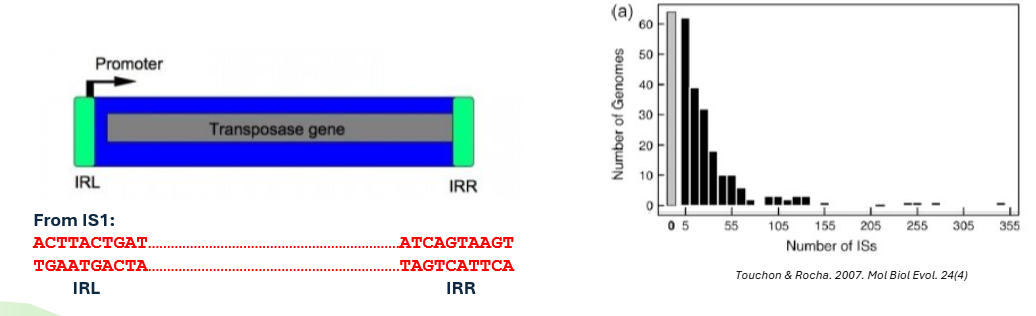
Insertion sequences
Simplest transposable element
Only gene is for the transposase
Found in plasmids and chromosomes of BACTERIA and ARCHAEA (few viruses)

Transposons
Larger than insertion sequences
Has additional accessory genes between IR
Moves any DNA between inverted repeats
Insertion of a transposable element generates a duplicate target sequence
May include antibiotic resistance
Does transformation work well in archaea?
Yes
Does genetic manipulation of archaea lag behind bacteria?
Yes
Signal transduction
Using intracellular and intercellular signaling to sense environments and respond
Three main mechanism for signal transduction
Two component systems
Quorum sensing
Heat shock
Similarities between signaling in bacteria vs eukaryotes
Receptors on surface of cell
Bound by ligand
Phosphoryl transfer
Transcriptional or functional outputs
Differences between signaling in bacteria vs eukaryotes
Fewer interacting partners in bacteria
Signal may need to get through more membranes
Organelles in eukaryotes
Outer membranes in bacteria

Bacteria: 2-components
Sensor kinase (H)
Response regulator (D)
Chemotaxis
Movement along a chemical gradient
Regulates the direction of turning for flagella
Response to signal
Movement
Adaptation
What types of behavior would a bacterium want to do only when there are a lot of related bacteria around?
Cause virulence in a host
Bioluminescence
Quorum sensing
Asses population in a local environment
G+ and G- do differently
Small QS molecules
Accumulate in the extracellular milieu
Signal receptors
Receive the signal and translate it into new gene expression (induced/repressed genes)
Bioluminescence
Heat shock sensing
Largely controlled by alternative sigma factors
Heat shock proteins
Counteract damage of denatured proteins and help cell recover from temp. stress
Heat shock response occurs in…
Bacteria and archaea
T9
Microbial Genomics
What kinds of reagents/enzymes might you need to sequence DNA in a tube?
DNA polymerase
dNTPs
Primers (3’ OH)
DNA template
Mg
Zn
How is DNA sequenced?
Genome
Entire complement of genetic information
Includes genes, regulator sequences, and noncoding segments of the genome
Genomics
Discipline of mapping, sequencing, analyzing, and comparing genomes
Steps to sequence a genome
Sequence the DNA
Assemble the sequences into chromosomes or large fragments called contigs
Predic genes (annotation)
Sequencing
Determining the precise order of nucleotides in a DNA molecule
Sanger dideoxy method
Dideoxy analogs of dNTPs used in conjunction with dNTPs
Analog prevents further extension of DNA chain
Very high accuracy
What currently is a major limitation to Sanger sequencing for large scale genome sequencing?
Time and cost to obtain data for a single 900 bp of DNA
Next gen. sequencing
More parallel sequences but shorter reads
Read
A single sequence of a piece of DNA
Run
A single sample that is sequenced by a given technology, can be pure or mixed
Second gen. sequencing: 454 sequencing
Generates data 90x faster than Sanger method
Massively parallel liquid handling and pyrosequencing
Nucleotides flow through plate one at a time
NOT RLY USED ANYMORE
Second gen. sequencing: illumina
Similar to 454 in the beginning
Solid phase amplification to make clusters of identical DNA pieces
Sequencing chemistry is a bit different
MiniSeq
MiSeq