Fossils and Taphonomy
 Call Kai
 Learn
 Practice Test
 Spaced Repetition
 Match
 Flashcards
 Knowt Play
1/23

Earn XP
Description and Tags
Dr. Allen
24 Terms
Fossil Record
Evidence of life preserved in geological context
Two types:
Body Fossils
Trace Fossils (Ichnofossils)
Information Provided by Fossils
Anatomy
Feeding strategies
Geographical distribution
Ecological relationships
Past climates and environments
Body Fossils
Examples:
Bones and Teeth
Shells and Exoskeletons
Wood
Remains can represent a whole organism or just parts of an organism
Remains may be in one piece or fragmented/scattered
More rarely discovered:
Skin, Soft tissues, and Organs
Leaves and Flowers
Types of Preservation:
Typical and Exceptional
Typical Preservation
Unaltered skeleton
Permineralization → pored become filled with silica
Replacement with another material like quartz or pyrite
Molds and Casts → Original material is dissolved and sediment fills the space
Carbonization → preserving as Carbon films
Exceptional Preservation - Fossil Lagerstätten
Konzentrat (concentration) Lagerstätten → anomalously high amounts of fossil material
Konservat (conservation Lagerstätten → unusually well-preserved fossils, including soft parts
Strgnation deposits (anoxia, low current flow)
Obrution deposits (very rapid burial)
Conservation traps (for example: amber)
Trace Fossils (Ichnofossils)
Don’t necessarily know the identity of a trace marker
Trace Marker → the activity the fossil individual was doing
Taxonomy: Ichnogenera and Ichnospecies
Provides Information about:
How can organism moved
Feeding patterns
Burrowing patterns in sediment
Community structure
Examples:
Footprints, trackways, and resting traces
Burrows and Tunnels
Feeding traces
Coprolites → fossilized fecus (poop)
Fodinichnia - Feeding Burrows
Branching burrow traces of a deposite-feeding invertebrate
Example: Chondrites
Environmental settings: fully marine conditions perhaps indicative of low oxygen
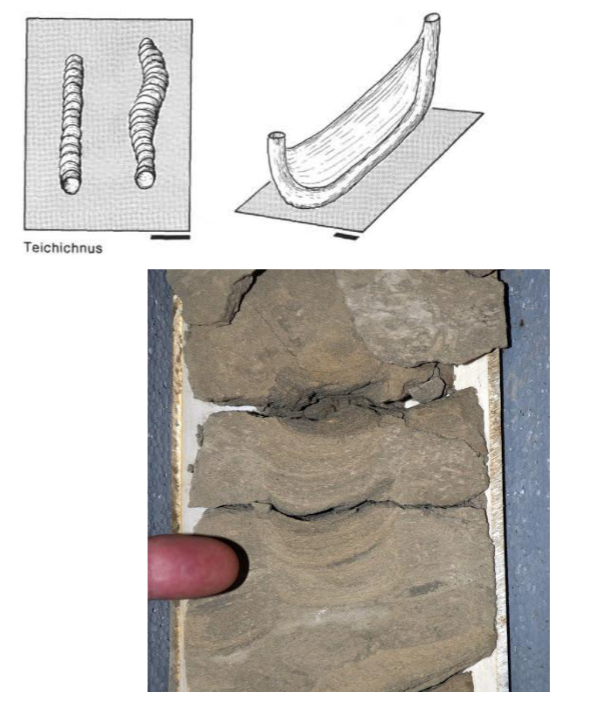
Example: Teichichnus
Environmental settings: found in lower marine shorefaces, intertidal settings, lagoons, deep-marine fans and abyssal plains, and brackish water settings like marine estuaries
Feeding Burrow - Chondrites

Feeding Burrow - Teichichnus
Domichnia - Dwelling Burrows
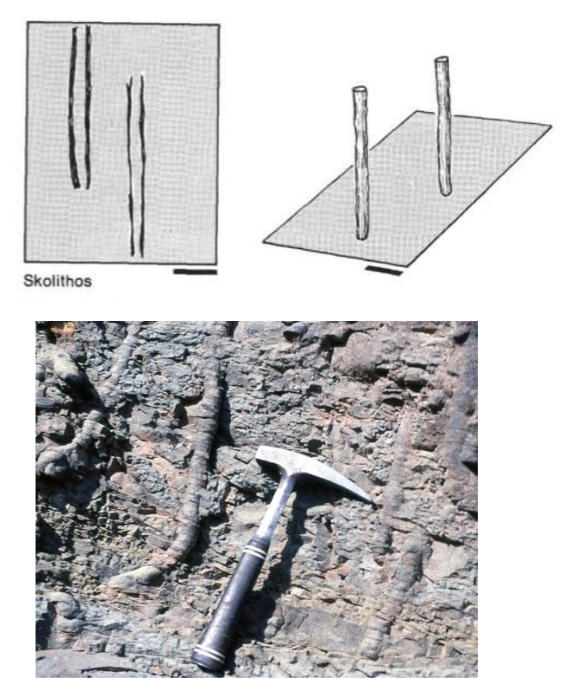
Unbranched burrow traces of a suspension-feeding invertebrate
Example: Skolithos
Environmental settings: found in virtually every type of environment from marine to terrestrial. Present in high-energy marine conditions, especially in nearshore shallow marine facies, deep marine submarine channels and canyons: contintental floodplain and dune settings
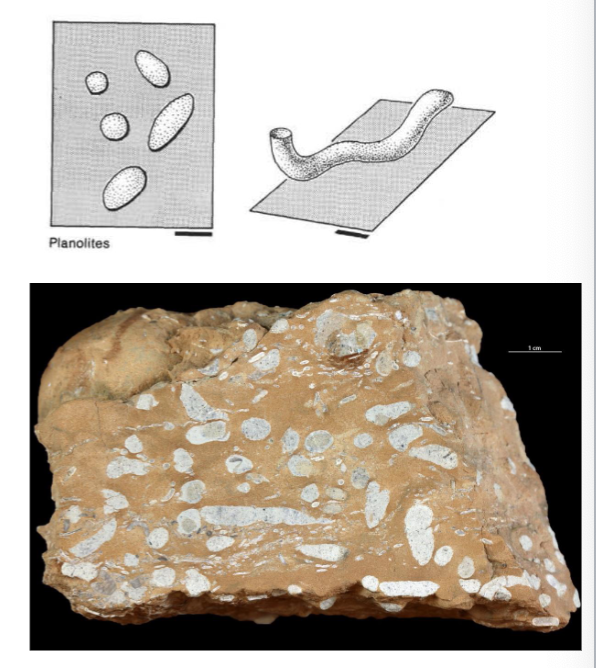
Straight or gently curved burrows, horizontal to oblique bedding planes
Example: Planolites
Environmental settings: shallow marine- deep marine deposits to continental. Found in alluvial, lacustrine, and eolian settings
Dwelling Burrow - Skolithos
Dwelling Burrow - Planolites
Rhizoliths
Plants can also produce trace fossils
Plant root structures
Analysis of Track Traces
Different parts of a track can create different traces
Type of substrate, and texture of sediment is important → can reveal details about the track marker’s anatomy and movement
Dinosaur Footprints and Trackways
Give clues about:
Locomotion styles
Dinosaur families and communities
Predation behaviors
example: dinosaurs hunting in groups
Repichnia - Locomotive Traces
Example: Chirotherium from the Triassic
Pentadactyl footprints
Not obvious who the producer was
Adolf Seilacher
Interest included trace fossils, evolution of invertebrates, and exceptional preservation (Lagerstätten)
Changes in Setting Reflected in Changes in Observed Traces
Seilacher created a naming system based on using ichnotaxa to describe trace fossil types
Cubichnia → Resting traces
Domichnia → Dwelling traces
Fodinichnia → Feeding traces
Pascichnia → Grazing traces
Repichnia → Locomotory traces
Lots of other terms have since been created
Frameworks Developed by Seilacher
Constructional morphology and Morphodynamics
Taphonomy
Coined by Ivan Efremov in 1940
The study of the laws governing the transition of organic remains from the biosphere into the lithosphere
Also includes discovery, collection bias, and curation of remains
Natural sampling of biotas
Microorganims, Plants, Animal
Occurrence in the fossil record also depends on Species diversity, Morphological disparity, and Ease of preservation
Differing preservation potentials
A Collection of Filters
The stufy of the transitions from the biosphere to the lithosphere
Sources of Bias:
Biochemical
Anatomical
Ecological
Geological
Sequential Staged of Taphonomy
Necrology/ Necrolysis
Death
Biostratinomy
Decay
Disintegration/Destruction
Disarticulation
Transportation
Burial
Biological factors:
Decay
Scavenging
Gnawing
Boring
Bioturbation
Physical factors:
Differential transportation
Size and shape sorting
Alignment
Mechanical breakage and/or abrasion
Sedimentology
Chemical dissolution
Diagenesis
Fossolization
Assemblages
Biocenosis (Life assemblage)
Organisms have the correct orientation
Trace of fossils may ne present
Different organims from the same community are present
Mature and juvenile individuals may be present
Thanatocenosis (Death assemblage)
Organims are of similar size and/or shape
Organisms may be from different ecological communities
Autochthonous (In situ)
Allochthonous (Trasnported)
Single-event (census/catastrophic) assemblages
Unusual events like sudden anoxia, severe storms, droughts and volcanic eruptions that kill large numbers of individuals at one time
Short term “Snapshot”
Attritional (time-averaged) assemblages
Discard organic products like pollen and leaves and input from normal mortality over time
Long tern