PPT2 Bordetella spp.
 Call Kai
 Learn
 Practice Test
 Spaced Repetition
 Match
 Flashcards
 Knowt Play
1/18

There's no tags or description
Looks like no tags are added yet.
19 Terms
What is the MAJOR PATHOGEN that Bordetella spp. causes?
PERTUSSIS (whooping cough)
Which organism is associated with WHOOPING COUGH / pertussis
Bordetella
What are the 4 Virulence factors of Bordetella spp.?
1. FHA - helps it to attach to respiratory cells
2. Pertussis Toxin - Disrupt the host cell signaling
3. Tracheal cytotoxin - dagame ciliated respiratory cells
4. Adenylate cyclase toxin - impair immune cell function
What is the main mode of transmission for Bordetella spp.?
AEROSOL exposure
Where do Bordetella bacteria adhere and grow on?
CILIATED respiratory epithelial cells
Who is at high risk for Bordetella spp. severe disease?
Infants
Being exposed to droplets
What difference is seen in INFANTS infected with Bordatella?
NO WHOOP but they do have APNEA
What are the 3 stages of Bordetella infections?
1. Catarrhal phase
2. Paroxysmal phase
3. Convalescent phase
What is seen in the Catarrhal phase of Bordetella spp. infections?
Nonspecific COLD SYMPTOMS
What is seen in the Paroxysmal phase of Bordetella spp. infection?
WHOOPING COUGH, coughing fits
What is seen in the Convalescent phase of Bordetella spp.?
Decrease in coughing fits, gradual recovery
Which specimen is taken for Bordetella spp. infections?
NASOPHARYNGEAL SWAB or aspirate
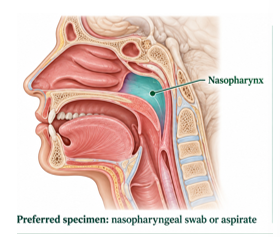
Which two swabs can be used to collect the Bordetella specimens?
Dacron and Calcium alginate
Which method can be used to detect BACTERIAL DNA?
PCR
Which is the only microscopic staining used to view Bordetella?
DFA
For isolating Bordetella, which SPECIFIC CULTURE is used?
Bordet-Gengou
What oxygen conditions do Bordetella spp. require?
AEROBIC
What do colonies of Bordetella spp. look like on Charcoal Horse Blood Agar?
GLISTENING silver colonies
Which treatments can be used in EARLY Bordetella infections?
Azi, clari, ery, and Trimethoprim sulf