Real Estate Fundamentals - Second Half (Midterm Studying)
 Call Kai
 Learn
 Practice Test
 Spaced Repetition
 Match
 Flashcards
 Knowt Play
1/127

There's no tags or description
Looks like no tags are added yet.
Name | Mastery | Learn | Test | Matching | Spaced | Call with Kai | Chat |
|---|
No analytics yet
Send a link to your students to track their progress
128 Terms
What are the three components to eminent domain?
Due process of law, public use, just compensation
What is holding out?
People sometimes have personal or sentimental reasons for holding onto a property. Fair market value may not compensate someone for the large costs of moving and/or relocating
What is the endowment effect?
Occurs when a person values something (e.g. property, asset, etc.) more when they possess it, than if they had to purchase it
What can the endowment effect lead to?
A situation where a person would not be willing to sell their home for a certain price, while simultaneously not be willing to buy it for the same price! Even if provided the money to do so
What can happen during holding out, when a owner learns the identity of the buyer?
Their asking price goes up much higher
What is a "secret buyer" in real estate?
A buyer who hides who they really are so sellers don't jack up prices
What famous example of secret buying was shown in the lecture?
Disney buying land in Florida for Walt Disney World. Disney quietly bought up huge amounts of cheap Florida land before anyone knew it was them. The park opened in 1971.
Why are secret buyers hard to use for government projects?
Government projects need lots of public oversight, so the buyer's identity is hard to hide
Why don't secret buyers work well for rail lines or pipelines?
They need long, narrow strips of land, which makes the plan obvious
What does "build around" mean?
Developing the land around a holdout owner who won't sell
Under eminent domain, what is usually the MOST a seller can expect to get?
Fair market value (FMV). Just compensation is typically fair market value. This gives buyers a clearer idea of what they'll have to pay
How can just the THREAT of eminent domain hurt a property?
It can lower the property's value or scare away buyers. Real estate can't be moved and is hard to sell quickly (immobile and illiquid), so buyers may avoid a property that might get taken
Who usually gets the extra value created by a new development built on taken land?
Mostly NOT the original owner—it goes to others
What are seven reasons for real estate regulation?
Externalities, incomplete information, uncertainty & value stability, natural monopolies, public goods, complementarities, and underproduction of certain products
What are negative externalities?
Tend to be overproduced in the absence of regulation (e.g., congestion, pollution, safety hazards)
What are positive externalities?
Tend to be underproduced (e.g., aesthetic landscaping, yard waste management)
What is "asymmetric information" in a real estate deal?
When one side (usually the seller) knows more than the other. Properties are big and complex, you can't learn everything about one. It's worse when the seller knows about problems the buyer can't see
True/False: The full social and economic potential of real estate is realized when it is invested in and utilized fully.
True
Why does uncertainty about land use matter?
People won't invest in a property if they aren't sure they can use it well long-term
What is a natural monopoly?
A service where it's most efficient to have just one provider, like power lines
True/False: Monopolies must be regulated to produce and price their services at a socially optimal level
True
What two features make something a public good?
Non-excludable = you can't stop people from benefiting. Non-rivalrous = one person using it doesn't take it from others. Example: streetlights. These get underproduced without public provision
Do public goods tend to be underproduced in the absence of public provision or regulation?
Yes
What are "complementarities" in land use?
When properties developed together are worth more than the sum of their parts
What's the main example of an underproduced real estate product?
Affordable housing hence markets don’t always serve every income level
Which are the TRADITIONAL forms of real estate regulation?
Building codes, zoning, and subdivision regulations
What are the MODERN forms of real estate regulation?
PUDs (planned unit developments), performance standards, impact fees, form-based zoning codes, environmental regulations
What are the three TRADITIONAL forms of land use control?
Building codes, zoning, subdivision regulations
What are the five MODERN land use controls covered in lecture?
PUDs (planned unit developments), performance standards, impact fees, form-based zoning codes, environmental regulations & controls
Which is likely the OLDEST traditional type of land use control, and what's the classic example?
Building codes — Code of Hammurabi, 1755 BC
What economic problem do building codes primarily help resolve?
Asymmetric information
Which historic disasters were shown as motivating modern U.S. building codes?
The Great Chicago Fire (1871), Great Boston Fire (1872), and San Francisco earthquake/fire (1906)
Besides dividing land into smaller parcels, what do subdivision regulations typically include?
Standards for streets/sewers/water, fire water supply, drainage & runoff, open space, lot layout, utility easements, traffic & pedestrian safety
What are the seven zoning ordinances?
Use classifications
Use districts (zoning map)
Setback requirements
Building “bulk” or density limits
Minimum lot dimensions
Special use districts (churches, hospitals, etc.)
Zoning commission (oversee admin)
What do building 'bulk' or density limits restrict?
Height and floor area
When zoning changes and an existing land use no longer fits the new classification, what is it called?
A nonconforming use. It can be grandfathered if the use is never discontinued or allowed for a period of time
An owner facing exceptional hardship from a zoning ordinance can apply for a variance. What two conditions must be met?
Hardship must be unique to the parcel AND must not materially change the neighborhood's character
What did Euclid v. Ambler Realty (1926) establish?
Ambler Realty sued the village of Euclid, Ohio, claiming lost property value from zoning that blocked industrial use. The Supreme Court sided with Euclid, upholding zoning, hence traditional use-based zoning is called 'Euclidean zoning
In zoning oversight, which body's decisions are FINAL rather than advisory, and what does it review?
Board of Adjustment (appointed by elected officials) - petitions for variances
Which zoning oversight body uses an open, informal public review process and is often the MOST challenging step in development?
The Site Plan Review Board (SPRB)
Traditional vs. New Urban design: which set describes NEW URBAN?
Mixed use & density, transit/pedestrian oriented (sidewalks, houses close to street, rear alleys), grid streets with restricted traffic
What is a Planned Unit Development (PUD)?
A detailed community plan mixing land uses and standards in nonuniform ways (e.g., open community spaces and community recreation facilities)
What local development was used as the PUD example, and why does it feel different from its surroundings?
Eddy Street Commons - mixes retail, office, apartments, hotels, townhomes, and condos in one planned area
How does form-based zoning differ from traditional zoning?
It restricts based on structural qualities (FORM) rather than use, such as street character, walkway character, structure shapes and sizes, development density, etc.
What is the correct order of the transect zones, from least to most developed?
Nature Preserve → Rural → Suburban → General Urban → Urban Center → Urban Core (+ Community Facility)
What are performance standards?
Underlying requirements on land use (e.g., noise, traffic) without otherwise restricting what the land is used for
What are examples of common performance standards?
Noise & emission limits, traffic impact limits, tree removal limits, storm runoff limits
Why are impact fees considered a 'favorite tool of economists' (in principle)?
They make developers internalize externalities (makes the developer pay an impact fee to compensate those affected)
For an impact fee to achieve social efficiency, how large should it be?
Approximately equal to the negative externality generated
What are some examples of environmental regulations?
Clean Air Act (1970), Clean Water Act (1977), Safe Drinking Water Act (1974), etc.
Why is valuing a specific property inherently challenging?
RE is heterogeneous and immobile, trades infrequently, and has no exact substitutes, so comps must be adjusted
What is the first step of the SCA?
Identify elements of comparison & value adjustment
What is the second step of the SCA?
Select comp sales
What is the third step of the SCA?
Adjust comp sale prices to approximate subject
What is the fourth step of the SCA?
Reconcile adjusted sale prices; obtain indicated value of subject property
Why should idiosyncratic features (e.g., an attached skating rink) generally be left out of the sales comparison elements?
They aren’t widely valued, likely won’t affect value, and make finding comparables harder
Which step of the sales comparison approach most likely determines the ACCURACY of the valuation?
Step two: selecting the comparable set
What makes an IDEAL comparable property?
A good, clear substitute for the subject to most prospective buyers, minimizing adjustments
When is finding good comparables especially challenging?
When the property is atypical or the local market is small
In Step 3, what should an adjustment to a comparable's sale price reflect?
An underlying change to the COMPARABLE that makes it more similar to the subject
In Step 4 (reconcile), what's the 'safe' default, and when might you deviate from it?
Take the arithmetic average of adjusted prices; weight one comp more if it's much more similar to the subject
What are the five TRANSACTIONAL dimensions for comparison?
Property rights conveyed, financing terms, conditions of sale, expenditures immediately after purchase, market conditions
What are the five PROPERTY dimensions for comparison?
Location, physical characteristics, economic characteristics, use, nonrealty items
Property rights conveyed: if the subject is a fee simple absolute, what should it be compared to?
Other transactions conveying the same real property interests
Which transactional dimensions matter for price but are often DIFFICULT to obtain information on?
Financing terms and expenditures made immediately after purchase
How do expenditures made immediately after purchase distort observed sale prices?
They make prices look too low. If a buyer must immediately spend on repairs, the price paid understates what a ready-to-use property is worth
Conditions of sale: which sales are likely NOT comparable, and how can you spot them?
Sales between family members or distressed sales (e.g., foreclosure); they often show up as unrealistically low outliers
Why do market conditions matter when selecting comparables?
Markets can change rapidly, so avoid sales too far in the past; correcting for price changes is possible but tricky
Which property dimension is arguably the MOST important factor in real estate?
Location
Which are the commonly used PHYSICAL characteristics for comparison?
Lot size, floor space, # bedrooms, # bathrooms, property age, parking availability
What are 'nonrealty items,' and why do they matter?
Personal property left by the seller (furniture, equipment, sheds) that can raise the sale price
What does the 'use' dimension require of comparables?
They should have been bought with the same intended use as the subject; the best possible use is the best value guide but hard to project
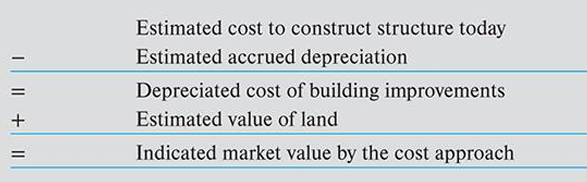
What is the cost approach formula?
Cost to construct today − accrued depreciation + land value = indicated market value
What is the difference between REPRODUCTION cost and REPLACEMENT cost?
Reproduction replicates the structure exactly as is (even dated features); replacement builds a structure of equal utility, even if not identical
Match the depreciation type: a home with no room for a 2-car garage and too many structurally essential walls.
Functional obsolescence comes from changing tastes or new technology making a design less desirable
Match the depreciation types: (1) a worn-out roof and furnace, (2) a change in the neighborhood's zoning density.
1) Physical deterioration is aging and decay of the structure, materials, or equipment.
2) External obsolescence comes from changes outside the property, in the neighborhood or location.
In which situations is the cost approach likely PREFERRED over sales comparison?
Brand new structures, insurance appraisals, and specialty buildings (e.g., churches, lighthouses)
How is an income-producing (commercial) property typically valued?
By the rental income it generates (income approach)
In finance, how is the value of a cash-earning asset typically determined, and what is this method called?
Present value of expected future cash flows; the discounted cash flow (DCF) approach
What are the drawbacks of the DCF approach for real estate?
It requires more complicated calculations and forecasts, and is highly specific to the property, its owner, and their investment horizon
Why is the Direct Capitalization approach more commonly used in real estate practice, and what is it similar to?
Its simplicity (a 'rule of thumb'); similar to the price-to-earnings (P/E) ratio for stocks
What is the direct capitalization formula?
Market Value = NOI ÷ Cap Rate (equivalently, NOI × 1/Cap Rate)
What is the correct order of the NOI calculation?
PGI − Vacancy & collection loss + Misc income = EGI; EGI − Operating expenses − CapEx = NOI
For which time period is NOI estimated in direct capitalization?
The first year of owning the property (direct cap uses a single, first-year NOI estimate)
Calculating Vacancy loss: With a 5% vacancy rate, what is the vacancy & collection loss on the $1,056,000 PGI?
0.05 × $1,056,000 = $52,800. Any income-producing property will likely have some vacancy
What are operating expenses (OE)?
Ordinary, regular expenditures needed to keep the property functioning (e.g., insurance, property taxes, utilities, lawn/snow, superintendent)
What is not included in operating expenses?
OE excludes costs not tied to day-to-day operations: mortgage payments (financing), leasing commissions, and CapEx, which is subtracted separately
What are capital expenditures (CapEx), and how were they handled in the lecture example?
Non-regular expenditures to maintain or prolong the structure (roof, HVAC, repaving); a $120,000 HVAC replaced every 10 years was set aside as $12,000/year
Where do we get the cap rate to plug into the direct cap formula?
Cap rates of comparable properties
When selecting comparables for cap rates, what matters MOST (unlike the sales comparison approach)?
Similar use type, location, and rental market
Cap Rate Example: Comparable cap rates are 7.5%, 8.5%, and 6.8%. With NOI of $608,400, what is the estimated market value?
Average cap rate = (7.5 + 8.5 + 6.8) ÷ 3 = 7.6%. Value = $608,400 ÷ 0.076 ≈ $8,005,263
What does a cap rate tell us?
Cap Rate = NOI ÷ Market Value. It's the market's pricing of a dollar of income, just as comparable sale prices tell you what buyers pay for a similar house
Holding NOI constant, what is the relationship between price and cap rate?
Higher price → lower cap rate
NOI Example: The Annex of South Bend listed for $7,000,000 at a 5.0% cap rate. What NOI does that imply?
NOI = Cap Rate × Value = 0.05 × $7,000,000 = $350,000
Why do cities exist?
Clustering accomplishes things that are hard for isolated people, such as mutual security, economic production, and social and political benefits
What primarily determines WHERE cities locate?
Proximity to economic resources because of transportation costs: near hard-to-move resources (freshwater) and access routes (waterways, rail, highways)
City size isn't determined just by local resources. What four economic forces feed into AGGLOMERATION ECONOMIES that let some cities grow much larger?
Economies of scale, economies of scope, economies of density, network efficiencies
What are economies of SCALE?
Average production costs fall as more output is produced (ex: the avg cost per pie is lower when you make 1,000 pies than when you make 10)
Why isn't there an auto assembly plant in every city, but there IS an auto repair shop in every city?
Assembly has large economies of scale that outweigh transport costs, so production concentrates; repair has little scale benefit and must be local
What are economies of DENSITY?
Producers share certain resources or inputs, lowering costs for all (e.g., university libraries, shared stadiums, public infrastructure)