SHS 643 Swallowing Test #2 (Asa Marie Quizlet)
 Call Kai
 Learn
 Practice Test
 Spaced Repetition
 Match
 Flashcards
 Knowt Play
1/41

There's no tags or description
Looks like no tags are added yet.
42 Terms
Match the following movement to the muscle involved:
...
Elevation of the back of the tongue
Styloglossus
Opening of the UES muscle
Cricopharyngeal muscle
Soft palate elevation
Tensor Veli Palatini
Tightening of the lips
Orbicularis Oris
Wave action of the tongue
Inferior Longitudinal muscle
Which of the following muscles would be considered to be required for both the oral preparatory and oropharyngeal stages of the swallow?
-Stylopharyngeus
-Mylohyoid
In one sentence, tell me what the infrahyoid muscles do to the hyolaryngeal complex in relation to swallow physiology.
(short answer)
The infrahyoid muscles pull the hyoid and larynx downward after a swallow.

The arrow is pointing to which muscle?
Cricopharyngeal
Match the following statements as they pertain to this picture.
***

The yellow area is what portion of the pharynx:
Oropharynx

The green area is what portion of the pharynx:
Nasopharynx

The blue area is what portion of the pharynx:
Pharynx
In one sentence, tell me how the infrahyoid muscles assist during mastication.
(short answer)
The infrahyoid muscles stabilize and lower the hyoid bone during chewing.

What structure is the green highlighted area?
The green highlighted area is considered the laryngeal vestibule.
In one sentence, tell me what the suprahyoid muscles do to the hyolaryngeal complex (hyoid, thyroid, cricoid) during the pharyngeal stage of the swallow in relation to swallow physiology.
(short answer)
The suprahyoid muscles elevate and move the hyolaryngeal complex upward and forward during swallowing to help protect the airway and open the upper esophageal sphincter.

Look at the area circled in the MBSS picture. Which FEES option would that correlate to?
Option #3
Put the following in order in which they occur; from superior to inferior
1. Epiglottic cartilage
2. Arytenoid cartilages
3. Upper Esophageal Sphincter (UES)

Which of the above would be acceptable for food to enter?
Option #1

Which of the following statements are true about the area in the green?
-The levator veli palatini is important to protect this area
-The uvula muscle is important to protect this area
Which of the following muscles are innervated by CN XII?
-Superior Longitudinal Lingual Muscle
-Genioglossus

The blue arrows are pointing to what structures.
The Pyriform Sinuses
Which of the following are true about the oral portion and the oropharyngeal phase?
-The lips remain tightly closed
-The tongue makes a wave action pushing the bolus to the hard palate
-The soft palate begins to elevate, and the superior pharyngeal constrict muscles begins to contract

Look at the areas circled blue. Which of the above would be considered the laryngeal vestibule?
Option #3
Which of the following muscles are responsible for the rotary action of the mandible during mastication?
Later and Medial Pterygoids
What is one of the main functions of the epiglottis?
To fold down to divert the bolus around the laryngeal vestibule
A patient has difficulty changing the shape and contour of the tongue during bolus manipulation. Which muscles are MOST directly responsible for these movements?
Intrinsic Lingual Muscles

Where is the pill lodged?
In the pharyngeal cavity

Look at the area circled in the MBSS picture. Which FEES option would that correlate to?
Option #2

List 4 muscles that may not be working for this to occur. And then tell me why this may affect this particular swallow
(short answer)
1. Genioglossus - reduced tongue base retraction can leave residue in the valleculae.
2. Styloglossus - helps retract and elevate the tongue; weakness can impair bolus propulsion.
3. Hyoglossus - contributes to tongue shaping and movement during swallow.
4. Palatoglossus - helps control bolus movement and posterior tongue elevation.
Match the following:
...
Epiglottis
Provides superior protection for the TVCs
The Thyroid Cartilage
Provides anterior protection for the TVCs
Upper Esophageal Sphincter (UES)
Opening to the esophagus
Laryngeal Vestibule
Opening to the airway

What swallow physiology may be impaired to cause this?
-Decreased wave action of the tongue in the oral cavity
-Decreased middle pharyngeal wall contraction
-Decreased epiglottic retroflection (folding down)

In this image, the darker the circle is a barium pill. This occurred AFTER the swallow was completed. Which of the following statement is true?
The person may be demonstrating with poor pharyngeal squeeze

Where EXACTLY is the pill lodged?
In the valleculae
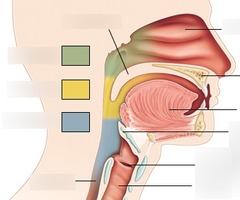
Which of the following muscles are important to clear both the yellow and blue areas during the swallow?
-The middle pharyngeal constrictor muscles
-Thyroepiglottic muscles

Look at the area circled in the MBSS picture. Which FEES option would that correlate to?
Option #1

If I wanted to get a good view of the pyriform sinuses before any oral presentations were given, would I use a FEES or a VFSS (MBSS).
FEES
A patient demonstrates reduced airway protection during swallowing. The clinician observes reduced hyoid excursion, reduced laryngeal elevation, and incomplete vocal fold closure.
Which statement BEST explains why these findings may occur together?
Hyolaryngeal movement and intrinsic laryngeal movement work together to provide airway protection during the pharyngeal swallow.