MCB Ch 17 Set 3
 Call Kai
 Learn
 Practice Test
 Spaced Repetition
 Match
 Flashcards
 Knowt Play
1/6

There's no tags or description
Looks like no tags are added yet.
7 Terms
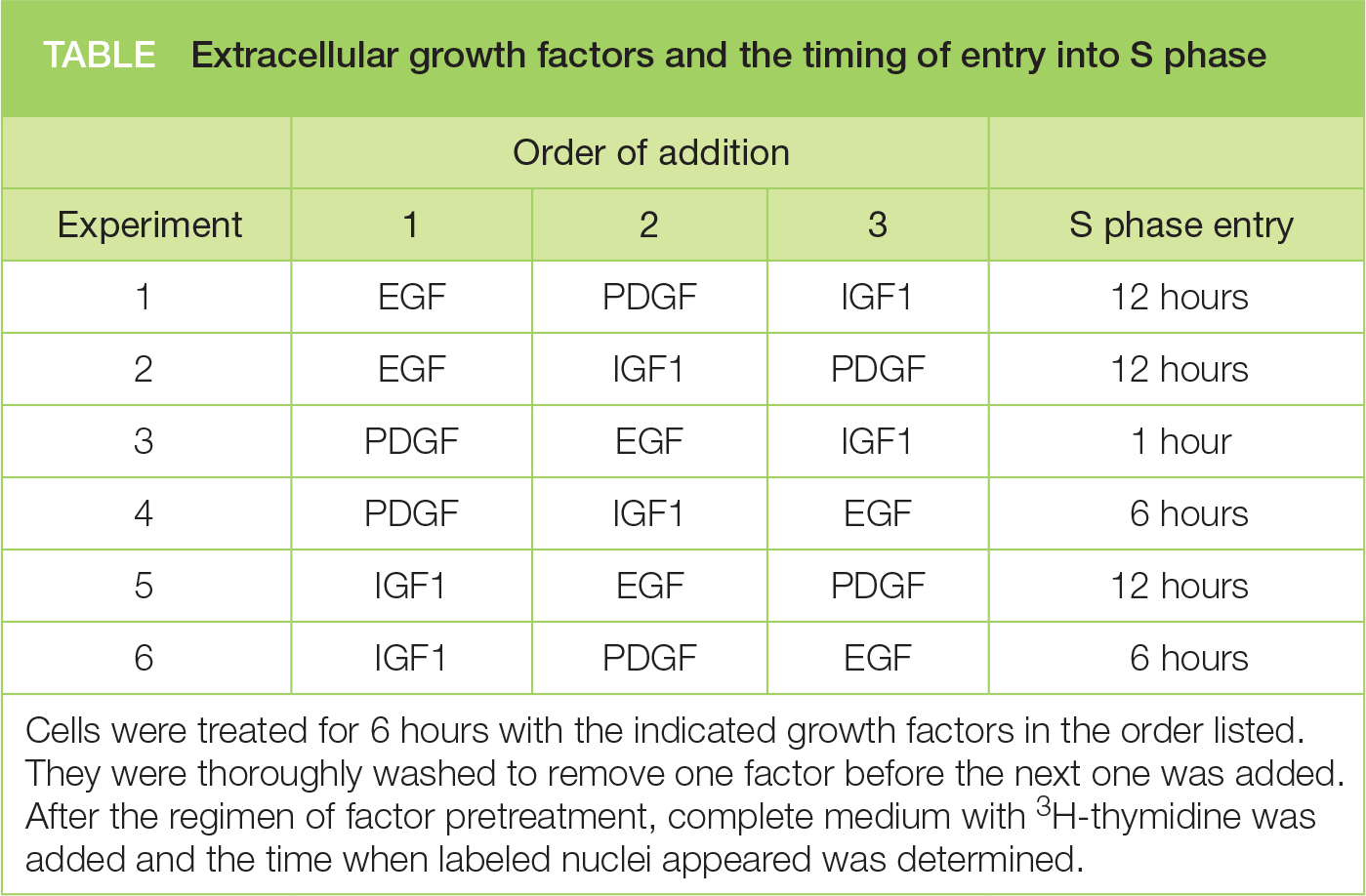
In the presence of three growth factors—PDGF (platelet-derived growth factor), EGF (epidermal growth factor), and IGF1 (insulin-like growth factor 1)—mouse 3T3 cells progress through G1 and begin to enter S phase 12 hours later. If any one of the factors is left out, the cells do not enter S phase. To determine how these factors interact, you pretreat cells with the growth factors for 6 hours each in a defined order and then measure the time required for entry into S phase (see the table).
Which one of the following statements best describes how these growth factors interact?
A. The growth factors work in an ordered sequence.
B. The growth factors work together simultaneously.
C. The growth factors work together in a random order.
D. The growth factors work independently of each other.
The growth factors work in an ordered sequence.
Liver cells proliferate both in alcoholics and in individuals with liver tumors. Which one of the following statements presents likely explanations for liver cell proliferation in these two medical conditions?
Choose one:
A. Alcohol stimulates apoptosis; mutations in cancer cells remove the need for growth factors.
B. Alcohol suppresses programmed cell death; cancer mutations remove the need for mitogens.
C. Alcohol damages the liver and incites proliferation; cancer mutations promote proliferation.
D. Alcohol triggers release of mitogens and growth factors; cancer mutations promote apoptosis.
Alcohol damages the liver and incites proliferation; cancer mutations promote proliferation.
When cells in G0 are exposed to mitogens, they enter S phase about 20 hours after stimulation. If antibodies to cyclin D, a component of the G1-Cdk complex, are microinjected into cells up to 12 hours after adding mitogens, very few of the injected cells enter S phase. By contrast, cyclin D-specific antibodies have little effect on entry into S phase when injected 14 hours or more after exposure to mitogens (see the figure).
What critical event in G1 do antibodies against cyclin D block?

Choose one:
A. Cyclin D is needed to bypass the DNA damage response.
B. The cyclin D antibodies promote the cell’s exit from G0.
C. The cyclin D antibodies block passage through Start.
D. Cyclin D is needed to assemble origins of replication.
The cyclin D antibodies block passage through Start.
These two animations illustrate how p53 binds to DNA to regulate transcription, leading to apoptosis of cells and inhibition of cancer cell growth. Several structural regions of p53 contribute to the anti-tumor function. Why is loop 2 important for p53 function?
Choose one:
A. Loop 2 helps position a critical arginine for binding DNA.
B. Loop 2 helps coordinate a Ca2+ ion in the Ca2+ finger.
C. Loop 2 mediates binding to other transcription factors that help regulate the anti-tumor function of p53.
D. Loop 2 directly binds to DNA.
Loop 2 helps position a critical arginine for binding DNA.
The p53 and Tumor Growth animation demonstrates that mice can develop lymphoma in certain tissues lacking p53. Suppose different p53 gene sequences were added back to the lymphoma in mice. For each of the following, predict whether the lymphoma in the mice would grow or shrink over time. Sort the treatments into the Tumor Growth or Tumor Regression boxes.
Add a DNA sequence lacking 90% of the p53 gene.
Add p53 that does not bind Zn2+.
Add p53 with Arg248 altered to alanine.
Add a stable p53 that binds better to DNA than wild-type p53.
Tumor Growth
-Add a DNA sequence lacking 90% of the p53 gene.
-Add p53 that does not bind Zn2+.
-Add p53 with Arg248 altered to alanine.
Tumor Regression
-Add a stable p53 that binds better to DNA than wild-type p53.
Replicative cell senescence occurs at a characteristic number of population doublings, typically about 40 for cells taken from normal human tissue. This observation suggests that in some way individual cells can “count” the number of times they have divided.
How does the structure of telomeres figure into a cell’s calculations?
Choose one:
A. Telomeres form circular structures that serve as clocks.
B. Telomeres progressively shorten with each cell division.
C. Replicative cell senescence is independent of telomeres.
D. Telomeres become longer each time the cell divides.
Telomeres progressively shorten with each cell division
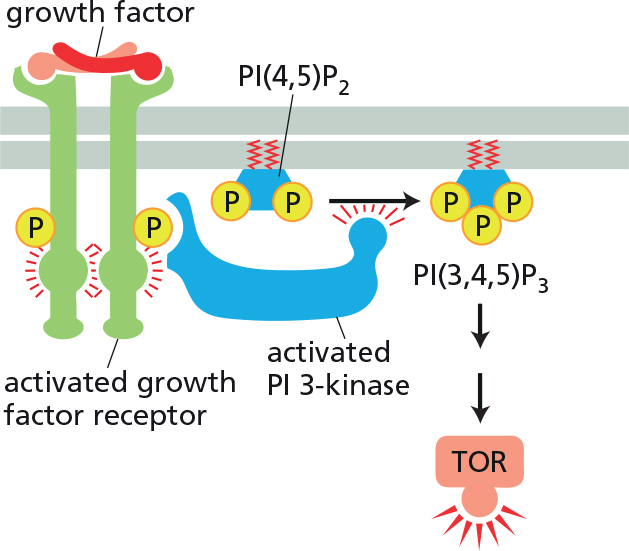
Growth factors promote the formation of PI(3,4,5)P3, which activates the TOR pathway and stimulates cell growth (see the figure). PTEN is a lipid phosphatase that removes a phosphate from phosphatidylinositol 3,4,5- trisphosphate [PI(3,4,5)P3]. It is frequently mutated in cancers. Based on the information in the figure, which one of the following statements explains why mutant PTEN promotes cancer formation?
Choose one:
A. Mutant PTEN increases PI(3,4,5)P3, increasing growth.
B. Mutant PTEN activates the receptor, stimulating growth.
C. Mutant PTEN reduces TOR activity, promoting cancer.
D. Mutant PTEN inhibits PI 3-kinase, promoting growth.
Mutant PTEN increases PI(3,4,5)P3, increasing growth.