Molecular Neuro Exam 2
 Call Kai
 Learn
 Practice Test
 Spaced Repetition
 Match
 Flashcards
 Knowt Play
1/30

There's no tags or description
Looks like no tags are added yet.
31 Terms
primitive streak
forms at posterior pole of embryo
forms the midline, where newly formed cells migrate inward to form the three germ layers
hensen’s node/primitive node
does not originate the CNS, but is the master organizer that instructs the overlying ectoderm to form it. it is this ectoderm that forms the CNS.
Neural plate
flat, thickened sheet of ectodermal cells that wil develop into neural tube
Neural crest
Derive from edges of neural plate
Migrate dorso-laterally to form sensory neurons and sympathetic neurons, also form cells from other systems (neuroendocrine, skeletal, etc.)
Transplanted progenitors from young to old
Cells travel to a shallower layer (layer 2 and 3) instead of deeper layer (layer 6)
cells lost original layer information, cells are still very plastic
Transplanted progenitors from old to young
Cells travel to a shallower layer (layer 2 and 3) instead of deeper layer (layer 6)
these older cells retained original layer information
Neuroepithelial cells
Symmetric division
Precursor to radial glial
Inside-out gradient
Cells on outer layer are younger
cells on inner layer are older
EMX2 and PAX6

Fgf8 and BMP
In the early post-natal cortex, FGF8 is high
anteriorly and BMP is high posteriorly

state machines
machines that can acquire different states
can change their state in response to specific inputs
in different state can have different functional properties = output
Specific response/function of a cell is influenced by
* Nature of the input or inputs (not all cells face same stimuli)
* Stimuli strength and duration
* The specific signaling determinants in the cell that respond to these stimuli
(not all cells respond in the same way to a given stimuli, if at all...)
both cell-surface receptors and intracellular signaling determinants...
* The specific status of the cell
Allosteric switch
the protein achieves an active conformation in response to stimuli interacting with an allosteric site
examples:
* phosphorylation
* ligand binding
kinase domain of insulin receptor
activated by phosphorylation of its activation loop, that leads to repositioning of the
activation loop to allow binding of peptide substrate.
Modular allosteric switch
Activity regulated by binding to regulatory domain instead of catalytic domain
Tyrosine phosphatase
Modular allosteric switch
Catalytic domain is constitutively active
Two regulatory domains autoinhibit by binding catalytic domain
Binding of tyrosine-phosphorylated ligands to the SH2 domains leads to the release of
the inhibitory binding of SH2 domains, resulting in activation of phosphatase activity.
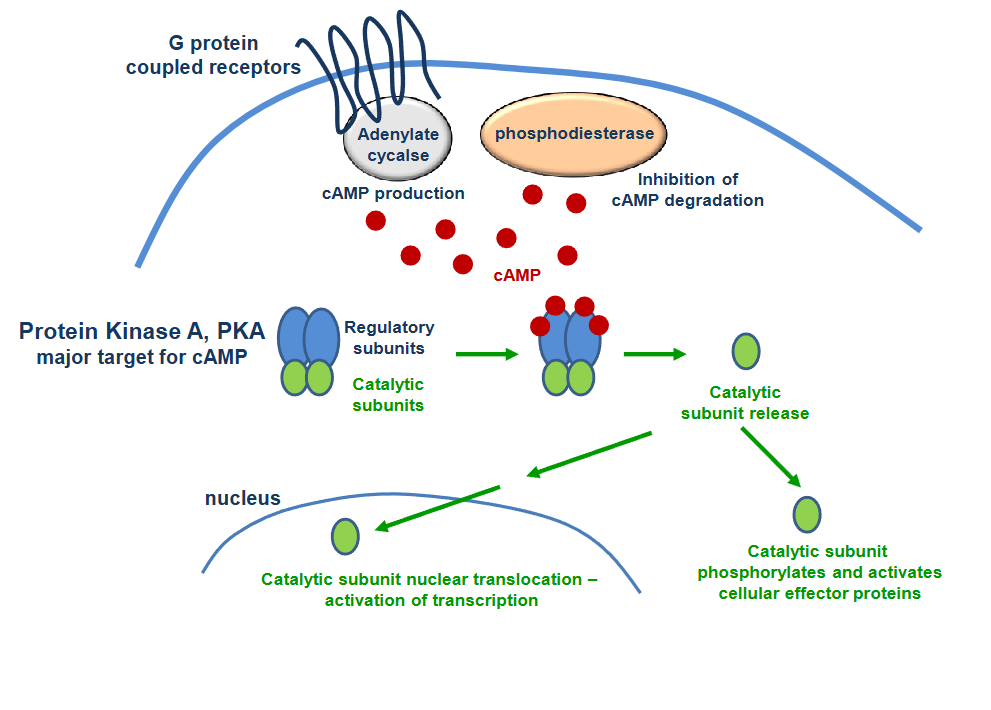
Protein Kinase A (PKA)
Linear/graded response
Cell detects a range of input levels and produces output that is proportional to the input level
Switch-like response
- Below threshold point, adding input will
lead to a sub-linear increase in output.
- near or at the threshold point, adding
input will lead to a very steep nonlinear
increase in output level
- can be achieved through positive feedback
N-WASP
catalytic domain activates Arp2/3, which induces actin polymerization
multiple inputs: PIP2 AND Cdc42
dual control allows activity to be localized at cell membrane
In Utero Electroporation of Cortical Neuronal Progenitors
Inject DNA into ventricle
electroporation electrodes placed around head
DNA moves towards positive electrode
Demonstrates inside-out manner of cortical development
Dissociated Embryonic Hippocampal Neurons in Culture
Still develop one axons and dendrites, they are just not oriented in a specific direction
BDNF (?) and semaphorin
BDNF may be attractive to axons and deter dendrites
semaphorin is attractive to dendrites and deters axons
Role of Ca2+ in netrin signalling
PKA induces calcium current
high calcium = attraction
low calcium = repulsion
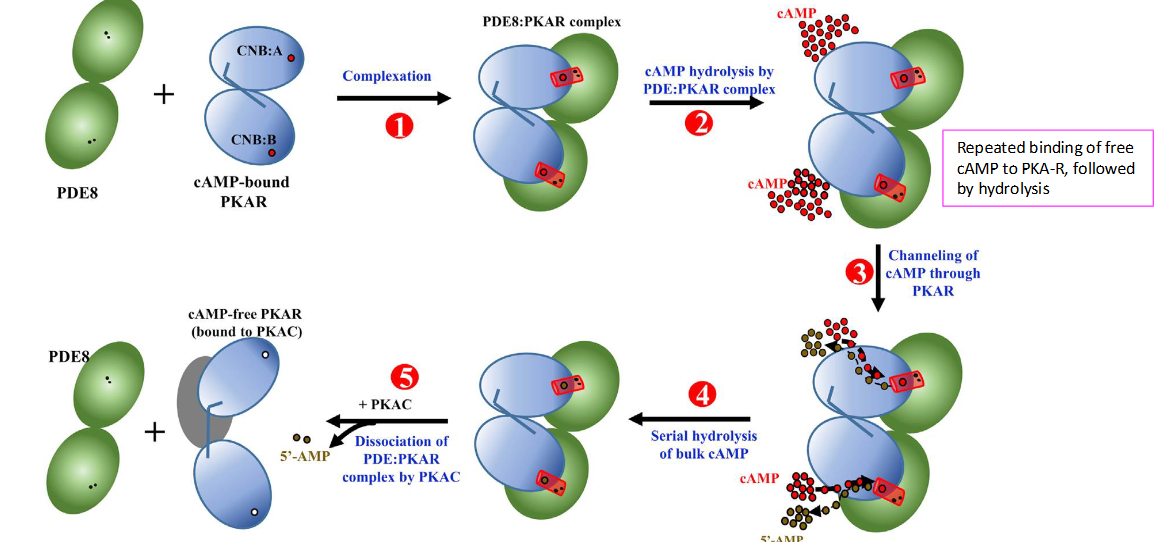
how cAMP self regulates
cAMP activates PKA
PKA phosphorylates and phosphodiesterase
PKAR (regulatory subunit) also binds phosphodiesterase
phosphodiesterase breaks down cAMP
Processive hydrolysis of cAMP by channeling through the PDE8-PKAR complex
PKAR = PKA regulatory subunit
PDE8 = phosphodiesterase 8
inside the rod - how is sensitivity achieved?
Ca2+ enters cell alongside sodium (in the dark)
Ca2+ inhibits cGMP
In extended light, absence of Ca2+ allows for cGMP levels to rise, which reopen ion channels
this ensures that all of the membrane channels don’t close during a given time period
Carvedilol
a b-arrestin-biased agonist for b-AR, has been demonstrated to inhibit the G protein-mediated toxic effect of catecholamines (dopamine; norepinephrine; and epinephrine/adrenalin) and stimulate b-arrestin-mediated cell survival signaling pathways
CRTC1
In basal conditions, is phosphorylated and sequestered in the dendritic spines
Increase in Ca2+ and cAMP leads to dephosphorylation
It then travels to the nucleus and is recruited to the Bdnf promoter by CREB
This promotes neuroplasticity
CBP
“CREB binding protein”
Recruited for transcription by CREB
is also a histone acetyltransferase
NGFI-A
binds to GR gene promoter
recruits CBP, which acetylates histones
in low LG rats, promotor for this gene is highly methylated