CHEM 10/2-27
 Call Kai
 Learn
 Practice Test
 Spaced Repetition
 Match
 Flashcards
 Knowt Play
1/159

There's no tags or description
Looks like no tags are added yet.
160 Terms
Heating curve
Plots of the amount of heat added as a function of temperature
Diagonal lines=specific physical state
Horizontal lines=phase changes

Cooling curve
Plot of the amount of heat released as a function of time
Diagonal lines=specific physical state
Horizontal lines=phase changes

Heat associates with phase changes
Heat to mealt/heat released in phase change
Heat=mass x heat of fusion
Heat of fusion of water=334 J/g
Heat of fusion from water
334 J/g
Heat needed to vaporize a substance
Heat=mass x heat of vaporization
Heat of vaporization of water=2260 J/g
Heat of vaporization of water
2260 J/g
Practice question: how many kilojoules are needed to freeze 10.0g of ice at 0°C?
3.34KJ
Remember: heat of fusion of water is 334J/g and heat=mass x heat of fusion
Practice question: how much heat is required to boil 10.0g of water at 100°C?
22,600 J or 2.26 × 10^4 J
Remember: heat of vaporization of water is 2260J/g and heat=mass x heat of vaporization
Does the state of matter affect a substances specific heat?
Yes
Ex: liquid water has a specific heat of 4.184J/g°C while specific heat of 2.05J/g°C
Specific heat equation
Heat=mass x change in temp. x SH
Practice question: how much heat is required to raise 10.0g of water from 0°C to 100°C?
4,180J or 4.18×10³ J/g°C
Remember: SH of water is 4.184 J/g°C and heat=mass x change in temp. x SH
Practice question:175g of steam at 100°C is emitted from a volcano. The steam condenses, cools, and falls as snow at 0°C. How many KJ of energy are released?
527 KJ
Remember: professor divided into 3 pieces and drew a cooling curve to show equation… want to calculate energy cost for condensation, energy cost of liquid cooling, and energy cost for freezing… add all three for end result…
Elements
Pure substances and the fundamental building blocks in chemistry
Structures of atoms is the basis for differentiation
How is the periodic table organized?
Table shows elements organized based on electron configuration
Based on element physical and chemical properties
Positioned in rows (periods) and columns (families)
Atom
Atoms consist of a dense positivity charged center called a nucleus
Nucleus contains neurons and protons
Nucleus is surrounded by unique number of electrons
Mass of an atom
The mass of subatomic particles (protons, electrons, neutrons) is based on the mass of a carbon atoms with 6 protons and 6 neutrons
Mass of proton
1 amu (1.007)
Mass if neutron
1 amu (1.008)
Mass of electron
Very small (0.00055 amu)
1 atomic mass unit is equal to
1/12 mass of carbon twelve
All atoms of the same element have same number of…
Protons, which often corresponds with number of electrons (neutral charge)
Atomic number=
Number of protons
Where is atomic number on a symbol square
Top left (which is how periodic table is organized)
Atomic symbol
1 or 2 letter symbol for element name (Ag=silver, Au=gold, Na=sodium)
Periods
Rows of periodic table
Families
Columns of periodic table
Have similar properties
Have names that tell properties (Alkali, halogens, noble gases)
Practice question: what is the atomic number, number of protons, and number of electron of:
Na
Zn
S
11, 11, 11
30, 30, 30
16, 16, 16
Mass number
The total number of subatomic particles in nucleus
Isotopes
Elements with different numbers of neutrons
Mass number-atomic number=number of neutrons
Practice question: an atom has 14 protons and 20 neutrons…
What is the atomic number?
What is its mass number?
What is the element?
14
34
Se
Practice question: an atom of zinc has a mass of 65.
How many protons?
How many neutrons?
What is the mass number of an atom of zinc that has 37 neutrons?
30
35
67
7A
Halogens
Exists as 2 atoms joined together (diatomic molecule)
Very reactive; combine with many other elements to form compounds
8A
Noble gases
Very stable
Rarely combine with any other elements
1A
Alkali metals
2A
Alkaline earth metals
6A
Chalcogens
Atomic symbol
Represent an isotope of an element
Provides information on number of protons, neutrons, and electrons

Atomic mass
Weighted average of masses of all naturally occuring isotopes of an element
Apears beneth the atomic symbol in the periodic table
Most elements have at least two (or more) isotopes htat contribute to the atomic mass of the element

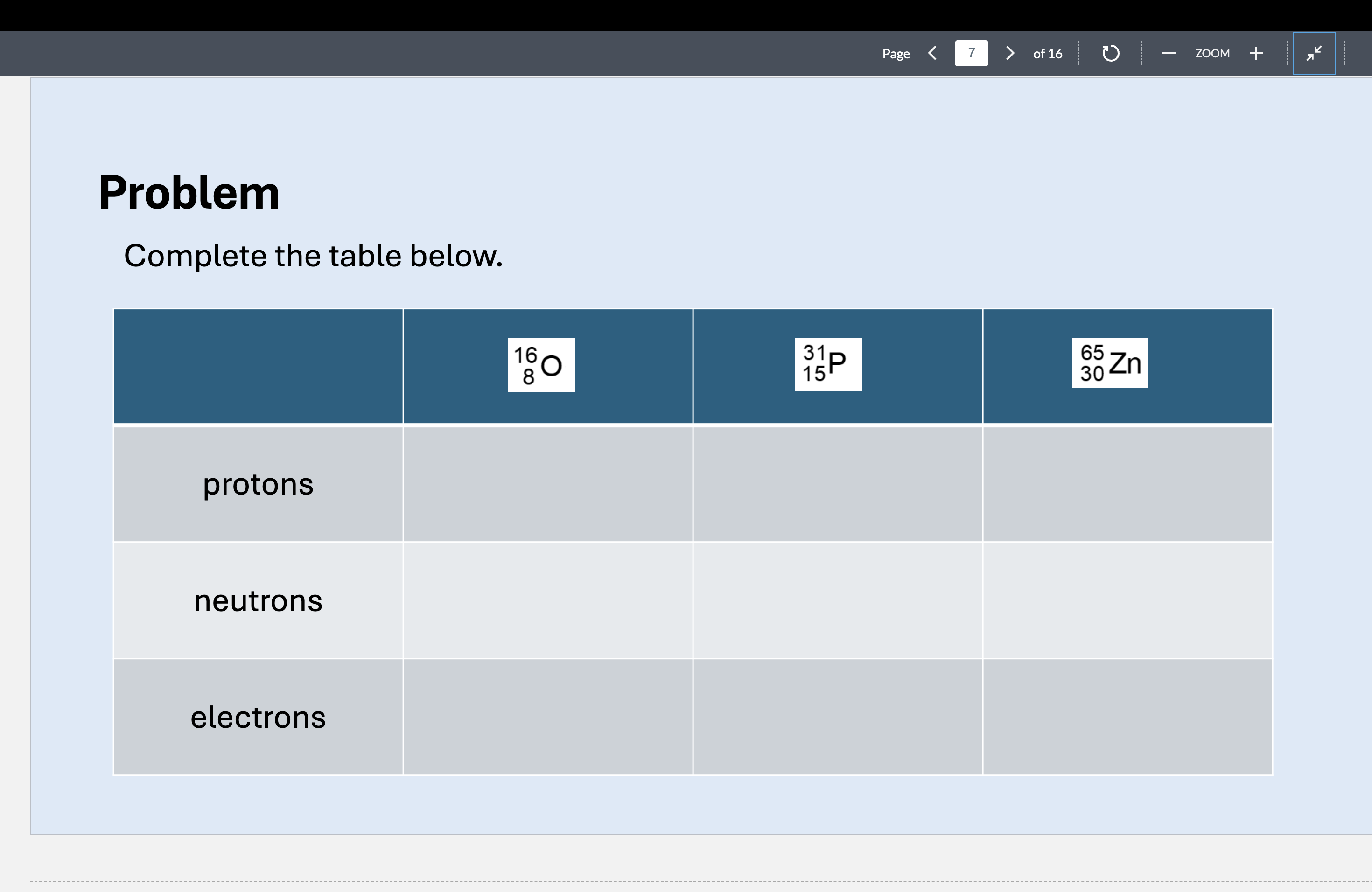
Protons: 8, 15, 30
Neutrons: 8, 16, 35
Electrons: 8, 15, 30
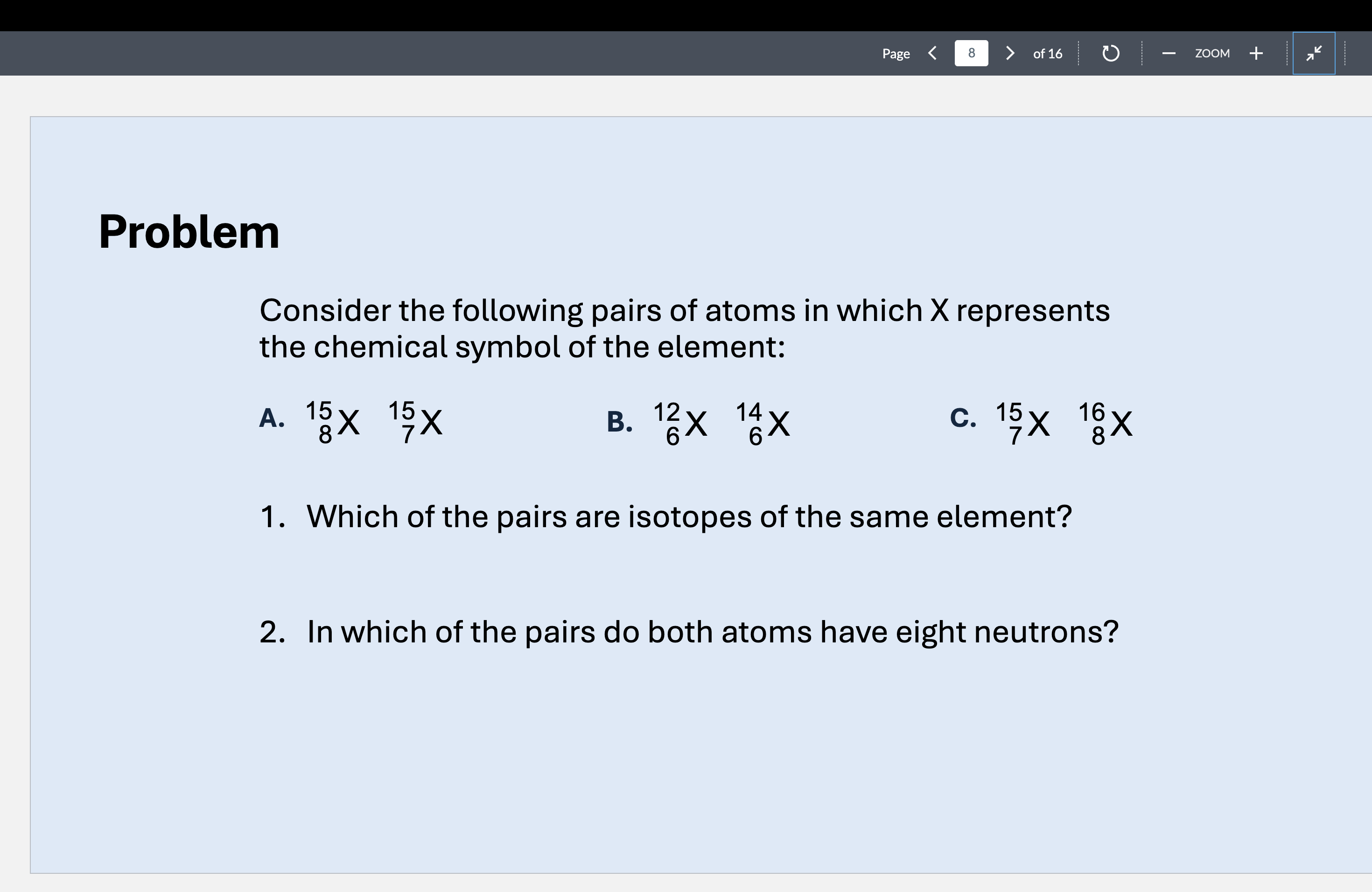
1.) B
2.) C
Row of periodic table
Periods
Tells you the relative postion of the outermost electrons in an element (shell)
Column of periodic table
Family
Tells you the spatial location of the outermost electron
The different orbitals have different shapes that hold a different…
Number of electrons
Higher numbers of shells are farther from the nucleaus and have a larger volume=hold more electrons
Shells have…
Subshells that consist of orbitals
A pair of electrons can occupy a single orbital
Subshells number of orbitals
s
p
d
f
s=1
p=3
d=5
f=7
goes down with increasing energy
s-orbital
Holds one pair of electrons/only one s orbital… lower in energy

p-orbital
3 p-orbitals… bigger than s-orbital

d-orbital
5 d-orbitals… bigger than p-orbitals

f-orbital
7 f-orbitals… not important

Number of electrons that can occupy a subshell
s - 1 orbital - 2 total electrons
p - 3 orbitals - 6 total electrons
d- 5 orbitals - 10 total electrons
f- 7 orbitals - 14 total electrons
Ground state
The lowest energy electron configuration… most stable form of an element
Energy diagrams
Short horizontal lines are used to represent the energy of an orbital… arrows represent electrons (max 2 per orbital)… 1 arrow points up and is assigned a spin of 1/2 and the 2 arrow points down and has an assigned spin of -1/2
Electrons are first added to…
The lowest state first (most stable) then to states of increasing energy
Hund’s rule
Electrons are placed one at a time in each of the orbitals having the same energy (degenerate)… this minimizes electron-electron repulsion
Pauli exclusion principle
When 2nd electron is added, the 2nd electron must have the opposite angular momentum (spin) from the 1st electron
Auf bau principle
The red arrows showing pattern to add electrons into orbital groups

Practice question: calciums building up principle for orbitals and electrons
Calcium has 20 electrons… 1s^2, 2s^2, 2p^6, 3s^2, 3p^6, 4s^2
Periodic properties
An element electron configuration is an important factor in determining its physical and chemical properties of the element
Group number relation to valence electrons
For main group elements in families 1A to 8A, chemical properties are primarily due to valence electrons
Valence electrons
The electrons in the outermost shell (period)
Family/group # tells you the number of valence electrons (exception is helium, which is stable with a pair of electrons in the outermost 2s shell)
Practice question: using the periodic table, write the group number and number of valence electrons for each other the following:
A) Ne
B) O
C) Na
A) 8A, 8
B) 6A, 6
C) 1A, 1
Lewis dot symbols
A way to represent the valence electrons of an element… up to 2 dots per side of symbol… must have one on each side before second on any side

Atomic size relative to periodic table
Determined by the distance of valence electrons from nucleus… atomic size increases as you go from top to bottom in a family (group) as you add electrons to larger shells…atomic size decreases as you move to the right in a period (b/c you add protons to the nucleus)… the size increases as you move down a family greater than it decreases across a period

Practice question: identify the larger atom
Li or Na
B or O
B or Br
Na, B, Br
Practice question: identify the smaller atom in each pair:
Li or Ca
K or Br
Li… Br
Remember: going down a period makes atoms smaller, going down families makes them larger… they get bigger as you go down a family than they get smaller down a period
Ionization energy (IE)
The energy required to remove the outermost electron form an element
Element + energy → element^+ and an electron
Element^+ is called an cation (has pos charge bc electron got knocked off)
IE trends
1.) IE decreases as you move down a family (bc the outmost electrons are further from the nucleus and held less tight
2.) IE increases as you move across a period (bc you are filling a shell, so removing an electron takes more energy)
Overall: The trends help explain reactivity; metals on left have low IE and lose electrons easily, while non-metals on right have high IE and tend to gain electrons
Practice question: which element in each pair has a higher IE
a.) Li or Ca
b.) B or O
a.) Li
b.) O
Metals
Low ionization energy, tend to form cations (pos ions)
Metallic character: increase as you move down a family, decrease as you go across a period
Non metals
High IE, tend to form anions (neg ion)
Practice question: answer the following questions for Li, N, F
a.) smallest IE
b.) highest IE
c.) element that belongs to 5A
d.) element that is most metallic
e.) element that is most non-metallic
a.) Li
b.) F
c.) N
d.) Li
e.) F
Ionic bond
Valence electrons of a metal are transferred to a non-metal
Forms a cation (pos) in metal and anion (neg) in non-metal
Covalent
Atoms of 2+ non-metals sharing valence electrons
Ionic bonding for metals and non-metals
Metals:
Have low ionization energies, readily lose outermost electrons to achieve filled outer shell (energy stable), cations are smaller than their neutral metals (more protons)
Non-metals:
Have high ionization energies, readily gain valence electrons to achieve a filled outer shell (energy stable), anions are larger than their neutral non-metals (more electron)
Groups and their attachment to their valence electrons
Group 1A: prefers to lose 1 electron to have filled outer shell
Group 2A: prefers to lose 2 electrons to have filled outer shell
Group 3A: prefers to lose 3 electrons to have filled outer shell
All above are metals (which want to lose valence electrons) and all below are non-metals (which want to gain electrons)
Groups 5A-7A: prefers to accept 3/2/1 electron to have filled outer shell
Note: when non-metals form anions, suffix changes to -ide
Note: when non-metals form anions, suffix changes to -ide
Practice question: consider the elements barium and selenium
a.) identify each as a metal or non-metal
b.) state the number of valence electrons for each
c.) state the number of electrons that must be gained/lost to have octet
d.) write symbol, including ionic charge and name of the resulting ion
a.) Ba: metal Se: non-metal
b.) Ba: 2 Se: 6
c.) Ba: -2 Se: +2
d.) Ba²+ and Se²-
Atomic mass
Protons+neutrons
Nonpolar covalent bond electronegativity difference
Between 0.0 and 0.4
Polar covalent bond electronegativity difference
Between 0.5 and 1.7
Ionic bond electronegativity difference
1.8 or higher
Typically between a nonmetal and a metal
Dispersion forces
Only intermolecular force that occurs between nonpolar molecules (in these molecules all bonds are nonpolar or the polar bond cancel eachother out… ex: SnH4 where each bond is polar but the dipole moment from each bond cancels each other out)
Ionic compounds (what are they made from?)
Products of metals and non-metals… 1st element in the formula/name is metal… products are generally salts (salts have ionic bonding and consist of cations and anions (strongest)
Ionic compound properties
Relatively high melting points… solid at room temperature… lustourus
Chemical formula for ionic compounds
Ionic compounds have a net neutral charge… metal on left, nonmetal on right… charge on m/nm are determined by family name… balance the charges to lowest common denominator
Ex: magnesium chloride Mg²+ and Cl^- = MgCl2
Practice questions: consider the elements potassium and iodine
a.) metal or nonmetal
b.) state number of valence electrons
c.) state number of electrons that must be lost/gained for octet
d.) write symbol, including ionic charge and name of ion
a.) K=metal I=nonmetal
b.) K=1 I=7
c.) K=-1, I=+1
d.) potassium ion, iodide
Metal ion, nonmetal anion, chemical formula for
Aluminum oxide=
Calcium fluoride=
Cesium iodide=
Aluminum oxide= Al3+,O2-, Al2O3
Calcium fluoride=Ca2+,F-,CaF2
Cesium iodide=Cs+, I-,CsI
Naming ionic compunds
Name of metal 1st, nonmetal +’ide’ ending with a space between
Transition metals
Have outershell d electrons (5 orbitals, hold 10e-), B families, often have multiple common charges,, roman numeral wqual to the charge is placed in parenthesis following the symbol
Ex: iron- Fe (II)/Fe2+ (ferrous), Fe (III)/Fe3+ (ferric)
Polyatomic ions
Nonmetals often share electrons with other nonmetals to form ions or compounds (covalent)
Many anions are neg charge, but a few have positive
Ex: OH^- (hydroxide), CO3²-
Rules for naming polyatomic ions
-ate (most common form of ion)… -ite (has one less oxygen than -ate… hypo- (one less oxygen than -ite)
Adding hydrogen to polyatomic ions adds +1 to charge
Bi- indicaties hydrogen is present in the ion… di- indicates there are 2 of an element
Rules for naming ionic compounds containing polyatomic ions
Rules we already learned appy
Work outside in (compounds are neutral)… parenthesis used when there is more than one polyatomic ions
Ex: magnesium nitrate= Mg(NO3)
Compounds containing ammonium cation
Ammonium cation= NH4^+
The ammonium cation is not a true metal but behaves like an alkali metal ion in many chemical reactions
Compounds containing an anion and the ammonium cation have ionic bonding and readily dissolve in water like alkali salt ions
Naming molecular compounds consisting of two different types of metals
The bonding involved in molecular compounds consisting of 2 types of nonmetals is covalent
The 1st nonmetal is named by its name, 2nd is named by its name with ending -ide, when there are more than 1 of a nonmetal a prefix is used for the 2nd element
Hydroxide
OH^-
Ammonium
NH4^+
Nitrate
NO3^-
Nitrite
NO2^-
Perchlorate
ClO4^-
Chlorate
ClO3^-