Genetic unit 3
 Call Kai
 Learn
 Practice Test
 Spaced Repetition
 Match
 Flashcards
 Knowt Play
1/125

There's no tags or description
Looks like no tags are added yet.
126 Terms
Lec 16: Translation
DNA and RNA are polymers of what? And proteins are polymers made up of what?
nucleotides
amino acids
What is an amino acid made up of?
have an central carbon surrounded by an amino group, a carboxyl group, a hydrogen and side chain

How and why peptide bonds are form?
Peptide bonds are made by the central carbon of one molecule binding to the nitrogen of another molecule during a h2o loss reaction
they are made to make polypeptide chains

When mRNA has a codon how do tRNA recognizes it?
tRNA recognizes it with its anticodon sequence where it pair at the 3rd codon position reading it from 3” to 5”

What is a wobble position?
When codon are flexible and this allows tRNA to recognize more than one codon
When ribosome is reading the genetic code where do it begin?
It begins at the start codon (AUG) and it will keep go until it reach a stop codons
What are reading frame and how are they set?
They are specific frame for coding sequences are usually nonoverlapping, which specifies the protein sequence
The reading frame is set during initiation by the start codon (AUG)
What does aminacl-tRNA synthetases do for amino acids?
Aminacl-tRNA synthetases is an enzyme that help affixed (attach) amino acids to specific tRNA
Positions on the tRNA help and give the enzyme info so it can attach the right amino acid
Where are amino acid attach on a tRNA
All tRNA have an invariable CCA sequence at the 3’ end, on the acceptor arm. From that arm they are attach to the carboxyl group with there sugar (on the 3’ carbon)

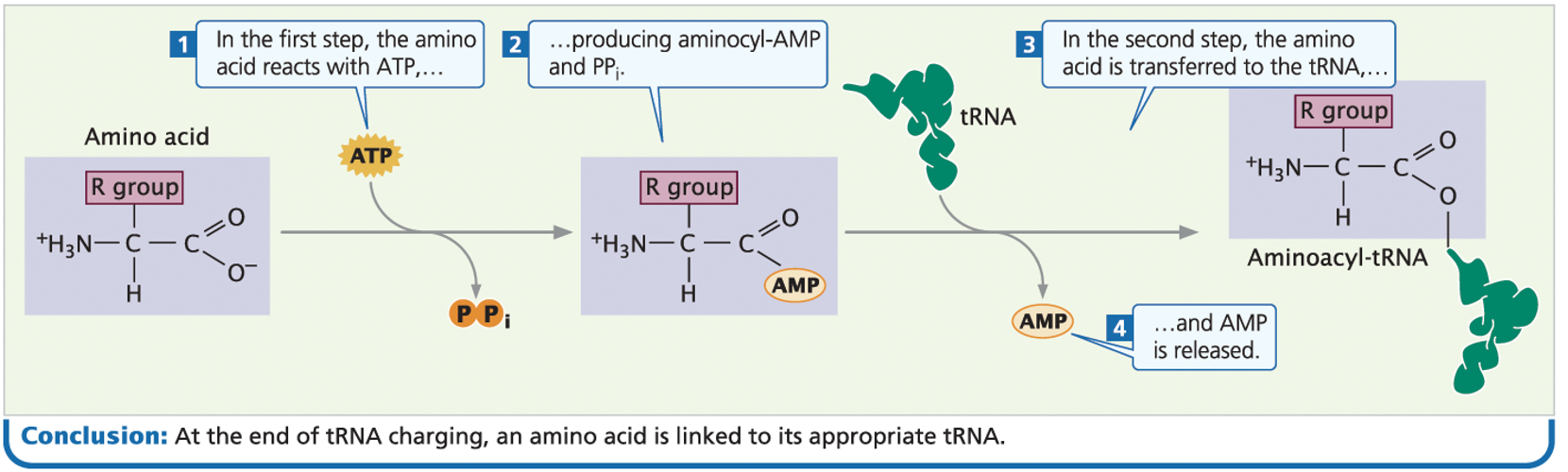
What is charging and when is tRNA charged, and also what is the process?
this is the process of attaching amino acids to tRNA. After the amino acid is attached to the tRNA it is charged.
the process:
The amino acid react with ATP
Producing AMP on the carboxyl group of the amino acid
AMP compound transfers the amino acid to the tRNA (at the rebose 3’ hydroxyl) , AMP is released and tRNA is attached.
What are bacterial ribosome consists of ?
It consists of two subunits: a large 50S subunit and a small 30S subunit. Each subunit is a large complex of proteins and ribosomal RNA (rRNA).
what does the 30S subunit do?
If it the first subunit to bind to mRNA, when it first binds the IF-3 (initiation factor 3) is attach to the subunit. Also the subunit is guided by the shine dalgarno sequence

What do IF-3 do?
Attach to 30S subunit and prevents premature binding of the 50S subunit
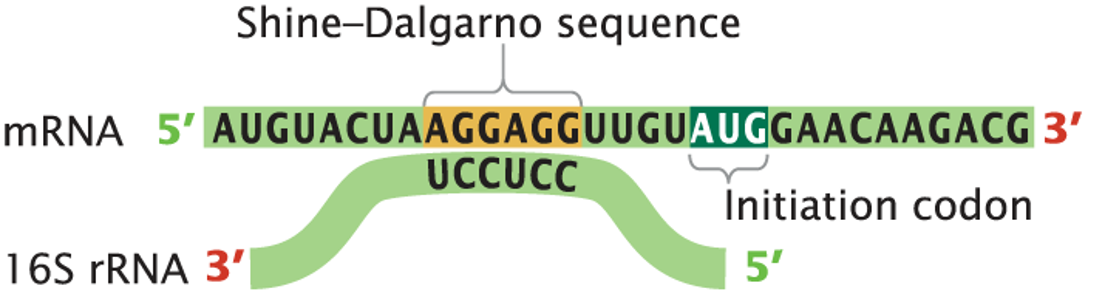
What is the shine dalgarno sequence?
It a guide for 30S subunit and it is a consensus sequence that occurs upstream of the start/ initiation codon (AUG). The recognition process of this sequence (when rRNA recognize the sequence in mRNA) is one of the most important process for rRNA in the translation
What is the step-by-step process of bacterial translation initiation?
1. IF-3 binds to the 30S subunit, preventing the 50S subunit from binding and allowing the 30S subunit to attach to mRNA.
2. The initiaton tRNA (fMet-tRNAifMet, carrying N-formylmethionine, forms a complex with IF-2 and GTP.
3. This complex binds to the initiation codon while IF-1 joins the small subunit
4. All initiation factors dissociate, GTP is hydrolyzed to GDP + Pi, and the 50S subunit joins to create the 70S initiation complex.

How is 70S initiation complex made?
It is when the 30S connect to 50S making 70S, this is with the mRNA and Initiator tRNA inside at the start codon

What do N-formylmethionine do?
It charge tRNA and it will be at the beginning/initiation of every bacterial protein
What do IF-2 do?
Bind to initiator fMET- tRNA with GTP and delivers it to the initiation codon
What do IF-1 do?
Bind to small subunit, playing an addition role in preventing the large subunit from binding prematurely
How does eukaryotic initiation differ?
DIfferents
No N-formylmethionine but there is an initiator tRNA is Met-tRNAiMet
No Shine-Dalgarno sequence
instead, the ribosome is recruited by proteins that recognize the 5’ mRNA cap.
Poly(A)-binding proteins recognize the mRNA tail 3' poly(A) tail and can form a loop structure interacting with cap-binding proteins to enhance ribosome binding.
Also help in translation initiation and elongation
Eukaryotic initiation factors (eIFs) plays the same roles as IF-1,2,3 of bacteria
The correct start codon is identified with the help of a consensus sequence called the Kozak sequence.
The ribosome subunits are 40S and 60S, which come together as an 80S complex.

What is Kozak sequence?
is another consensus sequence, which in this case helps identify the correct start codon in eukaryotes
What are the three active sites of a ribosome during elongation?
The aminoacyl (A) site
The peptidyl (P) site
The exit (E) site

Once the initiation complex is made, now elongation of the protein can begin. What are the steps of translation elongation in bacteria?
1. The fMet-tRNA goes on the P site.
2. A complex of EF-Tu, GTP, and a charged tRNA enters the A site. GTP is cleaved to GDP + Pi, and the EF-Tu–GDP complex is released.
3. EF-Ts regenerates the EF-Tu–GTP complex, so it can be used again for another changed tRNA.
4. A peptide bone form between the amino acids in the P and A site. Once the bond it made the tRNA in the P site release it’s a amino acid
The ribosome moves down the mRNA to the next codon by the process called translocation, which requires EF-G and GTP. Also as the ribosome move down the tRNA in the P site will be in the E site and exit. And tRNA with the bond peptide bond will now be in the P site.
Overall: At the end of each cycle of elongation the amino acid that was in the A site is added to the polypeptide chain and the A site is free to accept another tRNA

What does fMet-tRNA do ?
Provides first amino acid in peptide
What is EF-Tu (Elongation Factor Tu) use for?
EF-Tu and with the help of GTP it help charge tRNA and move it to the A site for elongation.
EF-Ts to EF-Tu is reuse for another tRNA

What is EF-G use for?
It help in translocation with the help of GTP, the tRNA + peptide that is on the A site will be in the P site by the ribosome moving down the mRNA and the tRNA that was in the P site will be in the exit site and will be remove
Overall it stimulates translocation of ribosome to next condon

How does translation termination(aka ends)
When the ribosome translocates to a stop codon, no tRNA can bond to it.
RF-1 attach to the A site and RF-3 forms a complex woth GTP and binds to the ribosome
The polypeptide is released from the tRNA
Gtp associated with RF-3 is hydrolyzed to GDP
Everything is released form the mRNA

What is the overall events of translation?
tRNA charging
Initiation
Elongation
Termination
Peptide Release

• What is a polysome, and how does translation coupling differ between bacteria and eukaryotes?
A polysome is an mRNA with multiple ribosomes attached to it at the same time. In bacteria, translation is coupled directly with transcription. In eukaryotes, translation occurs separately after mRNA processing and export from the nucleus.
What are sense codons, nonsense codons, and nonsense-mediated decay?
Sense codons: Codons that code for an amino acid
Nonsense codons: when a mutation or transcription errors that can generate premature stop codons
Nonsense- mediated decay: It target any nonsense codons on the mRNA for degradation
mRNA containing these nonsense codons are targeted for degradation by a surveillance mechanism called nonsense-mediated decay
What does a nonstop decay do?
It looks and target any mRNA that was mutated or had a process errors with no stop codon for degradation
Lec 17: Regulation of transcription bacteria
What are the two categories of a gene?
There are structural genes and regulatory genes.
Structural genes: encode proteins that plays a role in metabolism, such as enzymes, or make up structural elements of the cell, like transporters or cytoskeletal proteins
regulatory genes : encode RNA or proteins that affect how other genes are expressed, by affecting transcription or translation or posttranslational modifications
What are constitutive genes
Genes that are expressed continuously(always on ) under all cell or environmental conditions; frequently overlap with essential housekeeping genes
What are regulatory elements
Non-coding Dna sequences surrounding to within coding regions that serve as binding sites for regulatory proteins to modulate gene expression
Regulatory proteins tend to have commonly recurring structural features referred as what? and what are the different types
Referred as domains

What is a operon?
The fundamental organizational of a transcriptional region in bacteria, which consisting encodes for multiple genes with related functions controlled by one promoter and regulatory sequences
What is the overall structure of an operon?
A group of structural genes plus sequences that control transcription
There a separate regulator gene with its own promoter and has the ability to control the activity of the operon
does so by binding to the operator site to regulate the transcription of mRNA
The products of mRNA catalyze reactions is a proteins (enzymes)

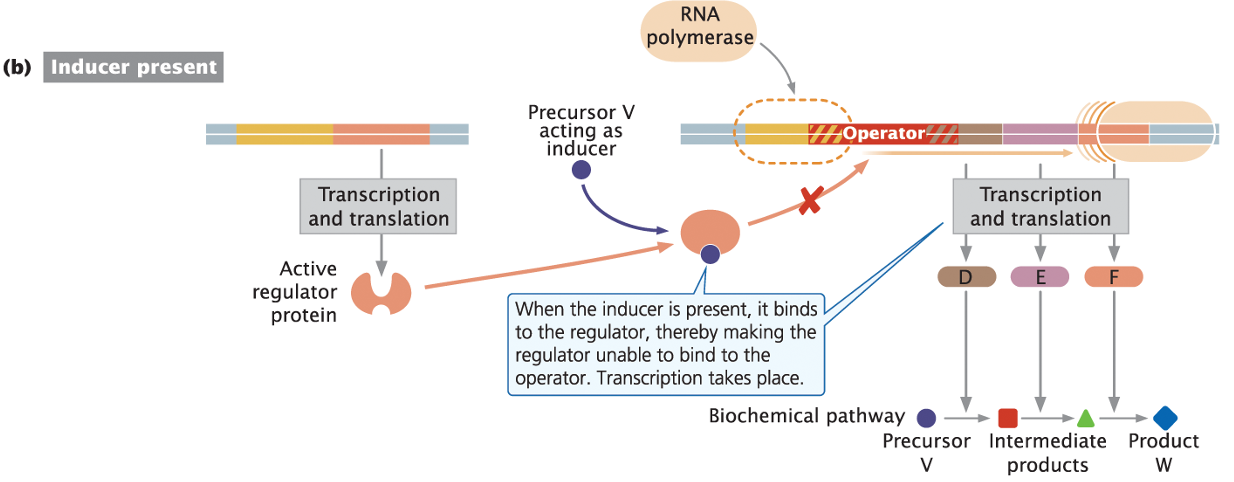
What is a negative inducible operon?
normally turn off but can be turned on by response to a condition
At normal conditions the repressor binds to the operator and prevents transcription
When an inducer is present, it binds the regulator protein at a second site that affects how the regulator interact with DNA
This is allosteric regulation, the allosteric effect of the inducer causes the repressor protein to dissociate from the operator, allowing transcription to go (inducing expression) (ON)
What is a negative repressible operon?
At normal condition it is expressed (ON)
a repressor is present but is inactive and not bind to DNA
with the corepressor which will change and active the repressor, it will bind to the operator and prevent transcription

lac operon of E. coli is an example of what type of gene regulation?
It uses negative inducible regulation
meaning under normal condition it is not expressed but it can be induced
Lac operon encodes a permease that allows lactose to pass the membrane, then B-galactosidase breaks lactose into glucose and galactose also converts lactose to allolactose
when lactose is low the repressor is bound to the lac operator
which prevent transcription
the inducer (in this case allolactose) is a signal for high lactose availability
when is binds to the repressor, it changes it and prevents it to bind to the lac operon
allowing transcription

When lactose is high what happen vs low?
Low lactose, the repressor is bind to the lac operator
High lactose allolactose (the inducer) binds to repressor (meaning the repressor can’t bind to lac operon). this will allow transcription of the operon
What is the catabolite activator protein (CAP)
a positive regulator of lac operon expression that can bind near the promoter region
DNA binding activity of CAP is regulated by a ligand
cAMP is a signaling molecule in both bacteria and eukaryotes
What is Cyclic AMP or cAMP
a common signaling molecule in both bacteria and eukaryotes
low glucose vs high glucose
low glucose: cAMP is high → cAMP binds CAP → CAP cAMP complex binds to lac operon, increasing the efficiency of RNA polymerase (high rates of transcription)
high glucose: cAMP is low(less likely to bind to CAP) → CAP(by itself) cannot bind to DNA → low rates of transcription
trp operon
negative regulation
which controls the production of the amino acid tryptophan
low trp: trp repressor is inactive, transcription proceeds (on)
high trp: tryptophan binds to trp repressor, it binds and block the operator to do transcription (off)
What is attenuation in the trp operon?
A second layer of control involving conditional, premature termination of transcription mediated by the secondary structures formed by complementary regions (1, 2, 3, and 4) in the 5' UTR of the mRNA.
What is a leader peptide?
a short peptide with two consecutive Trp codons that regulates activity of the transcript (and in this case affects
transcript length)
What are the two possible secondary structures of the trp operon 5' UTR?
Attenuator structure: Regions 1-2 pair and regions 3-4 pair; this terminates transcription.
Antiterminator structure: Regions 2-3 pair; this does not terminate transcription.

When Trp is high vs low, what forms
When Trp is high, the attenuator forms and terminates transcription
When Trp is low, the antiterminator forms and transcription of the trp operon continues
How does ribosome positioning cause attenuation when tryptophan levels are high?
The ribosome does not stall at the two consecutive Trp codons in the leader peptide because tryptophan is abundant. It proceeds and covers part of region 2, preventing it from pairing with region 3. Regions 3 and 4 then pair to produce the attenuator structure, terminating transcription.
How does ribosome positioning cause antitermination when tryptophan levels are low?
The ribosome stalls at the two Trp codons in region 1 due to low tryptophan. Because region 2 is not covered by the ribosome when region 3 is transcribed, region 3 pairs with region 2. This prevents region 3 from pairing with region 4, so the attenuator never forms and transcription continues.
How does antisense RNA achieve post-transcriptional regulation in the case of the ompF gene?
In response to high extracellular osmolarity, the micF gene is activated and produces antisense RNA. This micF RNA pairs with the 5' end of ompF mRNA, blocking the ribosome-binding site and reducing synthesis of the OmpF membrane channel protein.
What is a riboswitch mechanism in bacterial mRNA?
An elaborate secondary structure encoded in the mRNA that is stabilized by a ligand. When the ligand is present, the structure closes and masks the ribosome-binding site to inhibit translation (though some operate the other way around).
How does the ribozyme structure in the glmS mRNA regulate translation?
The glmS mRNA encodes an enzyme that helps synthesize the sugar glucosamine-6-phosphate (GlcN6P). When GlcN6P builds up, it binds to the ribozyme structure in the 5' UTR, activating its catalytic activity and inducing self-cleavage of the mRNA backbone, which stops further translation.
Lec 18: Epigenetic and Eukaryotic regulation of transcription
Transcription Factors in eukaryote bind ______ and affect recruitment/activity of ____________
Transcription Factors in eukaryote bind DNA and affect recruitment/activity of RNA polymerase

Where does general transcription factors assemble?
It assembles at the core promoter, which is located directly upstream of the transcription start site and contains consensus sequences like the TATA box.

How do regulatory promoters differ from core promoters in terms of location and function?
Regulatory promoters are located upstream of the core promoter. While the core promoter binds the basal apparatus for low-level transcription, regulatory promoters contain distinct combinations of consensus sequences that bind specific transcription factors to greatly increase transcription activity.
the regulatory promoters is also made up of different combinations while the core promoter is the same TATA

What is the function of an enhancer, and how does it physically communicate with the core promoter?
An enhancer elements also bind transcription factors and interact with the core promoter in three-dimensional space through the mediator complex, a very large multiprotein complex that makes up part of the basal transcription apparatus
What are chromatin in eukaryotic?
It is where intergenic space can be quite large is packaged into domains, kind of an organized regulatory neighborhood
What role do insulators play in eukaryotic gene regulation, and what structures do they help form?
Insulators act as barriers that block the action of an enhancer if positioned between that enhancer and a promoter. They interact with proteins like CTCF and cohesin to assist in forming discrete loops called topologically associating domains (TADs), confining enhancer-promoter interactions to their own "neighborhood".

How do eukaryotic cells coordinately activate thousands of genes scattered across multiple chromosomes in response to a single stimulus?
Through shared response elements (such as MREs for heavy metals or GREs for steroids) in their regulatory promoters or enhancers. This allows the exact same effector or transcription factor to bind and modulate hundreds to thousands of genes simultaneously.
How are microRNAs (miRNAs) produced, and what is their mechanism of post-transcriptional silencing?
They are cleaved from longer double-stranded stem-loop RNA precursors by the enzyme Dicer into short 21–25 nucleotide pieces. They pair imperfectly as antisense RNA with target mRNAs and guide the RNA-induced silencing complex (RISC) to inhibit translation.
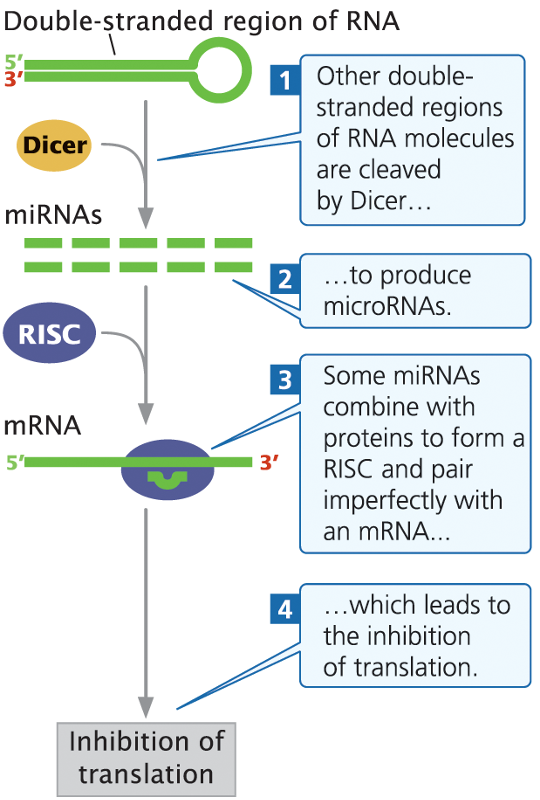
How do small interfering RNAs (siRNAs) differ from miRNAs in their origin and specific effect on target mRNA?
While both are 21–25 nucleotides long and processed by Dicer, siRNAs are derived from long double-stranded RNA precursors. They bind with high complementarity to their target mRNA, which directs RISC to cleave and degrade the mRNA, resulting in a more sustained silencing effect.
What is the mechanism of RNA-induced transcriptional silencing (RITS)?
siRNAs attach to complementary sequences on nascent RNA transcripts and recruit the RITS complex. This attracts methylating enzymes that modify histone proteins directly on the chromatin, inhibiting transcription.
What mechanism allows chromatin-remodeling complexes to alter gene expression without altering chemical groups on DNA?
They utilize the chemical energy of ATP hydrolysis to physically reposition or slide nucleosomes along the DNA strand, exposing or hiding transcription factor binding sites.
What is the "histone code"?
The specific pattern of reversible chemical modifications (such as acetylation or methylation) occurring on the amino acid tails of histone proteins that conveys information to dictate local chromatin structure and transcriptional activity.
How does histone acetylation typically affect chromatin structure and transcription?
The addition of an acetyl group (CH₃CO) to histone tails disrupts and relaxes the tight chromatin structure, rendering the DNA accessible and allowing transcription to take place.
What is the most common form of DNA methylation in eukaryotes, and what region is highly sensitive to it?
The modification of cytosine into 5-methylcytosine (5mC), typically in a symmetrical 5'-CG-3' (CpG) dinucleotide context. Regions of DNA with a high concentration of these sites are called CpG islands, and their methylation is strongly associated with the repression of gene expression.
What is hemimethylated DNA, and how is it converted back to a fully methylated state after replication?
It is DNA that features methyl groups on the old template strand but lacks them on the newly synthesized daughter strand. Methyltransferase enzymes recognize this asymmetric layout and add missing methyl groups to the unmethylated strand, preserving the epigenetic information.
From an epigenetic standpoint, how does feeding honeybee larvae royal jelly dictate their development into queens rather than workers?
Royal jelly represses the Dnmt3 gene, lowering the production of DNA methyltransferase. This results in less genomic DNA methylation, keeping queen-characteristic genes active and causing queen bee development.
What is pluripotency, and how are induced pluripotent stem cells (iPSCs) generated from adult cells?
Pluripotency is the ability of an undifferentiated stem cell to develop into any specialized cell type. iPSCs are created by exposing differentiated adult cells to a specific cocktail of transcription factors that erase tissue-specific DNA methylation and chromatin marks, resetting the transcriptional landscape.
Describe the step-by-step mechanism by which the Xist gene triggers X-chromosome inactivation.
The Xist gene on the future inactive X (\(\text{X}_{\text{i}}\)) is transcribed into a long non-coding RNA (lncRNA).
The Xist RNA molecules coat the \(\text{X}_{\text{i}}\) chromosome in cis.
The bound RNA recruits the PRC2 complex, which places inhibitory histone methylation marks (H3K27me3).
Subsequent DNA methylation solidifies the silencing, packing the entire chromosome into condensed heterochromatin (the Barr body).
lec 19
What is a mutation?
The ability of heritable genetic material to change, underlies all biological innovation and evolution
What’s the different between somatic mutation and germline mutation
Somatic mutation : occur during cell divisions in non reproductive cells and carried on through mitosis, this may happen over million times in a lifetime
Germline mutation: occur in the cell that produce gametes, and can be pass down to the next as part of their genetic program
What are the main categories of mutation that affecting coding sequences
Base substitution: When one codon change
causing transitions and transversions
when it is happening together it is called Indels
Nucleotide insertion
Nucleotide deletion
What is a frameshift mutation?
When an indel changes the reading fame of an mRNA
In-Frame Insertion or Deletion
A deletion or insertion of a multiple of three nucleotides that does not alter the reading frame.
Transitions VS transversions
Transition: when a purine is replaces with another purine or a pyrimidine replaces a pyrimidine (EX: A → G)
Transversions: When a purine change to a pyrimidine and vice versa (ex: A →C)
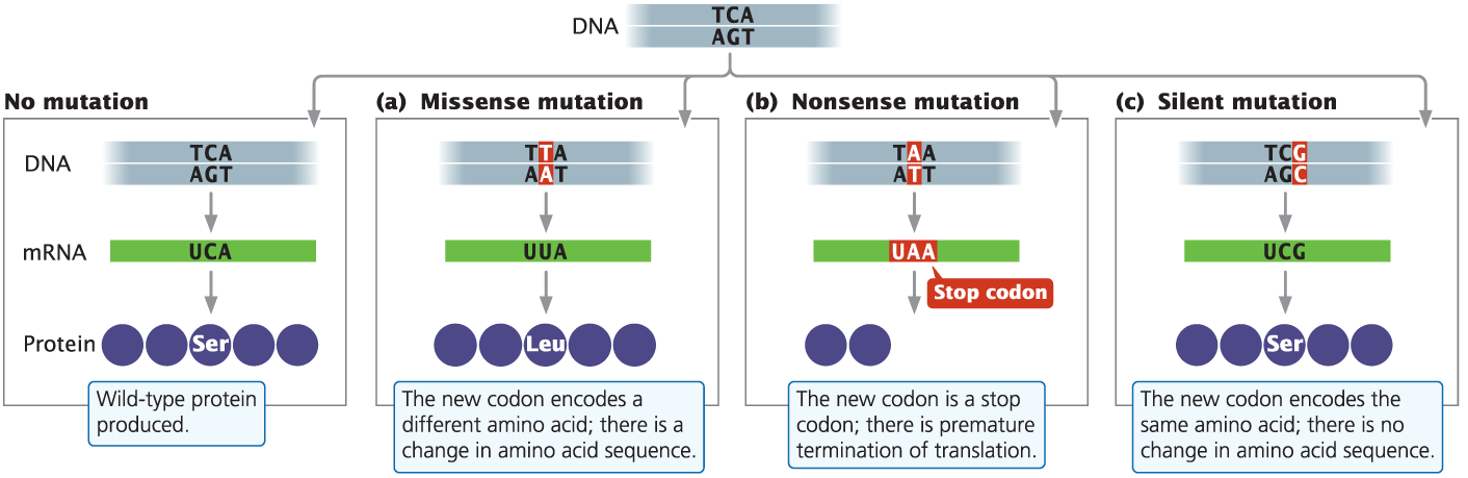
How a substitution in a codon can have one of several effects?
There can be:
silent mutation: if it doesn’t change the amino acid encoded by the codon
missense mutation: if it does change thr amino acid
nonsense mutation: change the codon to a stop codon
What is the different between forward mutation, reverse mutation, and suppressor mutation?
Forward mutation: mutations that change a wild type phenotype into a mutant phenotypes
reverse mutation: changes in the same gene that can revert the phenotype change back to wild type
suppressor mutation: revert the phenotype to wild type at a second site

What is a intragenic suppressor mutation?
changing the mutant gene sequence in a way that restores function
this can be as simple as a second mutation reverting an altered codon

What is a intergenic suppressor mutation?
A suppressor mutation that occurs in a completely separate gene from the original mutation (e.g., a mutant tRNA that can read a premature stop codon, or a compensatory surface amino acid change in a protein complex component).
Neutral Mutation, Loss-of-Function Mutation, Gain-of-Function Mutation and Lethal Mutation
Neutral Mutation: A mutation that changes the amino acid sequence of a protein without significantly altering its ability to function.
Loss-of-Function Mutation: A mutation causing a complete or partial loss of normal protein function. Loss-of-function mutations caused by frameshift can often be reverted by a second mutation
Gain-of-Function Mutation: A mutation causing the appearance of a new trait/function, or causing a trait to appear in inappropriate tissue or at an inappropriate time.
Lethal Mutation: A mutation that causes premature death.
How do mutations arise or in other words what replication anomalies cause spontaneous base mispairings and indels?
Tautomeric shifts / Wobble: Rare structures or structural flexibility causing abnormal base-pairing.
* Strand slippage: Looping out of the new or template strand during replication, causing indels.
* Unequal crossing over: Misalignment of repeat sequences during recombination, leading to indels
How do depurination, deamination, and base analogs damage DNA structure?
Depurination: Loss of a purine base leaving an apurinic (AP) site.
Deamination: Loss of an amine group; converts Cytosine to Uracil, or 5-methylcytosine to Thymine.
Base Analogs: 5-bromouracil substitutes for Thymine but frequently mispairs with Guanine (TA → CG transition).

mutagen
an agent that increases mutation rate, by environmental exposures :;base analog
Oxidative damage
changes base structures
This altered form of guanine, known as 8-oxoG for short, is among the most common forms of damaged bases can mispair with adenine (causing a transversion mutation)
8-oxoG has active mechanisms for repair in many eukaryotes
A severe form of DNA damage occurs from UV light reacting with pyrimidine bases
Most commonly, this causes formation of thymine dimers, a covalent bonding of thymine bases on the same strand This causes distortion in the DNA strands, and can block replication
Carcinogens
Ames Test
Purpose: Evaluates the potential mutagenic (and likely carcinogenic) activity of chemical compounds.
Method: Mixes auxotrophic Salmonella strains carrying a his⁻ mutation with liver enzymes and the test chemical, then plates them on histidine-lacking medium to observe his⁻ → his⁺ reverse mutations.
DNA Repair Systems
Mismatch Repair
Targets: Replication errors, mispaired bases, and strand slippage loop-outs.
Strategy: Lagging DNA methylation at GATC sequences allows the mismatch-repair complex to identify the old template strand vs. the unmethylated new strand; exonucleases remove the error, and DNA polymerase/ligase fill the gap.
Direct Repair
Targets: Pyrimidine dimers and specific base modifications (e.g., O⁶-methylguanine).
Strategy: Chemically modifies bases directly in place to restore correct structure without removing any nucleotides (e.g., methyltransferase strips the erroneous methyl group).
Base Excision Repair (BER)
Targets: Abnormal bases, modified bases, and uracil misincorporations.
Strategy: A specific DNA glycosylase cuts out the damaged base leaving an AP site; AP endonuclease cleaves the phosphodiester backbone, removes the sugar, and DNA polymerase/ligase replace the single nucleotide gap.
Nucleotide Excision Repair (NER)
Targets: Bulky DNA lesions distorting the double helix, such as thymine dimers.
Strategy: An enzyme complex recognizes structural distortion, separates the strands, cleaves out a wide single-stranded section containing the lesion, and refills it using the undamaged template strand.
Double-Strand Break Repair Pathways
Core Hazard: Highly severe breaks caused by ionizing radiation.
Homology Directed Repair: A pathway used to restore double-strand breaks by utilizing a homologous template to accurately repair the strand.
Nonhomologous End Joining: A pathway used to repair double-strand breaks by directly ligating the broken ends together without a template.
Lec 20 Transposable Elements
What are transposons and what do they do?
They are units of genetic sequence that have the ability to move around the genome or copy themselves and insert the copy at another location
they can disrupt or change DNA sequences in genes and can contribute to mutation and variation
what happen when a transposons cut into the DNA sequence and insert it self?
Direct repeat sequences will be formed after it is inserts on both sides of it
then after the inverted repeats will be add on which ends of the transposon
What is the enzyme that is involved with cutting and inserting transposon?
Transposase
What are the different type of transposase?
DNA transposons: which jump in DNA form, exiting from one location and inserting at another
Retrotranspons: use an RNA intermediate and then RNA is used for a template for DNA copy (by reverse transcriptase)
IS (insetion sequence): transposable elements in bacteria which carries a transposase gene alongside terminal inverted repeats
Composite transposon: when two transposons can joined, using the inverted repeats terminal to each, allowing genes in between to be carried by the transposon