LING 333 W4: Psycholinguistic
 Call Kai
 Learn
Learn Practice Test
 Spaced Repetition
 Match
Match Flashcards
 Knowt Play
1/60

There's no tags or description
Looks like no tags are added yet.
Name | Mastery | Learn | Test | Matching | Spaced | Call with Kai | Chat |
|---|
No analytics yet
Send a link to your students to track their progress
61 Terms
how do offline methods help?
measure the final outcome of conscious thought
no temporal access to millisecond-by-milisceond parsing
what are the offline methods formats
questionnaire, acceptability rates, end-of-sentence comprehension probes
offline methods = worried about final product
what are online methods for?
tap automatic, unconscious parsing operations in real time
highly time-senstivie protocols
what are the 2 types of formats online methods collect?
behavioural and neuroimaging
what are the behavioural formats for online methods
reaction times (LDT), reading dwell times (SPR, Eye-tracking)
what are the neuroimaging formats for online methods
ERPs, EEG, fMRI
What are the 3 processes of Garden-pathing?
Initial Parse
processing breakdown
reanalysis (reduced relative clause)

Garden-pathing
incremental structural misinterpretation followed by effortful reanalysis
think of something but you change direction for analyses
Lexical decision taks (LDT)
participants see a letter of strings/word on screen and judge whether its a real word
stimuli can be purely visual or cross-modal (audio + text)
What is LDT measuring
responses recorded via keyboard or dedicated millisecond response box (how long u take to answer)
What are the core dependent variables of LDT
Accuracy and reaction time
accuracy (LDT)
proportion of correct decisions
reaction time (LDT)
latency from stimulus onset to button press
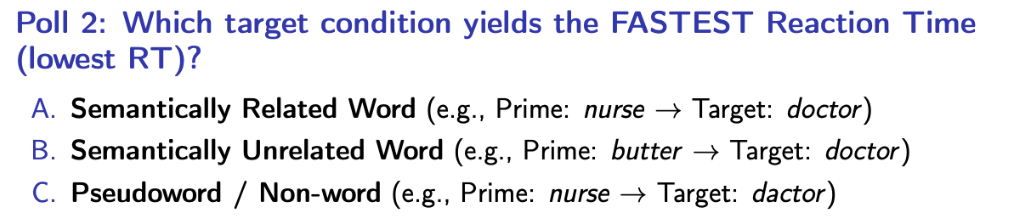
A
(might be bc their network is repeated so often so its faster realisation)
priming lexical
will affect your rxn time
whats the theoretical takeaway of semantic priming effect
encountering a related prime spreads activation across semantically associated nodes, lowering the retrieval threshold for target recognition
what does the self-paced reading (SPR) use
moving window paradigm
moving window paradigm
sentence appears masked (with —-)
pressing a space bar or button reveals one word/region at a time while re-masking the previous one

what does the SPR measure
measures dwell time per individual word/region
stimulates progressive reading while yielding millisecond-accurate fixation estimates
spillover effect
processing difficulty at a critical word frequency shows up 1-2 words later, bc button-press motor actions lag cognitive reanalysis
Evaluation of SPR PROS
low cost, highly portable, easy to script, sensitive to processing load
evaluation of SPR CONS
lower ecological validity (readers can’t make regressive saccades naturally)
PsyToolkit
lightweight, browser-based execution
simple scripting languages for rapid experiment design
ideal for running remote online participant pools
completely free and open-access
PsychoPy
Flexible Python library + Builder GUI
Sub-millisecond timing precision on local laboratory displays
integrates seamlessly with eye-trackers and EEG triggers
supports Pavlovia for browser hosting
eye-tracking in reading
infrared video cameras can track corneal reflections and pupil position
what are the key measures in reading
fixations
saccades
regressions
fixations
pauses on specific words
saccades
rapid jumping b/w fixation points
regressions
backward saccades indicative of parsing breakdown/reanalysis
visual world paradigm
you can measure so many things in 1 trial compared to other
what are the types of results you can get from visual world paradigm?
one-referent context
two-referent context
one-referent context
listeners look to the empty to the empty towel before hearing “in the box”
two-referent context
listeners immediately interpret “on the towel” as a modifier identifying which apple to move
N100
negative peaking post-stimulus onset
N100/P200
phonetic oddball detection
ex: bike, baby, balloon, pike
indexes early sensory detection of acoustic/phonetic deviance
N400
semantic anomaly
semantic integration difficulty
ex: whipped cream tastes anxious
P600
syntactic anomaly
structural reanalysis/repair
ex: the spoiled child throw the toy

B
LDT
LDT

SPR
SPR

Eye-tracking
ET

ERPs
ERPs

columns (RStudio)
used ti reference and manipulate data
numbers, text, dates or logical values
rows (RStudio)
individual observations, cases or records
w/ a unique index or identifier, typically starting from 1
dataframes (RStudio)
different data types within the same structure, making them versatile for handling diverse datasets
dimensions (RStudio)
numbers of rows and columns
empty dimensions (RStudio)
data.frame()
function w/ no arguments
initialising a data frame before adding data
initialisation (RStudio)
u specify a variable and set its initial value
variable used as a counter during the loop
iteration (RStudio)
after each iteration of the loop, the counter variable is updated according to a specified increment or decrement
how to display # of rows
head(file_name, #)
when there’s a Freq of 0
means that the word doesn’t exist in the corpus; (typically add 1)
to bring dataset into RStudio
read_csv(file_name)
once you give something a vector/name, you always have to run it again to double-check
how to specific which column
with a $
ex: length(ldf_lt$Length)
how to get specific elements
[#:#]
what to do if you want to change a value
ex: ldt_data$Freq[1] ← 9
OG csv doesn’t change, just in R
why do we use i
because it will help us code/measure from the same row (which R doesn’t normally do; it does it as a list)
logical → integer → numeric → character