Cranial Nerves Relevant to Speech and Swallowing MIDTERM
 Call Kai
 Learn
 Practice Test
 Spaced Repetition
 Match
 Flashcards
 Knowt Play
1/12

There's no tags or description
Looks like no tags are added yet.
13 Terms
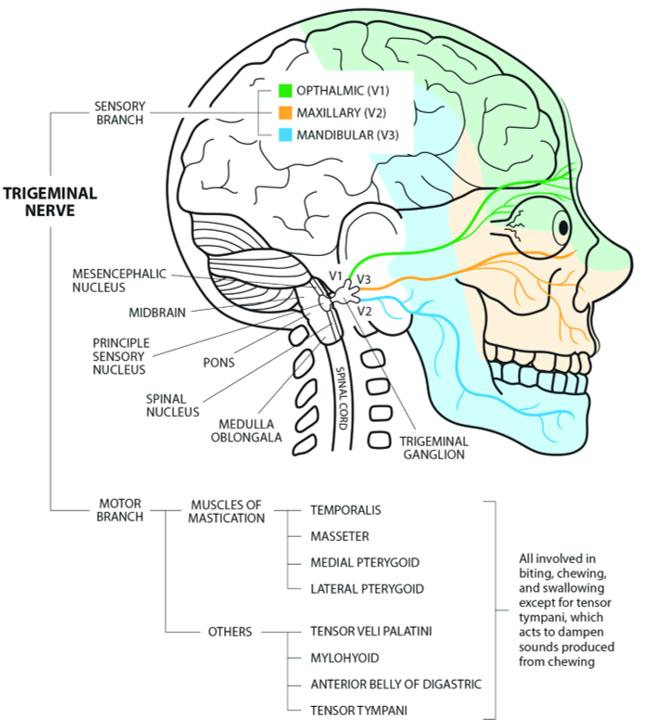
CN 5 — Trigeminal
Mixed: Sensory + Motor
Location: Pons; exits the brainstem and divides into three branches.
Sensory functions:
- Sensation from the face, lips, oral cavity, teeth, and anterior tongue (general sensation, not taste).
Motor functions:
Controls muscles of mastication (chewing).
Helps control jaw opening and closing.
Speech/swallowing relevance: Jaw stability, chewing, oral preparation, and oral sensation.
CN 7 — Facial
Mixed: Sensory + Motor
Location: Pons; exits near the pontomedullary junction.
Sensory functions:
Taste from the anterior ⅔ of the tongue.
Small area of sensation around the external ear.
Motor functions:
Controls muscles of facial expression.
Closes the lips.
Controls buccinator muscle (cheek tension).
Stimulates submandibular and sublingual salivary glands.
Speech/swallowing relevance: Lip closure, bolus control, preventing food leakage, and facial expression during communication.

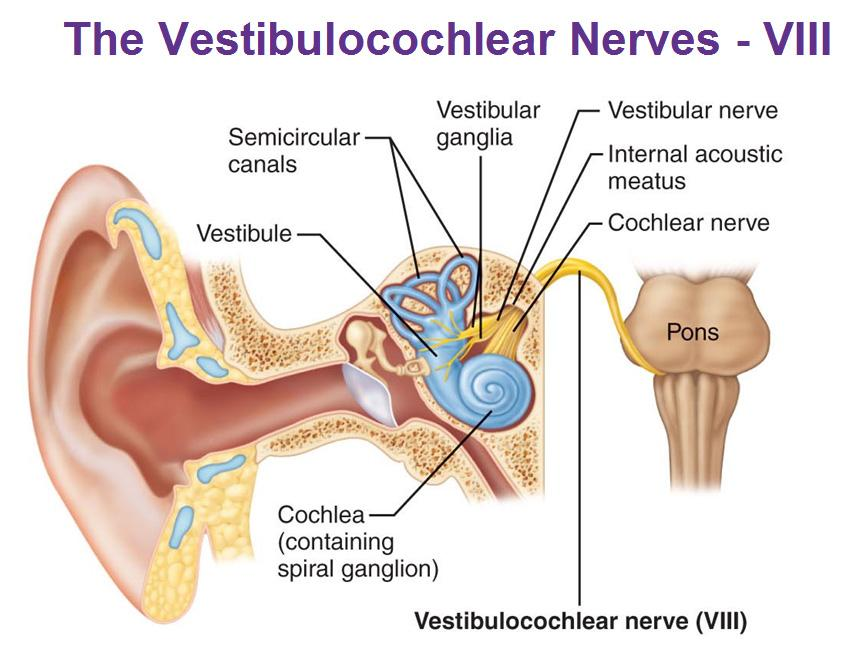
CN 8 — Vestibulocochlear
Sensory
Location: Exits at the pontomedullary junction and connects to the inner ear.
Sensory functions:
Hearing through the cochlear division.
Balance and equilibrium through the vestibular division.
Speech/swallowing relevance: Auditory feedback for speech production, monitoring voice loudness and quality, and balance during feeding.
CN 9— Glossopharyngeal
Mixed: Sensory + Motor
Location: Medulla; exits the lateral medulla.
Sensory functions:
Taste and general sensation from the posterior ⅓ of the tongue.
Sensation from the pharynx.
Provides sensory input involved in the gag reflex.
Motor functions:
Innervates the stylopharyngeus muscle, which elevates the pharynx.
Stimulates the parotid salivary gland.
Speech/swallowing relevance: Pharyngeal sensation, swallowing initiation, pharyngeal elevation, and gag reflex (sensory limb).

CN 10 — Vagus
Mixed: Sensory + Motor
Location: Medulla; exits the lateral medulla and travels into the pharynx and larynx.
Sensory functions:
Sensation from the pharynx and larynx.
Taste from the epiglottis and nearby region.
Sensory limb of the cough reflex.
Motor functions:
Controls most muscles of the soft palate, pharynx, and larynx.
Elevates the velum.
Controls vocal fold movement.
Supports phonation and airway protection.
Speech/swallowing relevance: Voice production, resonance, velopharyngeal closure, pharyngeal swallowing, and airway protection.

CN 12— Hypoglossal
Motor
Location: Medulla; exits the medulla and travels to the tongue.
Motor functions:
Controls most intrinsic and extrinsic tongue muscles.
Protrudes, retracts, elevates, lowers, and shapes the tongue.
Speech/swallowing relevance: Articulation, tongue movement, bolus manipulation, and propulsion of food toward the pharynx.
Exception: Palatoglossus is innervated by CN X, not CN XII.

Cranial nerve CN V=5
Sensory function=Facial and oral sensation
Motor function=Mastication
Cranial nerve CN VII-7
Sensory function=Taste: anterior ⅔ tongue
Motor function=Facial expression, lip closure
Cranial nerve CN VIII-8
Sensory Function=Hearing, equilibrium
Motor Function=None
Cranial nerve CN IX-9
Sensory Function=Taste: posterior ⅓ tongue, pharyngeal sensation
Motor Function=Stylopharyngeus, swallowing
Cranial nerve CN X-10
Sensory Function=Pharyngeal/laryngeal sensation, epiglottic taste
Motor Function=Phonation, velum, pharynx, larynx
Cranial nerve CN XII-12
Sensory Function=None
Motor Function=Tongue movement
Cranial Nerve Functions(SLP)
V: 5 Chew and feel.
VII: 7 Smile, close lips, taste.
VIII: 8 Hear and balance.
IX: 9 Taste back of tongue, feel pharynx.
X:10 Voice, velum, swallow, protect airway.
XII: 12 Move tongue.