Biology of the Sea
 Call Kai
 Learn
 Practice Test
 Spaced Repetition
 Match
 Flashcards
 Knowt Play
1/26

Earn XP
Description and Tags
bio 205
27 Terms
Autotrophs
make their own food
Heterotrophs
consume something else for energy
Chemoautotrophs
energy from inorganic materials
Where is energy constrained for autotrophs in the ocean?
Photic zone
Linnaeus
Swedish botanist who proposed the modern system of biological nomenclature (1707-1778)
Colonialism
establishment and maintenance of rule over an alien peoples that is subordinate to the ruling peoples

Parachute Science
When research teams arrive at a foreign research site, collect data independently of local scientists and residents (often without permission), then leave
Coriolis effect:
The effect of Earth's rotation on the direction of winds and currents.
Social Darwinism
the idea that some racial and ethnic groups are better than others and inherently deserve success
Why is Charles Turner important?
brain anatomy of birds, learning behavior competences, animal intelligence- bugs
Reflected from the equator:
lands right of the starting place
Reflected from the poles;
lands left of the starting place
Virus
non living entity that have to infect a host
Prokaryotes
no nucleus, single celled, no membrane bound organelles
Eukaryotes
cellular organisms with distinct cell nucleus
What was archaea originally classified as?
bacteria
Porifera
Sponges

Bottom up control:
abiotic & primary producers shape the ecosystem and organism abundance

Top-down control:
predators shape organism abundance and community structure

Which tidal zone is described here?
-low biodiversity
-no Algae
- Limpets, Snails & Louses
- Always exposed
- predation from above & terrestrial organisms
-Highest High tide
Spray Zone

Which tidal zone is described here?
-no algae
-intensive wave action
-no primary activity
-predation from above
-not hightide, high salinity
-lowest high tide
High Tide Zone

Which tidal zone is described here?
-intensive wave action
-predation from low tide zone
-low tide- hot/cold
-high salinity
-exposed 2x a day, frequenty submerged
-highest low tide
Middle Tide Zone

Which tidal zone is described here
-lowest low tide
-always submerged
-exposed at lowest point of tide
-highest biodiversity
-mobile predators
Low tide zone

Salt Wedge Estuary:
river output > > > marine input
-tidal influence is low
-fresh water on top → vertical stratification
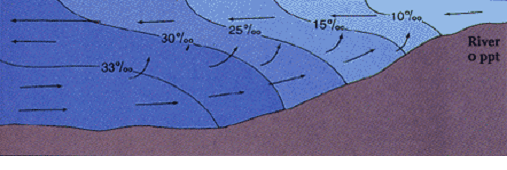
Partially mixed estuary
river output < marine input
-tidal influence is important
-mixing in water → horizontal stratification
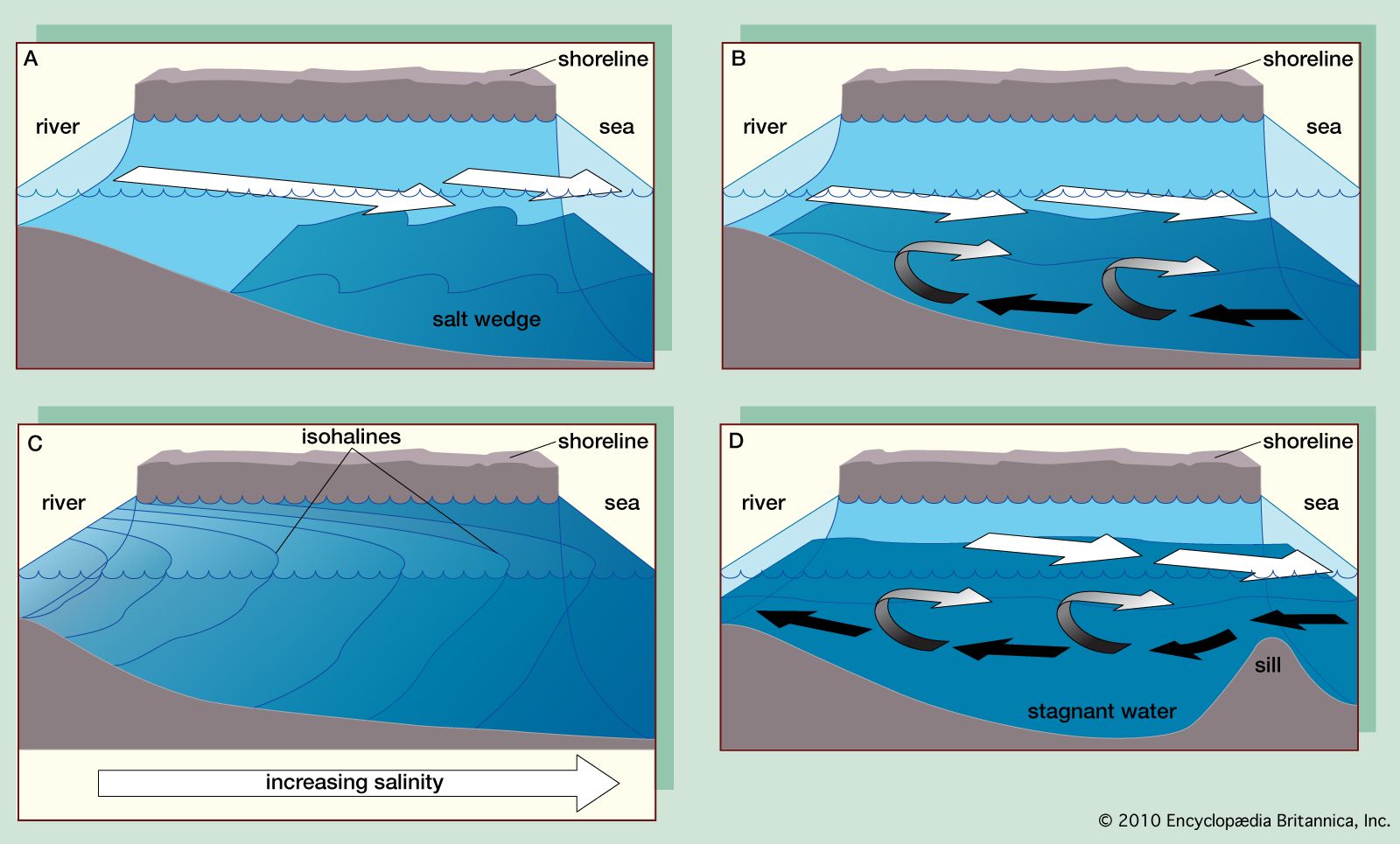
Well mixed estuary
river output < < marine input
tidal influence important
turbulent mixing → no mixing
Inverse estuary
Evaporation > > > freshwater flow
salinity maximum zone → salinity plug
inhibits mixing