Anatomy Cell Unit for Kyle
 Call Kai
 Learn
Learn Practice Test
 Spaced Repetition
 Match
Match Flashcards
 Knowt Play
1/36

There's no tags or description
Looks like no tags are added yet.
Name | Mastery | Learn | Test | Matching | Spaced | Call with Kai | Chat |
|---|
No analytics yet
Send a link to your students to track their progress
37 Terms
Nucleus
control center

Nucleus
Nucleolus
dense body in the nucleus that produces ribosomes

Nucleolus
Chromatin
loose mix of DNA

Chromatin
Rough ER
assembles proteins; contains ribosomes

Rough ER
Smooth ER
synthesizes lipids; no ribosomes

Smooth ER
Ribosome
synthesizes proteins; small RNA containing particles
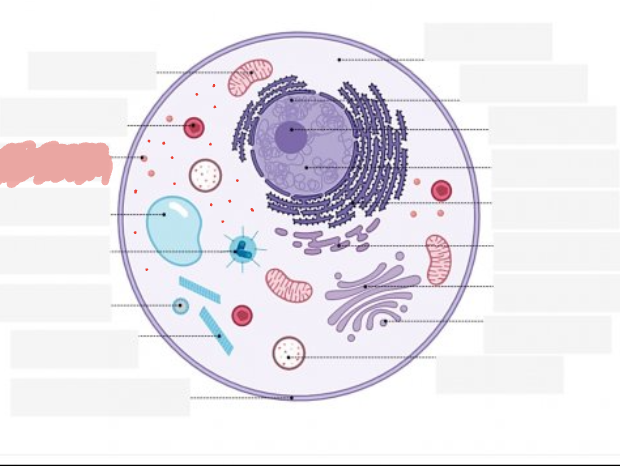
Ribosomes
Golgi apparatus (golgi body)
packages and modifies proteins

Golgi apparatus (golgi body)
Lysosome
digestion; membranous sac that contains digestive enzymes
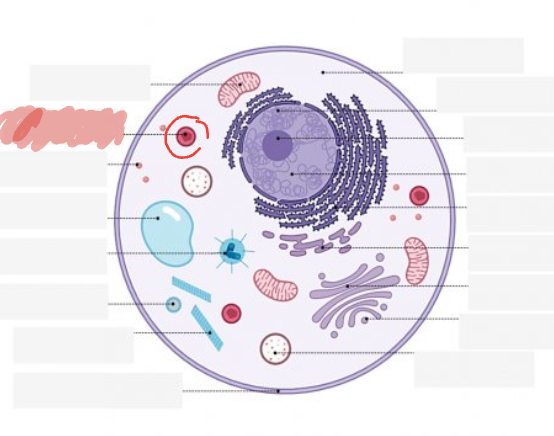
Lysosome
Centrioles
makes spindle fibers used in mitosis
Mitochondria (“powerhouse of the cell”)
produces ATP for cellular energy
Cytoplasm
jelly-like liquid inside the cell that is the center of metabolic activities
Cell
basic functional unit of organisms; microscopic package that contains all parts and processes necessary to survive
Organelle
cellular “organ”; individual structure with specific function
Cell membrane
protective layer around cell; double layer of phospholipid molecules
Passive transport
requires no energy input from cell
Simple diffusion
movement of a molecule from a higher concentration to a lower concentration
Facilitated diffusion
movement of a molecule from a higher concentration to a lower concentration; molecules are transported by carrier proteins
Osmosis
diffusion of water
Filtration
water and solutes move from region of high to low hydrostatic pressure along a pressure gradient
Active transport
requires ATP
ATP
cellular energy
Solute pumping
substance moves through membrane against concentration gradient; requires carrier protein
Bulk transport
larger substances enter or exit through the membrane
Exocytosis
ejection of substance from cell; vesicle fuses with membrane and ruptures
Endocytosis
large particle enters the cell; substance enclosed in membrane; pinches off cytoplasm and contents are digested
Tonicity
the water potential of 2 solutions separated by a partially permeable cell membrane
Isotonic
concentration of solutes (ex: sugar, salt) is equal inside and outside of the cell; ideal state
Hypotonic
concentration of solutes is LESS in the outside of the cell
Hypertonic
concentration of solutes is MORE on the outside of the cell