Forces Flashcards
 Call Kai
 Learn
 Practice Test
 Spaced Repetition
 Match
 Flashcards
 Knowt Play
1/91

There's no tags or description
Looks like no tags are added yet.
92 Terms
State the SI unit for momentum.
kg m/s
Compare the momentum of two cars of the same mass but one travelling faster than the other.
The car travelling faster has more momentum.
Name the pathways by which energy can be transferred.
Mechanically, electrically, by waves or by radiation.
Law of Conservation of Momentum
In a closed system, the total momentum before an event is equal to the total momentum after an event.
collisions meaning
A collision is when two objects come together and interact, and momentum is conserved.
explosion meaning
An explosion is when one object splits into parts that move apart, and momentum is conserved.
How to solve collision questions
An object of mass 1 kg is travelling at 3 m/s right when it collides with a heavier object of mass 2 kg. The two objects stick together and travel off as one. Calculate the combined velocity of the objects after the collision.
momentum = mass x velocity
Choose a positive direction (usually right).
Calculate momentum of each object before.
Add them to get total momentum before.
Set equal to total momentum after.
Solve for unknown velocity/mass.
answer is 1 m/s <3
EXPLOSIONS momentum rule
Before an explosion, total momentum = 0 (because everything is stationary). Afterwards, momentum is still 0, so the pieces move with equal and opposite momentum.

They would have the same momentum but in opposite directions before the collision, so momentum before = 0.
Total momentum after = 0, so if they have the same mass, they will have the same speeds in opposite directions.

Total momentum before would be towards the right.
Total momentum after would also be towards the right.
So, they may both move off together towards the right or trolley 1 would rebound more slowly than trolley 2.

Momentum before = 0.
Total momentum after = 0, so if they have the same mass, they will have the same speeds in opposite directions.
Define a force.
A push, pull or twist that can change an object’s shape, speed or direction.
Deformation meaning
The action of changing the shape of something.
examples of deformation & how it happens
Unbalanced forces can change the shape, speed or direction of an object.
Stretching is an example of deformation.
Compression is also an example of deformation.
what do u use to measure force applied
Newtonmeter
Extension measures…
stretching and deformation.
Extension is how much the spring is stretched.
It is the difference between the stretched length and the original length of the spring.
How will the extension of a spring be affected as more force is added to it?
As more force is added, the extension of a spring will increase.
This will not continue indefinitely, only until the spring cannot be stretched anymore without returning to its original shape (the limit of proportionality).
The stiffer the spring, the smaller the extension will be (if the same force is applied).
Spring constant unit
N/m
Investigating the relationship between force and extension for a spring.
We will be measuring the extension of a spring when different forces are applied to it.
How will we change the force applied?
How does this change the force applied?
What would be a control variable for this investigation?
Adding slotted masses to the base of the spring.
W = mg, so increasing the mass increases the force of weight.
The spring constant (the stiffness of the spring)
RP: Investigating the relationship between force & extension of a spring
Attach the clamp stand to the desk using a G-clamp to prevent it from tipping over. Hang the spring from the top clamp.
Place a vertical metre ruler next to the spring.
record the length of the unstretched spring in results table (read at eye level to prevent error)
add a 100g mass (or 1N weight) to the bottom of the spring & wait for it to stop oscillating
record new spring length in table
Add further masses in regular 100 g steps up to 1,000 g (10 N), recording the position each time. Repeat the whole process three times to calculate average lengths.
calculate extensions & plot graph
RP: Investigating the relationship between force & extension of a spring
how to calculate extension & plot graph
Calculate extension: Subtract the original unstretched length from each new length
Plot the graph: Plot a graph with Force on the y-axis & extension on the x-axis
what is terminal velocity
The forces have become balanced, and the skydiver reaches terminal velocity.
They continue moving at the same speed in the same direction.
The 5 Stages of Terminal Velocity
Start of fall: The only force acting on the object is its weight (acting downwards due to gravity). Air resistance is initially zero.
Acceleration: Because weight is much greater than air resistance, there is a downward resultant force. The object accelerates downwards.
Increasing air resistance: As the object's speed increases, the upward air resistance increases.
Decreasing Acceleration: The resultant force downwards gets smaller, which means the acceleration decreases (it is still getting faster, but at a slower rate).
Terminal Velocity: Eventually, the upwards air resistance exactly equals the downwards weight. The resultant force is now zero. The object stops accelerating and falls at a constant speed, known as terminal velocity.
what happens when a skydiver opens their parachute
Opening the chute: The parachute massively increases the surface area.
Sudden Deceleration: This causes a huge, sudden increase in air resistance. Air resistance is now greater than weight, creating an upwards resultant force. The parachutist decelerates (slows down rapidly).
Finding balance again: As their speed decreases, the air resistance also decreases.
New Terminal Velocity: Air resistance decreases until it equals weight once again. A new, much lower (and safer) terminal velocity is reached.
Velocity-Time Graph Features for parachute
Initial steep straight line: Constant maximum acceleration (on Earth, this is 9.8 m/s2).
Line begins to curve and flatten: Acceleration is decreasing because air resistance is building up.
Flat horizontal line: Terminal velocity has been reached (acceleration is 0, velocity is constant).
Sudden steep drop (if parachute opens): Rapid deceleration, followed by a new, lower flat horizontal line.

Newton's First Law
an object at rest stays at rest, and an object in motion stays in motion at a constant speed and in a straight line, unless acted upon by an unbalanced (or non-zero resultant) force
zero resultant force = constant velocity
Required Practical Context (e.g., Cup Stacking / Ball Bearings) How do you prove terminal velocity was reached?
Measure equal distances using tape on a measuring cylinder (or height marks in air) and time how long it takes to travel each segment. If the time intervals are equal, the object has reached a constant speed (terminal velocity).
Light Gates: Used with a computer to measure instantaneous velocity at different points along the drop to show the velocity graph flattening out.
Factors That Change Terminal Velocity
Increased Surface Area: Increases air resistance - Lowers terminal velocity.
Increased Mass/Weight: Requires a larger upward air resistance force to balance it - Object must fall faster to reach that higher air resistance - Increases terminal velocity.
Fluid Viscosity: Falling through thick oil produces more fluid resistance than falling through water or air - Lowers terminal velocity.
Why do objects of different masses fall at the exact same rate in a vacuum, and can terminal velocity be reached?
In a vacuum: There is no air resistance, so the only force is gravity. All objects accelerate downwards at 9.8 m/s2 and land at the exact same time.
Terminal Velocity: Cannot occur in a vacuum because terminal velocity requires air/fluid resistance to balance weight.
The motion of an object will not change unless it is acted upon by an…
unbalanced forces
If the forces acting on an object are balanced (resultant force = 0 N):
A stationary object will remain stationary
An object in motion will continue at a constant speed in the same direction


Acceleration
Acceleration is the rate of change of velocity.
Newton’s Second Law
Newton’s Second Law states that the acceleration of an object is proportional to the resultant force acting on it and inversely proportional to its mass.
Momentum meaning
Momentum is the product of an object's mass and velocity.
measured in kg m/s
A force on an object that is moving, or able to move, causes it to…
accelerate
Why does an object’s momentum change when it accelerates?
acceleration is a change in velocity
Momentum has direction, so …
a negative change in momentum acts opposite to the positive direction.
The resultant force on an object equals its , so a ….
rate of change of momentum
larger change in momentum, or the same change in a shorter time, gives a larger force
Safety features and stopping time
During a collision a person or object must lose momentum as it comes to rest.
Safety features reduce the force by increasing the time over which the momentum change happens.
examples of safety features
Seat belts stretch slightly, This stretching increases the time interval (Δ t) over which the passenger's speed drops to zero.
Crumple zones at the front and rear of a car are designed to crush and deform in a collision, increasing the time over which the car and its occupants come to rest.
Gymnasium crash mats compress as a person lands, increasing the time to stop.
Cycle helmets contain material that compresses on impact, increasing the stopping time of the head.
Cushioned playground surfaces deform on impact, increasing the stopping time of a falling person.
In each case the change in momentum is spread over a longer time, lowering the rate of change of momentum and so the average force, reducing the risk of injury.
Explain how a cycle helmet / crash mat / airbag reduces the risk of injury
Fixed Change in Momentum: The person/head starts with momentum and must come to a complete stop (change in momentum is fixed).
Increases Time: The safety feature (e.g., helmet foam crushing, crash mat compressing, seatbelt stretching) increases the time taken for the person to stop.
Decreases Rate of Change: This decreases the rate of change of momentum.
Reduces Force: Because Force = rate of change of momentum, the impact force on the body is reduced, decreasing the severity of injury.
Name the point above which a spring will not return to its initial length.
The limit of proportionality
Identify which axis of a graph the independent variable goes on.
x axis
The greater a spring constant, the … a spring.
stiffer
The force applied when stretching a spring is proportional to its …, and the… is the spring constant.
extension
ratio of these quantities
hen an elastic object is stretched beyond its limit of proportionality, the force applied is no longer …. The object is past its elastic limit and has now become ...
proportional to the extension
inelastic
When we draw a graph of the force applied to a spring and its extension, we usually get a graph that looks like this:
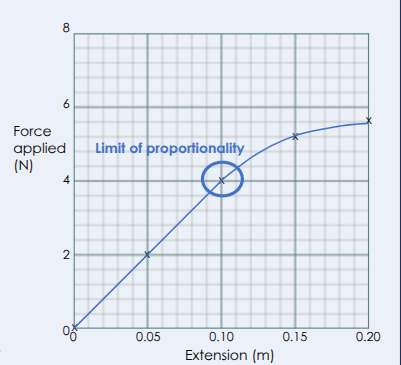
limit of proportionality
The limit of proportionality is the point beyond which Hooke’s Law is no longer true when stretching a material.
elastic limit
The elastic limit is the point beyond which a material will not return to its original shape.
If an object can return to its original shape when the force is removed, we can say it has been…
elastically deformed.
Once an object is past its elastic limit, it is ... It cannot go back to its original shape.
inelastically deformed
F=ke
Using Hooke’s Law Graphs:
We can calculate the spring constant of a spring using ...
But we can only do that when …
values of F and e from a graph
Hooke’s Law applies, up to the limit of proportionality.
What about compression?
Tennis balls are bouncy and can be compressed.
What do you think the relationship is between the force applied and the compression (how much it is squashed by)?
Hooke’s law also applies to the compression of objects.
Within the limit of proportionality, the more force applied, the more the object will be compressed.
Depending on the material, it will eventually reach the limit of proportionality and the elastic limit, after which it will inelastically deform. In the case of a tennis ball, this is a surprising amount of force!
What is the relationship between work done and elastic potential energy when a spring is stretched or compressed?
When a spring is stretched or compressed, work is done on the spring.
When a spring is stretched or compressed, its elastic potential energy store is filled.
As long as the spring has not been inelastically deformed, the work done in stretching the spring is equal to the elastic potential energy stored in the spring.
Explain what it means for a spring to be elastically deformed
the object WILL return to its original shape when the force is removed
Explain what it means for a spring to be inelastically deformed
the object will NOT return to its original shape when the force is removed
Describe the relationship between mass and acceleration.
They are inversely proportional.
Describe how you could tell from a velocity-time graph if there is a resultant force acting on an object.
If the resultant force acting on an object is zero, its velocity will not change and it will be represented by a horizontal line. If there is a resultant force, its motion will change.
Newton’s Second Law Investigation: the purpose
testing the formula Force = mass × acceleration by seeing how pulling an object harder makes it speed up faster.
The Setup: A trolley sits on a track connected by a string over a pulley to a hanging weight. The hanging weight gravity pulls down on is your accelerating force (F).
Two light gates are placed along the track. These are sensors that project an invisible beam of light. When the card (stuck to top of trolley) passes through, it blocks the beam. The computer records exactly how long the beam was blocked to calculate the speed and acceleration.
What You Change: You increase the pulling force by moving weights from the trolley onto the hanging hook.
Why You Move Weights (The Key Principle): To test how force affects acceleration, the total mass (m) of the entire setup must stay exactly the same. Taking a weight off the trolley and putting it on the hook increases the pulling force without changing the total mass of the system.
What You Measure: Light gates measure how quickly the trolley speeds up (acceleration, a) as it rolls down the track.
The Goal: You are proving that Force and Acceleration are directly proportional—if you double the pulling force, the trolley speeds up twice as fast.
Newton’s Second Law Investigation Method
Apparatus
Trolley with a piece of card attached (to break light gate beams)
Ramp/track elevated slightly at one end (to overcome friction)
String attached to the trolley, passing over a pulley to a hanging mass holder
Two light gates connected to a data logger
Masses (e.g., five 100 g masses)
Method (Investigating Force on Acceleration)
Set up the apparatus: Attach the string to the trolley, thread it over the pulley at the end of the track, and attach the mass holder.
Keep total mass constant: Place all five 100 g masses onto the trolley so the overall mass of the system stays unchanged throughout the experiment.
Position light gates: Place two light gates along the track connected to a data logger set to calculate acceleration.
Release trolley: Hold the trolley at a fixed starting point behind the first light gate, release it without pushing, and record the acceleration displayed on the data logger.
Change the accelerating force: Move one 100 g mass (1 N force) from the trolley to the hanging mass holder.
Repeat: Release the trolley from the exact same starting point and record the new acceleration.
Iterate: Repeat steps 5 and 6 until all masses have been transferred from the trolley to the hanging mass holder.
Analysis: Repeat the entire test three times for each force to calculate mean accelerations, then plot a graph of Force against Acceleration.
Key Exam Points for 6 Marks
Control variable: The total mass of the system must stay constant by transferring masses between the trolley and the hook (never removing them from the system).
Accuracy: Using light gates instead of a stopwatch eliminates human reaction time error.
Control variable: Always release the trolley from the same starting position.
Controlling Friction: Slightly tilt the ramp so gravity just balances out friction, ensuring the trolley only accelerates due to the hanging weight.
RPA Part 2 (Varying Mass)
The second part of the required practical where you keep the accelerating force constant (hanging mass stays the same) and vary the mass of the system by removing mass from the trolley entirely.
precision vs accuracy
Accuracy is how close your measurement is to the true value.
Precision is how close your repeated measurements are to each other (how consistent they are), or how small a division your measuring instrument can read.
how to improve accuracy & precision
To improve accuracy: Eliminate systematic errors (e.g., calibrate scales to fix zero errors, read scales at eye level to prevent parallax error).
To improve precision: Use measuring equipment with a finer resolution (e.g., using a micrometer instead of a standard ruler) and keep all control variables identical.
repeatable vs reproducible in experiments
Repeatable means you can get the same results using the same method and equipment.
Reproducible means someone else can get the same results using a different person, different equipment, or a slightly different method.
According to Newton’s Second Law (F=ma), this mass and force applied should produce an acceleration of 10 m/s2.
So why does it not?
This 10 N is the applied force, which is not the same as the resultant force. When using F=ma, F must be the resultant force. In this set up, there are other forces acting. If your equipment set up was on an air track, that can help to reduce the effects of friction, but on any other surface friction will have an effect.
Are there any other forces that may be involved?
Air resistance.
We can minimise air resistance by making the glider as streamlined/aerodynamic as possible, but we cannot remove air resistance.
One way of compensating for resistive forces is by doing the experiment on a slope. This compensates for friction.
We could then work backwards from our results to estimate the size of the force of air resistance.
Explain the difference between distance and displacement.
Distance is how far an object has travelled whereas displacement is where an object is from a starting position, including direction.
Stopping distance meaning
Stopping distance is the sum of the distance covered during the driver’s reaction time and the distance covered under the braking force.
Stopping distance = thinking distance + braking distance
Thinking Distance meaning
Thinking distance is the distance covered during the driver’s reaction time.
Braking Distance meaning
Braking distance is the distance covered under the braking force.
What effect does speed have on braking distance?
The faster the speed, the greater the braking distance.
How do brakes work & how does speed affect this
When a force is applied to the brakes, they do work on the wheels.
This empties the kinetic store of the vehicle but transfers energy to the brakes, increasing their temperature.
The greater the speed of a vehicle, the larger the braking force needed to stop it and the greater deceleration needed.
Large decelerations can cause the driver to lose control of the vehicle or cause the brakes to overheat.
Factors Affecting Thinking Distance:
Speed of Vehicle: The faster the car is travelling, the further it moves during the driver's reaction time. Thinking distance is directly proportional to speed.
Driver's Reaction Time: Longer reaction times increase thinking distance. Reaction time is negatively affected by:
Tiredness / Fatigue
Alcohol consumption
Drugs or medication
Distractions (e.g., mobile phones, satellite navigation, radio)
Factors Affecting Braking Distance:
Speed of Vehicle: Braking distance increases with the square of the speed. Doubling the speed quadruples the braking distance.
Road Conditions / Weather: Wet, icy, snowy roads, or loose gravel reduce friction between the tyres and the road surface, increasing braking distance.
Vehicle Condition:
Worn brakes: Cannot exert maximum friction force.
Worn tyres: Reduce tread depth, making it harder to grip the road or disperse water.
Mass of Vehicle: A heavily loaded car or lorry has greater mass, requiring a larger braking force or a greater distance to stop at the same speed.
Why Speed Impact on Braking Distance is Non-Linear
Because kinetic energy depends on velocity squared (v2):
If speed doubles (2v), kinetic energy increases by 22 = 4 times.
Assuming braking force (F) stays constant, the vehicle requires 4 times the work done, meaning 4 times the braking distance.
If speed triples (3v), kinetic energy increases by 32 = 9 times, requiring 9 times the braking distance.
As the car slows down its … is emptied.
The … of the brakes is filled.
kinetic store
thermal store
Work is done on an object whenever…
…a force causes the object to move through a distance.
Doing work transfers energy from one store to another
When work is done against friction:
The mechanical work done is converted into thermal energy.
This causes an increase in temperature of the object, the contacting surfaces, and the surroundings.
What is the line of action rule for work done, and why is no work done by the force in:
Carrying an object horizontally?
Circular motion (e.g., a satellite in orbit)?
Line of Action Rule: Work is only done if displacement occurs along the line of action / direction of the applied force.
1. Carrying horizontally: The supporting force acts vertically, but displacement is horizontal (zero vertical movement) : No work done by the vertical force.
2. Circular motion: The centripetal force acts towards the centre, but movement is perpendicular to it: No work done by the centripetal force.
Momentum meaning
Momentum is a property of moving objects and helps to explain many physical interactions.
Momentum is the product of an object’s mass and velocity.
This means that:
the greater the mass of an object, the more momentum it has
the faster an object is travelling, the more momentum it has
Compare the motion of two runners, one with mass 70 kg and one with mass 80 kg. They are both running at 3 m/s.
Both are running at the same speed
If they are running in the same direction, they will have the same velocity
The runner with the greater mass will have more momentum than the runner with the smaller mass
The runner with the larger mass will require more force in order to stop
Definition of inertia
the tendency of objects to continue in their state of rest or uniform motion
Definition of inertial mass
a measure of how difficult it is to change the velocity of an object, defined as the ratio of force over acceleration
Typical Reaction Time & Testing reaction time
Typical Reaction Time: The typical range for human reaction time (0.2s to 0.9s).
Testing Reaction Time: Methods to measure reaction time in a lab setting (e.g., the ruler drop test or computer reaction software).
RPA Safety Precautions Hooke’s Law
Clamping the base of the stand to the bench using a G-clamp to prevent tipping, and wearing eye protection in case the spring snaps.
Hooke's Law & Elasticity
Graph Gradient Analysis
Graph Area Analysis
Graph Gradient Analysis: k is represented by the gradient of the linear (straight) section of a Force-Extension graph.
Graph Area Analysis: Work done (or elastic potential energy stored) is represented by the area under the force-extension graph.
Joule Definition
1 joule = 1 newton-metre
doing 1J of work occurs when a force of 1N causes a displacement of 1m
Light Gate Operation (N2L RPA)
You must measure and input the exact width of the card on top of the trolley into the data logger software. The software divides the card width by the time the light beam is blocked to measure instantaneous velocity.
Near the Earth’s surface any object falling freely under gravity has an acceleration of about…
9/8m/s2
moment meaning
A moment is the turning effect of a force.
Clockwise moment = … moment
anticlockwise
use the idea of moments to explain why the maximujm load of something must not be exceeded
Increasing the load increases the anticlockwise moment
This may make the anticlockwise moment greater than the clockwise moment
This means the thing may tip over
This is because the line of action from the centre of mass would move outside the base