intro, structure & composition of the atmosphere
 Call Kai
 Learn
 Practice Test
 Spaced Repetition
 Match
 Flashcards
 Knowt Play
1/22

Earn XP
Description and Tags
L1
23 Terms
Why study AQ?
AQ is
the air you breathe
the earth’s radiation balance, climate
visibility
conservation of historic buildings & statues
human health, cost of medication and quality of life
ecosystem & crop health
wildlife, aquatic ecosystems
How does temperature change with changes in atmospheric structure?
troposphere: T decreases with height
surface heating & turbulent mixing
tropopause: turbulent mixing stops
stratosphere: T increases with height
stability
stratopause: ozone layer, absorption of UV light
mesosphere: T decreases with height
lack of ozone. Without ozone to absorb solar radiation, there is very little heat input
mesopause: highest clouds, coldest
thermosphere: T increases with height
photodissociation and ionisation

Why does atmospheric pressure increase exponentially towards the surface?
ρ = F/A =mg/A
gravity & compressible fluid
gravity pulls air downward, and air is a compressible fluid
weight accumulation
the deeper you go in the atmosphere, the more air molecules exist above you
their weight compresses the air below, making air denser near the surface
feedback loop
higher density (ρ) at lower altitudes means pressure increases much faster /m of descent compared to higher up, creating an exponential curve:
ρ(z) = ρ0 e-z/H

What determines surface pressure?
total weight of the air column
surface pressure (ρ0) is equal to the total weight of the air column resting directly above a given unit area on the surface, extending all the way to the top of the atmosphere.
Hydrostatic formula
δρ/δz = -ρg
What is the Hydrostatic Balance/equilibrium?
The exact balance between the net upward force on a layer of air (due to decreasing pressure with height) and the downward gravitational force.
δρ/δz = -ρg
the -ve sin shows that the pressure decreases as height(z) increases.
What was the atmosphere like 3.5 billion years ago?
consisted mainly of
nitrogen
large amounts of gg (CO2 & CH4)
and small amounts of water vapour
almost no O2
originated from the continuous volcanic eruptions
What was the atmosphere like 2.5 billion years ago?
various processes led to a dramatic increase in the amount of oxygen (the great oxidation event)
photosynthesis led to a gradual increase in the amount of oxygen
so the harmful UV radiation in the atmosphere was absorbed more and more
What is the composition of the current atmosphere?
By volume not mass:
total 99.9%
N2: 78%
O2: 21%
Argon: 0.9%
CO2: 0.042%
CH4: 0.0002%
CO: 0.00001%
O3: 0.000004%
What are the roles of the gases occuring in very low amounts? Such as CO2, CH4, NOx etc.
chemical reaction in the atmosphere
air pollution and its effects on public health
cleansing the atmosphere
protecting against damage by UV radiation
the greenhouse effect
What are trace gases?
gases which have very small mole fractions.
examples: CH4, N2O etc.
What is photochemical smog? Include their health effects.
near the surface of the Earth, O3 is the primary ingredient of photochemical smog.
summer smog occurs in big cities where chemical reactions occur under the influence of summer sunlight
winter smog consists of SO2 and H2SO4
smog causes harmful health effects such as respiratory problems
negative impacts on vegetation
What does the concentration of pollutants depend on?
sources
transport (advection, dispersion)
chemistry
sinks
Molar mass (M) formula including mole fraction (Cv,i) formula
M = ∑Cv,iMi
Cv,i = (number of moles of gas i) / (total number of moles of all gases in the mixture)
Define residence time. Include the general notation.
the time during which the concentration (the gas density in kgm-3) of a gas in the atmosphere decreases
as a result of the removal processes to a factor of 1/e (0.368) of the initial concentration,
assuming that there is no formation of the substance
dC/dt = -kC
C = concentration of gas density (kgm-3)
k = reaction constant (s-1)
What is the purpose of the constant k in residence time.
includes all removal processes
the equation is a rough approximation because the removal processes depend on many aspects
𝛕 = 1/k
Explain 2 methods the residence time of gases in the atmosphere can be estimated.
1st method:
select a part of the atmosphere in which we know that there are no sources of a given substance (for e.g. a column of air above the ocean)
by following the concentration of this column over time (using balloon measurements)
can get an idea of the removal rate of the substance.
𝛕 = (t)/ ln(C(0)/C(t)
2nd method:
applied in a situation in which the concentration is (fairly) constant over time and the sources are known
the sum of all removal processes is in equilibrium with the sources
turnover time:
𝛕 = VCe/Q
V = the volume of air parcel (m3)
Ce = the equilibrium gas density (kgm-3)
Q = the total flux of the substance (kgs-1)
Describe and explain the relationship between variability and lifetime.
the larger the variability, the smaller the lifetime 𝛕
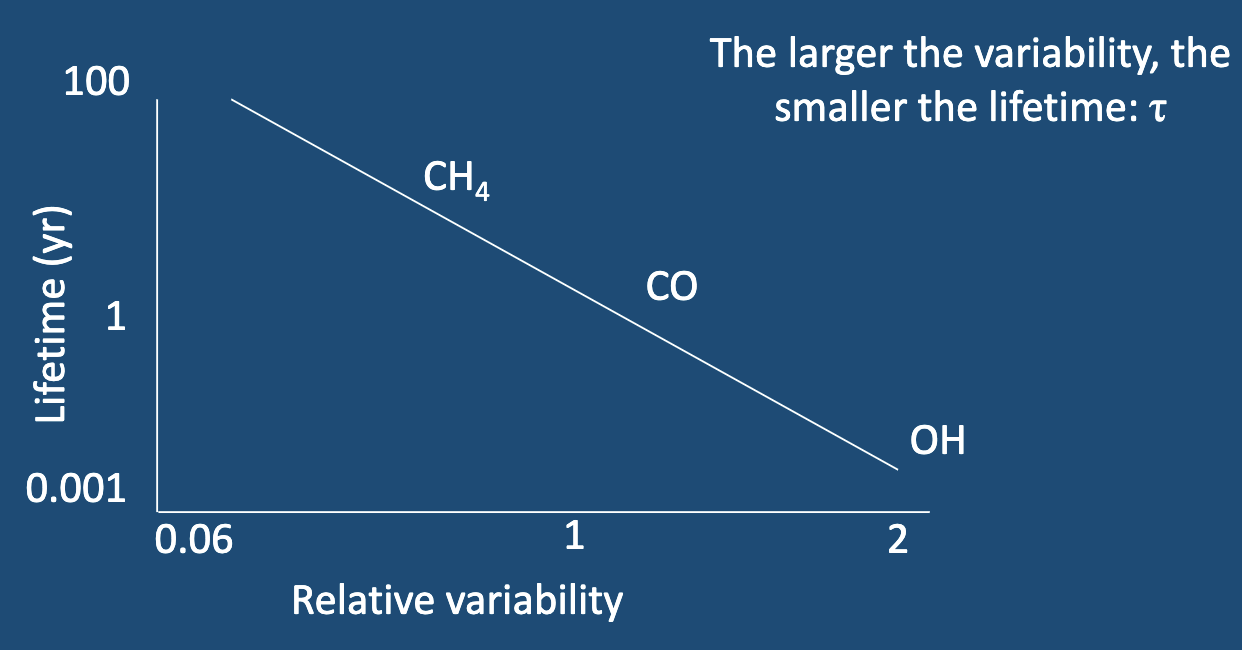
How can you measure mole fractions of gases in the atmosphere experimentally?
by measuring a time series of a specific gas
can separate the average mole fraction (or conc. C)
into an average and its variations
What is the box model and mass balance equation?
dm/dt = E + Fin - Fout + P - L - D + Fv
E: emission
Fin: horizontal inflow
Fout: horizontal outflow
P: production
L: loss
D: deposition
Fv: vertical transport

What is the relative (R) and absolute (L) removal rate?
R: the fractional rate at which a substance is removed per unit time by deposition, chemical loss, or nuclear decay.
L: scales linearly with concentration/mass,
L = R x m
𝛕 = 1/R
What is the lifetime in case of sinks?
sinks may be:
chemical reaction, e.g. with OH: (k x [OH] x m)
photolysis: (J x m)
dry deposition: (vd x m)
wet deposition: (vw x m)
almost all sinks are linear with mass m (or conc.)
dm/dt = E - k x [OH] x m - J x m - vd x m - vw x m
so lifetime:
𝛕 = 1/ (k[OH] + J + vd + vw)
Advantage of using a Eulerian model?
allow to describe spatial gradients
differences between the hemisphere and temporal variation related to the general circulation
understand the CO2 balance in more detail
compare to observations at different locations on Earth
Which components need a Eulerian model?
shorter lived species, like CO, NH3, NOx