introduction & scope of USP 797
 Call Kai
 Learn
 Practice Test
 Spaced Repetition
 Match
 Flashcards
 Knowt Play
1/24

There's no tags or description
Looks like no tags are added yet.
25 Terms
introduction to USP
the USP convention (USP) is a scientific nonprofit organization that sets standards for the identity, strength, quality, and purity or medicines, food ingredients, and dietary supplements manufactured, distributed, and consumed worldwide
the USP compounding compendium is a publication that provides all compounding-related general chapters and compounding monographs from the United States Pharmacopeia and the national formulary (USP-NF), the official compendia for drugs marketed in the United States.

public health need
need identified by an stakeholder or USP
need evaluated for possible standard development
draft standard
best practices and scientific information collected
public comment period
draft standard published for stakeholder input
review & approval
comments evaluated and addressed <or>
comments evaluated and further revision and comment needed
publication
final standard published with official date at least 6 months after publication
USP monographs, general chapters, and general notices
monograph requirements are specific to the monograph in which they appear. monograph requirements supersede general notice and general chapter requirements in case of a conflict
general chapters contain requirements that are more broadly applicable, such as tests, methods, and procedures referenced in multiple monographs, or practice standards
general notices provide the basic assumptions and definitions for applying USP-NF compendial standards, which are applied to official articles recognized in monographs and any applicable general chapters

compendial applicability for general chapters
general chapters can be:
required and compendially applicable if numbered below <1000> and referenced and made compendially applicable in one of the following:
general notices
a monograph
another applicable chapter numbered below <1000>
note that compendially applicable chapters are often considered enforceable. regulators and enforcement bodies have the ability to enforce USP standards more broadly, even informational chapters. USP itself does not play any role in enforcement
informational if numbered <1000> to <1099> or numbered below <1000> and not applicable through one of the references above
specific for dietary supplements (which are numbered above <2000>)
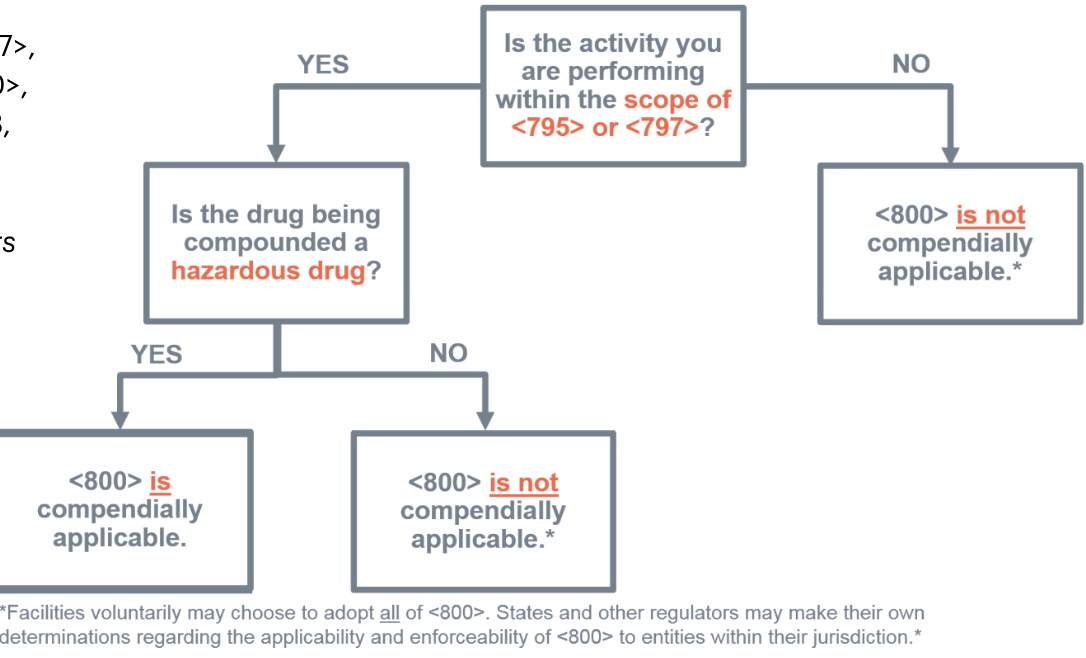
compendial applicability for <795>, <797>, and <800>
revisions to USP <795> and <797> for nonsterile and sterile compounding, published November 1, 2022, include cross-references to USP <800>
this will make <800> compendially applicable on November 1, 2023, for facilities that are required to implement USP <795> and <797>
prior to November 1, 2023, the currently official chapters of USP <795> and <797> (last revised in 2014 and 2008, respectively) will remain official
these currently official compounding chapters do not reference USP <800>
thus USP <800> is an informational chapter until November 1, 2023
when revised USP <795> and <797>, which contain references to USP <800>, become official on November 1, 2023, <800> will be applicable and compendially required only to the extent to which USP general chapters <795> and <797> apply
for hazardous drugs, this means only when a practitioner is “compounding” (as that term is defined in USP <795> and <797>) would <800> be applicable and compendially required
for example, because administration is out of scope of USP <795> and <797>, general chapter <800> would not be applicable or compendially required in this context
determining compendial applicability for an activity
when the revised USP <795> and <797>, which contain reference to USP <800>, become official on November 1, 2023, <800> will be applicable and compendially required only to the extent to which USP general chapters <795> and <797> apply
introduction to USP compounding standards
USP provide 3 types of public standards for compounding
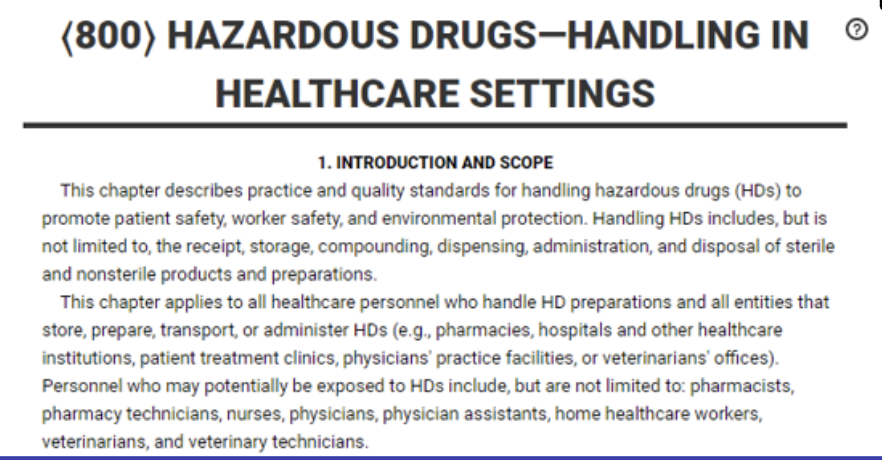
USP general chapters
establish practice standards to help ensure the quality of compounded preparations
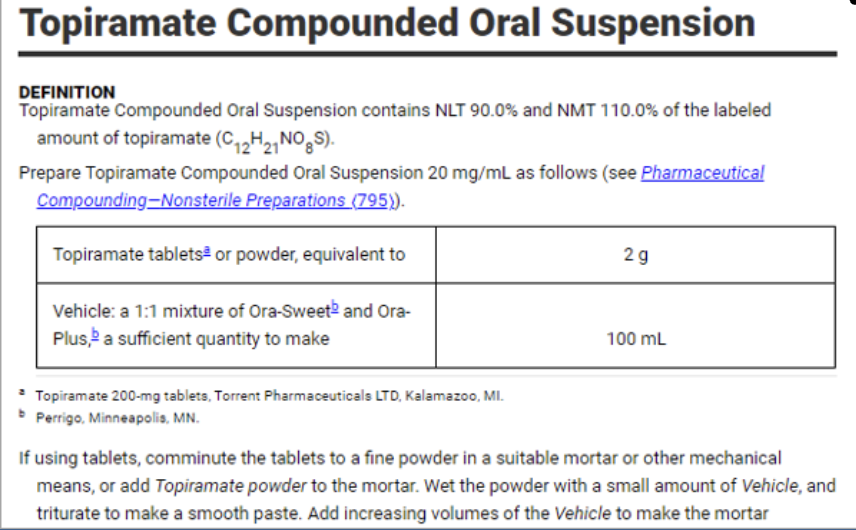
USP compounded preparation monographs
contain formulations for specific preparations for which there is no suitable commercially available product
USP monographs for bulk substances and other ingredients
provide standards for identify, quality, purity, strength, packaging and labeling for bulk substances and other ingredients that may be used in compounded preparations

existing regulations and standards
USP compounding standards
USP <795> pharmaceutical compounding - nonsterile preparations
USP <797> pharmaceutical compounding - sterile preparations
USP <800> hazardous drugs - handling in healthcare settings
occupational safety and health administration (OSHA) regulations
state regulations
centers for medicaid and medicare services (CMS) conditions of participation
introduction and scope of USP <797>
compounded sterile preparations (CSPs) must meet expected quality parameters and be free of any microorganisms to avoid harm to the patients who use them
USP <797> standards must be followed to minimize harm, including death, to human and animal patients that could result from:
microbial contamination (nonsterility)
excessive bacterial endotoxins—a by-product of bacterial cell wall breakdown
variability from the intended strength of correct ingredients
physical and chemical incompatibilities
chemical and physical contaminants
use of ingredients of inappropriate quality
note:
there may be additional laws and regulations within the applicable jurisdiction that may also apply to the preparation of compounded sterile preaparations
the use of technologies, techniques, materials, and procedures other than those described in this chapter is not prohibited as long as they are noninferior to those described herein and validated for the intended purpose (see validation of atlernative microbiological methods (1223) and validation of compendial procedures (1225)).
practices in-scope of USP <797>
sterile compounding in USP <797> is defined as:
combining
admixing
diluting
pooling
reconstituting
repackaging
otherwise altering a drug product or bulk drug substance to create a sterile preparation
USP <797> standards aim to ensure that patients receive CSPs that meet quality requirements for purity and strength, are free or microbial contamination
one of the key standards in minimizing contamination risk is the practice of aseptic technique
aseptic technique is a set of methods used to keep objects and areas free of microorganisms and thereby minimize infection risk to the patient
it is accomplished through practices that maintain the microbe count at an irreducible minimum
sterilization
implants
these are placed in the body
pellets
injections
these include infusions
may be provided as a syringe, bad, cassette, or another dosage form
example routes of administration of sterile injectable medications: IV, IM, SubQ
irrigations
include any internal body cavity that does not normally communicate with the environment outside of the body such as the bladder cavity or peritoneal cavity
note that the irrigations for the mouth, rectal cavity, and sinus cavity are not required to be sterile
ophthalmic
example routes of administration of sterile ophthalmic dosage forms include topical, intravitreal, intracameral, subconjunctival
aq preparations
for pulmonary inhalation
note that nasal dosage forms intended for local application are not required to be sterile
baths & soaks
for live organs and tissues
corneal solutions, solutions for transplant organs
compounding of CSPs
CSPs can be compounded by using only sterile starting ingredients or some or all nonsterile starting ingredients
if all the components used to compound a drug are sterile to begin with, the sterility of the components must be maintained during compounding to produce a CSP
if one or more of the starting components being used to compound is not sterile, the sterility of the compounded preparation must be achieved through a sterilization process
sterility must be maintained if the CSP is subsequently manipulated
when compounding with nonsterile starting components, supplies, or equipment, the quality of the components, the effectiveness of the sterilization step, and bacterial endotoxin mitigation strategies are critical to achieving a sterile preparation that is free from excessive bacterial endotoxins
categorizing CSPs
USP <797> distinguishes three categories of CSPs—category 1, category 2, and category 3—primarily based on:
state of the environmental control under which they are compounded
probability for microbial growth during the time they will be stored
time period within which they must be used
other personnel requirements applicable to the compounding of all CSPs (e.g., training, competency testing, and personal hygiene)
note: immediate-use CSPs do not all into category 1, category 2, or category 3
requirements for categorizing CSPs
category 1 CSPs
location:
ISO class 5 PEC may be placed in na unclassified SCA
environmental control:
least controlled
beyond-use dates:
controlled room temperature: must be less than or equal to 12 hours
refrigerated: must be less than or equal to 24 hours
additional testing:
not required
category 2 CSPs
location:
must be prepared in a cleanroom suite
environmental control:
more than category 1
beyond-use dates:
controlled room temperature: may be greater than or equal to 12 hours
refrigerated: may be greater than or equal to 24 hours
additional testing: some CSPs may require additional tests (e.g., sterility testing, bacterial endotoxin testing)
category 3 CSPs
location:
must be prepared in a cleanroom suite
environmental control:
more than category 2
beyond-use dates:
may exceed category 2, based on stability data and additional requirements
additional testing:
all CSPs require sterility testing, and some may require additional testing (e.g., bacterial endotoxin testing)
knowledge check 1

sterile preparations with special considerations
USP <797> addresses some specific practices.
repackaging:
of a sterile product or preparation, which is the act of removing it from its original primary container and placing it into another container, usually or smaller size without further manipulation, must be performed in accordance with the requirements of USP <797>
allergenic extracts:
a biological substance used for the diagnosis and/or treatment or allergic diseases such as allergic rhinitis, allergic sinusitis, allergic conjunctivitis, bee venom allergy, and food allergy
compounded allergenic extract prescription sets are subject to less stringent requirements in SP <797>, only when both of the following occur:
the compounding process involves transferring via sterile needles and syringes of conventionally manufactured sterile allergen products and appropriate conventionally manufactured sterile added substances
manipulations are limited to penetrating stoppers on vials with sterile needles and syringes, and transferring sterile liquids in sterile syringes to sterile vials
hazardous drugs (HDs):
any drug identified by at least one of the following six criteria: carcinogenicity, teratogenicity or development toxicity, reproductive toxicity in humans, organ toxicity at low dose in humans or animals, genotoxicity, or new drugs that mimic existing HDs in structure or toxicity
CSPs that contain HDs as componens must also be prepared following USP <797> standards and those general chapter <800> hazardous drugs-handling in healthcare settings
blood-derived and other biological materials:
when compounding activities require the manipulation of a patient’s blood-derived or other biological material, such a autologous serum, the manipulations must be clearly separated from other compounding activities and equipment used in CSP activities, and they must be controlled by specific standard operating procedures (SOPs) in order to avoid any cross-contamination
handling of blood components must also comply with laws and regulations of the applicable regulatory jurisdiction
sterile radiopharmaceuticals:
compounding of radiopharmaceuticals is not required to meet the standards of USP <797> and is subject to the requirements in general chapter <825> radiopharmaceuticals-preparation, compounding, dispensing, and repackaging
Jessica, a pharmacist at Cityville Hospital, receives several orders for compounded preparations including ophthalmic ointments, ophthalmic solutions, a glycopyrrolate injection, and an aluminum bladder irrigation. she notices that only one workstation is available in the sterile compounding area. which action(s) are within the scope of USP <797>? select all that apply.
Jessica withdraws commercially available glycopyrrolate solution from a vial and repackages the contect into 3-mL syringes within a laminar airflow workbench for the operating room
Jessica prepares the ophthalmic solutions in the sterile compounding area
personnel and settings affected
USP <797> describes the minimum requirements for sterile compounding that must be followed by all persons who prepare CSPs. the standards apply to healthcare professionals, which include but are not limited to:
pharmacists
pharmacy technicians
nurses
physicians
veterinarians
dentists
naturopaths
chiropractors
any person entering a sterile compounding area must meet personal hygiene and garbing requirements
USP <797> requires that the compounding facility must have designated person(s) responsible and accountable for the performance and operation of the facility
healthcare sites
compounding is typically performed in:
hospitals and other healthcare institutions
medical and surgical patient treatment sites
infusion facilities
pharmacies
physicians’ practice sites
veterinarians’ practice sites
out-of-scope practices for USP <797>
administration of medication is out of the scope of USP <797>
administration means the direct application of a sterile product or preparation to a single patient by:
injecting
infusing
otherwise providing a sterile product or preparation in its final form
standard precautions, such as the CDC’s safe injection practices, apply to administration
see USP <800> for additional recommendations for the administration of hazardous drugs
additional out-of-scope practices
the following practices are not required to meet the full standards of USP <797> for category 1, category 2, and category 3 CSPs if the conditions prescribed under each practice are met:
immediate-use CSPs
preparation per approved labeling
proprietary bag and vial systems for immediate administration
immediate-use CSPs
USP <797> defines immediate-use CSPs as preparations that are compounded or direct and immediate administration to a patient. there is a difference between administration and immediate use:
adminstration:
direct application of a sterile product or preparation to a single patient by injecting, infusing, or otherwise providing a sterile product or preparation in its final form
does not involve combining more than one sterile active ingredient
immediate-use:
do involve more than one, but not more than three different sterile products for immediate and direct administration to a patient within four hours following the start of the preparation
immediate-use CSPs are not subject to the USP <797> requirements for category 1, category 2, and category 3 CSPs if all requirements given in this document are met
immediate-use CSPs must comply with USP <800>
preparation per approved labeling
preparation per approved labeling is another practice which takes place often in healthcare institutions that is out of scope of USP <797> standards
preparing a conventionally manufactured sterile product in accordance with the directions in the manufacturer’s approved labeling is not required to meet the standards for category 1, category 2, and category 3 CSPs only if:
the product is prepared as a single dose for an individual patient
the approved labeling includes information for:
the diluent
the resultant strength
the container closure system
storage time
proprietary bag and vial systems
docking and activation of proprietary bag and vial systems in accordance with the manufacturer’s labeling for immediate administration to an individual patient are not considered compounding and thus may be performed outside of an ISO class 5 environment
docking of the propriety bag and vial systems for future activation and administration is considered compounding and must be performed in an ISO class 5 environment in accordance with USP <797> requirements, with the exception of section 14: establishing beyond-use dates
BUDs for proprietary bag and vial systems must not be longer than those specified in the manufacturer’s labeling
Leilani, a nurse, and gerry, a custodial staff employee at Cityville Hospital, are both new hires and received training on various policies, procedures and respective USP <797> standards that are applicable to them. after completing her training and orientation, Leilani starts working in the intensive care unit (ICU).
what actions can Gerry and Leilani perform that are aligned with USP <797> standards? select all that apply.
Leilani reconstitutes an antibiotic for IV injection for a patient in accordance with the manufacturer’s approved labeling that includes information for the diluent, the resultant strength, the container closure system, and storage time
a patient urgently needs an infusion of phenylephrine. Leilani may prepare the infusion at the patient’s bedside with aseptic processing by adding the contents of a commercially manufactured vial of phenylephrine to a commercially manufactured IV bag of sterile 0.9% sodium chloride
Leilani requires several phenylephrine syringes to be used throughout her 12-hour shift. she plans to use the syringes that were compounded in accordance to USP <797> requirements in the classroom suite within the pharmacy