Week 2 - Deeper Dive Into Genetics
 Call Kai
 Learn
Learn Practice Test
 Spaced Repetition
 Match
Match Flashcards
 Knowt Play
1/45

Earn XP
Description and Tags
Note For Week 1 Mendel's Peas, Pedigrees, and Mitosis/Meiosis Review BIO 1090 Notes
Name | Mastery | Learn | Test | Matching | Spaced | Call with Kai | Chat |
|---|
No analytics yet
Send a link to your students to track their progress
46 Terms
What do Recessive Mutations Involve?
Often involve loss of gene function
Null/Amorphic Alleles = Complete loss of function
I. A nonfunctional protein is produced OR
II. No protein is produced
Hypomorphic Alleles = Partial loss of function
I. A poorly functioning protein is produced OR
II. Reduced amounts of a normally functioning protein is produced
What do Dominant Mutations often Involve?
Gain/Change of Gene Function
Dominant Hypermorphic Alleles = Too much normal function
Negative phenotypic consequences due to the over-production of a normal protein OR
Negative phenotypic consequences due to the production of a protein with increased activity levels
Neomorphic Alleles = New function
Negative phenotypic consequences due to the presence of an altered protein that has a new function
Negative phenotypic consequences when the altered protein interferes with the wildtype protein (Dominant-negative allele)
The Three Different Kinds of Dominance
Complete dominance and complete recessiveness are extremes of a range.
Phenotype: BB=Bb is different from bb
Complete Dominance: Heterozygotes appear similar to one of the homozygotes; used to define a dominant allele and a recessive allele
Dominant allele (W) encodes a functional protein and the one
allele of the heterozygote is sufficient to produce the same
phenotype as the two functional alleles of the WW homozygote.White phenotype results from the absence of functional product in
ww homozygote
Incomplete dominance: BB, Bb and bb all differ phenotypically; Bb is intermediate between homozygous phenotypes ex. Flower colour (red, white, pink)
Codominance: BB, Bb and bb all differ phenotypically, but Bb exhibits phenotypes of both homozygotes. ex. Blood type
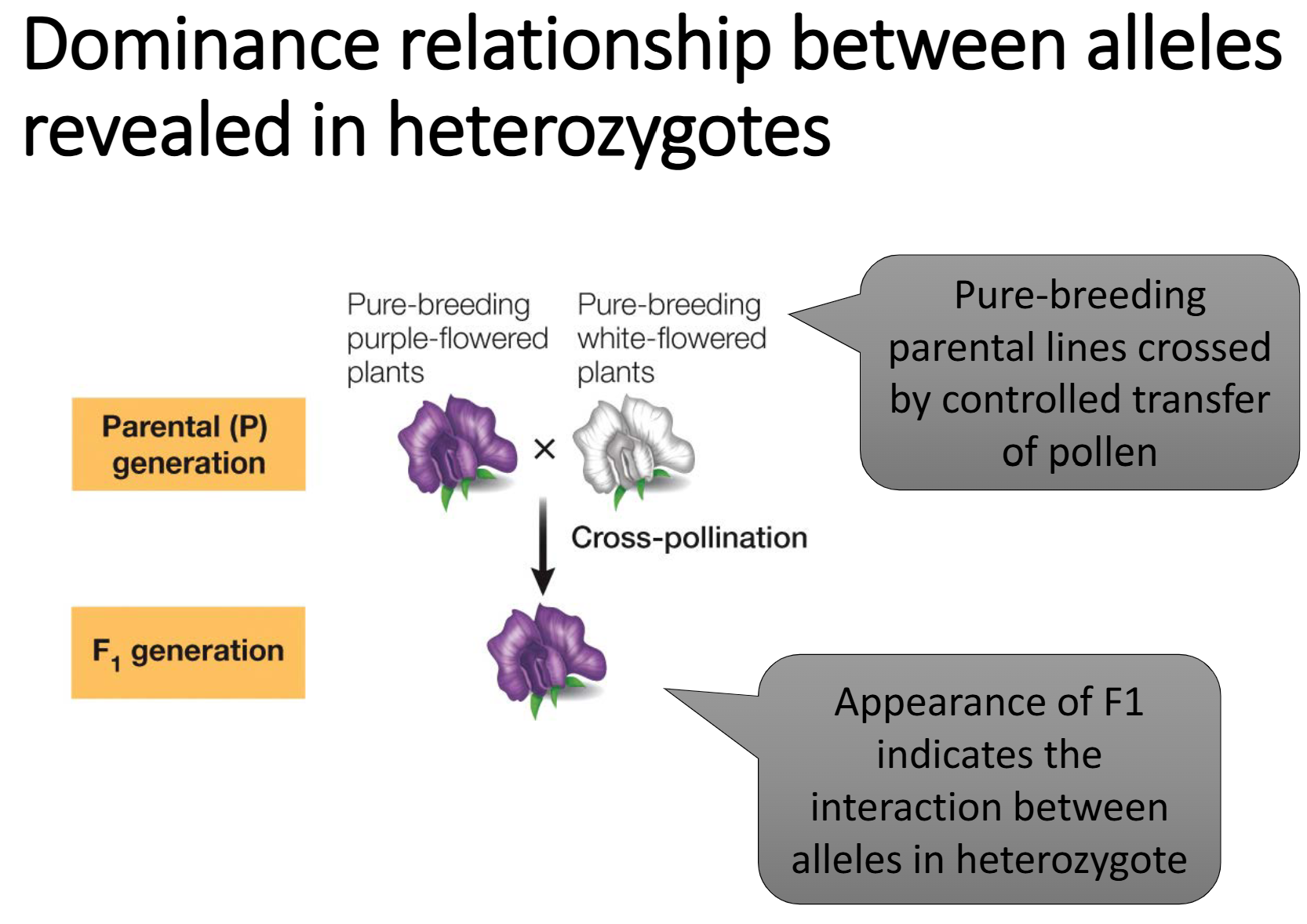
Incomplete Dominance
Heterozygote has an intermediate phenotype to either homozygote
One allele is insufficient to produce the same phenotype as the two alleles of either homozygote, so the phenotype lies between
As long as the heterozygote’s phenotype can be differentiated from those of the two homozygous and falls between them, dominance is incomplete
Monohybrid crosses produce a 1:2:1 ratio of phenotypes in F2, so that
each genotype has a distinct phenotype

Co-Dominance
The phenotype of the heterozygote is not intermediate between the phenotypes of homozygotes; rather the heterozygote simultaneously expresses the phenotypes of both homozygotes.
Phenotypes of both alleles appear in the heterozygote
Each allele is expressed in the heterozygote, such as the antigens of the IA and IB alleles.
IA Encodes A Transferase Which Adds Acetylgalactosamine
IB Encodes A Transferase Which Adds Galactose
Both enzymes are made, so the red blood cells have both A and B antigens. That's why Iᴬ and Iᴮ are codominant—neither one masks the other.
i Encodes A Non-functional Transferase (Nothing…Loss of Function Allele!)

Can only two ever alleles exist at a particular loci?
Some genes have many alleles.
Some of these alleles are common; others are rare.
Some alleles are associated with certain breeds or varieties of plants and animals.
Frequency of a particular allele varies from population to population

Dominance Series/Allelic Series
One allele can dominate another depending on which two are paired.
In order of dominance;
C → full function → normal/dark pigmentation
cᶜʰᵈ → reduced/altered function (hypomorphic) → chinchilla
cʰ → reduced/temperature-sensitive function (hypomorphic) → Himalayan pattern
c → null allele → completely nonfunctional → no pigment-producing function from that allele → albinoSo, for example, C/cʰ looks wild-type because C dominates cʰ. And cʰ/c looks Himalayan because cʰ dominates the null c allele.

How do wild-type, null (amorphic), and hypomorphic alleles affect protein function and phenotype?
Wild-type (a⁺): produces a fully functional polypeptide → normal/wild-type phenotype.
Null/amorphic (a): complete loss-of-function → produces no functional polypeptide → can cause a severe mutant phenotype when homozygous.
Hypomorphic (aʰ): partial loss-of-function → produces a partially functional protein (or reduced amount of functional protein) → usually causes a milder mutant phenotype than a null allele.
In a⁺/a or a⁺/aʰ heterozygotes, the wild-type allele can produce enough functional protein for a normal phenotype (haplosufficiency), so these mutations are often recessive

How does a dominant-negative mutation differ from recessive loss-of-function mutations?
A dominant-negative allele (aᴰ) produces an altered protein that interferes with the functional protein produced by the wild-type allele.
Therefore, an a⁺/aᴰ heterozygote can have a mutant phenotype because the normal allele cannot fully compensate.
In contrast, recessive null (a) and hypomorphic (aʰ) proteins generally do not interfere with the wild-type protein, so a⁺/a and a⁺/aʰ can remain wild-type.
Key idea: Null = no function | Hypomorphic = reduced function | Dominant-negative = interferes with WT function.

Key Points To Remember about Genetics
Genes often have multiple alleles.
Mutant alleles may be dominant, recessive, incompletely dominant, or codominant.
Most genes encode polypeptides.
In homozygous condition, recessive mutations often abolish or diminish polypeptide activity.
Some dominant mutations produce a polypeptide that interferes with the activity of the polypeptide produced by the wild-type allele of a gene.
What are wild-type and loss-of-function alleles?
Wild-type allele: generally produces a normal, functional protein/enyzme; “wild-type” can also describe the common phenotype/genotype in a natural population.
Loss-of-function (LOF) allele: reduces/eliminates normal gene function because the protein is not produced, produced at lower levels, or is nonfunctional.
LOF mutations are often recessive, but they can sometimes be dominant.
What are haplosufficiency and haploinsufficiency, and how do they affect dominance of loss-of-function mutations?
Haplosufficient: one functional allele (~50% normal protein) is enough for a normal phenotype → LOF mutation is usually recessive.
Often the wildtype allele is dominant over the loss of function allele
Half as much protein is synthesized yet this is often sufficient to achieve the wildtype phenotype
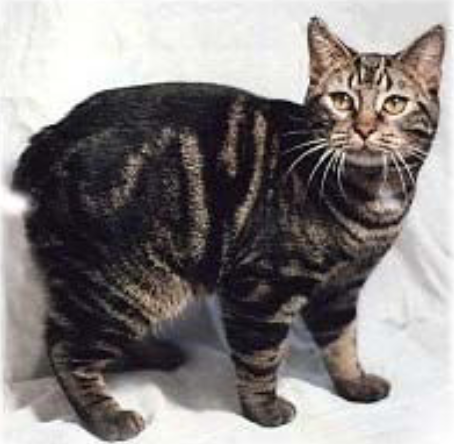
Haploinsufficient: one functional allele (~50% protein) is NOT enough for a normal phenotype → LOF mutation can be dominant.
In the heterozygote, half as much protein is synthesized and this is not sufficient for a normal phenotype
E.g Tailless Cats (Manx)
Therefore, whether a LOF mutation is dominant or recessive depends on how much functional protein is required.
Why aren't dominant alleles always normal/wild-type alleles?
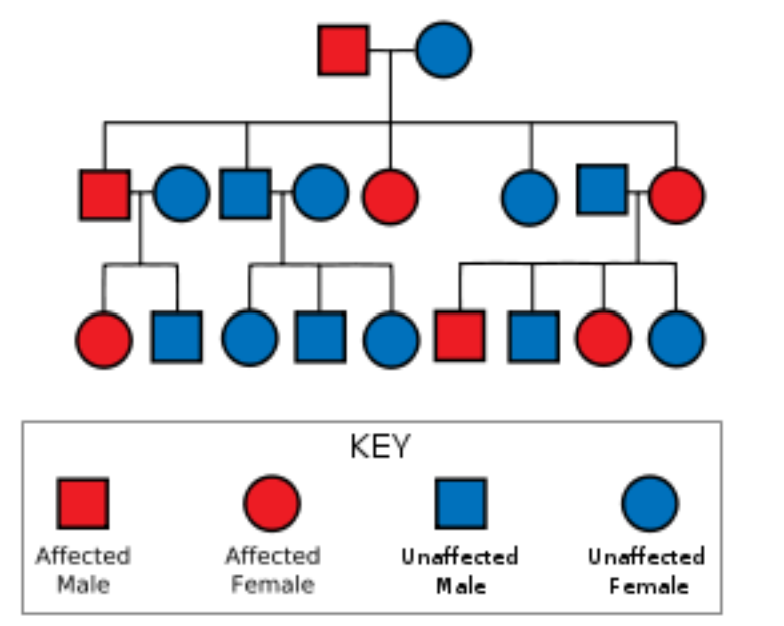
What are lethal alleles, and how do dominant vs. recessive lethal alleles differ?
Lethal alleles are mutations that can cause death when present in certain genotypes, often because they affect an essential gene.
Dominant lethal: lethal in heterozygotes and homozygotes (e.g., Bb and BB lethal; bb viable).
Recessive lethal: lethal only when homozygous; heterozygotes survive (e.g., ts/ts lethal; TS/ts viable).
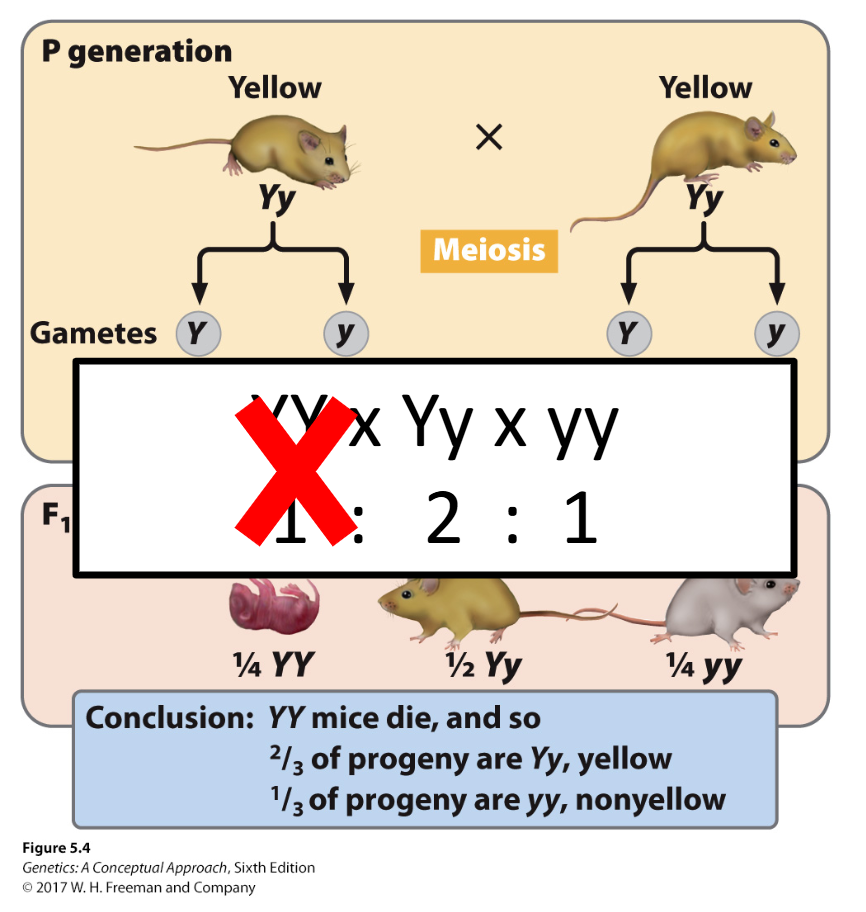
Yellow mice example: Y is dominant for yellow coat colour but recessive for lethality:
YY = lethal
Yy = yellow and viable
yy = non-yellow and viable
Therefore, Yy × Yy initially gives ¼ YY : ½ Yy : ¼ yy, but the YY offspring do not survive, leaving a 2 yellow : 1 non-yellow ratio.
Key clue: a 2:1 ratio among surviving offspring often indicates a recessive lethal allele.
What are penetrance and expressivity?
Penetrance: the percentage of individuals with a particular genotype who actually express the expected phenotype.
Example: If 38/42 people with a polydactyly allele show polydactyly → 90% penetrance.
Expressivity: the degree/severity to which a phenotype is expressed in individuals who show it.
Example: One person with polydactyly may have a fully developed extra finger, while another may only have a small amount of extra tissue.
Key difference:
Penetrance = WHETHER the phenotype appears.
Expressivity = HOW MUCH/HOW SEVERELY it appears.
Remember: The determination of phenotypes is further complicated by the fact that the same genotype does not always produce the same phenotype.

What are complete/incomplete penetrance and variable expressivity, and what causes them?
Penetrance = the proportion of individuals with a particular genotype who express the expected phenotype.
Complete penetrance: 100% of individuals with the genotype show the phenotype.
Incomplete penetrance: <100% show the phenotype; some have the genotype but do not express the trait.
Example: If only half of people with the polydactyly genotype have extra digits → 50% penetrance.
Variable expressivity: individuals with the same genotype express the phenotype to different degrees/severities.
Differences in penetrance/expressivity can result from other genes and environmental factors that modify or suppress gene expression.
Key idea: Having a gene/genotype does not guarantee that its phenotype will appear or appear to the same degree.

What is variable expressivity, and what are some examples?
Variable expressivity = individuals with the same genotype can express the phenotype to different degrees or in different ways.
Examples:
Split hand-foot syndrome (rare autosomal dominant disorder): severity/number of missing central digits can vary.
Piebaldism (rare autosomal dominant disorder): amount and location of unpigmented skin/hair can vary due to absence of melanocytes in certain areas.
Huntington disease (rare autosomal dominant disorder): age of onset and severity can vary among affected individuals.
Key idea: Expressivity asks “To what degree/how is the phenotype expressed?”, whereas penetrance asks “Is the phenotype expressed at all?”

What causes incomplete penetrance and variable expressivity, and what is the norm of reaction?
Incomplete penetrance and variable expressivity can result from other genes and environmental factors that alter or suppress the effect of a particular gene.
Factors that can affect phenotypic expression include:
Age
Sex
Temperature
Chemicals/environmental exposures
These factors can determine whether a phenotype appears at all (penetrance) or how strongly it is expressed (expressivity).
Norm of reaction: the range of phenotypes that a single genotype can produce under different environmental conditions.
Key idea:
Genotype + other genes + environment → phenotype.
How can temperature affect phenotype? Explain using Himalayan rabbits and Siamese cats.
Some alleles produce temperature-sensitive proteins, meaning the protein functions differently depending on temperature.
Himalayan rabbits: the enzyme needed for dark pigment production is active at cooler temperatures but inactive at warmer temperatures.
Cooler extremities (ears, nose, feet, tail) → enzyme active → dark pigment
Warmer body core → enzyme inactive → little/no dark pigment → white fur
Siamese cats: have a temperature-sensitive allele of the tyrosinase gene.
Cooler extremities → tyrosinase active → dark pigment
Warmer body regions → tyrosinase inactive → lighter fur
Key idea: The same genotype can produce different phenotypes depending on environmental conditions, such as temperature.

What is a phenocopy, and how can environmental factors produce one?
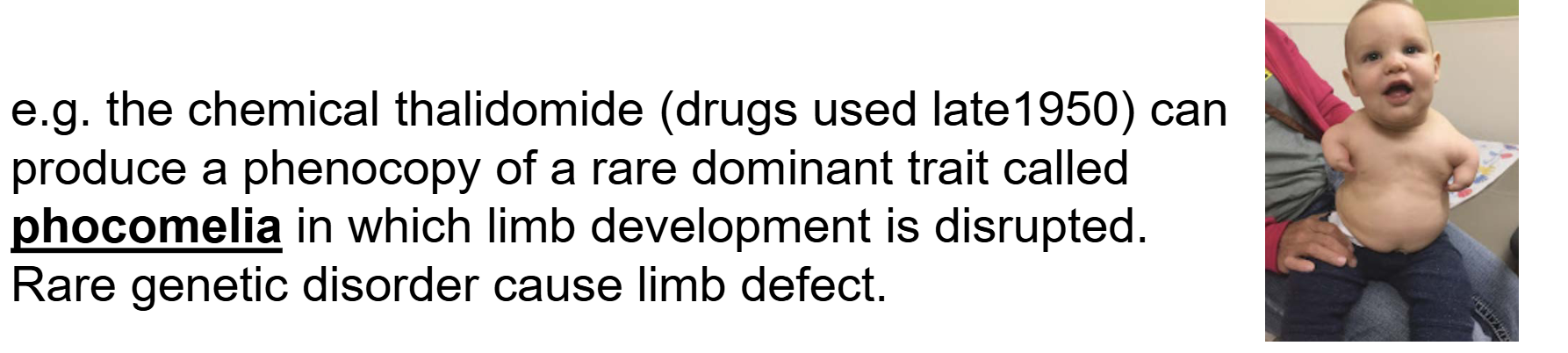
A phenocopy is a phenotype caused by an environmental factor that mimics the phenotype normally caused by a genetic mutation.
The individual does not need to have the mutation that normally produces the phenotype—the environment produces a similar effect.
Example: exposure to thalidomide during fetal development can disrupt limb development, producing a phenotype similar to the genetic condition phocomelia.
Key idea: Phenocopy = environment produces a phenotype that looks genetically caused.
How can controlling environmental factors influence the expression of a genetic condition?
Environmental factors can influence whether and how strongly a genetic phenotype is expressed.
PKU: the genetic mutation is still present, but controlling phenylalanine intake can greatly reduce/prevent many of its harmful effects.
More generally, environmental factors can modify:
Penetrance → whether the phenotype occurs.
Expressivity → how strongly/severely the phenotype occurs.
Therefore, having a particular genotype does not always guarantee a particular phenotype because the environment can modify gene effects.
Key idea: The environment doesn't necessarily change the genotype—it can change how that genotype is expressed as a phenotype.
What is a genetic interaction, and what happens in a dihybrid cross with complete dominance at two interacting genes?
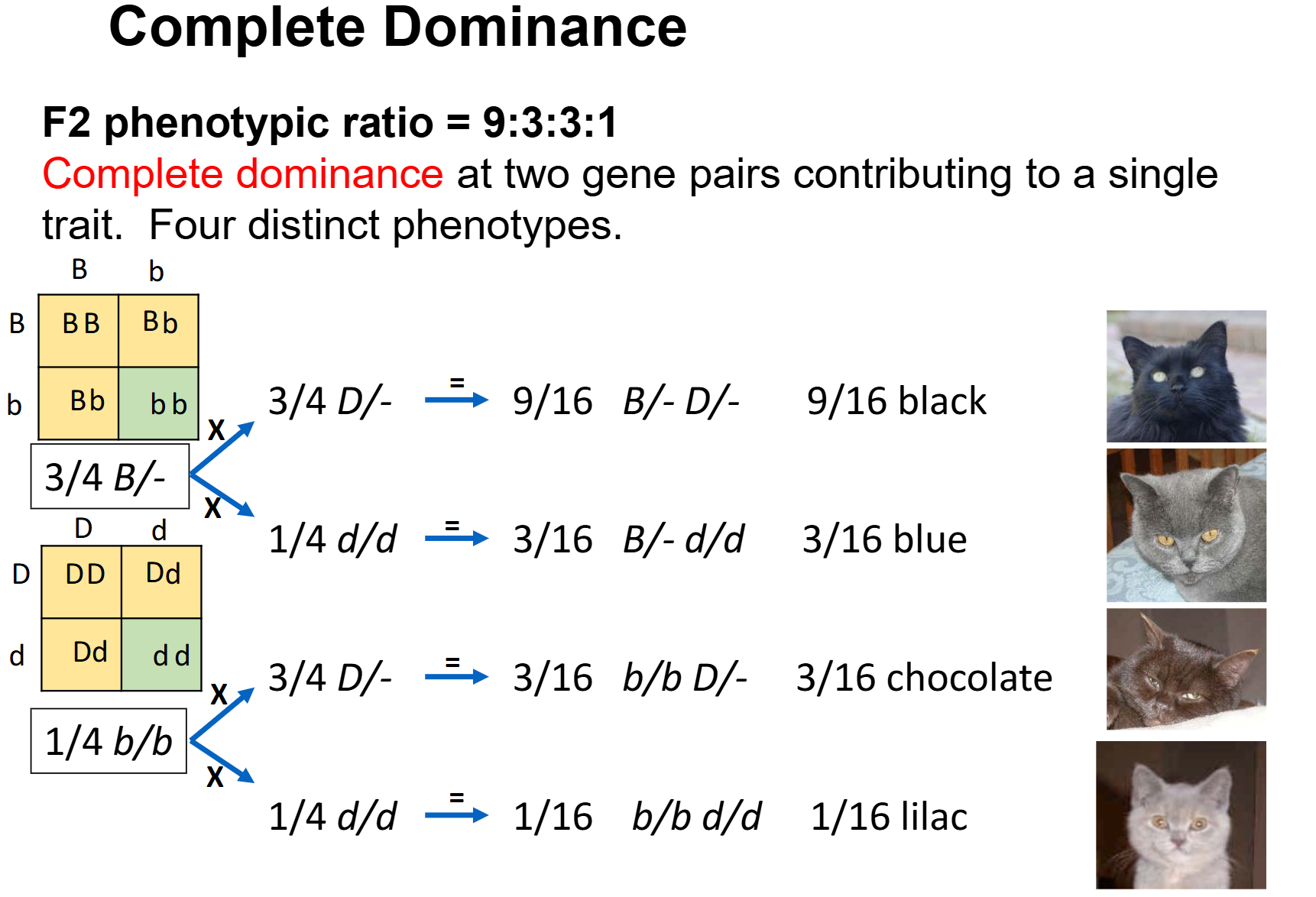
A genetic interaction occurs when two or more genes contribute to the same phenotype because their gene products interact at the cellular/biochemical level.
Mendelian segregation still occurs normally.
For AaBb × AaBb, with complete dominance at both genes, offspring can be grouped as:
9/16 A–B–
3/16 A–bb
3/16 aaB–
1/16 aabb
If each genotype category produces a distinct phenotype, the F2 phenotypic ratio is 9:3:3:1.
Example: two genes can interact to produce four different coat colours.
Dominant Alleles in Cat Example

What is complementation, and how can a complementation test determine whether two mutations are in the same or different genes?
Complementation occurs when two organisms with the same mutant phenotype have homozygous recessive mutations in different genes.
When crossed, each parent supplies a functional allele of the gene that is mutated in the other parent, so the offspring has at least one functional copy of both genes and displays the wild-type phenotype.
Example: cc AA × CC aa → Cc Aa (wild-type).
Wild-type offspring → mutations are in DIFFERENT genes → complementation occurs.
Mutant offspring → mutations are in the SAME gene → no complementation.
Different genes → they complement. Same gene → they can't complement.

Complementation Example: Two Different Albinos

How can complementation occur in human pedigrees?
A heterogeneous trait can be caused by recessive mutations in different genes.
If two affected parents have mutations in different genes, they can produce unaffected offspring through complementation.
Example: AA bb × aa BB → AaBb
Each parent provides the functional allele missing from the other.
AaBb has functional A and B alleles → wild-type phenotype.
If both parents have mutations in the same gene, complementation does not occur and offspring remain affected.

Why can complementation produce a 9:7 F₂ phenotypic ratio?
For AaBb × AaBb, the normal dihybrid genotype classes are 9:3:3:1, but the wild-type phenotype requires at least one dominant/functional allele at BOTH genes.
9/16 A–B– → wild-type
3/16 A–bb → mutant
3/16 aaB– → mutant
1/16 aabb → mutant
The mutant categories combine:
3 + 3 + 1 = 7
Therefore, the F₂ phenotypic ratio is:
9 wild-type : 7 mutant
Key idea: Both genes must function for the wild-type phenotype.

What is epistasis, and what is the difference between an epistatic and hypostatic gene?
Epistasis occurs when one gene masks the phenotypic expression of another gene at a different locus.
Epistatic gene: does the masking.
Hypostatic gene: is masked.
Epistasis modifies the normal 9:3:3:1 dihybrid phenotypic ratio because different genotype classes can produce the same phenotype.
Recessive epistasis: homozygous recessive genotype (
aa) masks another gene → typically 9:3:4.A/- b/b and a/a b/b have the same phenotype
Dominant epistasis: at least one dominant allele (
A–) masks another gene → typically 12:3:1.A/- B/- and A/- b/b have the same phenotype

How does recessive epistasis produce a 9:3:4 ratio?
In recessive epistasis, a homozygous recessive genotype at one locus masks the other gene.
Mouse example:
A– C– → agouti = 9/16
aa C– → black = 3/16
A– cc → albino = 3/16
aa cc → albino = 1/16
Because cc prevents pigment production, the A genotype doesn't matter when
ccis present.The genotype at the A locus would have determined how the pigment is deposited: either black (a/a) or agouti (A/-)
Therefore:
3/16 + 1/16 = 4/16 albino
F₂ ratio = 9 agouti : 3 black : 4 albino
Key idea:
ccis epistatic because it masks A/a.

Recessive Epistasis Ratio

What is dominant epistasis and why does it produce a 12:3:1 F₂ phenotypic ratio?
Dominant epistasis occurs when one dominant allele at one locus masks the expression of another gene.
Cat example: W– masks the B/b locus, so any cat with
WWorWwis white, regardless of its B genotype.If the cat is
ww, B/b can be expressed:ww B–→ blackww bb→ brown
In a
WwBb × WwBbcross:9/16 W–B–→ white3/16 W–bb→ white3/16 wwB–→ black1/16 wwbb→ brown
The two white categories combine: 9 + 3 = 12
F₂ phenotypic ratio = 12 white : 3 black : 1 brown (12:3:1)
W is epistatic (does the masking); B is hypostatic (is masked).

Summary of F2 Ratios

What is pleiotropy, and how does it differ from epistasis?
Pleiotropy occurs when one gene influences multiple distinct phenotypic traits.
This can occur when the gene's product functions in multiple tissues or biological processes.
Examples: sickle cell disease and cystic fibrosis, where a change in a single gene can have effects in multiple parts of the body.
Pleiotropy: 1 gene → multiple phenotypic effects
Epistasis: one gene masks/modifies the phenotypic effect of another gene

Some key points to remember

What is inbreeding depression and why can inbreeding cause it?
Inbreeding increases homozygosity and decreases heterozygosity.
This increases the chance that harmful recessive alleles become homozygous and are expressed.
Expression of harmful recessive alleles can reduce fitness, growth, fertility, survival, or overall vigor.
This reduction in biological performance is called inbreeding depression.
Inbreeding → ↑ homozygosity → ↑ expression of harmful recessive alleles → ↓ vigor/fitness
What is heterosis (hybrid vigor), and how is it related to inbreeding?
Heterosis (hybrid vigor) occurs when hybrids produced by crossing genetically different lines show greater performance/vigor than the inbred parental lines.
Different inbred lines are highly homozygous, often for different alleles.
Crossing them produces offspring that are heterozygous at many loci.
Functional alleles from one parent can mask harmful recessive alleles from the other.
Therefore, hybrids may grow faster, survive better, or have greater yield than the inbred parental lines.
Different inbred lines → cross → ↑ heterozygosity → heterosis/hybrid vigor

What is the Hardy–Weinberg principle, and what assumptions must be met?
The Hardy–Weinberg principle states that allele and genotype frequencies remain stable across generations if a population is not evolving.
For Hardy–Weinberg equilibrium, the population must have:
Large population size → minimizes random changes due to genetic drift
Random mating
No mutation
No migration/gene flow
No natural selection
If these assumptions are met:
Allele frequencies do not change across generations.
After one generation of random mating, genotype frequencies occur as:
p² = AA
2pq = Aa
q² = aa
What is the difference between allele frequency and genotype frequency, and how are they calculated?
Genotype frequency = proportion of individuals with a particular genotype.
Example with 30 individuals:
7 CᴮCᴮ → 7/30 = 0.23
15 CᴮCᴳ → 15/30 = 0.50
8 CᴳCᴳ → 8/30 = 0.27
Allele frequency = proportion of all copies of the gene represented by a particular allele.
Because diploid individuals have 2 alleles each, 30 individuals have 60 total alleles.
For Cᴮ:
[(2 × # CᴮCᴮ) + (# CᴮCᴳ)] / total alleles
= [(2 × 7) + 15]/60
= 29/60
= 0.48
For Cᴳ:
= [(2 × 8) + 15]/60
= 31/60
= 0.52
Allele frequencies must add to 1.
What are the Hardy–Weinberg equations, and what do p, q, p², 2pq, and q² represent?
Allele frequencies:
p + q = 1
p = frequency of allele A
q = frequency of allele a
Genotype frequencies:
p² + 2pq + q² = 1
p² = frequency of AA
2pq = frequency of Aa
q² = frequency of aa
Why 2pq?
A heterozygote can be produced in two ways:A from one parent + a from the other = pq
a from one parent + A from the other = pq→ pq + pq = 2pq
Example: If p = 0.55 and q = 0.45:
AA = p² = 0.3025
Aa = 2pq = 0.495
aa = q² = 0.2025
Key distinction:
p and q = allele frequencies
p², 2pq, q² = genotype frequencies
Recap: Hardy Weinberg Equations


How can the X and Y chromosomes pair during meiosis if they are not homologous?
The X and Y chromosomes are mostly different and contain different genes.
However, they share small homologous regions called pseudoautosomal regions (PARs).
These matching regions allow the X and Y chromosomes to pair during meiosis in males.

What is dosage compensation and why is it necessary?
Dosage compensation balances the expression of X-linked genes between individuals with different numbers of X chromosomes.
XX individuals have two X chromosomes, while XY individuals have one X chromosome.
Without compensation, XX individuals could have greater expression of many X-linked genes.
In mammals, this is largely prevented through X-chromosome inactivation.
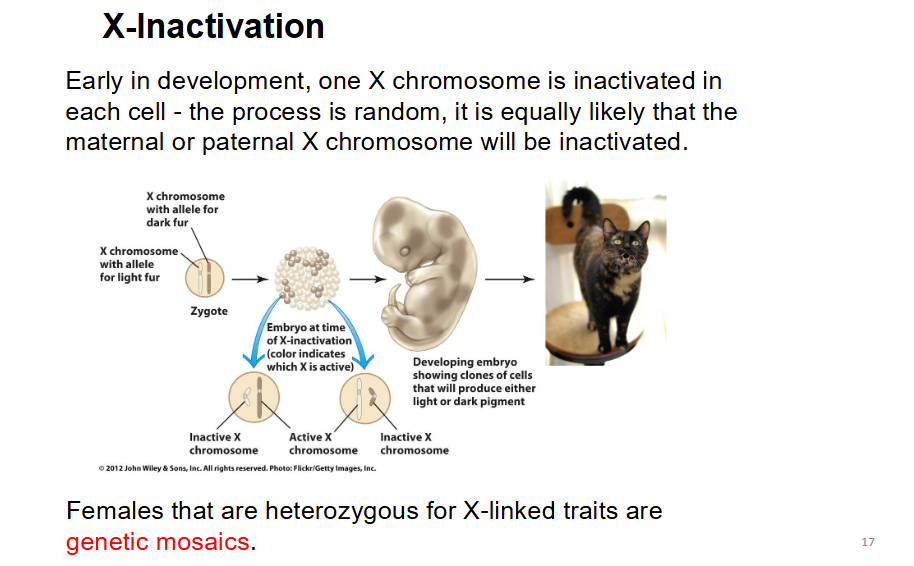
What is X-chromosome inactivation and what is a Barr body?
In XX mammals, one X chromosome is largely inactivated in each cell.
The X chosen for inactivation is generally random early in development.
The inactive X becomes highly condensed and forms a Barr body.
Once an X is inactivated, the same X generally remains inactive in descendant cells.
This makes XX individuals mosaics for X-linked gene expression.
Some genes can escape X-inactivation and remain expressed.

How does random X-inactivation cause mosaicism in females heterozygous for an X-linked gene?
Early in development, one X chromosome is randomly inactivated in each XX cell and forms a Barr body.
Some cells keep the maternal X active, while others keep the paternal X active.
Once an X is inactivated, the same X generally remains inactive in that cell's descendants.
Therefore, a heterozygous female can have groups of cells expressing different X-linked alleles, making her a mosaic.
This random X-inactivation is described by the Lyon hypothesis.
# of Barr bodies = # of X chromosomes − 1.

Calico Cat Example