370 LIPIDS AND MEMBRANES (2.7)
 Call Kai
 Learn
 Practice Test
 Spaced Repetition
 Match
 Flashcards
 Knowt Play
1/16

There's no tags or description
Looks like no tags are added yet.
17 Terms
Fatty acids
—Carboxylic acids with long hydrocarbon chains
—3 fatty acids esterfied with glycerol → triglyceride
—→Esterification: alcohol + carboxylic acid
Lipids
—Biological substances soluble in organic solvents (non-soluble in water)
Triglycerides
—Unused calories stored as triglycerides
—Glycerol backbone + 3 fatty acid tails, bonded via ester linkages
——→The 3 fatty acid tails can be the same or different

Saturated fatty acid
—Only single bonds between the carbons
—Saturated with hydrogen
—Longer chains with similar saturation = higher melting point

Unsaturated fatty acid
—Hydrocarbon chain contains a double bond
—Contain cis or trans fatty acids
——→Cis causes a bend that prevents tight packing, keeps it as liquid in room temp (weak intermolecular forces)
—More double bonds = lower melting point

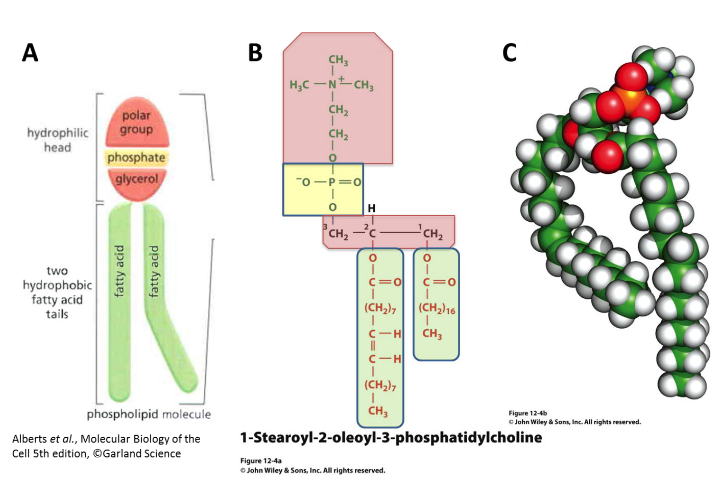
Phosphoglycerides
—Main component of biological membranes
—Two fatty acids + phosphate group (attached to the glycerol instead of one of its OH groups)
—Amphipathic: hydrophobic + hydrophilic part
Steroids (Cholesterol)
—Fused ring structure
——→Four linked carbon rings + short tail
——→Can have -OH functional group
—Hydrophobic, insoluble in water
Cholesterol
—Polar OH group, weakly hydrophilic
—Rigid ring provides rigidity, maintian cell integrity

Micelles
—Structure that shields hydrophobic body from water with hydrophilic heads
—Conformation of hydrophobic tails determines micelle shape
—If fatty acid tail too long, forms water-filled cores

Liposomes
—Phospholipids with bulkier tails forms this
—Hollow droplet of bilayer membrane
—Used for drug delivery by protecting the drug inside, fuse with cell membrane to deliver drugs
——→Protects mRNA in vaccines

Saturated and unsaturated fatty acids (membrane fluidity)
—Straight chains: packed tightly (saturated)
—Kinks in chains: harder to pack tightly (unsaturated)
——→Remain fluid at lower temperatures more than a saturated layer

Temperature (membrane fluidity)
—Layers go through a phase change to a gel-like solid after temperatures drop (gel-to-fluid transition)
—Transition temperature increases with chain length and saturation of fatty acids in layer
——→Shorter chains, higher # of double bonds, less strongly bonded together, smaller transition temp

Cholesterol (membrane fluidity)
—Holds phospholipids together so they don’t separate too far, let unwanted things in, pack too tightly
——→Phospholipids withh get closer when cold, things can’t fit
—At body temp: decreases membrane fluidity from the rigid ring structure
—At high temp: Membrane becomes more fluid, decreases fluidity by restricting movement
—At low temp: Membrane becomes more rigid, increases fluidity by preventing tight packing

Bacteria cell wall
—Composed of peptidoglycan
—Gram positive or gram negative

Peptidoglycan
—Polymer consisting of polysaccharide chains cross-linked by peptide chains
——→Peptide chains break = falls apart
——→Gram positive = more layers of bricks (yellow and orange things)

Gram negative membrane
—Contains LPS on outer membrane surface
——→Lipids that include a polysaccharide chain
——→Helps bacteria stick to cells, create biofilms
—Two lipid layers with selective permeability
—Perpiplasm: space between outer and cytoplasmic membrane

Gram staining
—Thick peptidoglycan cell wall retains stain, therefore Gram-positive
—Thin peptidoglycan cell wall does not retain stain, therefore Gram-negative