RESERVOIR QUIZ CHAPTER !
 Call Kai
 Learn
 Practice Test
 Spaced Repetition
 Match
 Flashcards
 Knowt Play
1/54

There's no tags or description
Looks like no tags are added yet.
55 Terms
What is Oil & Gas
Oil and natural gas
hydrocarbon resources formed from organic matter that was buried, transformed and preserved over geological time.
Crude Oil
Liquid hydrocarbon
Used to produce fuels, lubricants, petrochemicals and other products
Natural Gas
Mainly methane (CH₄)
Used for electricity generation, heating, industrial processes and LNG
Offshore n offshore oil and gas
exploration, drilling, production, processing and transportation of petroleum resources from reservoirs located beneath the seabed / the land surface.
Typical Offshore Facilities
Offshore drilling rig
Fixed platform
Floating production system
FPSO
Subsea well
Flowlines
Risers
Typical Onshore Facilities
Land drilling rig
Wellhead
Pumping unit
Gathering system
Processing plant
Storage tanks
Pipelines
Lifecycle of an Offshore and Onshore Field (8 Stages)
1. Exploration
Both: Identify potential oil and gas resources
Both: Conduct geological and geophysical studies
Both: Use seismic surveys to locate possible reservoirs
2. Appraisal
Both: Drill appraisal wells to confirm hydrocarbon presence
Both: Determine reservoir size, pressure, fluid properties
Onshore only: Also assess fluid quality
3. Field Development Planning
Both: Select development strategy and facility type
Both: Design wells, pipelines and processing systems
Offshore difference: Choose fixed platform, FPSO or subsea system
Onshore difference: Focus on surface facilities
4. Development & Construction
Both: Drill production and injection wells
Offshore: Fabricate and install offshore platforms + subsea equipment
Install pipelines, risers, cables and processing facilitiesOnshore: Construct roads, well pads and surface facilities
Install pipelines, tanks, power and utilities
5. Production
Both: Produce oil and/or gas from the reservoir
Both: Separate and process oil, gas and water
Offshore: Export hydrocarbons to shore or directly to markets
Onshore: Store and transport hydrocarbons to market
6. Enhanced / Improved Recovery
Both: Apply methods when natural production declines
Examples (Both): Water injection, gas injection, Enhanced Oil Recovery (EOR)
Onshore extra examples: Chemical / EOR injection, pressure maintenance, infill drilling
7. Decommissioning
Both: Stop production when field is no longer economic
Both: Permanently plug and abandon wells
Offshore: Remove, leave in place, or repurpose platforms, subsea equipment and pipelines
Onshore: Remove or repurpose surface facilities, pipelines and equipment
8. Site Restoration & Monitoring
Both: Restore the site and surrounding environment
Both: Conduct environmental monitoring
Offshore: Restore or secure the seabed; meet regulatory and safety requirements
Onshore: Restore land to safe condition; ensure long-term stewardship
Simple Overall Flow (Both)
Explore → Appraise → Plan → Develop & Construct → Produce → Enhance Recovery → Decommission → Restore & Monitor
4 Major Phases (Both)
Explore → Develop → Produce → Decommission
Global Production Share

Major Geological Elements
1. Source Rock
Organic-rich rock where hydrocarbons are generated.
Example: shale
2. Reservoir Rock
Porous and permeable rock that stores and transmits hydrocarbons.
Examples: sandstone and limestone.
3. Seal / Cap Rock
Low-permeability layer preventing hydrocarbons from escaping.
Examples: shale and evaporites.
4. Trap
Geological structure that allows hydrocarbons to accumulate.
Examples: anticline, fault, and stratigraphic traps.

Major Petroleum Processes
Generation: Heat converts organics to hydrocarbons.
Expulsion: Movement out of the source rock.
Migration: Travel to the reservoir trap.
Accumulation: Gathering within the trap.
Preservation: Survival without degradation
Products Made From Petroleum
Agriculture
Fertilizers
Food preservatives
Pesticides & herbicides
Clothing & Textiles
Tights & nylons
Windbreakers
Shoes
Sports, Hobbies & Games
Fishing lures & rods
Golf balls & bags
Oil paints
Beauty
Shampoo
Toothpaste & toothbrushes
Lotion
Health & Medicine
Aspirin
Allergy medication
Cough syrup
Electronics
Mobile phones
Televisions & radios
DVDs
Origin of Oil and Gas
Oil and gas are made of a mixture of different hydrocarbons.
As the name suggests these are large molecules made up of hydrogen atoms attached to a backbone of carb
Thermal Maturation
the heat-driven chemical and physical transformation of buried organic matter into oil and natural gas over millions of years.
the process by which organic matter in buried sediments is gradually transformed into oil and natural gas due to increasing temperature and pressure over geological time.
thermal maturation importance
It helps determine whether a source rock:
1. Has generated hydrocarbons.
2. Is currently generating oil or gas.
3. Has passed the main oil-generation stage.
4. Can contribute to a petroleum system.
How Hydrocarbons Form
Organic matter from marine plants, algae, and microorganisms accumulates in sediments.
Burial under sediments increases temperature and pressure over millions of years.
Organic matter transforms into kerogen within the source rock.
Further heating generates oil and natural gas.
Black Shale
Where sediment contains more than 5% organic matter, it eventually forms a rock known as a Black Shale
Organic matter is first changed by the increase in temperature into kerogen, which is a solid form of hydrocarbon
Around 90°C, it is changed into a liquid state, which we call oil A rock that has produced oil and gas in this way is known as a Source Rock
Around 150°C, it is changed into a gas

(Migration)
Hot oil and gas is less dense than the source rock in which it occurs.
Oil and gas migrate upwards up through the rock in much the same way that the air bubbles of an underwater diver rise to the surface

Thermal Maturation Process
1. Diagenesis
Shallow burial (up to 1 km) under normal temperatures. Biological activity creates biogenic methane (swamp gas), and kerogen begins to form.
2. Catagenesis
Deeper burial increases heat (60°C - 150°C) and pressure. This is the "Oil Window" where thermal cracking converts kerogen into liquid petroleum.
3. Metagenesis
Extreme depths and heat (150°C - 200°C). Remaining hydrocarbons are heavily cracked into natural gas. This is known as the "Gas Window".
4. Migration
Because hydrocarbons are less dense than water, they undergo primary and secondary migration, migrating upwards through porous rock layers.
Exploration and Production

1. Oil Traps
Some rocks are permeable and allow oil and gas to freely pass through them
Other rocks are impermeable and block the upward passage of oil and gas
Where oil and gas rises up into a dome (or anticline) capped by impermeable rocks it can’t escape. This is one type of an Oil Trap.

Common Geological Traps
Anticline Trap; A structural trap formed by the upward folding of rock layers into a dome or arch shape, capturing fluids at the crest.
Fault Trap; Occurs when rock strata fracture and slip. A permeable reservoir rock is shifted against an impermeable seal rock, blocking flow.
Stratigraphic Trap; Created by changes in rock type rather than structural deformation. Examples include sand channels pinching out into shale.
2.Reservoir Rocks
The permeable strata in an oil trap is known as the Reservoir Rock
Reservoir rocks have lots of interconnected holes called pores. These absorb the oil and gas like a sponge

3.Seismic Surveys
Seismic surveys are used to locate likely rock structures underground in which oil and gas might be found
Shock waves are fired into the ground. These bounce off layers of rock and reveal any structural domes that might contain oil
4.Drilling the well
Once an oil or gas prospect has been identified, a hole is drilled to assess the potential
The cost of drilling is very great. On an offshore rig, it may cost $10,000 for each metre drilled.
A company incurs vast losses for every “dry hole” drilled
5.Enhanced Recovery
Although oil and gas are less dense than water and naturally rise up a well to the surface, in reality only 40-50% of the total will do so.
To enhance recovery, a hole is drilled adjacent to the well and steam is pumped down. The hot water helps to push the oil out of the rock and up into t
6.Transport
Once extracted oil and gas must be sent to a refinery for processing
Pipelines transport most of the world’s oil from well to refinery
Massive Oil Tankers also play an important role in dist

7.At the Refinery
Before it can be used crude oil must be refined.
Hydrocarbons can be separated using distillation, which produces different fractions (or types) of oil and gas
Reservoir Drives
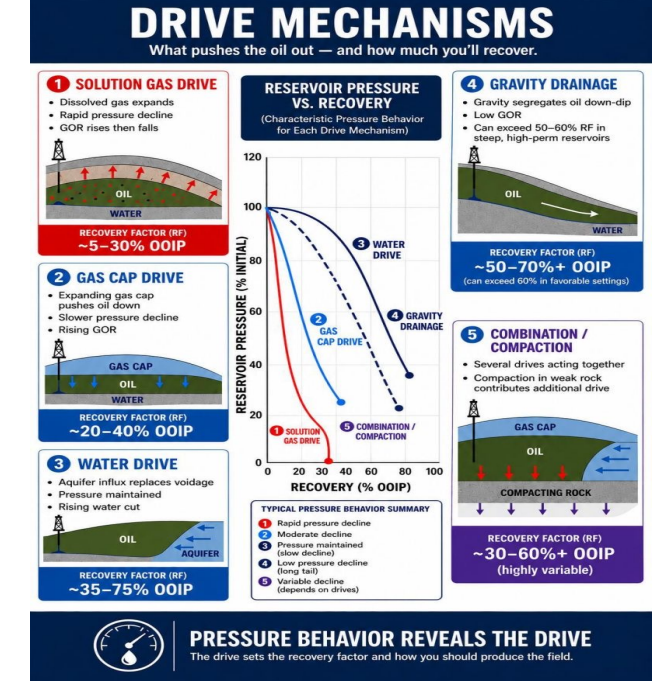
Primary Recovery (up to 15 % recovery rate)
Primary recovery drive mechanisms use natural reservoir energy such as fluid expansion, gas pressure, water influx, and gravity to move oil and gas into the wellbore and up to the surface
Five important drive mechanisms;
1) Solution gas drive
2) Gas cap drive
3) Water drive
4) Gravity drainage
5) Combination or mixed drive
Secondary Recovery (20-40 % recovery rate)
Secondary recovery is the result of human intervention in the reservoir to improve recovery when the natural drives have diminished to unreasonably low efficiencies.
Two techniques are commonly used:
1) Water flooding
2) Gas flooding
Tertiary Recovery (up to 60 % recovery rate)
Primary and secondary recovery methods usually only extract about 35% of the original oil in place. Clearly it is extremely important to increase this figure. Many enhanced oil recovery methods have been designed to do this, and a few will be reviewed here.
They fall into three broad categories;
(i) thermal,
(ii) chemical,
and (iii) miscible gas
3 Types of Plate Boundaries

1.Divergent Plate Boundaries
Two tectonic plates move apart.
Magma rises from the mantle.
Cooling magma creates new crust.
Common at mid-ocean ridges.
Example: Mid-Atlantic Ridge.

2. Convergent Boundaries
Plates move toward each other.
A denser plate may sink beneath a lessdense plate.
This process is called subduction.
Produces earthquakes and volcanic activity.
Can form major mountain ranges.
Example: Andes Mountains.

3. Transform Boundaries
Two plates slide alongside each other.
Crust is generally neither created nor destroyed.
Friction can cause stress to build up.
Sudden movement releases energy as earthquakes.
Example: San Andreas Fault, California.
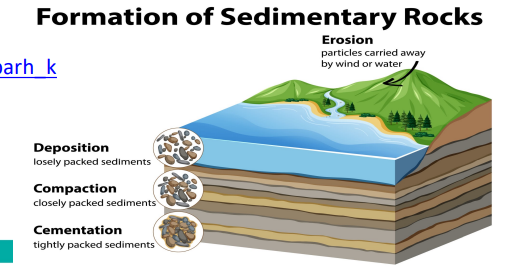
What is a Sedimentary Basin
Definition: A low area in the Earth’s crust (a depression) where tectonic activity causes the land to sink (subsidence).
The Process: Over millions of years, water and wind carry eroded rocks, minerals, and organic matter into this depression.
Layering: As sediments accumulate, the immense weight causes further sinking. Bottom layers undergo compaction and cementation, turning loose sediment into solid sedimentary rock (lithification).
Scale: They can range in size from a few kilometers across to massive depressions spanning hundreds of thousands of square kilometers.
How Do They Form?
Driven by Plate Tectonics Basins primarily form where tectonic plates interact, stretch, or bend.
The three main types are:
1. Extensional (Rift) Basins: Formed when the Earth's crust is pulled apart (divergent boundaries). As the crust thins and stretches, it drops down to create a basin (e.g., the East African Rift).
2. Compressional (Foreland) Basins: Formed when plates collide (convergent boundaries). The immense weight of a growing mountain range pushes down the adjacent crust, creating a deep trough alongside it (e.g., the Persian Gulf).
3.Strike-Slip (Pull-Apart) Basins: Formed along transform faults where plates slide past one another. Irregularities in the fault line can cause localized stretching and sinking (e.g., the Dead Sea)