Life cycles (EX 1)
 Call Kai
 Learn
Learn Practice Test
 Spaced Repetition
 Match
Match Flashcards
 Knowt Play
1/13

There's no tags or description
Looks like no tags are added yet.
Name | Mastery | Learn | Test | Matching | Spaced | Call with Kai | Chat |
|---|
No analytics yet
Send a link to your students to track their progress
14 Terms

unembryonated egg in feces -→ embryonates in soil —> person ingests egg —> larva hatches -→ matures in ileocecal mucosa —> adults embed anterior region in mucosa —> females produce eggs
Trichuris trichuria
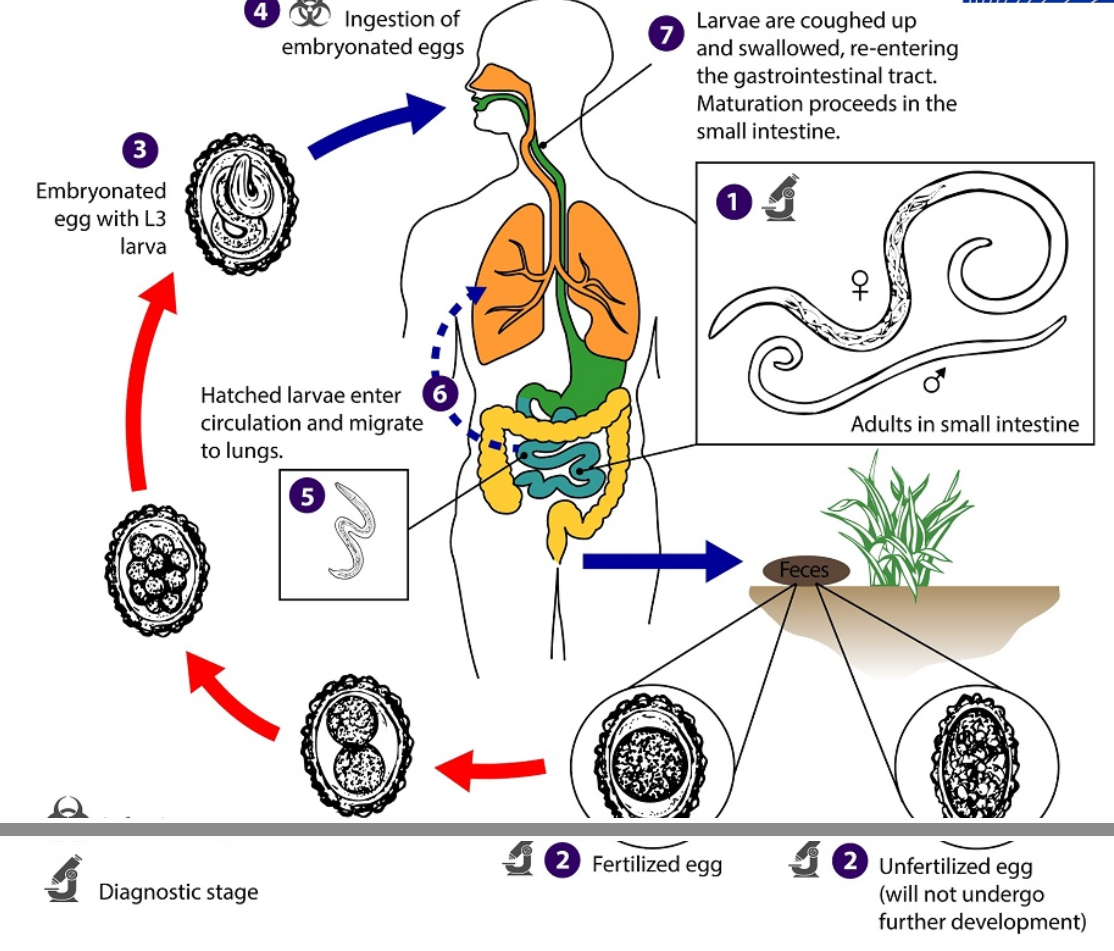
eggs in feces —> embryonate in soil becoming infective —> ingestion —> hatch in duedenum —> penetrate mucosa —> blood to liver and lungs —> enter alveoli and molt —> coughed up and swallowed again —> mature in small intestine
Ascaris lumbricoides

eggs pass in dog feces —> embryonate in soil —> dog acquires/ingests larvae —> larvae migrate —> adults mature in intestine —> eggs pass
Humans ingests egg —> larvae migrate but do not mature
Toxocara canis

eggs pass in raccoon feces —> embryonate in environment —> accidental host ingests infective egg —> larvae hatch and migrate to viscera, eye, or nervous tissue without maturing
Raccoons hatch larvae intestine and produce eggs
Baylisascaris procyonis

female deposits eggs on perianal skin —> eggs become infective in 6 hours —> eggs are swallowed or inhaled —> adults mature in colon —> females migrate to perianal skin
Enterobius vermicularis
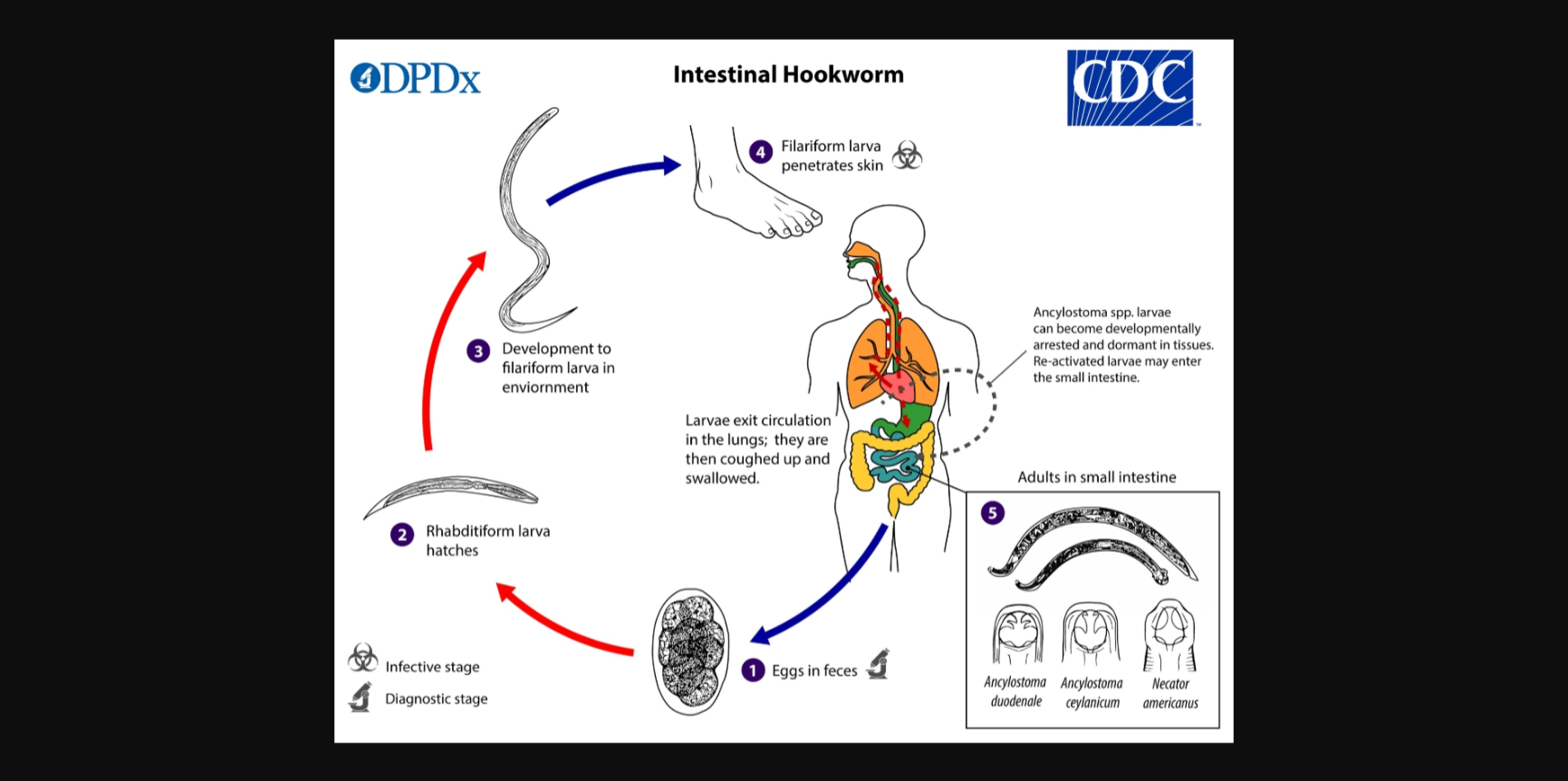
eggs pass in feces —> hatch in soil —> feeding rhabditiform larvae —> infective filariform penetrates skin —> migrates to lungs vis circulation —> coughed up and swallowed —> adults attach in small intestine —> eggs pass
Ancylostoma duodenale and Necator americanus

Filariform penetrates skin —> migrates to lungs via circulation —> coughed up and swallowed —> parthenogenic female reproduces in small intestinal mucosa —> eggs hatch —> rhabditiform larvae pass in feces and become free living adults (some j3 or infective inside host and autoinfection occurs)
Strongyloides stercoralis

host eats undercooked meat with encysted larvae —> larvae released and mature in intestinal mucosa —> viviparous females release J1 —> larvae enter circulation —> invades skeletal muscle —> nurse-cell cysts forms —> next host eats infected muscle
Trichinella spiralis

eggs remain in liver of infected host —> host dies/decomposed —> eggs reach ground —> embryonate for weeks —> new hosts ingest eggs —> larvae hatch and migrate to liver —> adults reproduce in liver and eggs are trapped
Capillaria hepatica

mosquito ingests microfilariae from dog—> larvae become infective in mosquito —> mosquito deposits —> larvae mature in dog —> mature in pulmonary vessels and heart —> females release microfilariae in blood —> another mosquito comes
Dirofilaria immitis

biting fly ingests microfilariae —> larvae develop to infective stage —> fly transmits during blood meal —> adults mature and migrate in human subcutaneous tissue —> females release sheathed microfilariae in blood —> ingested by another fly
Loa loa

blackfly ingests skin microfilariae —> larvae develop to infective stage —> fly transmit larvae —> adults mature in subcutaneous onchocercomas —> females release microfilariae that move through skin and eyes —> another black fly ingests
Onchocerca volvulus

mosquito ingests sheathed blood microfilariae —> larvae develop to infective stage —> mosquito transmit larvae —> adults mature in lymphatic vessels —> females release microfilariae into blood —> another mosquito ingests them
Wuchereria bancrofti

person drinks water with infected copepod —> copepod digested and larvae released —> larvae penetrates gut/mature tissues —> gravid female migrates to skin —> painful blister —> contacts water female releases larvae —> copepod ingests larvae
Drancunculus medinensis