Prediction in Differential Psychology
 Call Kai
 Learn
 Practice Test
 Spaced Repetition
 Match
 Flashcards
 Knowt Play
1/18

There's no tags or description
Looks like no tags are added yet.
19 Terms
What can be used for predictions?
Individual differences
What are some drawbacks of psychology being focused on objective, clean explanations?
Experiments in contrived settings
Models of the mind that strive for parsimony (few significant associations + variations)
Relevance for real-world goals not a huge priority
What is the alternative to making clear explanations?
Use individual differences as a predictive science (behaviour + outcomes)
Goal is for generalisable, out-of-sample prediction that aren’t based on particular samples or contrived experimental designs
Collect data from rep sample then collect outcome data
What can individual differences be used to predict?
Educational achievement + attainment
Job performance
Attained social class + socioeconomic status
Income + financial resources
Health + longevity
Snares: unemployment, divorce, out-of-wetlock birth, incarceration, public benefit receipt, school dropout
What is the typically effect size for predictive individual differences (personality coefficient)?
~0.2 - 0.3
Why is intelligence predictive?
Jobs are increasingly intellectually complex (automate simpler ones)
Society rewards educational achievement starting from young childhood
Both financially + socially
At least in higher-SES groups
Financial resources buy healthy lifestyles + cultural access (piano lessons, test preps etc)
Parents pass both genes + educational culture to children
Reinforced by SES-related access to health + cultural knowledge + social support
Why is personality predictive?
Individual differences as a science of any numbers → many predictors with small effects that aggregate up
We can use multiple variables from any level of trait nierarchy
Broad traits → broad outcomes
Narrow traits → narrow outcomes
Measure many psych variables → summarise a lot of psych stuff
What are some challenges within prediction?
Vulnerability to responder distortions (e.g. social desirability) → over-claimers of personality = over claim outcomes
Intelligence tests’ cultural loadings → may bias effects, especially for group differences
Omissions from the Big 5 (e.g. religiosity, libido) that predict important outcomes
Difficult to make simple, causal inferences
Reciprocal influences
Reverse causation
Education gene-environment correlations
Statistical confounding (e.g. IQ + socioeconomic status → education)
Multipotentiality + equifinality
When are personality and intelligence predictions used?
Psychometric testing → one of our greatest contributions outside of psych
Originated in selecting soldiers for WW1 + 2
Wide variety contexts
Workplace → who should we hire for this job?
Courts → is this person a danger to society?
Hospitals → what should we target for treatment?
What are personality disorders?
Problems in functioning of the self and/or interpersonal dysfunction that
Persist over an extended period of time
Manifest in patterns of cognition, emotions, behaviour
Aren’t developmentally appropriate or due to social/cultural factors
Are associated with substantial distress or significant impairment in personal, family, social, education or occupational areas of functioning
Not attributable to physio effects of a substance/medical condition
Describe the early history of personality disorders
Kraepelin → viewed them as natural disease entities
Same as simple-cause somatic diseases (e.g. infectious disease, stroke)
Each disease has its own unique etiology
Normal vs abnormal are qualitative distinct, flip from 1 state to another
Consistent with pharmacological treatment psych disorders
Fix the cause + symptoms will go
Sprawling taxonomy of diseases (dom model in 20th century)
What is a common classification system of personality disorders?
Diagnostic and Statistical Manual of Mental Disorders
Controlled + promoted by the American Psychiatric Association
5th iteration (current)
Alt: International Classification of Disease
What are some weaknesses of common classification systems of personality disorders?
Clinical authority with negotiating, politics + vested interested
Overdiagnosis vs underdiagnosis
Cultural bias (e.g. homosexuality in early DSMs)
Categorical disorders BUT with overlapping phenytupes
What are some limitations of the categorical (discrete) approach to diagnoses?
Have extensive list of inclusion criteria (symptoms)
Polythetic (same diagnosis, different symptoms)
Many share endophenotypes (different diagnosis, same symptoms)
Very low inter-rater agreement common among mental health conditions
Co-morbidity means identifying distinct predictors + outcomes is hard
Arbitrary cut-offers (~15% of the population on Psychopathy Checklist)
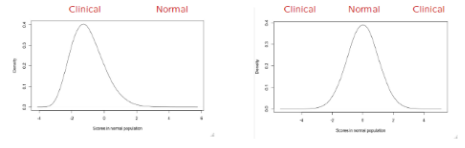
How are symptoms of pathology continuous?
People vary in quantity + probability
Distribution may be normal or skewed
Clinical cases are at either ends (e.g. contentiousness) or at one end (e.g. suicide attempts)
What is the alternative model for personality disorders?
Model of pathological personality traits that maps onto the Big 5
Criterion A: level of personality function (e.g. direction, identity)
Criterion B: elevated levels of pathological personality traits
High levels of both = diagnosis of eprsonality disorder
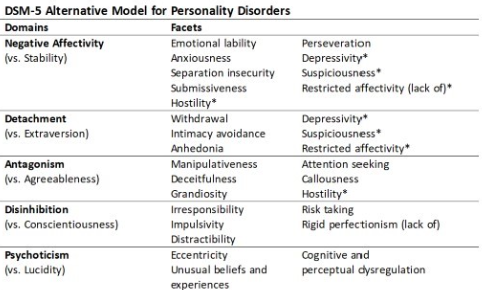
How is the alternative model for personality disorders similar to the Big 5?
Themes overlap across the 2 models BUT specific content differs
Hard for normal trait measures to also provide adequate coverage of extreme end of the distribution
Pathological measure need to be more sensitive at those extreme ends (e.g. when does preference to be alone become withdrawal?)
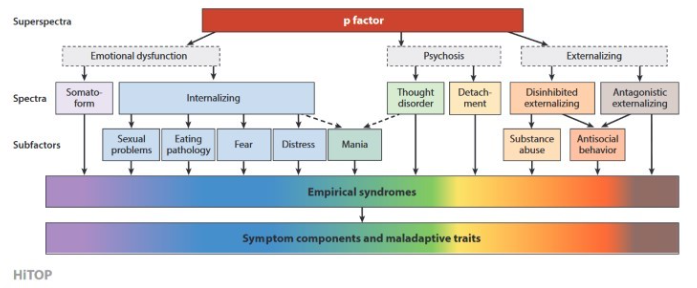
What is the hierarchal taxonomy of pscyhopathology?
Developed by a research consortium, first major paper in 2017
Attempt to systematise all of psychopathology as a hierarchy of ABCD patterns
Framework descends from very general dysfunction to specific disorders + symptoms
Attempt to fix the existing approach of pages of isolated symptoms + diagnoses
What is the dark triad (non-clinical model)?
Cluster of socially malevolent personality constructs
Psychopathy → recklessness, poor impulse control
Narcissism → grandiose attention-seeking, gregariousness, vulnerability + shame
Machiavellianism → self-control, strategic planning, cynicism
United by a common core of antagonism (callous, manipulative + exploitative style that causes harm to others)
Related constructs in ‘dark tent’: sadism, entitlement, greed, dependency, perfectionism
BUT extreme traits can be adaptive, given a suitable niche
Assumption of evolutionary psychology (wouldn’t exist in the population if they weren’t at some point adaptive)
BUT personality pathology has to to equal extreme traits + impaired functioning