Lecture 5 refraction of light
 Call Kai
 Learn
 Practice Test
 Spaced Repetition
 Match
 Flashcards
 Knowt Play
1/16

There's no tags or description
Looks like no tags are added yet.
17 Terms
Q: What is refraction?
Refraction is the change in direction of light when it passes from one medium to another with a different optical density because its velocity changes.
Q: Why does light refract?
Light changes speed when entering a medium with a different refractive index, causing it to change direction.
Q: Define the angle of incidence and angle of refraction.
Angle of incidence (i) = angle between incident ray and normal.
Angle of refraction (i') = angle between refracted ray and normal.
Q: How does light bend when moving between media of different optical density?
Less dense → more dense = bends towards the normal.
More dense → less dense = bends away from the normal.
Q: State Snell's Law.
nnn = refractive index of first medium
n′n'n′ = refractive index of second medium
iii = angle of incidence
i′i'i′ = angle of refraction

Q: What is refractive index?
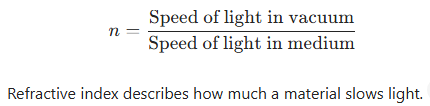
Q: What is apparent depth?
Objects under water appear shallower than they actually are because light refracts at the water-air interface.
Q: Why does a straw appear bent in water?
Due to refraction of light at the water surface, making the submerged portion appear displaced.
Q: What happens when light passes through a parallel-sided glass block?
The emergent ray is parallel to the incident ray but shifted sideways.
This sideways shift is called lateral displacement.
Q: What is lateral displacement?
The sideways shift of a ray after passing through a parallel-sided medium.
Q: What is an optical prism?
A transparent optical element with flat polished surfaces that refracts light.
In optometry, prisms can help manage binocular vision problems caused by extraocular muscle dysfunction.
Q: Compare convex and concave refracting surfaces.
Convex surface
Converges light rays
Concave surface
Diverges light rays
Q: What is reduced vergence?

Q: What is the paraxial equation for refraction at a spherical surface?
nnn = first medium refractive index
n′n'n′ = second medium refractive index
rrr = radius of curvature
LLL = object vergence
L′L'L′ = image vergence
FFF = surface power

Q: What is the magnification equation for refraction at a spherical surface?

Q: State the sign convention used in refraction calculations.
Along the principal axis
With direction of light = positive (+)
Against direction of light = negative (−)
Heights
Above axis = positive (+)
Below axis = negative (−)
Angles
Anticlockwise = positive (+)
Clockwise = negative (−)
All distances are measured from the vertex of the surface.